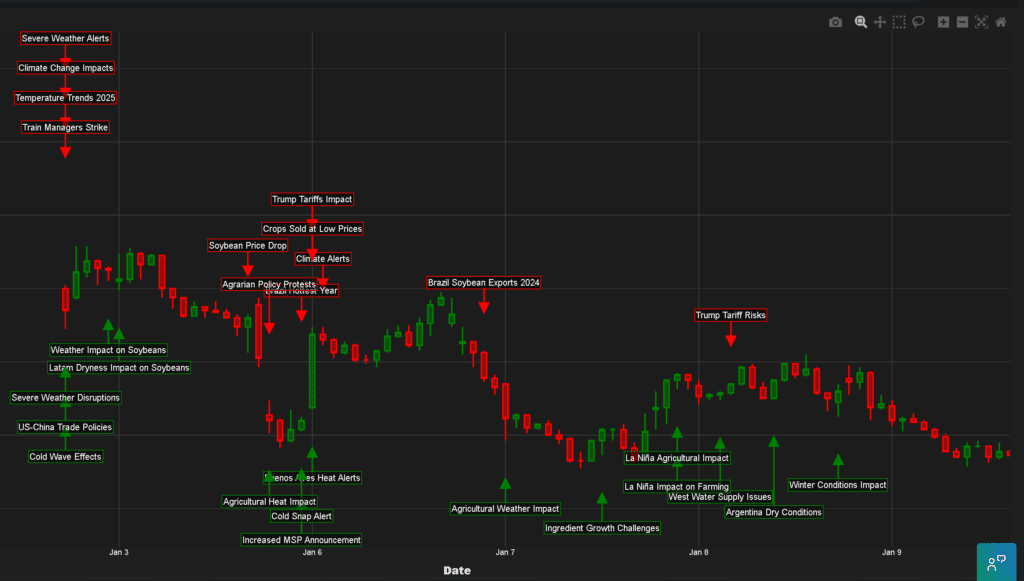
Commodity prices: Cross-asset analysis – mid-February 2025 outlook

As we move into mid February, the obvious pattern emerging across commodity markets is that of an intensifying impact of trade tensions and extreme weather events. There is no doubting that each commodity class is responding uniquely to these catalysts, creating a complex trading environment that demands sophisticated analysis. In this article, we take a look at the commodity prices outlook for this week, using analysis from our Trading Co-Pilot.

Energy markets 

Henry Hub natural gas

You can make the argument that this has been the most dramatic mover in terms of commodity prices, with a 9% surge on February 3rd reaching significant technical levels. The hardest part is distinguishing between weather-driven spikes and structural shifts. Severe winter storms across the Midwest and Northeast have created a significant uptick in energy demand, while critical supply shortfalls in southern regions reinforce bullish momentum. Current Henry Hub market dynamics suggest this strength could persist beyond the immediate weather impact. Regional supply constraints and increased demand for gas-fired power generation create a supportive backdrop for prices. The question is how long these conditions will maintain their influence over price action, particularly as we approach the shoulder season.

TTF natural gas

Then there is the challenge of European gas markets, where prices reflect multiple pressures. Slovakia’s increased imports and resumed Russian gas flows provided initial stability, but escalating Ukraine conflict creates persistent uncertainty. Critical gas needs in southern Ukraine add another layer of complexity to the supply picture. The market’s response to these developments has been notably volatile, with traders attempting to price in both immediate supply concerns and longer-term structural changes to European gas markets. Supply diversification efforts, including rare Australian shipments, indicate the market’s adaptation to new geopolitical realities.

Heating oil

Looking an the broader issue of commodity prices, one finds that the situation is little more complicated in heating oil markets, where tariffs on Canadian oil combine with extreme weather to drive prices higher. The fact that NYC landlords are switching to less clean heating oil due to high gas bills indicates a structural demand shift that could have lasting implications for the market. This transition in consumer behaviour, particularly in the Northeast, suggests a fundamental change in regional energy dynamics. The impact of tariffs extends beyond immediate price effects, potentially reshaping traditional supply routes and trading patterns. Storage levels and distribution challenges in key consumption areas add another layer of complexity to the current market structure.

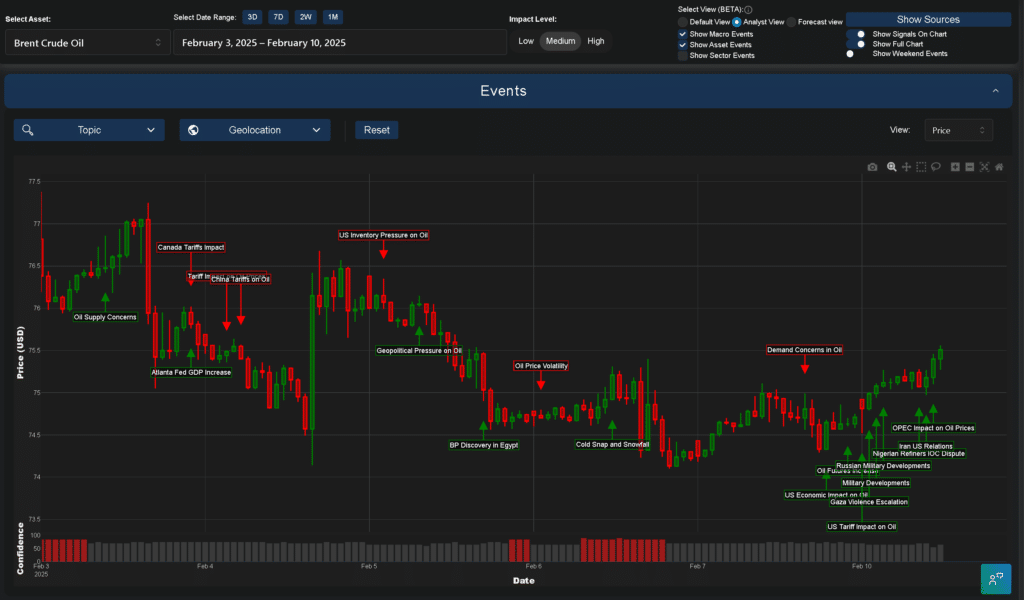
Brent Crude

Of course,  recent cold snaps in the US have supported prices, countering earlier bearish sentiment. Meanwhile, ongoing military tensions in Ukraine and Middle East sanctions continue to influence supply concerns, despite rising inventories in key storage hubs. The market’s reaction to these conflicting signals has been notably measured, suggesting traders are carefully weighing immediate weather-driven demand against broader macroeconomic concerns. The interplay between OPEC+ output decisions and US inventory builds creates an additional dynamic that warrants close monitoring.
Metals market

Gold

The big recent news across commodity prices is that gold continues to see remarkable strength near $3,000. The game changer here has been combined monetary easing signals from central banks (RBI and BOE) alongside escalating geopolitical tensions. Safe-haven demand remains robust amid uncertain economic conditions. Technical analysis suggests the current price levels could establish new support zones, particularly if trade tensions escalate further. The correlation between gold prices and real yields continues to provide a helpful framework for understanding price movements, while physical demand from key Asian markets adds fundamental support.

Platinum

Here, we’re seeing the impact of China’s manufacturing slowdown (PMI at 50.1) combined with Anglo American Platinum’s profit decline. The automotive sector’s weakness, particularly in Germany, has created significant headwinds for demand, leading to the current bearish outlook. Supply-side dynamics, including potential production cuts and recycling rates, could provide some price support. However, the structural shift in automotive technology preferences continues to cast a shadow over longer-term demand prospects.

Palladium

The question here is whether positive US manufacturing data can offset European automotive weakness. This divergence in regional industrial activity creates a complex trading environment for a metal heavily dependent on automotive catalytic converter demand. Recent market behaviour suggests a delicate balance between supply constraints and demand concerns. While US economic resilience provides some support, the German industrial production drop signals potential weakness in a key consumption center. For now, the automotive sector’s ongoing transition toward electric vehicles adds another layer of uncertainty to longer-term demand projections.

Silver

Despite initial bullish signals from strong demand and positive drill results, inflation fears and trade tensions have created choppy trading conditions for silver. The metal’s dual role as both an industrial and precious metal continues to create complex price dynamics. While safe-haven demand provides some support during periods of market stress, industrial demand concerns and correlation with gold prices remain key drivers of market sentiment for silver.

Copper

While housing market recovery provides some support, trade tensions create significant uncertainty for copper. Recent price movements reflect the market’s struggle to balance positive economic indicators against rising geopolitical risks. The broader implications of Trump’s reciprocal tariffs could fundamentally alter trading patterns in industrial metals. Concurrently, infrastructure development plans in key economies remain a potential catalyst for demand growth, but uncertainty around implementation and timing keeps market sentiment cautious.
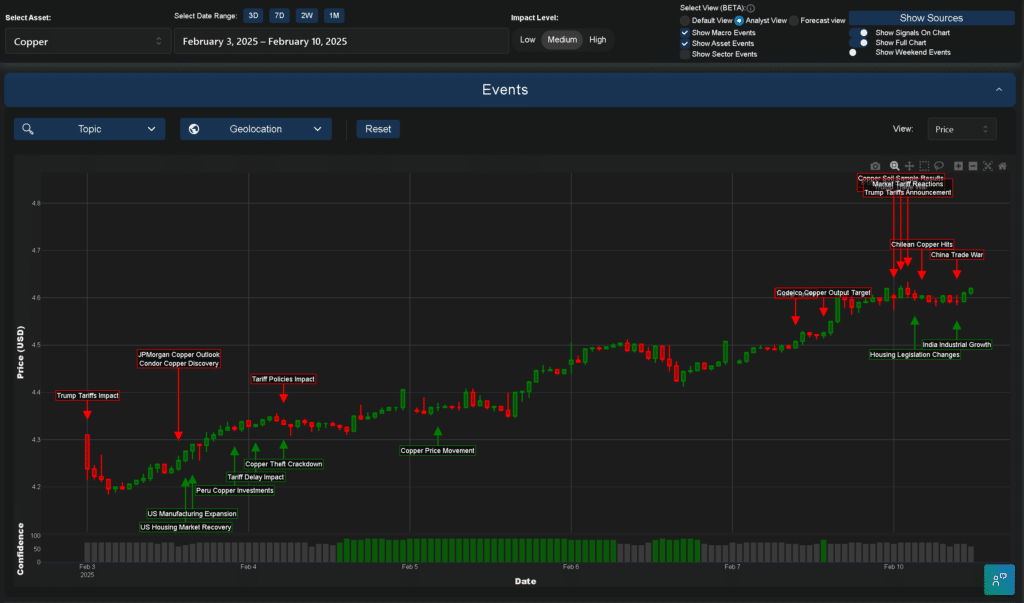
copper commodity prices feb 2025

Agricultural markets 

Wheat

Initial bullish momentum in wheat markets driven by severe weather disruptions – drought in Argentina and flooding in Australia – has given way to bearish sentiment as of February 10th, with Chinese tariffs and fears of US retaliation creating significant headwinds. Growing Canadian stocks and increased local production suggest ample supply, while forecasts of declining global imports add further pressure. This alignment of negative factors suggests continued downward pressure on wheat prices in the near term, despite earlier weather-related supply concerns. 

Coffee 

We live in an age of highly volatile geopolitics and commodity prices, with coffee prices have reached record highs driven by fundamental supply fears and severe weather impacts. Arabica’s recent price action reflects both immediate supply constraints and longer-term structural changes in production patterns. Nestlé’s Indian market expansion signals growing demand in emerging markets, while weather-related supply disruptions continue to support prices. The potential for further supply chain disruptions, particularly in key growing regions, suggests continued price strength in the near term.

Corn

The present outlook for corn reflects complex crosscurrents in both supply and demand. Argentina’s severe drought has tightened supply expectations, while Mexico’s decision to rescind its ban on U.S. biotech corn provides some positive sentiment for traders. However, the broader impact of trade tensions and potential new tariffs creates significant headwinds. Fund positioning indicates some market confidence, but recent declines in Chicago corn futures suggest traders remain cautious amid these conflicting signals.

Cotton

Cotton markets are facing multiple challenges from both weather events and trade tensions. Queensland flooding and California’s adverse weather conditions raise significant concerns about agricultural productivity and potential supply shortages. The market’s recent rally gave way to more cautious sentiment as traders assessed the implications of new U.S. tariffs on China. These developments raise broader concerns about inflation impacts and potential demand destruction in key consumption markets.

Sugar

The sugar market presents a particularly nuanced picture amid current volatility. Once again, severe flooding in Queensland and ongoing drought challenges in Argentina have raised serious concerns about agricultural output and potential supply disruptions. While temporary support came from reduced Indian production and improved realisations for sugar companies, the stronger US dollar and projections of a global surplus create counterbalancing pressures. Recent developments suggest potential for recovery, but weather concerns and mixed economic indicators maintain market uncertainty.

Milling wheat

Markets have now  pushed to four-month high levels amid severe flooding in North Queensland and ongoing Ukraine-Russia supply disruptions. The impact of these weather events on global supply chains has been particularly acute given the already strained market conditions. The announcement of retaliatory tariffs by China and Trump’s reciprocal measures adds another layer of complexity to traditional trading patterns. While some weakness emerged towards the end of the week, the overall trend remains bullish as markets continue to price in supply risks and shifting trade flows.

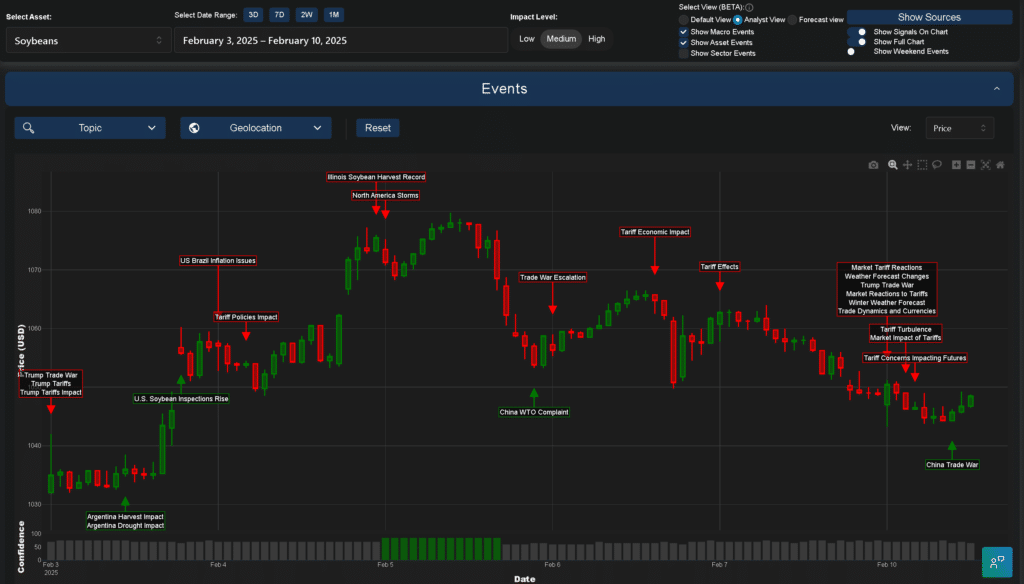
Soybeans

There are several areas where trade tensions impact is evident, none more so than soybeans. Recent tariff announcements have amplified bearish sentiment, with prices declining as traders anticipate further volatility and potential supply chain disruptions. This dovetails with weather-related concerns in Argentina and North America, creating a complex market dynamic. The combination of trade uncertainty and adverse weather conditions suggests continued pressure on prices, with particular attention needed on Chinese demand patterns and South American production levels.
Looking ahead on commodity prices 

If narratives shape politics, then current trade tensions suggest continued market volatility across commodity sectors. What this reveals is the increasing importance of real-time market intelligence in navigating these complex conditions. Commodity traders must remain vigilant to both immediate catalysts and longer-term structural shifts, particularly as weather patterns and geopolitical developments continue to drive price action.

The interconnectedness of commodity markets has never been more evident, with developments in one sector frequently creating spillover effects in others. Successful trading strategies will require careful monitoring of cross-commodity correlations by using tools like our Trading Co-Pilot and the ability to quickly adapt to changing market conditions.

Get ahead of commodity price movements

Our Trading Co-Pilot can enhance your commodity trading operations with real-time cross-asset insights. It works by analysing the complex interplay of weather events, trade policies, and supply chain dynamics as well as other market factors across energy, metals, and agricultural markets, helping you identify price movements before they emerge. Our enterprise solution offers real-time analysis of market-moving events, cross-commodity correlation insights, early warning signals for price movements, and comprehensive monitoring of supply chain announcements, weather impacts, and trade flows.

To arrange a demo or request a free enterprise trial get in touch with our team at enquiries@permutable.ai or simply fill in the form below to see how our AI-driven market intelligence can complement your existing trading strategies. We’re currently offering a 14-day trial for qualified institutional traders (subject to approval) to experience our next-generation market intelligence . Find out how it can start maximising your trading potential today.

Request demo/free trial

Factors affecting coffee prices: A deep dive into the recent market rally

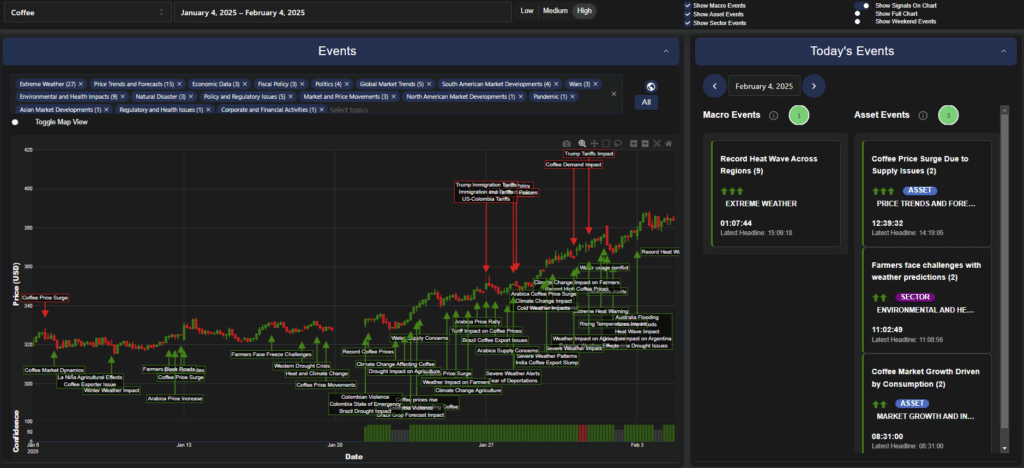
Understanding the factors affecting coffee prices has never been more key, especially as we look at the recent coffee market rally when coffee prices began their  ascent towards 400 USD. According to our Trading Co-Pilot’s analysis, multiple interconnected factors drove this surge, creating a complex web of market influences that continues to shape the coffee trading landscape. Understanding these dynamics offers valuable insights for commodity traders, producers, and industry stakeholders alike. In this article we’ll take a closer look at the events that led to this historic milestone.

factors affecting coffee prices

Climate and weather: A primary factor affecting coffee prices

This year has brought unprecedented weather challenges to major coffee-producing regions. The trail of blood between severe weather events and price volatility has never been more apparent. A record heat wave across key growing areas marked a turning point in market sentiment, pushing prices above key resistance levels, whilst drought conditions in Brazil, the world’s largest producer, exacerbated supply concerns. Traders monitoring these weather patterns will have found significant predictive value in tracking regional climate anomalies.

For the initiated, these weather patterns represent more than temporary disruptions amongst the factors affecting coffee prices. Whether it is these factors or longer-term climate change impacts, the coffee market faces structural challenges that could reshape pricing dynamics for years to come. Around the same time, flooding in parts of South America further complicated the supply picture, creating opportunities for traders who could accurately forecast weather impacts on production.

Supply chain dynamics and trade policy

The rivalry between major coffee-producing nations has intensified amid supply constraints, emerging as another crucial factor affecting coffee prices. In contrast to previous years, trade policies have taken centre stage. This is not a new revelation, but the impact of Trump-era tariffs and immigration policies looming over the market has added new complexities to coffee trading, requiring stakeholders to develop more sophisticated risk management strategies.

For some, this represents a fundamental shift in how coffee supply chains operate. The narrative picked up momentum when labour shortages began affecting harvesting operations. And there it sat, creating a bottleneck in the supply chain that rippled through to prices, offering opportunities for traders who could anticipate these disruptions.

Market demand: A key factor affecting coffee prices

Despite the challenges on the supply side, demand has played an equally key role among factors affecting coffee prices. Sometimes the problem lies in the changing consumption patterns across different markets. There is debate about whether these shifts represent temporary or structural changes in coffee consumption habits, with important implications for long-term price trends.

It is viewed as a potential game-changer that developing markets are showing increased appetite for premium coffee varieties. Will this last? Sentiment around coffee consumption remains strong, particularly in emerging markets where coffee culture continues to evolve, creating new opportunities for market participants.

Agricultural and production dynamics

Then there is what some would regard as the core issue: agricultural productivity as a factor affecting coffee prices. It is an experience that included both technological advances and setbacks. In the past few years, we have had a real-life experiment in how climate change affects coffee farming practices. And this is the other thing about modern coffee production: sustainability has become inseparable from pricing discussions, influencing investment decisions and risk assessments.

Economic and currency impacts

There may be something in that old saying about commodity prices and dollar strength. As we write, currency fluctuations continue to influence coffee trading patterns. There is the good, the bad, and the ugly about how exchange rates affect producer revenues and market pricing, making currency risk management an essential skill for market participants.

Both are on the radar screens of traders: inflation concerns and monetary policy shifts. It used to be the case that coffee prices moved primarily on supply-demand fundamentals. Anyway, despite all this, macroeconomic factors now play an increasingly important role, requiring a more sophisticated approach to market analysis.

Practical applications and trading strategies

These factors affecting coffee prices provide several key insights for market participants. To recap:

  • Weather pattern monitoring has become key for predicting price movements
  • Supply chain disruptions offer opportunities for prepared traders
  • Currency risk management is increasingly important
  • Sustainability considerations affect long-term price trends
  • Emerging market demand creates new trading opportunities

Analysing the factors affecting coffee prices requires a holistic understanding of multiple variables. From weather events to geopolitical tensions, from supply chain disruptions to changing consumption patterns, the coffee market continues to evolve in response to both traditional and emerging influences. Understanding and monitoring these dynamics whilst developing appropriate risk management strategies is crucial for success in today’s coffee trading environment.

Ready to improve your cross-commodity trading strategy?

Discover how our Trading Co-Pilot can improve your commodity trading operations by incorporating sophisticated coffee market insights into your portfolio. Our advanced platform seamlessly integrates real-time analysis of weather events, supply chain disruptions, and market sentiment, providing you with the competitive edge needed in today’s complex trading environment. By combining our coffee asset insights with your existing commodity strategies, you’ll unlock powerful cross-market correlation opportunities and gain access to early warning signals that can enhance your decision-making process.

We invite you to experience these capabilities firsthand through a personalised demo tailored to your institution’s specific trading requirements where we’ll show you how our AI-driven market intelligence can complement your existing operations and strengthen your risk management framework. For qualified institutional traders, we’re currently offering a 14-day trial to demonstrate the full potential of our platform in your trading environment.

Take the first step towards maximising your trading potential by contacting our enterprise team at enquiries@permutable.ai or fill in the form below to schedule your demo and join the leading trading houses already leveraging our next-generation market intelligence to stay ahead in the evolving commodity trading landscape.

Request demo


5 key reasons behind falling soybean prices as we enter 2025

As we enter 2025, soybean prices have been experiencing significant downward pressure in what can only be described as a volatile market, with prices predicted by unpredictable and ever-moving forces that continue to shape the agricultural commodity landscape. The initial rally at the start of the year, which saw prices climb amid optimistic trading sentiment, has given way to a more bearish outlook, raising omnipresent questions about market fundamentals. In this article, we’ll explore the five key reasons behind recent falling soybean prices, with insights and market analysis taken from our Trading Co-Pilot.

soybean prices

1. Weather patterns influencing market sentiment and soybean prices 

There’s been a real shift in weather-related market dynamics, particularly in South America. Today, the struggle to reconcile conflicting weather reports from Argentina’s soy belt highlights the market’s complexity. While initial concerns about dry conditions sparked a rally in early January, with prices reaching six-month highs, subsequent rainfall forecasts have contributed to a decidedly bearish sentiment. First, severe dry conditions raised alarm bells about potential yield impacts, but second, improved weather outlooks triggered substantial price corrections, demonstrating how quickly weather conditions can influence market direction.

2. Soybean prices and global trade dynamics 

There isn’t any doubt about it – U.S. export sales falling below market forecasts have significantly impacted prices. The latest data shows inspections declining sharply, suggesting either reduced demand or logistical constraints affecting shipments. Either way, the consequence of these disappointing figures has created sustained downward pressure on prices. Together with lower-than-expected demand from key importing nations, there is no question that these trade dynamics are reshaping market expectations for 2025.

3. Supply chain disruptions persist

Next, it appears that once again supply chain issues are plaguing the market, creating additional headwinds for prices. Recent reports have been indicating a decrease in inspections for corn and soybeans, suggesting potential supply chain issues or reduced demand. This disruption echoes challenges seen in previous years, but with added complexity due to evolving global trade patterns

4. Market sentiment shows sharp reversal

The early January rally proved short-lived, with trader psychology shifting rapidly from bullish to bearish. That might be an echo of previous market cycles, however, we’re seeing unprecedented volatility in sentiment. The key here is to understand how these rapid shifts affect price discovery. It transpires that market fundamentals suggested the initial optimism was overextended, particularly given current inventory levels and production forecasts.

5. South American production outlook Improves 

And guess what? To add to all of this is the mixed signals from South American production which have been creating additional market uncertainty. Some blame weather volatility, and it’s not an unreasonable concern given the region’s importance to global supply. But it is far more likely that the combination of improved rainfall and existing inventory levels will continue to pressure prices. 

Navigating uncertainty in soybean prices 

There was a time when soybean price movements were more predictable, but the problem with current market conditions is their increased complexity and volatility. The alleged supply constraints may prove less severe than initially feared, particularly if weather conditions normalise in key growing regions. Yet one thing is clear – the current environment demands careful position management and robust risk assessment. We may well see increased volatility as weather patterns evolve and trade flows adjust. 

Want deeper insights into soybean market movements? 

As commodity markets become increasingly complex, staying ahead of rapidly shifting soybean dynamics requires sophisticated analytical tools. Our Trading Co-Pilot platform has been specifically designed to address this challenge, delivering comprehensive market intelligence that helps traders make more informed decisions in real-time.

At the heart of our platform is a powerful AI engine that continuously monitors global price movements, weather patterns, and supply chain dynamics along with other key market factors giving you actionable insights that can directly impact your trading decisions.

What sets our Trading Co-Pilot apart is its ability to synthesize multiple data streams into clear, actionable intelligence. Our platform provides the comprehensive view needed for successful trading in today’s volatile market conditions.

Experience why leading commodity traders are already using our Trading Co-Pilot. Our enterprise trial gives you access to all platform features, including comprehensive market coverage, customisable alerts, and dedicated support from our expert team. We’ll work closely with you to ensure seamless integration with your existing trading and ensure a continuous feedback loop. Contact us at enquiries@permutable.ai to learn more or fill in the form below to request a free enterprise trial, subject to approval. 

Request a free 


Commodity news analysis January 2025: 4 key developments reshaping global trade

It is indeed a volatile market as global commodities continue to see unprecedented challenges into early 2025. According to our Trading Co-Pilot’s Analyst View prices are predicted by the unpredictable and ever-moving forces, creating a landscape where commodities traders must remain increasingly vigilant. In this article, we outline the key commodity news stories shaping the markets at the beginning of 2025.

Key commodity news insights 

Energy markets 

There’s been a real shift across energy markets of late, particularly across natural gas and LNG sectors. The struggle to maintain supply stability intensifies as North American markets confront widespread power outages affecting critical infrastructure across Mississippi and Colorado. Meanwhile, European markets simultaneously face severe supply constraints, with regional gas storage levels depleting at the fastest rate since 2018.

LNG dynamics 

So what are the broader implications of these disruptions? First, the confluence of events has catalysed significant upward momentum in US LNG export valuations. Second, operators are positioning themselves to capitalise on emerging supply gap opportunities, particularly in the Atlantic basin where price spreads have widened to unprecedented levels. All of which indicates potential arbitrage opportunities as regional price disconnects persist.

Crude oil and geopolitical pressures 

Now let’s look to Crude oil, which is demonstrating equally compelling market dynamics. Brent crude’s achievement of a two-month price ceiling amid multiple supply constraints signals deeper market stress.  Fresh US sanctions targeting Russian vessels have created immediate logistical challenges, forcing a reconfiguration of traditional trading routes and pushing freight rates to multi-year highs.

Supply chain disruptions 

Which bring us nicely onto our next point – the question of supply chain resilience across the commodity complex. The shutdown of illegal refineries in the Niger Delta is the latest twist in this story, together with the environmental crisis near Sevastopol, where a significant tanker spill has disrupted Black Sea shipping lanes, the risk for further disruption remains elevated. These events continue to ripple through global markets as they unfold, creating knock-on effects across the petrochemical and refined product sectors.

Agricultural outlook and weather impacts 

Assuming that weather-related disruptions maintain their current trajectory, agricultural markets face mounting pressure through Q1 2025. Australia’s wheat production confronts heightened risks amid sky-high temperatures, with crop analysts revising yield estimates taking a downward tumble. Meanwhile, Vietnamese Robusta coffee harvests remain stalled by persistent rain conditions, pushing arabica-robusta spreads up.

The sharp end of this problem spills over into the Americas’ agricultural outlook. While some say conditions might improve, Latin American row crops are facing severe moisture deficits, with all eyes on Brazilian soybean estimates. Our sources tell us that the situation is serious enough that major trading houses are already revising their Q2 supply projections downward, suggesting sustained price support through the first half of 2025.

Precious metals safe-have flows 

Precious metals recent performance has seen safe-haven flows accelerate, with silver breaching key technical levels at $29.80 amid substantial position building. To add to this, gold continues to climb as analysts signal the potential for gold to climb to new highs in 2025.  All of which suggests that  institutional investors are continuing to seek portfolio protection against broader market uncertainties.

Adapting to new realities in 2025

Economics can be difficult in such dynamic market conditions, but our Trading Co-Pilot platform continues to identify emerging opportunities through real-time market monitoring and advanced pattern recognition in commodity news. We’re already seeing how this is translating into success for our early-adopter users from some of the leading commodity and energy trading houses. This is thanks to their being equipped with sophisticated market intelligence enabling them to act decisively on rapidly evolving market conditions. As these dynamics continue to unfold, accessing up-to-date and comprehensive market intelligence will becomes increasingly crucial for effective risk management and opportunity identification throughout 2025.

For deeper insights into breaking commodity news  and access to real-time market developments, contact our team at enquiries@permutable.ai.

Top commodity trades this week according to our Trading Co-Pilot’s TradeRank feature

This week, what we’re seeing is a convergence of bullish signals across multiple commodity markets. This isn’t new, but there is a certain flavour of intensity around alignment of these signals deserve closer attention. Let us not forget that commodity trades often reflect broader economic and geopolitical dynamics. Here’s our top commodity trades for this week across coffee, natural gas, gold, wheat and crude oil.

Top commodity trades: #1 Coffee

There is a case for strong optimism in coffee markets, with our AI analysis indicating an 85% confidence buy signal. The realisation that supply constraints from Brazil alongside rising Arabica prices. Then there’s the rising demand in Chinese markets exemplified Luckin Coffee’s expansion.

Top commodity trades: #2 & 3 Natural gas (TTF and Henry Hub)

This, we suspect, is where the most interesting commodity trades are developing. Both TTF Natural Gas and Henry Hub Natural Gas markets show strong buy signals. Day by day, the real world consequences of geopolitical tensions in Europe become more apparent. By unhappy coincidence, these market pressures coincide with forecasts of colder U.S. temperatures. Then, consider the additional pressure from record-breaking U.S. LNG exports to Europe. What this situation requires is an appreciation of the complexity and context of global gas markets. These spikes happen whenever there is a perfect storm of supply constraints and demand surges.

Top commodity trades: #4 Gold

History has shown time and again that gold strengthens during periods of geopolitical uncertainty. Or rather – because of its safe-haven status – gold often presents compelling commodity trades during such times of geopolitical unrest, particularly in relation to the Russian-Ukraine conflict. Additionally, with  significant investments in gold mining and Goldman Sachs targeting $3,000/oz, the bullish sentiment appears well-supported.

Top commodity trades: #5 Copper

Last but not least, the copper market is showing bullish momentum with 77% confidence based on multiple supply-demand drivers. Recent discoveries of copper mineralisation and successful drilling campaigns signal strong supply prospects against the backdrop of increasing demand. Meanwhile, industrial demand continues to grow, particularly from green energy and EV sectors. Supply chain bottlenecks and historically low inventories provide additional price support. Increased mining investment and successful resource expansion indicate potential price appreciation ahead.

The future of intelligent commodity trading

In this complex market environment the role of granular analysis and real-time intelligence can not be understated. Day by day, the real world consequences of supply constraints, geopolitical tensions, and evolving demand patterns create both challenges and opportunities for commodity traders.

Our Trading Co-Pilot‘s proven track record in identifying these key market movements enables trading desks to act with greater confidence and precision. For commodity houses, energy trading firms, hedge funds, and CTAs looking to enhance their trading decisions with AI-driven intelligence, we would love you to experience our technology firsthand.

Our Trading Co-Pilot delivers institutional-grade analysis and real-time trading signals across multiple asset classes, now available via enterprise API integration. Leading energy trading houses and hedge funds are already leveraging our technology to enhance their trading decisions. Experience how our AI-driven signals, multi-asset analysis, and risk-adjusted positioning can transform your trading strategy with a corporate trial. Simply email us at enquiries@permutable.ai or fill in the form below to request your personalised demo and free trial.

Request demo/free trial