This is a comprehensive guide for institutional investors, quants, and macro strategists on applying news sentiment to trading, risk management, and regime detection, with examples taken from Permutable AI’s market sentiment data.
We’re often asked how to apply our market sentiment insights in practice, how to turn the behavioural layer of markets into measurable, actionable intelligence. This guide brings together our best practices, use cases, and live results to show how news sentiment in trading can be harnessed across asset classes.
Markets move on perception before they move on data. Whether it is fear, optimism, or conviction, each leaves a measurable trace. The challenge has been turning those traces into something institutions can trust and use. That is where market sentiment adds edge: it quantifies the market narrative and converts it into a tradable, target-aware signal that leads the data and sharpens price discovery.
Our market sentiment intelligence does precisely that. We capture global financial, geopolitical, and policy news in real time, measure tone across millions of headlines, and translate the flow into structured, time-stamped data. The outcome is a continuous read of market perception, supported by more than ten years of history, providing a behavioural pulse that complements fundamentals and price action. Every observation is version controlled, time stamped, and traceable to source for full transparency and auditability.
Delivered via our Trading Co-Pilot and alert system, or directly through an API, our signals give economists, portfolio managers, and quants a faster view of shifting narratives and a practical way to turn that insight into strategy. In a world where policy rhetoric, supply shocks, and geopolitical risk shape expectations ahead of official releases, market sentiment supplies the missing layer of context. It shows not only what has happened, but what the market believes is happening, and belief often moves first.
The two charts below illustrate how this works in practice across both an asset and macro level. At the asset level, gold’s monetary-policy sentiment series captures how shifts in central-bank communication, liquidity expectations and policy risk premia accumulate into market positioning long before those dynamics are visible in price alone. At the macro level, Japan’s inflation sentiment provides a high-frequency reading of narrative pressure around prices and wages, often anticipating inflection points in core CPI.
Taken together, they show how sentiment functions as a real-time gauge of market interpretation, revealing investors are processing news flow, giving clients an earlier and more nuanced read on evolving regimes.


At Permutable, we don’t just provide market sentiment intelligence, we trade on it ourselves. For the past twelve months, we’ve run a fully audited systematic commodity strategy driven entirely by our sentiment signals. This wasn’t a backtest or simulation. It was real capital, real markets, and real risk.
Our systematic strategy runs a balanced long-short structure across six liquid front-month contracts in energy, agriculture, and precious metals, distributing risk evenly across sectors. Every position is driven by sentiment signals.
Because it proves sentiment-driven trading isn’t theoretical. When market narratives shift, whether due to sanctions, weather, or policy changes, our signals capture those shifts early and translate them into disciplined, profitable positions. The track record validates what we offer: intelligence that consistently outperforms the market.

In October 2024, our strategy generated a 13.6% return on Brent and 21.8% on natural gas by capturing narrative shifts before they appeared in pricing. When fresh sanctions on Russian producers shifted the risk position from production to logistics, longer routes, compliance costs, vessel uncertainty, our sentiment layers detected trade tensions and shipping disruption in the news flow early, initiating long exposure ahead of the rebound while earlier shorts cushioned drawdowns.
Similarly, when winter demand risk, record US exports, and volatile weather converged to flip natural gas sentiment sharply bullish, the model closed shorts ahead of the rally, held through the surge, then trimmed as momentum faded, preserving profits through disciplined regime adaptation. This is market sentiment in action, identifying not just what is moving, but why, and positioning accordingly before the rest of the market has a chance to catch up.
Traditional economics measures outcomes. Market sentiment measures perception. Each headline carries a measurable tone, expressed as a score between +1 and -1. We apply news sentiment analysis across more than 50 traded assets spanning energy, metals, agriculture, FX, crypto and equities. Each headline is scored and fed into 2,580 asset-level indices, refreshed with upwards of 500,000 new stories each day.
This turns the market narrative into structured, high-frequency signals that behave like traditional market indicators yet respond immediately to changes in news flow. In the Brent chart below, those same signals are decomposed into supply, demand, trade and geopolitical themes to show which narratives are driving prices.

At the macro level we take the same approach, aggregating local-language news from global sources into 2,640 regional macro indices with more than a decade of history across over 30 regions. For each topic we split news sentiment into international and domestic lenses, separating how the story is told on the ground from how it is framed globally.
The chart below compares UK inflation sentiment from these two angles, international headlines and domestic news, against CPI, showing how global and local narratives can diverge or move together before the official data. Applied at scale, these indices behave like familiar economic time series but move at the speed of real-time news, flagging shifts in growth, inflation, labour markets, policy and political risk ahead of releases.

Unlike surveys, which are periodic, lagging and prone to response bias, market sentiment indices update continuously with the flow of information, providing an immediate map of collective perception. Structured into indices, these readings become early indicators of how economies and assets are evolving, and where pressure is building or fading.
The raw signal captures tone, rolling averages smooth short-term noise, z-scores can help place narratives today in historical context, and topic-level breakdowns show where attention is clustering, whether around inflation, labour markets, political tension, energy supply or policy risk, across both assets and macro.
Market sentiment does not replace traditional data, it refines it. It turns narrative into measurable evidence and connects perception with reality.
For systematic investors and quantitative teams, market sentiment is a live signal rather than a concept. Each score is a numerical input, time-stamped, replicable, and ready for testing, converting unstructured information into tradable behavioural factors.
Tuned market sentiment windows identify when optimism or pressure is building and how persistent that move is. Within systematic strategies, market sentiment plays three clear roles:

This chart tracks Permutable’s US macro sentiment indices, normalised and smoothed over 30 days so you can see the underlying regimes across growth, housing, manufacturing, policy and politics without getting lost in day-to-day noise.
Looking at the themes side by side lets a systematic user spot persistent patterns and turning points, then test them properly: which narratives tend to move first, which ones line up with future returns, spreads or macro surprises, and which are mostly noise. From there you can group themes into cleaner factors, build “policy pressure” or “growth risk” baskets, and drop weaker signals, giving you a more stable feature set and a better chance of keeping performance out of sample.
This framework extends naturally across energy, metals, and agriculture. By embedding market sentiment feeds into systematic workflows, traders capture not only what has moved but why, improving conviction, responsiveness, and drawdown control.
Our own trading strategy demonstrates this in practice: a 2.85 Sharpe ratio over twelve months shows what’s possible when sentiment signals are integrated systematically.
Markets are narratives in motion. Quantifying them requires objectivity, scale, and continuous monitoring.
Our framework translates headlines and policy commentary into structured evidence of how investors interpret change. When positive or negative market sentiment dominates coverage, liquidity adjusts and risk premia shifts. As news sentiment builds in one direction, positioning often changes before fundamentals do. These behavioural transitions, visible in tone, emphasis, and persistence, underpin market sentiment’s reflexive power.
Tracking how narratives cluster and evolve allows our indices to surface early signals of where attention, confidence, and stress are shifting, the same forces that drive asset repricing.
Track evolving narratives around supply, demand, regulation, and weather. Shifts in policy or disruption tone appear first in market sentiment data, often preceding volatility or curve steepening across oil, gas, metals, and agriculture. Our October Brent performance, capturing the sanctions-to-logistics narrative shift, illustrates this edge in practice.
Use market sentiment as a high-frequency complement to conventional indicators. Changes in tone around growth, inflation, and policy frequently precede data releases or surveys, sharpening scenario analysis and turning-point detection.
Treat market sentiment as a behavioural factor that can be tested directly within trend, carry, or volatility models, enriching alpha generation and regime classification. Our live 2.85 Sharpe demonstrates this isn’t theory, it’s repeatable performance.
Monitor divergences in growth, policy and news sentiment between economies. When tone splits meaningfully across regions, it can highlight curve misalignments or FX asymmetries before markets adjust.
Identify where stress is building and where complacency persists. Real-time news sentiment provides early signals of overheating or uncertainty, adding a behavioural lens to leverage, liquidity, and hedge calibration.

Our Trading Co-Pilot turns sentiment data into clear visual intelligence on market conditions. It highlights the headlines shaping each sentiment regime, maps bullish or bearish shifts across categories like supply, demand, and policy, and aligns these directly with asset-price behaviour.
From the bullish rotation in Brent to volatility spikes in metals or FX turbulence ahead of policy meetings, each chart combines sentiment and price action to provide an immediate, explainable view of the forces driving regime change.
For quant, systematic, and data-sourcing teams, the API delivers the same intelligence at scale: structured, transparent, and ready to integrate into dashboards, quantitative models, or automated trading systems.
The edge now lies not in spotting the fundamentals first, but in understanding how the market already feels about them, and news sentiment makes that visible.
At Permutable AI, we convert global news and policy narratives into real-time, explainable signals that strengthen timing, conviction, and risk control across asset classes. For economists, portfolio managers, and quants, our Trading Co-Pilot and API provide a structured bridge between perception and performance. Market sentiment becomes a live input to strategy, continuously testing house views against the information set and signalling where narratives are shifting before prices move.
Here, it is important to note that news sentiment does not replace expertise, it amplifies it. It gives investment teams a systematic read on market psychology, transforming perception into foresight and narrative into alpha.
We don’t just sell these signals. We trade them ourselves. And over the past twelve months, we’ve demonstrated they work: 20.6% returns, 2.85 Sharpe, and 4.4% maximum drawdown in live markets.
Reach out to our team at enquiries@permutable.ai to see how our real-time news sentiment intelligence can enhance your decision-making across markets, assets and strategies.
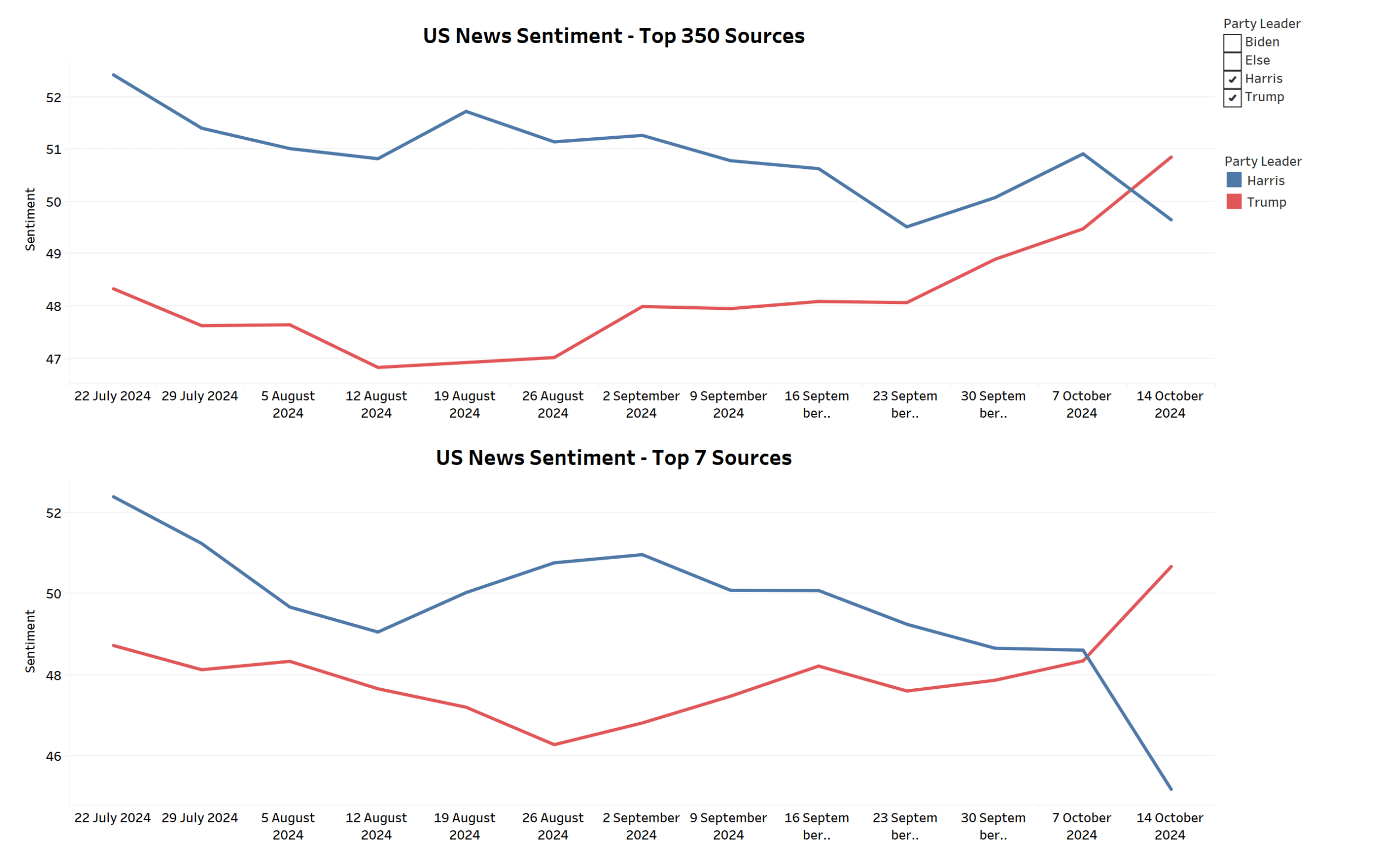
With only just over two weeks left to the U.S. election, in this follow up analysis to our previous Trump vs Harris news sentiment analysis, we look at how news sentiment seems to be shifting between the two candidates. These findings may – or perhaps may not – come as a surprise to many political pundits and election watchers, with Kamala Harris seeming to maintain a consistent lead over Donald Trump in terms of positive sentiment across major news sources.
On the week of October 7th, something changed. Our AI-driven sentiment analysis detected a notable shift that could potentially alter the course of the election. It is perhaps due to a combination of factors, but the data is clear: Trump’s sentiment surpassed Harris’s for the first time since the impact of the assassination attempt and within the analysed period.
Some may voice concerns that AI-driven analysis might be biased or unreliable in political forecasting. So how do we address this? Fundamentally, our technology doesn’t just count positive or negative words. Instead, it understands context, nuance, and the complex interplay of factors that influence perception.
Sketching out the details, here’s what our analysis revealed:
The idea of this analysis is to provide unbiased, data-driven insights that can help understand the shifting political landscape. Today, it seems that landscape is more volatile than many expected. In recent weeks, we’ve all seen a flurry of activity from both campaigns. Supporters of Harris might argue that this is just a temporary blip, a reaction to recent events that will soon correct itself. And, optimists believe that the Harris campaign has time to regain lost ground. We will have to wait and see if this argument holds water or as others have put forward, whether the Harris campaign has reached its ceiling.
But, now to mention the obvious. This shift in sentiment doesn’t necessarily translate directly to votes. That’s because, without actual ballot results, we’re still in the realm of prediction and analysis. Of course, there will always be exceptions to the rule, and political campaigns are notoriously unpredictable. As so often is the case, they cannot have their cake and eat it too – just like election polls can get it wrong, positive news sentiment doesn’t guarantee electoral victory, but it may be an indicator of things to come.
Now on the subject of momentum, it seems that Trump’s campaign has found its stride at a crucial moment having – some would say – earlier lost steam post assassination attempt. Never one to mince his words, Trump has been capitalising on this shift in public perception. Cynicism is based on the idea that this is just another example of Trump’s ability to dominate news cycles. After a golden period for Harris, the tables appear to have turned.
Another interesting finding from our analysis is that the volume of election coverage reached its lowest point during this period of significant sentiment change. This time, they are making every headline count. Some say that this is a deliberate strategy to focus media attention when it matters most as some say U.S. election fatigue has well and truly set in.
In all of this, it would seem, that the Harris campaign faces an uphill battle in the final weeks before the election. But how much should we read into this? Well, only time – and votes – will tell. Meanwhile, according to the latest data, early voting has already begun in many states, potentially amplifying the impact of this sentiment shift.
As ever, whilst our AI-analysis is perhaps a peek into the mood around the U.S. election sentiment, we must be cautious about drawing too firm conclusions. Whilst our analysis provides a unique window into the evolving narrative of this election, an obvious point to make is that perhaps this shouldn’t be attributed to any single event or statement, but rather a culmination of factors that our AI is uniquely positioned to detect.
Another point to note is that it is not just the overall sentiment that’s changing, but the nuances of how each candidate is perceived on key issues. We all know that Trump is known for his ability to rally his base and dominate media narratives. And the last thing the Harris campaign needs it a last-minute surge to overshadow the real issues at stake in this election – although the possibility is a very real one.
Our news sentiment analysis shows that the issues driving this sentiment shift are complex and multifaceted. But, many expect that the final weeks of the campaign will see even more dramatic swings in public opinion. Building news sentiment for the Harris ticket will take more than just a few good news cycles for the Harris campaign. However, that does not mean the election is decided – far from it. With two weeks to go in the final sprint, there’s still room for manoeuvre.
At Permutable AI, we’re committed to providing unbiased, data-driven insights. Our approach combines cutting-edge AI technology with a deep understanding of both financial markets and political landscapes. By applying the same rigorous methodologies we use in financial analysis to political sentiment, we offer a unique perspective on how public opinion evolves.
Our approach combines cutting-edge AI technology with deep understanding of both financial markets and political landscapes. We’re excited to announce that our geopolitical data insights like those featured above are being integrated into our powerful Trading Co-Pilot. Register your interest now by emailing enquiries@permutable.ai or fill in the form below.
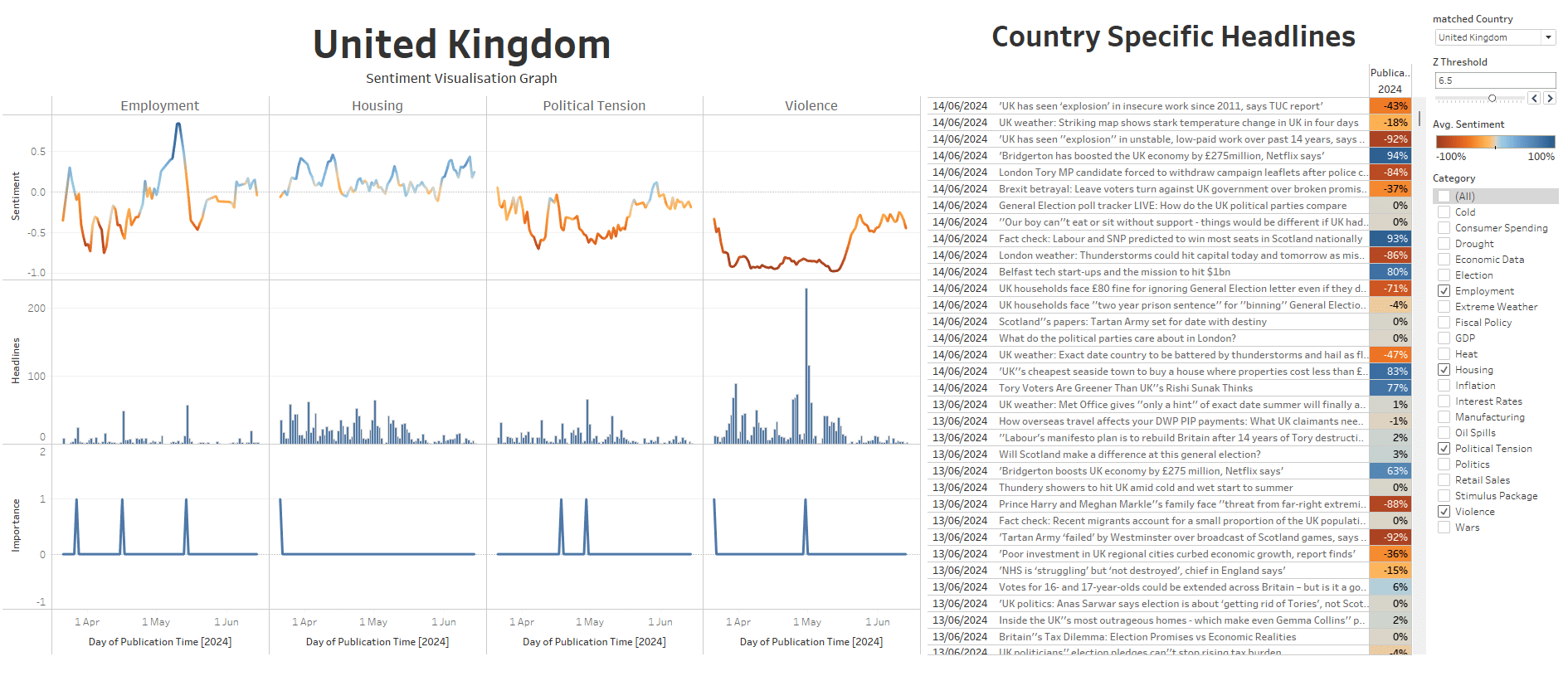
The pulse of news sentiment can shift rapidly, understanding these changes is crucial for policymakers, business leaders, and community advocates. Our recent comprehensive analysis of our UK data sets sheds light on the intricacies of public mood across various sectors in the United Kingdom, revealing how employment, housing, political tension, and concerns over violence influence collective sentiment. Let’s take a closer look at what we have uncovered.
Let’s start by looking at employment sentiment. The employment landscape in the UK during the selected period of late March to June 2024 has been marked by significant volatility, as indicated by our UK data sets. Over the past few months, news sentiment has experienced sharp peaks and deep troughs, reflecting the complex realities of the job market. Take late April – for example – where there was a notable spike in positive sentiment, suggesting a temporary boost in public confidence. This is likely to be due to the announcement of new legislation expanding rights for employees around flexible working, paid and unpaid leave, and protection from redundancy during parental leave around that time. Sad to say that this resulting optimism was sadly short-lived as sentiment quickly plummeted thereafter. But look how the fluctuating sentiment can be linked to a series of impactful headlines.
In contrast to the employment sector, the housing market sentiment has been relatively stable in recent months, albeit with its own set of challenges which we are all well versed on. Here, the overall trend is that of a slight positive sentiment, which suggests that despite periodic setbacks, the public maintains a generally optimistic view of the housing sector. This stability is occasionally disrupted by minor peaks and valleys, often triggered by specific news events. For example, a headline like “UK’s cheapest seaside town to buy a house where properties cost less than £83,000” in early June unsurprisingly brought a wave of positive sentiment. This would have provided a glimmer of hope for potential homeowners, reflecting affordability and accessibility in certain areas while so many continue to struggle to get a foot on the ladder. However, the housing market remains susceptible to broader economic trends and policy changes, so continuous monitoring and adaptive strategies are the order of the day, as reflected in the UK data sets.
Next, let’s look at political sentiment. Political sentiment in the UK remains predominantly negative, reflecting widespread public dissatisfaction with the current political landscape. Our UK data sets reveal significant dips in sentiment, particularly in late March and mid-April. These periods of heightened tension are often driven by contentious political developments and policy decisions, and in this case most likely linked to when speculation around a general election date began to mount. As so often happens, headlines like “Brexit betrayal: Leave voters turn against UK government over broken promises” capture the essence of public discontent. The ongoing Brexit saga, coupled with perceived governmental failures, continues to erode public trust. This sustained negativity calls for a more transparent and accountable political process to rebuild confidence and address the root causes of dissatisfaction, as suggested by the trends in the UK data sets.
Now let’s talk violence. News sentiment regarding violence has remained consistently low, highlighting a deep-seated concern among the populace. Although there are brief periods of stabilisation, the overall mood is marked by apprehension and unease. The persistent negative sentiment around violence highlights a need for comprehensive strategies to address underlying causes and improve public safety to mitigate these concerns. The reality is that this low sentiment is reflective of widespread fear and anxiety about crime and violence, which can have far-reaching impacts on community well-being and cohesion that must be addressed by policymakers and community leaders alike.
So what does this all mean? All of these points taken from our UK data sets highlight the varying sentiments across different sectors, illustrating the complexities of news sentiment. For policymakers, this data provides critical insights into areas requiring immediate attention, such as employment stability and political transparency. For businesses, understanding these trends is vital for tailoring strategies that resonate with consumer sentiment and address their concerns effectively. Ultimately, the data highlights the importance of staying connected to news sentiment. By keeping a finger on the pulse of public opinion through our UK data sets, decision makers can better navigate the challenges and opportunities that lie ahead. For community leaders and advocates, this means leveraging these insights to drive positive change and foster resilience within communities.
Now let’s get to the part where we explain how we do this. We use advanced machine learning algorithms to analyse extensive news data from various reputable sources. This comprehensive process begins with data collection, where news articles, reports, and headlines related to key sectors such as employment, housing, political tension, and violence are aggregated. Next, sentiment analysis is conducted using natural language processing (NLP) techniques to evaluate the tone of each news piece, categorising it as positive, negative, or neutral and assigning a sentiment score to quantify its intensity.
But that’s not all. The analysis also includes trend identification, tracking sentiment trends over time to detect significant fluctuations and patterns, thereby understanding how specific events and headlines influence public sentiment daily. Finally, significant sentiment changes are correlated with impactful headlines and news events, providing context and insight into the underlying factors driving public mood.
Our data-driven analysis of news sentiment in the United Kingdom, based on our UK data sets, offers a nuanced understanding of the current mood across various sectors. The fluctuating sentiments around employment, the relative stability in housing, the persistent negativity in political tensions, and the consistent concerns over violence all paint a complex picture of public opinion.
There are so many use cases for our UK data sets. If you’d like to experience firsthand how our comprehensive news sentiment analysis can inform your decisions and strategies, get in touch to request a free by emailing enquiries@permutable.ai or fill in the form below.
The relationship between news sentiment and GDP gross domestic product performance has long been a topic of interest for economists and policymakers. Understanding how news sentiment impacts the economy can provide valuable insights into economic forecasting, business decision-making, and policymaking. In this article, we will explore the concept of news sentiment analysis and its connection to GDP performance.
News sentiment analysis is the process of determining the sentiment or tone of news articles, social media posts, and other textual data. It involves using natural language processing algorithms to classify text as positive, negative, or neutral. By analyzing the sentiment of news, economists and analysts can gain a better understanding of public perception and its potential impact on economic variables such as GDP.
News sentiment analysis relies on advanced machine learning techniques that can accurately identify sentiment from large volumes of text data. These techniques use algorithms to analyze the words, phrases, and context of the text to determine sentiment. By classifying news articles into positive, negative, or neutral categories, analysts can quantify the overall sentiment of the news and its potential influence on the economy.
Positive news sentiment has been shown to have a positive impact on GDP gross domestic product performance. When the news is filled with positive stories and optimistic forecasts, it can boost consumer and investor confidence. This increased confidence often leads to higher spending, investment, and overall economic growth.
For example, during periods of positive news sentiment, consumers may feel more optimistic about their financial situation and be more willing to make purchases. This increase in consumer spending can stimulate economic activity and contribute to GDP gross domestic product growth. Similarly, positive news sentiment can also encourage businesses to invest in expansion, hiring, and research and development, further driving economic growth.
On the other hand, negative news sentiment can have a detrimental effect on GDP performance. When the news is dominated by negative stories, such as economic downturns, political instability, or natural disasters, it can create a sense of uncertainty and fear among consumers and investors. This increased uncertainty often leads to reduced spending, investment, and economic activity.
During periods of negative news sentiment, consumers may become more cautious about their spending, fearing potential economic hardships. This decrease in consumer spending can have a cascading effect on businesses, leading to reduced sales, layoffs, and a contraction in economic activity. Negative news sentiment can also deter investors from making new investments or expanding existing ones, further impacting economic growth.
To better understand the relationship between news sentiment and GDP gross domestic product performance, let’s examine two different case studies.
This study by the European Central Bank (ECB) examined the use of news sentiment analysis for “nowcasting” GDP growth in the Eurozone. Nowcasting refers to predicting economic activity in the very near future, typically within a quarter.
The ECB compared news sentiment metrics derived from newspaper articles to traditional economic indicators like the Purchasing Managers’ Index (PMI). They found that news sentiment offered valuable insights, particularly in the first half of a quarter when other data might be unavailable.
Interestingly, the study also highlighted the importance of considering the specific economic climate. News sentiment analysis proved especially effective during crisis periods like the Great Recession and the COVID-19 lockdowns.
This study by the Bank for International Settlements (BIS) looked at the relationship between news sentiment and economic activity in Malaysia [2]. The researchers used news sentiment analysis to forecast various economic indicators, including private investment growth and GDP growth.
Their findings suggested that news sentiment was a reliable predictor of private investment growth, particularly within a 2-3 quarter timeframe. However, the link between news sentiment and broader measures of GDP growth was less clear.
This case study highlights the potential limitations of news sentiment analysis. While it can provide valuable insights into specific economic sectors, it might not always capture the full picture of a nation’s GDP.
These two case studies demonstrate that news sentiment can be a useful tool for understanding and potentially predicting economic activity. However, it’s important to consider the specific context and limitations of this approach.
Several factors can influence the correlation between news sentiment and GDP gross domestic product performance. Firstly, the credibility and reliability of news sources can impact how individuals perceive and react to news sentiment. If news sources are viewed as biased or unreliable, their impact on sentiment and subsequent economic behaviour may be diminished.
Additionally, the timing and intensity of news sentiment can also affect its impact on GDP performance. For example, a short-lived positive news sentiment may not have a significant and lasting effect on economic variables. Conversely, a prolonged period of negative news sentiment can have a more profound and enduring impact on economic behaviour.
Furthermore, the specific economic conditions and structural factors of a country can influence the relationship between news sentiment and GDP performance. For instance, a country with a robust and diversified economy may be less susceptible to the impact of negative news sentiment compared to a country heavily reliant on a specific industry.
At Permutable AI, we have harnessed the power of cutting-edge natural language processing technologies to develop a robust platform that systematically evaluates the sentiment of global news sources towards GDP gross domestic product performance. We used state-of-the-art machine learning models to scan, categorize, and analyze large volumes of news data. This process not only identifies the general sentiment of articles—whether they are positive, negative, or neutral—but also captures the nuances and context that could influence economic indicators.
Our technology performs real-time tracking of news sentiment related to GDP trends. This data intelligence allows users to observe how shifts in media tone correlate with economic activity, offering insights into potential GDP movements before traditional economic data is available. Our data feeds offer insights based on sentiment trends. For policymakers, this could assist with adjusting economic policies in anticipation of changes signaled by news sentiment. For businesses, it can provide a basis for strategic planning and risk management, particularly in volatile markets.
Above: Our economic data GDP gross domestic product data intelligence
News sentiment analysis has gained popularity as a valuable tool for economic forecasting. By incorporating news sentiment data into forecasting models, economists and analysts can improve the accuracy of their predictions. News sentiment data provides real-time insights into public perception, which can be used to anticipate changes in consumer behaviour, investment trends, and overall economic performance.
For example, if news sentiment analysis indicates a rising positive sentiment, economists may forecast an increase in consumer spending and subsequent economic growth. Conversely, if news sentiment analysis reveals a declining negative sentiment, economists may forecast a decrease in consumer spending and a potential economic downturn.
By leveraging news sentiment analysis for economic forecasting, policymakers and businesses can make more informed decisions and develop strategies to mitigate potential risks or capitalize on emerging opportunities.
The link between news sentiment and GDP gross domestic product performance has significant implications for businesses and policymakers. Businesses can benefit from monitoring news sentiment to gauge consumer and investor confidence, identify emerging trends, and adjust their strategies accordingly. By understanding how news sentiment affects consumer behavior and economic activity, businesses can make informed decisions about product development, marketing campaigns, and investment opportunities.
Policymakers can also utilize news sentiment analysis to inform their economic policies and decision-making. By monitoring news sentiment, policymakers can gain valuable insights into public perception and adjust their policies to promote economic growth and stability. For example, during periods of negative news sentiment, policymakers may implement measures to boost consumer and investor confidence, such as tax incentives or stimulus packages.
The connection between news sentiment and GDP gross domestic product performance provides a fascinating area of study for economists and analysts. By understanding the impact of news sentiment on economic variables, businesses, and policymakers can make better-informed decisions and develop strategies to promote economic growth.
News sentiment analysis offers a powerful tool for analyzing public perception and its influence on economic behaviour. By leveraging advanced techniques and tools, economists and analysts can extract valuable insights from large volumes of textual data. Incorporating news sentiment analysis into economic forecasting models can improve the accuracy of predictions and enable businesses and policymakers to stay ahead of economic trends.
Ready to harness the power of Permutable’s data intelligence on GDP gross domestic product? To find out more about our data intelligence feeds and how it can benefit your organisation visit our dedicated data intelligence hub or request a free trial below.