There was a time when energy trading relied purely on instinct and experience, with traders poring over data and news feeds to make split-second decisions. Today, as we face unprecedented energy markets volatility, the landscape has transformed dramatically. It’s plain for all to see that the confluence of geopolitical tensions, rapid technological advancement, and the global energy transition has created a trading environment more complex than ever before, and this is a trend that’s here to stay.
So then, in this new era, successful trading requires a sophisticated blend of human expertise and technological innovation. In 2025 – much the same as in 2024 where we saw unprecedented market volatility – we will continue to witness more of the same. And this volatility that will be marked by swift price swings, intricate correlations between different market factors, and an ever-expanding web of influences that can impact trading outcomes. All this means that traditional approaches to market analysis and decision-making are no longer sufficient to capture the nuances of these dynamic markets.
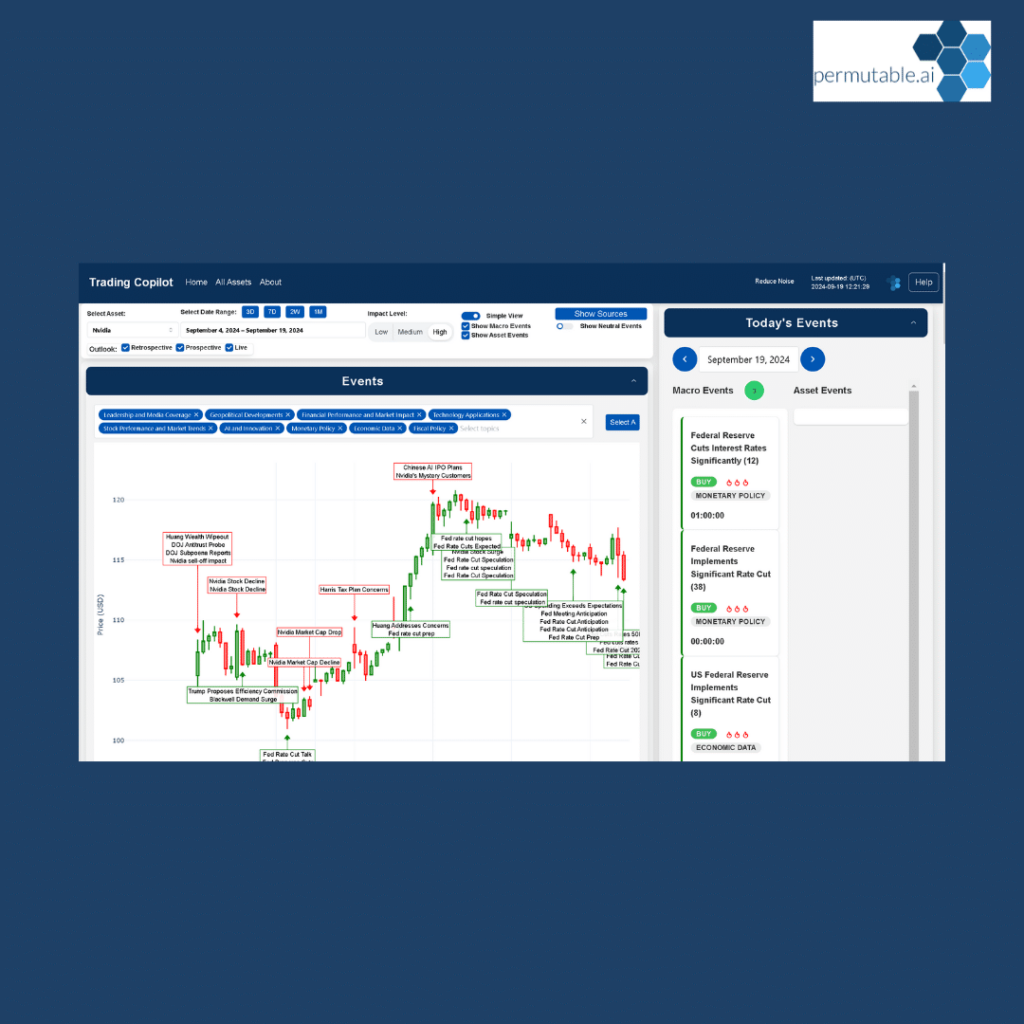
And this is precisely where our advanced Trading Co-Pilot technology is becoming increasingly valuable. By leveraging artificial intelligence, machine learning, and real-time data analytics, our Trading Co-Pilot is already transforming how traders interact with data, identify opportunities, manage risks, and execute strategies. Now, the ability to process vast amounts of data, identify subtle market patterns, and generate actionable insights in real-time is served up to those energy traders in the know who are already using our tool and API to stay competitive in today’s energy markets.
Now that we stand at the beginning of 2025 (with plenty more energy markets volatility ahead of us) those moving the herd will be adopting technological tools like these alongside human expertise and it is this that will form the key differentiator between successful traders and the rest of the pack. Here we highlight seven ways our Trading Co-Pilot and Commodities API can be used to navigate energy markets volatility in 2025.
It’s not new news that energy markets of today operate in an unprecedented geopolitical landscape. Regional conflicts, trade disputes, and shifting alliances are creating ripple effects that span continents. Traditional pressure points like OPEC decisions and inventory reports are now intertwined with complex factors such as renewable energy adoption rates, carbon pricing mechanisms, and emerging market demand shifts. The speed at which these factors can impact markets has accelerated dramatically, with price swings occurring in minutes rather than days.
In volatile markets such as these, understanding pressure points is vital. Our Trading Co-Pilot platform employs sophisticated algorithms to analyse macro and fundamental factors driving price movements. Think real-time alerts that allow energy traders to spot supply chain disruptions, regulatory changes, and demand shifts before they impact prices. It is this continuous monitoring of key indicators that ensures that no critical market signals are missed.
The energy landscape is experiencing a fundamental transformation. The interplay between traditional fossil fuels and renewable energy sources creates new market dynamics daily. Energy companies are pulling back from green energy projects as governments struggle to set clear pathways towards Net Zero goals, and then there’s technological breakthroughs such as in energy storage and distribution – which can instantly alter market fundamentals. To add to that, emerging markets are developing their own energy ecosystems, adding layers of complexity to global trade flows.
In all of this, the struggle to find relevant information and filter out noise is real. Instead of drowning in data, our platform’s advanced taxonomy filters help traders focus on specific themes like geopolitical tensions, infrastructure or regulatory developments. It is this targeted approach which helps traders cut through complexity and focus on what truly matters in periods of energy markets volatility.
The extent to which the democratisation of information has created a double-edged sword can not be argued against. While more data is available than ever before, the challenge of separating signal from noise has grown exponentially. Think about it – social media, instant news, and the proliferation of market commentary has all come together to create a veritable cacophony of information that can obscure rather than illuminate market dynamics. So what, you may ask? Well, quite simply, the cost of acting on unreliable data has never been higher.
For the avoidance of doubt, reliable data is the foundation of successful trading. That is an echo of why our platform maintains a comprehensive network of validated source links. One of the most valuable features here in terms of validating source data integrity is that each piece of data comes with a clear audit trail. And it is this that allows traders to verify information instantly and make confident decisions based on trusted sources during periods of energy markets volatility.
It’s hard to argue against the fact that market psychology has taken on new dimensions in this digital age. In fact, one can say that sentiment can shift quicker than a New York minute across global markets, driven by an avalanche of social media trends, policy announcements, and changing consumer preferences. And it is this interconnectedness of global energy markets means that regional sentiment shifts can quickly cascade into global price movements. All of this means that understanding these sentiment patterns has become as key as analysing fundamental data.
And so, with market sentiment such a major driving force in price movements, suffice to say that the consequence of overlooking global perspectives can be costly to say the least. Cue our Trading Co-Pilot and Commodities API, which analyses market sentiment across multiple regions, providing early warning signs of energy markets volatility and helping traders spot opportunities others might miss.
Now more than ever before, the modern energy market narrative’s complexity can be felt keenly. Given that a single event, such as a pipeline disruption or renewable energy policy shift can creates cascading effects across multiple market segments, the traditional approach of analysing markets through a single lens – whether technical, fundamental, or news-based – is no longer up to scratch.
As we’ve already highlighted, today’s market movements are driven by intricate webs of interconnected factors, with prices being predicted by unpredictable and ever-moving forces. But what if you had a tool that could explain live stories with macro factors? This comprehensive approach combining real-time news analysis with economic indicators is exactly what our Trading Co-Pilot seeks to deliver, helping energy traders understand how various elements interact during periods of energy markets volatility. The key benefit of which is how its multi-layered analysis captures these complex narratives, providing traders with a deeper understanding of market dynamics.
Spoiler alert: Climate change has fundamentally altered the relationship between weather and energy markets. One can not dispute the fact that extreme weather events, once considered rare, have become regular market disruptors. This increasing fragility shaped by unprecedented frequency of hurricanes, polar vortexes, and heatwaves creates new patterns of energy demand and supply disruption. To add to this, the growing share of weather-dependent renewable energy in the global power mix has amplified the impact of meteorological conditions on market prices.
As you might expect given the above, there’s been a real shift in how weather affects energy markets. Here, the risk for traders who ignore weather patterns is significant. Our Trading Co-Pilot’s analysis quantifies how extreme weather events impact market behaviour, providing valuable insights for trading during energy markets volatility. This means that by integrating historical data with current patterns and future forecasts, energy traders can better anticipate and respond to weather-driven market movements.
One thing we can be certain of is that the energy markets of 2025 will demand a much more holistic perspective. It’s clear that the traditional silos between energy commodities have blurred, with oil, gas, power, and renewable markets increasingly interconnected. Meanwhile, factors such as carbon markets, government policies, and technological innovation create complex feedback loops that affect multiple market segments simultaneously. No more so than now, success in this environment requires understanding not just individual market segments, but the entire energy ecosystem.
Little wonder that success in navigating energy markets volatility in 2025 will require more than just individual data points. Ultimately, we believe the points we’ve raised above will lead energy traders to put greater emphasis on how complex and varying market factors interact. Over and over again, our Trading Co-Pilot tirelessly integrates real-time events with macro-economic analysis in way that only a huge team of round the clock analysts could, creating a holistic view that helps traders navigate energy markets volatility with confidence. The upshot? Our ambition here is to create a comprehensive approach that ensures traders can see both the forest and the trees, understanding both micro-level market movements and macro-level trends.
There’s been a real shift in the evolution of energy markets, and as this continues to accelerate driven by technological innovation, policy changes, and shifting global dynamics, success in this environment will require both sophisticated tools and the wisdom to use them effectively. It is out belief that while our Trading Co-Pilot provides powerful capabilities, it’s the combination of these tools with human expertise that will create true trading excellence and new opportunity.
To our mind, there is no question that the future of energy trading belongs to those who can effectively blend technological sophistication with market intuition. As we move forward on into 2025, the ability to quickly adapt to new market dynamics while maintaining a comprehensive understanding of traditional factors will become increasingly vital.
The complexity of today’s energy markets demands sophisticated tools and insights. Our Trading Co-Pilot and Commodities API are already helping energy traders across the globe make more informed decisions, and we’re excited to show you how they can transform your trading strategy as we move into 2025.
Would you like to experience our platform firsthand through a personalised demo? We’ll walk you through how our tools can address your specific trading needs, from leveraging real-time market insights to integrating our API with your existing systems. You’ll see practical examples of how traders are using our platform to stay ahead of market movements and make more confident decisions.
Prefer to explore at your own pace? Start a 30-day free enterprise trial with access to our complete suite of trading tools, including real-time market analytics, historical data analysis, and live market sentiment tracking. You’ll have the opportunity to experience firsthand how our platform can enhance your trading strategy and help you navigate market volatility with greater confidence.
Taking the next step is simple. Email us at enquiries@permutable.ai or fill in the form below to schedule your demonstration or begin your free trial.
At first glance, learning how to trade with artificial intelligence might seem like something out of a science fiction novel. Dip beneath the surface though, and you’ll find that AI-powered trading is not only real but rapidly becoming the norm in financial markets. At Permutable AI, we’ve been at the forefront of this revolution, and we’re excited to share our insights on how to trade with artificial intelligence effectively.
Let’s start with the issue of why understanding how to trade with artificial intelligence is gaining such momentum. The obvious point here is that financial markets are incredibly complex, with countless variables affecting asset prices at any given moment. It’s inevitable that human traders, no matter how skilled, will miss important signals or struggle to process information quickly enough. This creates a big problem for traditional trading methods.
But also, the sheer volume of data available today is overwhelming. This is where AI shines. By leveraging machine learning algorithms, AI can process vast amounts of data in real-time, identifying patterns and trends that would be impossible for a human to spot. Not only that, but AI can do this round the clock, without fatigue or emotion clouding its judgment.
So, how do you actually trade with artificial intelligence? There are two questions you need to consider:
We’ll unpack this below…..
When exploring how to trade with artificial intelligence, it’s important to start with the different approaches available. Broadly speaking, there are three main categories:
At Permutable AI, we believe that a combination of these approaches often yields the best results when learning how to trade with artificial intelligence. Our philosophy has always been to use the right tool for the job, rather than trying to force a one-size-fits-all solution.
So now the question you are all wanting to ask us…..how hard is it to implement AI trading? Well hey, it’s certainly not a walk in the park, but it’s also not as daunting as you might think. The first major development in how to trade with artificial intelligence is choosing the right platform or tools. There are numerous ready-made solutions available – including our very own Trading Co-Pilot.
But now, let’s remember that AI is not a magic bullet. The problem is, many traders expect AI to instantly boost their profits without any effort on their part. A bigger game changer is achieving a deep understanding of how to trade with artificial intelligence and how it can complement your trading strategy and human expertise. This is exactly how we use our own Trading Co-Pilot in-house and very much where we see the strongest results.
If you plan to incorporate AI into your trading, you may want to start small. There is some low hanging fruit in areas like market sentiment analysis, again – which is all packaged up and available to you through our Trading Co-Pilot, including AI-driven buy/sell directionals. From there, you can gradually expand the role of AI in your trading process.
Meanwhile, it’s crucial to keep an eye on regulatory developments. The world is taking notice of AI trading, and regulations are evolving rapidly. Fortunately, at Permutable AI, we stay on top of these changes and design our systems to be compliant with the latest regulations – so you’re very much in a safe pair of hands with us.
Yet the reality is that learning how to trade with artificial intelligence is not without its challenges. A frisson of fear often runs through traditional traders when they first encounter AI systems, and this is to be expected. Of course, there is worry about job displacement or losing control over their trading strategies. These are not idle concerns, but we believe they’re outweighed by the potential benefits of AI being used in collaboration with human expertise, which is very much the basis on which our Trading Co-Pilot has been designed and developed. An often cited rule of thumb is to treat AI as a tool, not a replacement for human judgment. The idea is that you can leverage AI’s strengths while still maintaining control over your overall trading strategy.
Against all that, a sceptic might say that markets are too unpredictable for AI to be truly effective. However, we would say that this is precisely why AI is so powerful in the context of increasingly volatile markets. Take our Trading Co-Pilot for example – it can process and analyse far more information than a human ever could, identifying subtle patterns and correlations and ultimately, providing sound trading strategies and ideas – all in real-time.
The bigger picture, though, is that AI is transforming the entire financial landscape. Central to that revolution is the democratisation of advanced trading techniques. Tools and strategies that were once the preserve of large institutions are now accessible to individual traders. From AI trading algorithms that execute trades at lightning speed to AI-guided investing that helps novice investors make informed decisions, the applications of AI in stock market analysis are vast and growing.
Many wonder, “Can AI pick stocks?” or “Is AI stock trading real?”. Well good news folks, because the answer here is a resounding yes! Artificial intelligence stock analysis has become increasingly sophisticated, with AI-powered investing platforms and apps offering everything from basic stock recommendations to complex portfolio management (again see our buy/sell directionals as part of our Trading Co-Pilot).
For those asking how to use AI to invest in stocks or how to start trading with AI, there are numerous options available. Free AI investing apps provide a low-risk entry point, whilst more advanced artificial intelligence trading tools offer comprehensive tools for seasoned traders. The best AI investment apps combine powerful algorithms with user-friendly interfaces, making it easier than ever to harness the power of AI for investing. Whether you’re using AI to pick stocks or relying on stock market AI analysis for deeper insights, it’s clear that AI is transforming the investment landscape.
When all is said and done, the most important question is: how can you get started with AI trading? Here are a few steps we recommend:
In the wake of recent market volatility, many traders are coming out of a brutal period looking for new approaches. AI trading offers a promising path forward. But it’s not just about using AI to make more money. It’s about making more informed, data-driven decisions. At Permutable AI, we’re excited about the future of AI trading and our Trading Co-Pilot is the glimpse of the future, right here in the present. To find out more request a demo or free trial below.
Schedule a free enterprise demo to see how our Trading Co-Pilot can help you make smarter trading decisions, faster.