Germany economy insights: Understanding global perception through sentiment analysis
It’s a fact that how people see a country’s economy depends on more than just its policies and performance. The way news reports on it plays a big role too which is what is currently happening with regards to the Germany economy with media speculation around whether the country will once again be the sick man of Europe. At Permutable AI, we’ve built smart tools to measure and analyse these opinions through AI-driven sentiment analysis. These tools and our data intelligence give businesses, investors and government officials key insights into how the world views their actions and economic situation.
Our recent sentiment analysis about Germany’s economy from June 5, 2024, to August 29, 2024, gives a clear picture of how the world sees the fourth-biggest economy. This study isn’t just for researchers; it has real-world effects for people in global markets international trade, or economic policy. We’ll look into the main findings of our analysis and what they mean for Germany, the European economy as well as world economy implications.
How sentiment shapes economic analysis
Before we get into the details of what we discovered through our news sentiment analysis, let’s talk about why sentiment analysis matters so much in today’s economic scene. The usual economic signs—how fast the economy’s growing how many people are out of work, and how prices are changing—are still key, but they don’t tell the whole story. Sentiment analysis adds another piece to the puzzle. It captures the mood and views that drive how markets act, sway decisions about investing from other countries, and help shape government policies.
Our sentiment analysis doesn’t just count words or link positive and negative terms. Our cutting-edge systems take into account context how often topics appear, and how strong the sentiment is in news stories. This gives us a detailed picture of how people view economic events. As a result, we can forecast market trends, evaluate how economic policies might affect things, and provide valuable insights that you can use right away.
Germany economy sentiment: Key findings
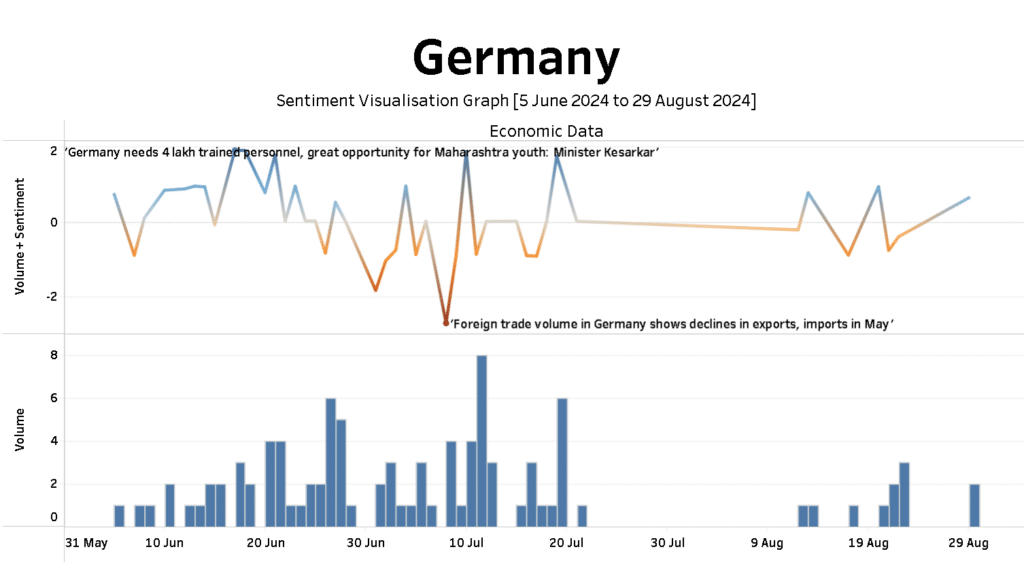
When we looked at news sentiment around the Germany economy over the last three months, we saw a mix of feelings that was very revealing. The overall sentiment oscillated, with some hopeful periods balanced by times of worry about trade issues. Let’s take a closer look at what we discovered:
Germany economy and mixed sentiment around employment
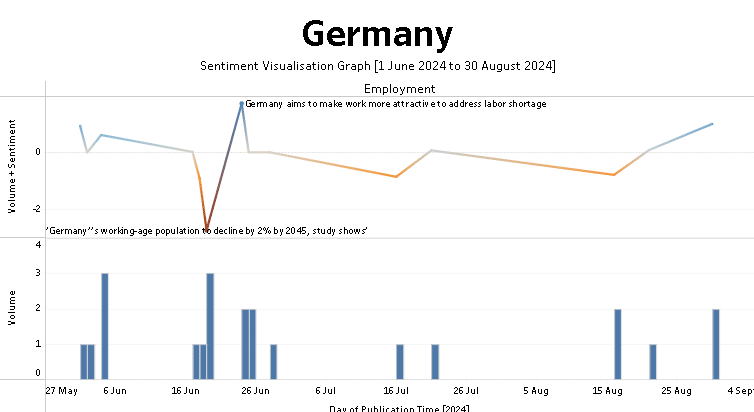
Our sentiment analysis reveals varied opinions. A decrease in sentiment shows concern around the expected 2% drop in Germany’s working-age population by 2045. But Germany’s active steps to tackle labour shortages, like making working in Germany more appealing, was met with positive sentiment. Overall, our sentiment analysis shows the world approves of Germany’s efforts, which suggests people recognise the country’s dedication to keeping a strong job market despite population challenges.
Trade worries about Germany economy lead to negative views
Our analysis found major drops in sentiment around trade issues. News that “Foreign trade volume in Germany shows declines in exports, imports in May” caused a clear dip in people’s outlook. Germany’s economy has deep ties to global trade. As the world’s third-biggest exporter, any hints of weak trade volumes worry people. The negative sentiment around falling trade volumes in May shows worldwide concern about Germany’s ability to weather possible trade problems.
For global companies and investors, this highlights the need to keep a close eye on Germany’s trade flows. Our sentiment analysis suggests that further drops in trade could make worries worse, leading to more careful investment choices and a new look at risks in German markets.
Germany economy and sentiment around economic doubt
The ups and downs in sentiment during the time we looked at match the shaky economy that’s been a big part of 2024. Times when sentiment was more positive thanks to brighter economic news often came before drops in sentiment when bad reports came out.
These sentiment swings show a bigger picture of a world economy that’s hard to predict. Things like global conflicts, supply chain disruptions and and fluctuating prices of raw materials have all added to this uncertainty. For Germany, keeping a steady and upbeat economic mood in the face of these tough spots is key to make sure investors stay confident and the economy stays stable.
What our sentiment data means for economic strategy and the Germany economy
What we found from looking at the sentiment in the media has several big takeaways for businesses, investors, and policymakers alike.
1. Using positive sentiment to boost economic growth
While the world still looks upon the European country’s efforts to strengthen its labour market and tackle challenges head on, Germany should use this feeling of relative goodwill about its job market to make itself more appealing to talent from around the world. Surely, then, the government must think about creating specific immigration rules and perks to bring in skilled workers. But also, companies might look into teaming up and coming up with hiring plans that tap into this.
2. Tackling trade worries head-on
Most importantly, Germany needs to deal with the worries about how well it’s doing in trade, as perceived by the rest of the world. There is some low hanging fruit to be had in making trade deals stronger, or putting money into areas that don’t get hit as hard when global trade is impacted by global forces. By facing these concerns head-on , Germany can lower the chances of negative sentiment towards its economy and its association implications.
3. Quick thinking helps handle uncertain times
Against all that, when the economy gets shaky, you need to think on your feet as a leading economy. Companies and leaders should be ready to change plans fast using up-to-the-minute sentiment data to guide their choices. By keeping an eye on global news sentiment, there are opportunities to spot risks and grab chances as they surface, rather than reading it in yesterday’s news when it’s already too late.
We help you understand the economic mood
Here at Permutable AI, we take pride in giving our clients top-notch, real-time, AI-driven insights about the economy and world events. We’ve built our sentiment analysis tools to give you a clear, fact-based picture of how people see economic events worldwide.
If you’re a business wanting to grow in new markets, an investor trying to make improve your portfolio, or a policymaker aiming to boost economic stability, our real-time news sentiment insights can give you an advantage. By using our cutting-edge AI tools and core datasets, you can keep up to date with global shifts and make sure your plans are based on the latest and most correct info out there. For an idea of what you may be missing drop us a line to enquiries@permutable.ai or get in touch by filling in the contact form below.
Get in touch
Further reading
Looking for more global insights? Why not read our articles on:
How countries of Europe view each other’s economy according to GDP
How the UK’s economy is perceived in Europe
How France’s political situation is viewed
An analysis of sentiment around the UK property market recovery
How the world views Russia in terms of wars, politics and the economy
An analysis of global perceptions towards the Germany economy