Global trade tariff impact: Analysis of macro sentiment 1 Apr 25

*This article analyses how trade tensions are affecting different economies, highlighting UK’s resilience, Asia-Pacific’s retail growth, and Western nations’ employment challenges. It’s aimed at institutional investors and financial professionals seeking data-driven insights on currency markets and macroeconomic trends to inform their investment strategies in an increasingly complex global trade environment.

In the constantly evolving theatre of global finance, understanding the increasingly intricate relationships between trade policies, domestic economic indicators, and currency movements has never been more fundamentally important that during the times we are living through. Despite what Trump purports, we – like many others – maintain there is nothing “beautiful” about tariffs. In this article, we’ll look at the latest global trade tariff impact through our Trading Co-Pilot’s newly launched Sector Analysis feature, which reveal a fascinating divergence in how major economies are responding to mounting global trade tariff pressures.
global trade tariff impact market sentiment

The widening impact of global trade tariff tensions

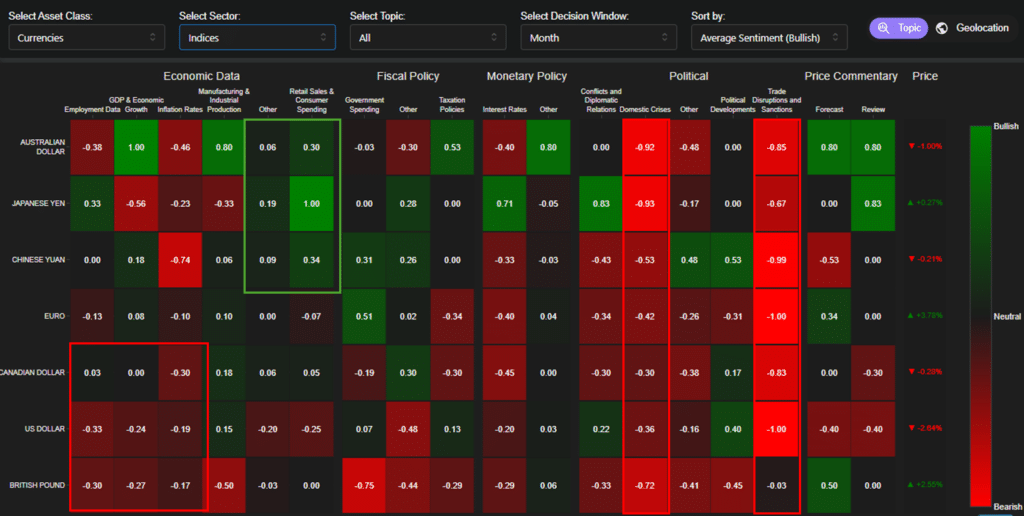
When looking at our LLM-driven market sentiment data across G10 currencies using our new Sector Analysis feature, a clear pattern emerges: nearly all major economies are displaying signals of domestic crisis against the backdrop of escalating global trade tariff conflicts. This week’s imposition of tariffs by the Trump administration has only exacerbated these tensions. Perhaps one of the most interesting stories here – particularly for those of us based out of the UK is that the United Kingdom stands as a notable exception to this trend.

Our Sector Analysis sentiment matrix provides a detailed breakdown of how these tensions are manifesting across different economic dimensions. The data suggests that the ripple effects of trade barriers are now extending beyond immediate trade balances and beginning to influence core domestic indicators.

As we can observe from our sentiment heatmap, the negative values clustering around employment data and inflation rates for most currencies tell a worrying story about market concerns. What we are clearly seeing is that in terms of market sentiment, the global trade tariff impact is no longer contained to international commerce metrics but has created vulnerabilities throughout domestic economic structures. The imposition of these taxes will, presumably, only deepen these vulnerabilities.

Asia-Pacific resilience: Retail strength amid global uncertainty

On the bright side, a more positive insight from our analysis is the resilience currently being displayed in retail and consumer sectors across several Asia-Pacific economies. The Australian Dollar, Japanese Yen, and Chinese Yuan are all showing strong positive sentiment values in retail sales and consumer spending categories.

In particular, the Australian Dollar exhibits a robust +0.80 sentiment score particularly in connection with manufacturing and industrial production, complemented by an impressive +1.00 in GDP growth indicators. Similarly, the Japanese Yen demonstrates robust strength in consumer spending with a +1.00 sentiment reading, suggesting that domestic consumption remains buoyant despite external pressures.

What makes this particularly noteworthy is that this retail strength persists despite the global trade tariff impact threatening supply chains and potentially increasing consumer prices. Our Trading Co-Pilot’s cross-dimensional analysis indicates that these economies have successfully insulated their consumer sectors through a combination of monetary policy adjustments and fiscal support measures.

Western Economies: Employment concerns and inflation anxiety

Moving on, in stark contrast to the Asia-Pacific region’s consumer resilience, Western economies are displaying troubling signals in employment data and persistent inflation concerns. The sentiment readings for the Canadian Dollar, US Dollar, and British Pound reveal a consistent pattern of weakness in labour market indicators.

The Canadian Dollar’s -0.30 sentiment in inflation rates, coupled with the US Dollar‘s -0.33 reading in employment data, points to a challenging economic environment where central banks face the difficult balancing act of addressing inflation without triggering further employment deterioration. What makes this all the more worrying is the rhetoric surrounding these policy decisions, with bizarre arguments such as tariffs being “job creators” flying in the face of the data our Trading Co-Pilot is surfacing.

Most telling is the cluster of negative sentiment values in the Western currencies‘ GDP growth prospects. These values suggest that the global trade tariff impact is creating more profound structural challenges for these economies than for their Asia-Pacific counterparts.

Our analysis also reveals that markets anticipate these employment and growth challenges to persist, with forecasting models indicating continued pressure. This is particularly evident in the deeply negative readings in the trade disruptions category, where Western currencies universally display sentiment scores below -0.8.

UK’s mixed signals

Now here’s an interesting story  – while the UK shares some of the employment and GDP concerns of its Western counterparts, our Sector Analysis breakdown reveals a more nuanced picture. Here, we can see the British Pound showing stronger resilience in market sentiment in certain categories, particularly in monetary policy sentiment, where it outperforms both the US and Canadian dollars.

This relative strength may explain why the UK appears to be weathering the global trade tariff impact more effectively than other major economies (for now, at least). The data suggests that market sentiment perceives UK monetary policy as more appropriately calibrated to current economic conditions, despite the challenges in growth and employment.

Furthermore, the UK’s +0.50 reading in the forecast category stands in contrast to the negative readings for both the US and Canadian dollars, indicating greater market confidence in the UK’s medium-term economic trajectory.

As the above trends continue to evolve, our LLM-driven Sector Analysis feature is a powerful way of monitoring shifts in sentiment across all categories in real-time. The retrograde step in global trade policy will continue to require careful analysis as its effects ripple through economies worldwide. Ultimately, the persistence of these patterns, particularly the strength in Asia-Pacific retail sectors and the weakness in Western employment data will be key indicators of how the global trade tariff impact will continue to reshape the economic landscape.

Conclusion

The current global economic environment presents a complex picture of vulnerabilities and resilience. While the global trade tariff impact continues to create headwinds for most major economies, the divergent responses across different regions offer valuable insights for investors and policymakers alike.

By leveraging our Trading Co-Pilot’s comprehensive sentiment analysis, market participants can gain a deeper understanding of how these cross-currents are likely to influence currency movements and economic outcomes in the months ahead. As always, we remain committed to providing timely, data-driven insights that cut through market noise and highlight the trends that truly matter.

Enhance your market intelligence

Ready to move beyond surface-level market analysis? Our Trading Co-Pilot delivers comprehensive macroeconomic sentiment data you need to navigate today’s complex investment environment with confidence. Our proprietary LLM-driven analytics tool provide institutional investors with unparalleled insights into global economic trends, helping you identify emerging opportunities and avoid hidden risks before they impact your portfolio. To request a personalised demo of our Trading Co-Pilot dashboard and to learn how you can leverage our analytics for your investment and trading decisions, simply contact our team at enquiries@permutable.ai or fill in the form below to request a complimentary trial.

Request demo/trial

GBPJPY analysis: A tale of two economies at critical turning points

The first principle of understanding GBPJPY movements lies in recognising the complex interplay between two major economies at crucial policy junctures. For several years, both nations have followed divergent monetary paths, but recent developments suggest a potential convergence that’s dramatically impacting the currency pair. In this article we’ll look at developments across one of the most volatile currency pairs, taken from our Trading Co-Pilot, where we are gearing up to a roll out of FX on our market intelligence platform. 

GBPJPY news analysis

Policy evolution 

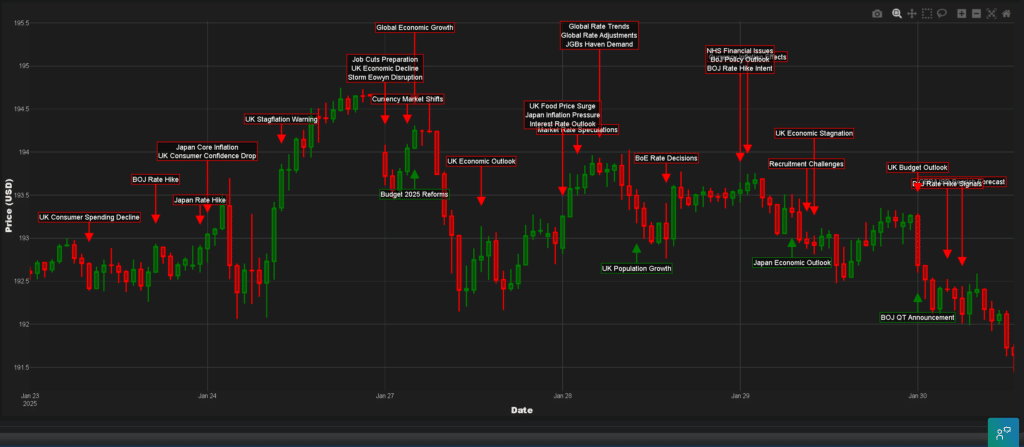
Let’s start with the fact that the Bank of Japan’s monetary policy is undergoing its most significant transformation in decades. There is evidence of fundamental change as the BOJ raised rates to 0.5%, making it one of the most substantial policy shifts since 2008. This is obviously a pivotal moment for FX traders, with more than just rate differentials at stake. The BOJ’s planned balance sheet reduction of nearly $500 billion through quantitative tightening measures signals a fundamental shift in Japanese monetary policy that could support long-term yen strength, suggesting this may be just the beginning of a longer-term policy normalisation cycle.

Economic contrasts

It is the story of contrasting economic narratives. While Japan emerges out of the doldrums of deflation, the UK faces mounting challenges. Only after this week’s data releases did the full picture emerge, showing UK consumer confidence hitting its lowest level in over a year. This contrasts with Japan’s gradual but steady economic recovery. The compound effects are particularly visible in employment markets, where UK firms report the largest decline in output and profit since the pandemic.

Market sentiment and dynamics

Market sentiment towards GBPJPY reflects these divergent economic trajectories, whilst technical aspects show no signs of abating volatility. The consequences of these movements are far-reaching, particularly given the pair’s sensitivity to risk sentiment. Trading volumes suggest institutional investors are actively repositioning their portfolios in response to these shifts. Meanwhile, our event analysis has identified a notable increase in correlation between GBPJPY movements and global risk sentiment indicators, suggesting the pair could become increasingly sensitive to broader market dynamics beyond purely bilateral economic factors

Structural changes 

What many observers have found surprising is the pace of the BOJ’s policy evolution, especially considering Japan’s corporate service inflation reaching 2.9%. Part of this attitude has developed from years of ultra-loose monetary policy. Beyond the immediate rate decision, the UK’s projected population growth of five million by 2032 due to migration presents a complex economic variable that could influence long-term GBPJPY trends. Though the current situation has unique characteristics given the global monetary policy environment, previously similar policy transitions have typically led to sustained currency trends.

Trading considerations 

However, we are not out of the woods yet with GBPJPY volatility. The acceleration of Japan’s policy normalisation, combined with UK economic uncertainty, creates an important reminder that currency markets can shift rapidly. A range of factors, from interest rate differentials to economic growth trajectories, continues to influence the pair’s direction, and particular attention should be paid to signs of BOJ policy normalisation acceleration and UK employment figures.

Market navigation

The compound effects of the above factors require a sophisticated approach to risk management, and so far, analysts reckon that the pair’s direction will heavily depend on both central banks’ next moves and economic performance indicators. This is magnified by the current global economic environment and shifting monetary policy landscapes. Ultimately, the answer will fall to several key factors in the coming weeks, but traders who maintain disciplined risk management and stay informed of both economies’ developments will be best positioned to navigate these challenging markets – and for that, there is the FX roll out on our Trading Co-Pilot

Get early access to FX on our Trading Co-Pilot

As we prepare for the FX roll-out on our Trading Co-Pilot platform, our mission is to bring the same level of comprehensive market intelligence we’ve delivered in commodities markets to currency trading. Our platform processes over 10,000 articles daily, providing real-time event detection and analysis that helps traders stay ahead of market-moving developments.

Want to be among the first to experience our FX capabilities? We’re currently accepting registrations from enterprise clients for early access to our beta testing programme. Our platform offers real-time currency market event detection, advanced geolocation filtering, cross-asset correlation analysis, customisable event alerts, and comprehensive macro monitoring.

Contact us at enquiries@permutable.ai to learn more about how we can help you navigate FX market complexity together or fill in the form below to register interest.

Register interest for FX roll out on our Trading Co-Pilot


Read other articles in this series

GBP/USD FX rate: A deep dive into Sterling’s market reality using our Trading Co-Pilot January 2025

FX It is perhaps fair to say that the start of 2025 has brought an unprecedented confluence of factors moving the GBP/USD FX rate. Looking back, the acceleration of UK wage growth to 5.5% has set the stage for what many hope will be the comeback year for British economic policy, and if that’s the case, there will of course be direct implications for the GBP/USD FX rate. In fact, this burgeoning trend will have left many watching anxiously for signs of how the Bank of England might respond to these inflationary pressures.

The policy puzzle

If we had to summarise the current view, pragmatism is needed more than ever. The GBP/USD FX rate’s sensitivity to central bank announcements has created some interesting trading dynamics to say the least. It remains to be seen what the Bank of England’s approach will be at their next base rate review in February and if this will achieve the desired stability in sterling markets that is so desperately needed (we say this wholeheartedly writing from our UK office). Well, like everything in FX markets, we’ll have to see how these potential outcomes play out. 

Political influence and market reality

There’s no doubt that political developments, particularly from across the Atlantic which we’ve all been playing out with Trump officially in office this week and, have become increasingly influential in driving the GBP/USD FX rate. Indeed so, the impact of the slew of Trump-related news has created distinct volatility windows in sterling trading. Whether this narrative holds through the year will be an interesting one to watch. 

And let’s just say it’s pretty remarkable how these political events have synchronised with economic data releases to create some interesting market movements. In truth, this goes beyond simple cause and effect – it’s a reflection of the complex interplay between global political dynamics and currency valuations that we’re currently seeing play out. 

Trading implications and opportunities

All of this means that the current market environment and sentiment demands a sophisticated approach to risk management when it comes to FX trading. What our Trading Co-Pilot’s analysis shows is that there’s a clear clustering of high-impact events, and that it’s tools like this that equip traders with the market insights they need to anticipate and navigate these volatile periods which come with an overwhelming amount of market-moving event data.

As we head further on into 2025, we can expect more turbulence, particularly around key economic data releases and central bank communications. Then there is the noise from political quarters, where one could make the argument that traditional currency correlations might not hold as firmly as they once did.

Looking forward

Ultimately, the success of FX trading in this environment will depend largely on maintaining a balanced perspective while staying alert to rapid changes in market conditions. For traders equipped with the right tools and insights – cue our Trading Co-Pilot, these challenging conditions might actually present more opportunities than risks.

The key is understanding that volatility isn’t just noise – it’s information. And in this respect, our Trading Co-Pilot’s ability to map and analyse these complex interactions provides valuable context for making more informed trading decisions. As we progress through 2025, it will be this kind of systematic analysis that will become increasingly valuable for successful market navigation.

The future of FX trading intelligence is here

We’re excited to announce the launch of FX on our Trading Co-Pilot platform, and we’re looking for select enterprise users to help shape its evolution. Our Trading Co-Pilot has already proven its worth in energy and commodities, and now we’re bringing that same powerful analysis to FX markets. The platform’s unique ability to map complex market interactions and provide clear, actionable insights has already transformed how our users navigate market volatility.

We’re offering early adopters a unique opportunity to shape the future of FX market intelligence. As part of our select group of enterprise users, you’ll receive early access to our advanced FX market intelligence platform, direct influence on feature development, premium support with dedicated onboarding, and preferential early-adopter pricing. You’ll have a direct line to our development team and exclusive early access to future releases.

The launch of our FX capabilities comes at a key time. As we’ve seen in recent market movements, the interplay between political events, economic data, and central bank decisions has created unprecedented complexity in event-driven trading. Our platform uniquely maps these interactions, providing the clarity needed to make informed trading decisions in volatile markets.

To ensure we can provide the highest level of support and incorporate meaningful feedback, we’re selecting a small group of enterprise users to join this early access programme with only five spots available. This exclusive opportunity allows you to be at the forefront of FX market intelligence technology while helping shape its evolution.

Simply contact our team at enquiries@permutable.ai to find out more about our early access FX programme, or schedule a demo by filling in the form below. 

Get in touch


7 reasons why FX options trading is gaining traction amidst global market uncertainty

Today, there is a broad consensus that FX options trading has become the cornerstone of modern currency trading strategies. Overall, traded volumes in FX options have risen 58% year-on-year, according to the US Federal Reserve’s latest FX survey. Meanwhile, FX has become a thriving asset class for banks’ quantitative investment strategy.

With markets experiencing unprecedented volatility in 2024 – which is expected to continue on into 2025 – the acceleration of global events from central bank decisions to geopolitical tensions has created a trading environment where sophisticated options strategies have become essential rather than optional. The truth of the matter is that traders who previously relied solely on directional bets are now finding themselves exposed to increased risk without the protective layers that options provide.

A new era of complexity

As conundrums go, today’s currency markets present a perfect storm of challenges. This is magnified by the 24-hour nature of FX markets, where news from Asia can trigger immediate reactions in European trading sessions, creating compound effects across multiple time zones. The logic goes that traditional risk management approaches struggle to keep pace with this new reality, where currency correlations shift rapidly and market sentiment can turn on a dime. Successful traders are those who can navigate these interconnected markets while maintaining sophisticated hedging strategies.

The technology revolution 

With artificial intelligence transforming FX options trading through pattern recognition and predictive analytics, modern trading platforms now offer extensive capabilities in real-time volatility surface analysis, delivering instant insights that were previously impossible to obtain. Dynamic hedging recommendations have become increasingly sophisticated, incorporating cross-currency correlation insights that help traders identify opportunities across multiple markets. Meanwhile, advanced risk monitoring systems now operate continuously, while sentiment analysis spans multiple time zones to provide a truly global perspective.

Beyond traditional trading

Of course, the vulnerability caused by relying solely on spot trading has become increasingly apparent in today’s markets. Yet in terms of sophisticated options strategies, ultimately, this is what will separate the market leaders from followers. During volatile periods, attention will turn to how traders can protect their positions while maintaining upside potential. The answer will fall to those who can effectively combine traditional options expertise with AI-powered market intelligence

Managing risk in uncertain times 

As the threat of geopolitical risk evolves, institutional investors face unprecedented challenges in managing currency exposure. The logic is that while traditional hedging strategies remain important, FX options trading provides essential flexibility and protection. Dynamic delta hedging has become a cornerstone of modern risk management, allowing traders to adjust their exposure in real-time as market conditions change. Meanwhile, correlation trading across currency pairs has emerged as a key source of alpha, with event-driven options positions helping to manage specific risk scenarios.

Permutable rolls out across Trading Co-Pilot

Insiders say successful traders in 2025 will need to master both traditional options theory and modern trading technology, with which we wholeheartedly agree. And with that, we’re excited to announce that we will be expanding our Trading Co-Pilot coverage to address these evolving FX market challenges. Our platform combines advanced AI technology with comprehensive market data to provide real-time insights across major currency pairs. Traders using our system benefit from continuous market monitoring and actionable intelligence that helps them stay ahead of market moves.

Our platform uses our proprietary GenAI model and encompasses real-time analysis of economic indicators, central bank policy impacts, global market sentiment shifts, cross-currency correlations, geopolitical event analysis and natural disaster impacts.  And it is this comprehensive approach that ensures traders can identify opportunities while maintaining robust risk management protocols.

Ready to transform your FX options trading?

Be one of the first to experience how our Trading Co-Pilot can enhance your FX trading capabilities with our comprehensive 4-week enterprise trial where you’ll get full access to our platform’s features and see firsthand how AI-powered market intelligence can transform your trading approach. Simply complete the form below to begin your journey to request a demo. Alternatively, contact us directly at enquiries@permutable.ai to discuss how we can support your trading needs.

Request demo