Permutable AI Developer Platform: Market intelligence infrastructure for financial institutions
22 Apr 2026
22 Apr 2026
This article explains how Permutable AI’s Developer Platform provides market intelligence infrastructure for financial institutions, enabling real-time access to structured sentiment data across macro, commodities and FX. It is aimed at global macro hedge funds, systematic trading teams and institutional investors seeking to integrate machine-readable signals into models, research workflows and decision-making processes.
The current market environment is increasingly defined by narrative rather than scheduled data. Policy shifts, geopolitical developments and supply disruptions now influence pricing as expectations form, often before they are reflected in official releases.
For institutional desks, the challenge is not access to information. It is structuring that information into signals that can be consistently applied. This is where market intelligence infrastructure for financial institutions becomes critical.
At Permutable, we work to address this gap, converting unstructured global information into structured intelligence that can be deployed across systematic and discretionary workflows. Our newly launched Developer Platform extends this capability, providing a cleaner, faster and more intuitive way to access and operationalise that intelligence at scale.
Institutional teams no longer need more data. They need infrastructure. At Permutable, our new Developer Platform represents a shift from simple data delivery to market intelligence infrastructure for financial institutions, designed to support the full lifecycle from discovery to deployment.
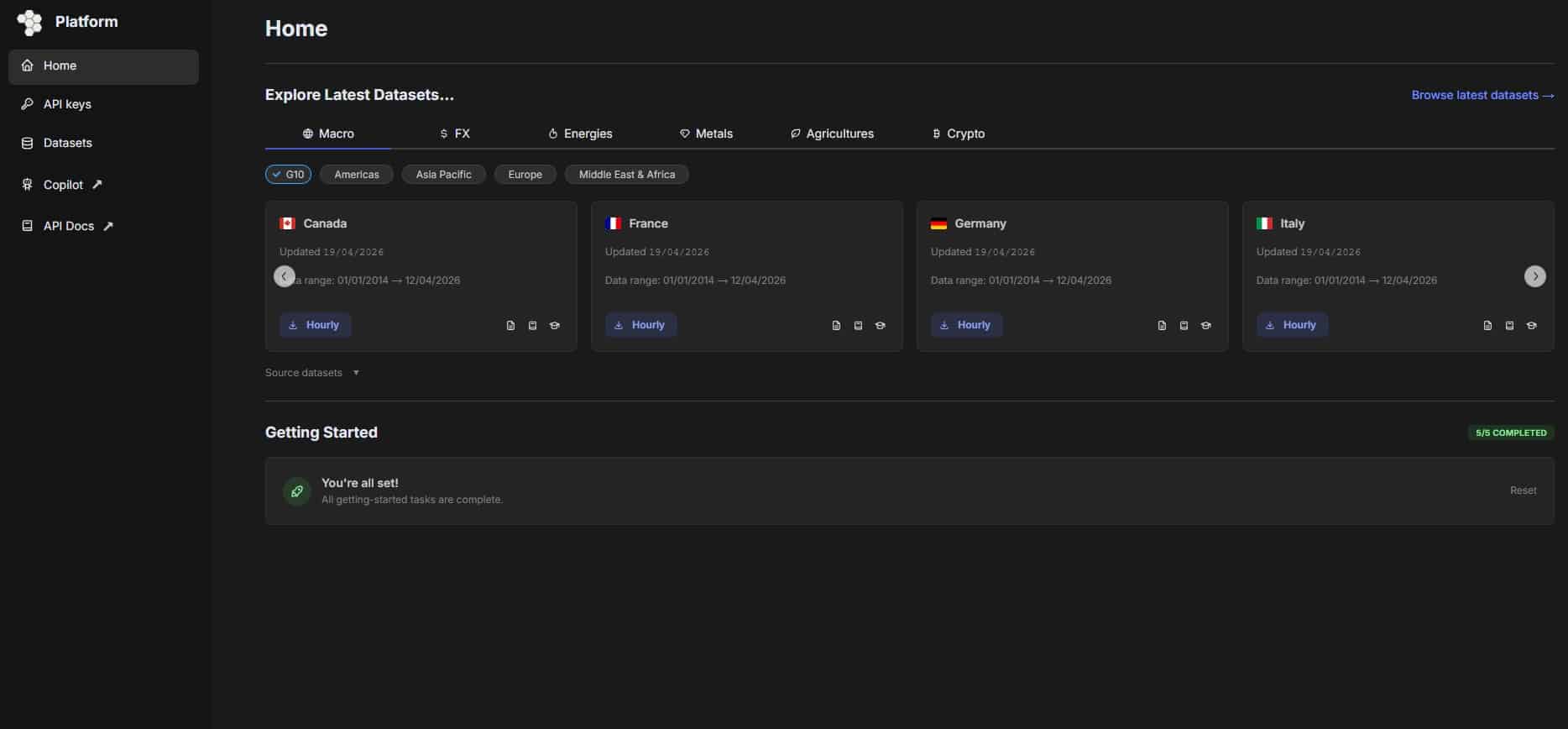
Users can access live and historical sentiment data across macro markets, commodities, FX and rates, integrating machine-readable signals directly into models, dashboards and research workflows. Datasets are versioned, lifecycle states are clearly defined and metadata is transparent, covering schema, coverage and methodology.
This infrastructure-first approach ensures that data is not only accessible, but immediately usable.
One of the key challenges in institutional environments is data discovery. Traditional workflows rely on fragmented documentation and manual processes. Permutable’s Developer Platform replaces this with a consumer-led model, where users can browse a structured catalogue of datasets and evaluate them before integration.
This is a core component of market intelligence infrastructure for financial institutions, enabling faster and more efficient onboarding and subsequently workflow.
Each dataset includes:
Out-of-the-box tutorials, supported by public repositories, allow users to move quickly from exploration to testing. This significantly reduces the time between identifying a dataset and deploying it within a workflow.
For systematic teams, this accelerates research. For discretionary desks, it improves transparency and understanding of signal construction.
Accessing data is often where operational friction emerges. Permutable’s Developer Platform addresses this by removing dependency on manual processes and introducing secure, automated retrieval. Short-lived access credentials improve security, while partitioned data structures ensure efficient ingestion into institutional pipelines.
This design reflects the requirements of market intelligence infrastructure for financial institutions, where both performance and governance are critical.
Partitioned datasets allow quantitative teams to ingest data directly into models with minimal preprocessing. At the same time, security controls align with institutional standards, ensuring that access is both controlled and scalable.
At the core of the platform is a flexible API layer.
Users can generate and manage their own API keys, creating and deleting access points as required. This removes operational dependencies and gives teams direct control over integration.
The API is designed with:
This consistency ensures that signals behave the same way across research and production environments, a key requirement for market intelligence infrastructure for financial institutions.
Even the most advanced platforms fail if they are difficult to use. Permutable’s Developer Platform is designed to reduce time to integration, a central objective of market intelligence infrastructure for financial institutions.
In-app tutorials guide users through workflows, while a structured onboarding checklist helps teams track progress and understand platform capabilities. The homepage surfaces key datasets, enabling quick access without navigating complex interfaces. Meanwhile, documentation is embedded alongside datasets, ensuring that users always have the context they need at the point of use.
This design reduces friction, allowing teams to focus on building models and strategies rather than navigating infrastructure.
The Developer Platform is part of a broader intelligence framework. Users can move seamlessly between API data access and documentation including suggested recipes creating a unified workflow where the same underlying signals support both systematic and discretionary use cases.
This is a defining feature of market intelligence for financial institutions. It ensures that data, signals and insights are aligned across teams, reducing fragmentation and improving consistency in decision-making. Within the platform, systematic teams can ingest structured signals directly into models while discretionary teams interpret those same signals within a broader market context.
At Permutable, we know that institutional adoption depends on performance as much as functionality. Our Developer Platform is built to meet industry-standard latency benchmarks, ensuring real-time data delivery. Infrastructure is designed for scalability, supporting growing user demand without degradation in performance.
Security is embedded at every layer, with controlled access, short-lived credentials and robust data handling practices. These elements are foundational to market intelligence infrastructure for financial institutions, ensuring that data can be deployed at scale without compromising reliability.
The introduction of our Developer Platform will change how institutional teams interact with our real-time market intelligence.
It reduces friction between discovery and deployment, allowing faster integration of new datasets. It improves transparency, ensuring that signals are understood and validated. And it creates a consistent framework for integrating narrative-driven intelligence into trading strategies.
In practice, this leads to:
The advantage lies not just in access to data, but in the ability to use it effectively within a structured framework.
Explore how structured sentiment data can be integrated into your trading and research workflows. Request access to the Permutable AI Developer Platform to review datasets, API capabilities and onboarding resources.
Q: What is market intelligence infrastructure for financial institutions?
A: It is a framework that enables institutional teams to access, structure and integrate real-time market data into trading and research workflows.
Q: How does Permutable AI’s Developer Platform support institutional traders?
A: It provides structured sentiment data, API access and integration tools that allow direct deployment of Permutable’s live and historical sentiment data across macro markets, commodities, FX and rates into models and workflows.
Q: Why is structured data important for institutional trading?
A: Because it enables consistent, testable and scalable integration into both systematic and discretionary strategies.
Q: How does the platform improve data integration?
A: Through versioned datasets, clear metadata, partitioned data structures and consistent API outputs.
Q: How is this different from traditional data platforms?
A: It combines discovery, access and integration into a single environment, reducing friction between research and production

Analysis
06 Oct 2026
Copper Sentiment Data for Institutional Commodities Desks: How Sentiment Flagged the 2026 Supply Squeeze Early
Read more >
30 Sep 2026
The Hawkish Turn: G10 Central Bank Policy Outlook into Q4 2026
Read more >
Guide
30 Sep 2026
The complete guide to early macro regime sentiment signals for hedge funds and institutional investors
Read more >