What a commodities sentiment data feed adds to institutional research and trading
21 May 2026
21 May 2026
This article explores how commodities sentiment data feeds help institutional trading desks transform unstructured market narratives into actionable intelligence. It examines where sentiment fits within modern research, trading and risk workflows, and what differentiates useful signals from noise. The piece is aimed at hedge funds, commodity traders, quant teams, portfolio managers and institutional firms evaluating sentiment-driven market intelligence solutions.
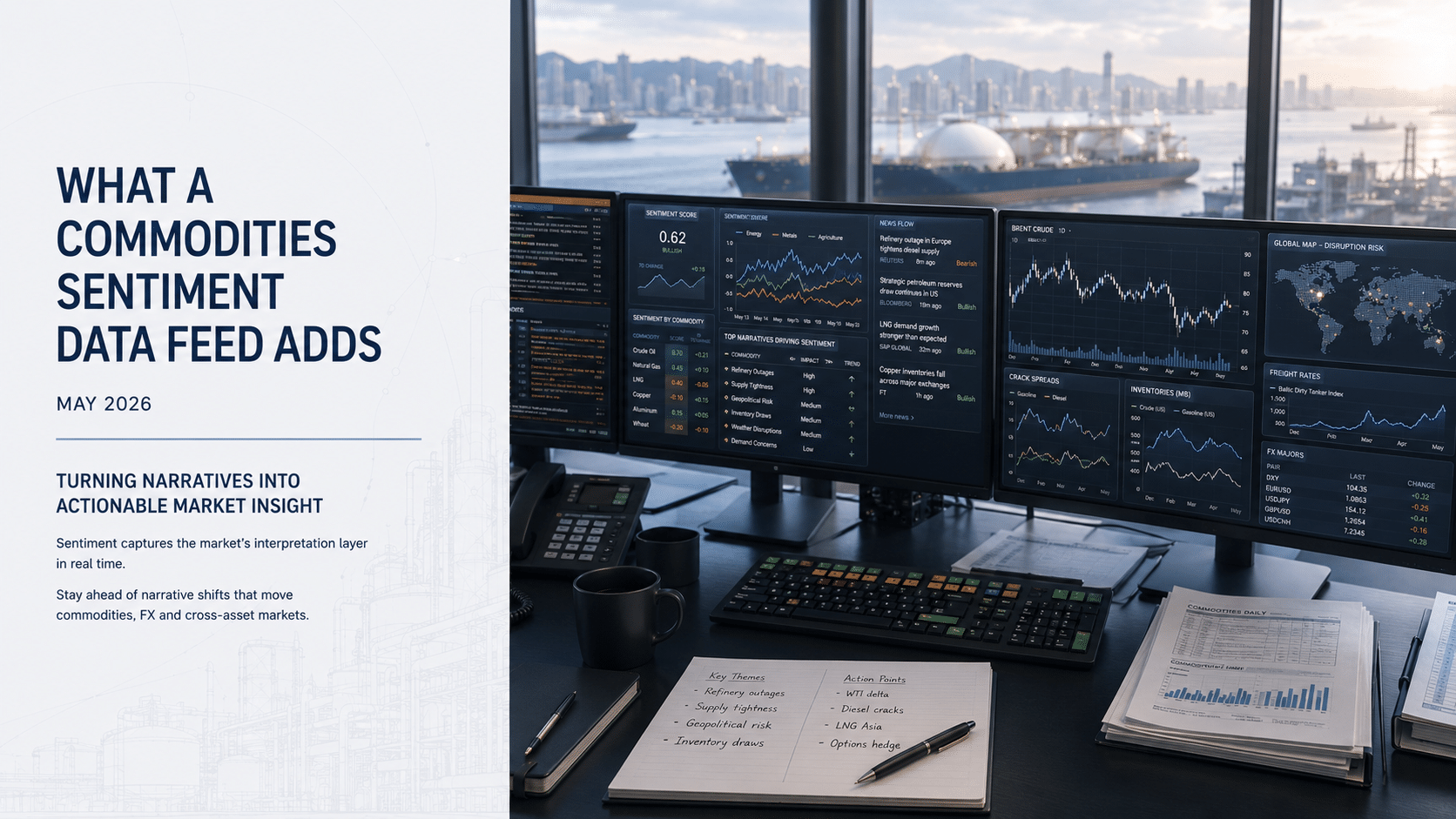
A refinery outage hits the wires, freight rates tighten, and suddenly energy and commodities markets begin repricing risk in real time. The challenge is not access to information. Institutional desks already operate in an environment saturated with headlines, broker commentary and market analysis. The real challenge is turning that constant stream of information into a structured commodities sentiment data feed that can be monitored, tested and incorporated into trading and risk workflows.
For both discretionary and systematic teams, sentiment is no longer viewed as a soft overlay. In commodities markets, it often sits between the event itself and the subsequent price response. Supply disruptions, policy announcements, weather developments, inventories, sanctions, labour actions and shipping constraints all emerge first as narratives before they become fully reflected in positioning and pricing. By the time traditional models absorb those developments, part of the move may already be underway.
Commodity markets are particularly sensitive to shifts in narrative because the transmission from news to price is rarely linear. The same geopolitical event can produce very different outcomes depending on inventory levels, spare capacity, positioning or regional demand dynamics. Copper may react to Chinese policy rhetoric long before economic data confirms the trend, while energy markets can reprice on logistics and infrastructure concerns ahead of any measurable supply disruption.
Commodity markets are unusually sensitive to changing narratives because the transmission mechanism from news to price is fast, uneven and highly path dependent. Oil reacts differently to the same geopolitical event depending on spare capacity, positioning and refinery economics. European petrol may move on storage concerns one month and on LNG shipping deviations the next. Copper can trade on Chinese demand rhetoric long before hard activity data confirms anything.
That is where a structured feed matters. A commodities sentiment data feed standardises unstructured information into machine-consumable fields such as topic, entity, directional bias, intensity, relevance and time decay. Instead of asking an analyst to read everything and interpret tone manually, the feed produces a persistent view of how market narrative is evolving across contracts, regions and sub-sectors.
The value is not that sentiment replaces fundamentals. It does not. The value is that it captures the market’s interpretation layer in real time. In many cases, that layer is what drives short-horizon repricing, volatility clustering and cross-asset spillover.
Not all sentiment products are useful for trading. A generic feed that labels articles positive or negative at headline level is rarely enough for commodity markets. Institutional users need granularity and context.
First, the feed should map narrative to the right commodity exposure. A bullish signal on LNG demand in North Asia is not simply a petrol signal. It may have implications for European TTF, US Henry Hub export optionality, freight and regional power pricing. Entity resolution and taxonomy design matter because commodity price formation is rarely isolated.
Second, timestamp quality is critical. If the feed is intended for execution-relevant research, latency must be measured tightly and event capture must be consistent across sources. A delayed sentiment score may still be useful for monitoring or end-of-day research, but it is less valuable for intraday decision-making.
Third, explainability matters more than marketing language. A desk needs to understand why sentiment shifted, which entities drove the change, and whether the move came from primary reporting, official statements or secondary commentary. Black-box outputs create operational friction, especially when PMs and risk teams need to defend positions.
A common mistake is to treat sentiment as a standalone signal. In practice, it works best as part of a broader market intelligence framework.
For discretionary portfolio managers, the feed can act as an early warning layer. If news intensity and sentiment skew turn sharply negative on a producing region before implied volatility reprices, that may justify deeper review of options hedges, basis exposure or nearby contract risk. The feed is useful not because it makes the final call, but because it tells the desk where to look first.
For systematic teams, the question is different. They want to know whether sentiment has independent predictive power once you control for price momentum, carry, inventory data and macro variables. Sometimes it does. Sometimes it is strongest as a regime filter rather than a directional signal. For example, sentiment deterioration in energy may improve the performance of existing trend signals during supply shock regimes, while adding little in quieter periods.
This is why feed design should support both exploratory research and production deployment. Clean history, stable schemas, revision handling and consistent scoring methodology are not minor details. They determine whether a quant team can trust the output enough to backtest and deploy it.
Commodity news flow is noisy by nature. The market reacts to rumours, official guidance, vessel movements, weather revisions and political rhetoric, often in overlapping ways. A useful commodities sentiment data feed needs to discriminate between narrative volume and narrative importance.
High article count does not always mean high signal value. A widely discussed theme may be fully priced. Conversely, a small number of high-quality reports tied to a critical infrastructure asset or policy action may have far greater market impact. This is where weighting becomes important. Source quality, entity relevance, novelty, geographic proximity and historical market sensitivity should all affect scoring.
There is also a horizon problem. Some narratives move front-month contracts immediately but have limited relevance further down the curve. Others matter more for medium-term expectations than for prompt pricing. A feed that collapses all sentiment into one aggregate number can miss this distinction. Better implementations preserve enough structure to support horizon-specific modelling.
On a macro or commodity desk, sentiment data is rarely consumed in one way. The same feed may support several workflows.
Research teams use it to identify which themes preceded large moves in oil, metals or agriculture, and whether those themes persisted long enough to be tradeable. Traders use it to monitor live narrative shifts around supply, policy, demand and logistics. Risk managers use it to track concentration in event-sensitive exposures and to challenge assumptions when headline flow changes direction quickly.
Cross-asset teams can extract additional value because commodity sentiment often transmits into FX, rates and equities. Energy sentiment can matter for petro-currencies, inflation pricing and utility names. Metals sentiment can feed into industrial cyclicals and China-linked FX. The point is not to force a simplistic causal chain. It is to capture how narrative pressure migrates across the book.
This is one reason institutional desks increasingly prefer structured feeds over manual monitoring alone. Human judgement remains essential, but scale and speed favour systems that can read broadly, classify consistently and surface anomalies in real time.
A feed is only as useful as its fit within the desk’s workflow. If it arrives as an opaque dashboard with limited export options, adoption usually stalls. Institutional users need delivery that works inside research pipelines, model environments and trader tooling.
That usually means, stable field definitions, historical depth and clear documentation on methodology changes. It also means the ability to join sentiment with price series, volatility, position proxies and proprietary datasets without excessive engineering overhead.
There is a trade-off here. Highly customised sentiment models may fit one desk’s exact use case better, but they can become harder to maintain across teams and asset classes. Standardised feeds are easier to operationalise, though sometimes less tailored. The right answer depends on whether the priority is speed to deployment or bespoke alpha research.
For firms building production-grade workflows, enterprise standards are vital. Data lineage, monitoring, schema stability and support for auditability are not back-office concerns. They affect whether a signal can move from research notebook to trading environment with confidence.
The sensible evaluation question is not whether a feed sounds sophisticated, it is whether it improves decision quality in measurable ways.
A strong provider should be able to show broad commodity coverage, clear methodology, low-latency delivery and enough transparency for the desk to understand what is driving the scores. It should support event-level interpretation rather than forcing users to rely on a single aggregate number. It should also reflect the reality that commodities trade in a cross-asset world, where narrative spillover often matters as much as the original trigger.
Here at Permutable, we approach this problem as market infrastructure rather than generic text analytics. Ultimately, institutional users need sentiment data that is research-ready, explainable and relevant to execution, not just an abstract NLP output.
Everyone knows that the market is not short of information. But what it is short of is clean prioritisation. Here, a well-constructed sentiment feed helps desks distinguish between loud stories and price-relevant change, which is often where the real edge begins.
The practical test is simple: if narrative conditions shift materially, your desk should know fast, understand why, and be able to act before the broader market fully reprices.
If you are evaluating how sentiment intelligence can strengthen your commodities research, trading or risk workflows, at Permutable we provide structured, real-time market narrative data designed for institutional use.
Explore how our commodities sentiment data feeds help desks move from information overload to actionable insight by requesting a walkthrough.