Turn global reporting into structured precious metals intelligence – with live and historical indices, driver signals, events and source-level evidence across gold, silver, platinum and palladium.
Built for systematic research, market monitoring, cross-asset analysis and institutional workflows.
| European asset manager | “Permutable gave us more confidence to stay in the silver trade. The price action was noisy, but the underlying signals still pointed to support from investment demand and macro policy.” |
| What is measured? | What explains the move? | How is it used? |
| Metal and driver-level indices | Inflation, real yields, central bank policy, FX, safe-haven demand, investment flows, industrial demand, mining supply and geopolitics | Research, monitoring, systematic models and risk workflows |
| Direction and magnitude | Source-linked events and story development | Historical replay, alerts, API, Excel and data feeds |
| Gold, silver, platinum and palladium | Narrative persistence, cross-metal divergence and cross-market transmission | Portfolio analysis, scenario testing and custom configurations |
Precious metals can respond to different combinations of macro policy, currency pressure, investment flows, physical demand and supply risk. Permutable separates these drivers so users can see which narratives are strengthening, weakening or becoming persistent enough to influence price.
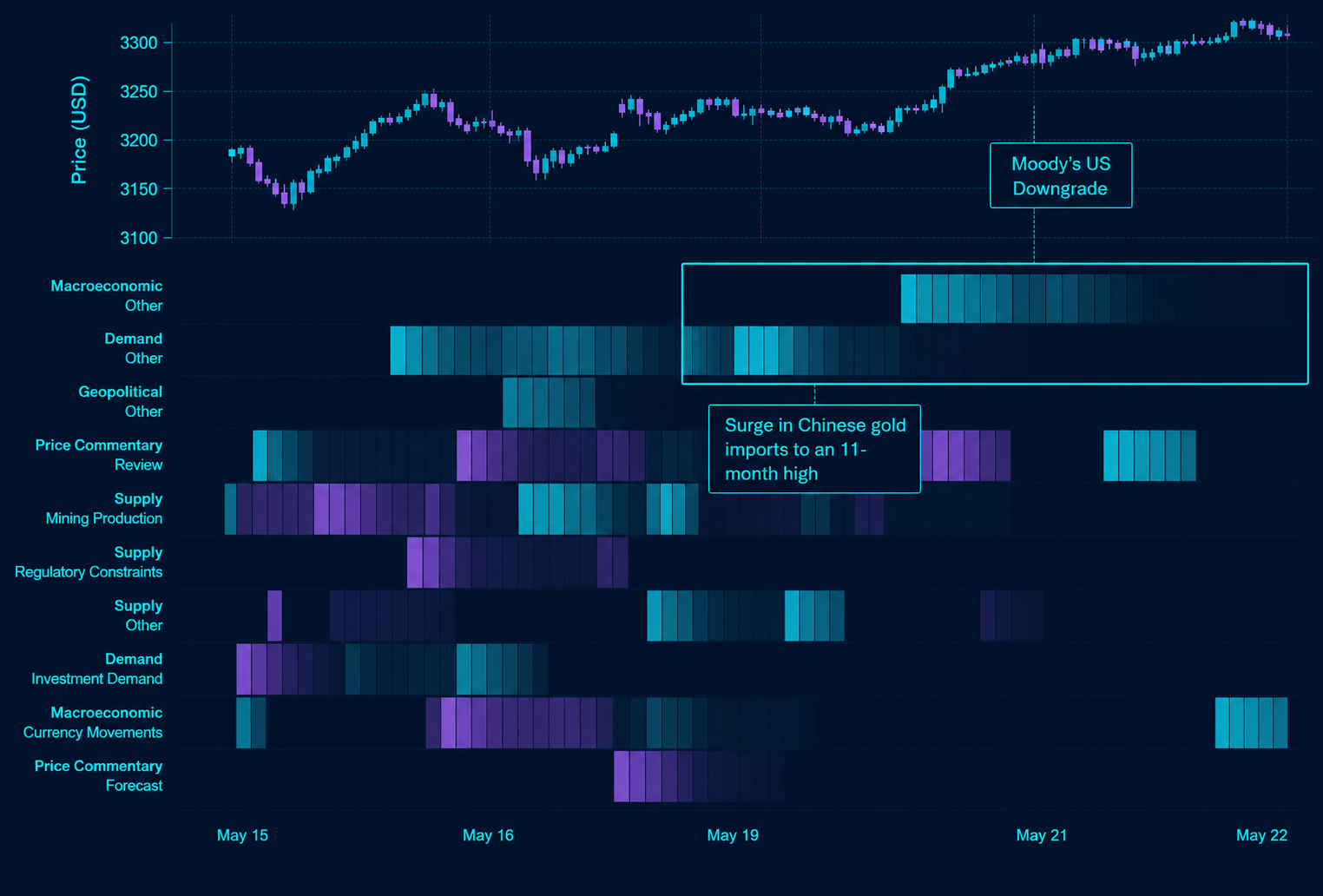
Permutable overlays gold prices with macroeconomic, investment-demand, mining, regulatory, geopolitical and market-commentary signals. This helps show whether a move is being driven by one isolated catalyst or a broader change in the balance between policy risk, currency pressure and defensive demand.
Signals shown: Macroeconomic conditions, investment demand, mining production, regulatory constraints, geopolitical developments and price commentary
Events shown: Moody’s US downgrade and increased Chinese gold imports
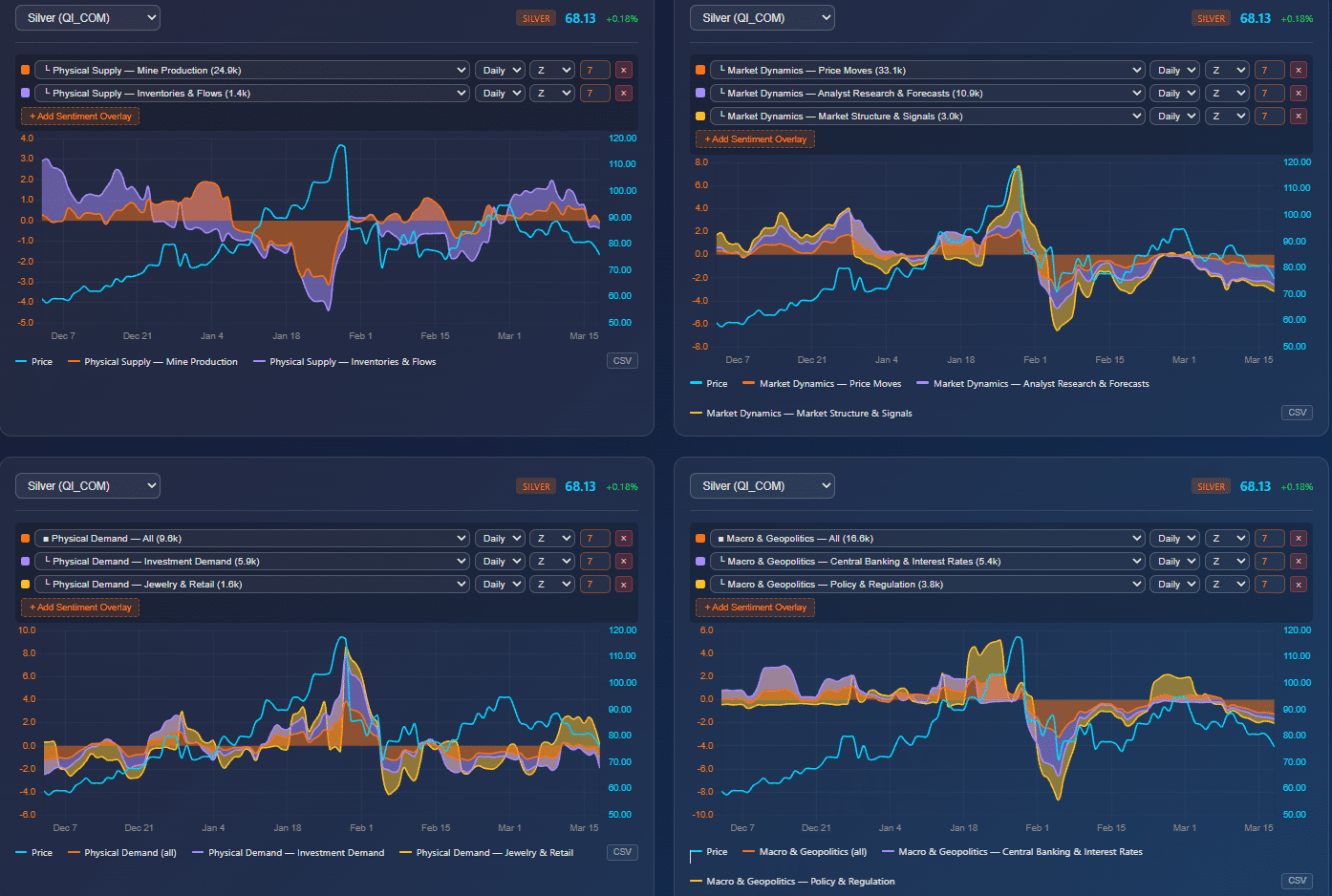
Permutable’s silver view compares price with physical supply, physical demand, market dynamics and macro-geopolitical signals. It shows how the composition of the move changes as industrial, investment and broader market forces gain or lose influence.
Signals shown: Physical supply, physical demand, market dynamics and macro-geopolitical pressure
| Conventional workflow | With Permutable |
| Precious metals headlines disconnected from individual metals and drivers | Metal, driver and event-level signals |
| One generic gold or metals sentiment score | Separate policy, FX, safe-haven, investment, industrial-demand, supply and geopolitical series |
| No clear evidence behind a signal movement | Source-linked events, headlines and timestamps |
| Difficult to compare drivers across gold, silver and PGMs | Consistent cross-metal signal structures |
| Historical analysis vulnerable to hindsight | Strict point-in-time construction |
| Manual monitoring across multiple sources | API, Excel, files and institutional feeds |
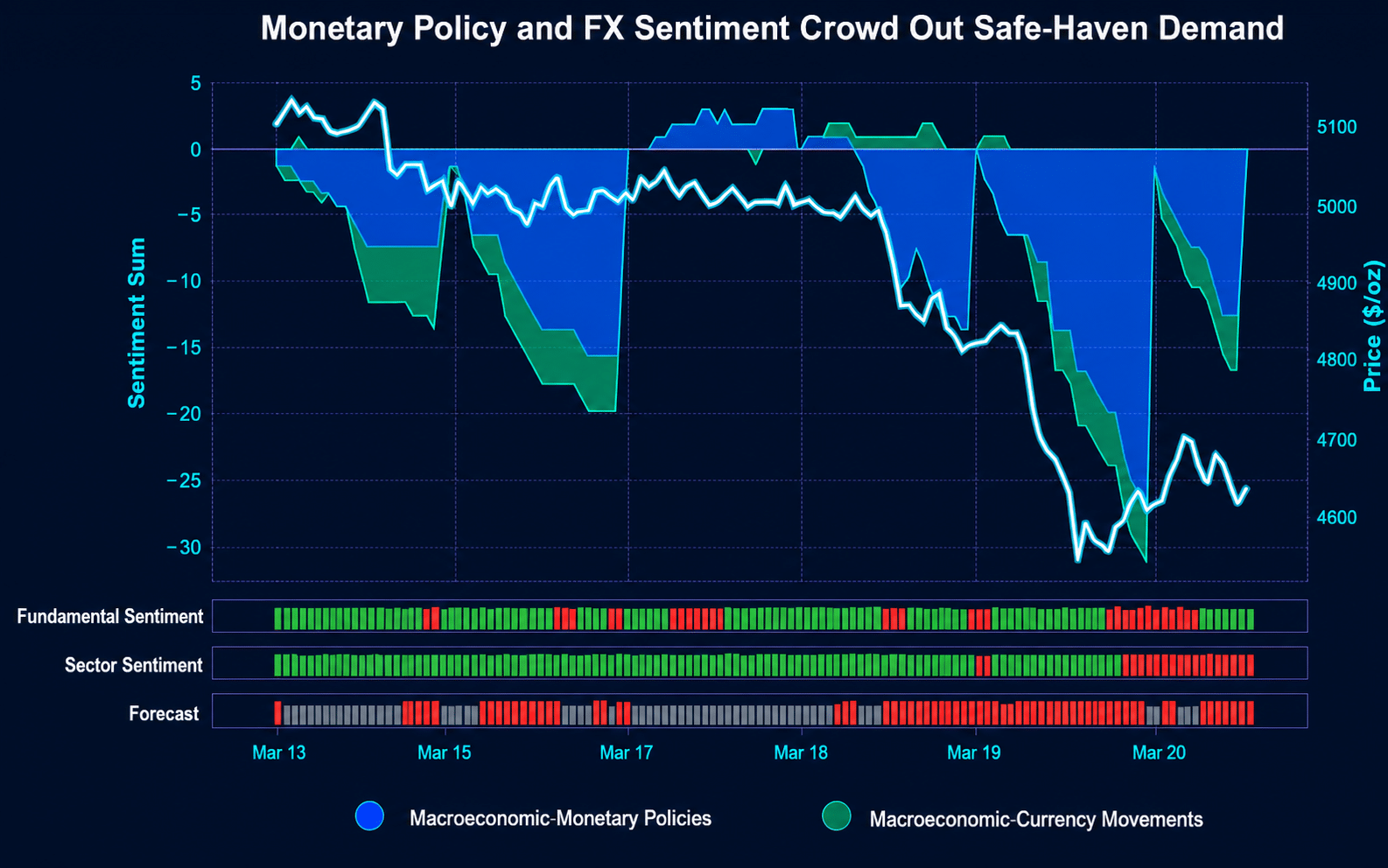
Historical observations reflect only the information available at their original timestamps, allowing the same signal structure to be examined historically and monitored in production.
Permutable’s precious metals dataset includes historical and live metal-level indices, driver signals, event records and source-linked observations across gold, silver, platinum and palladium. Outputs can be organised by metal, market driver, geography, event type and direction of pressure, allowing users to move from an aggregate signal to the developments contributing to it.
Coverage includes gold, silver, platinum and palladium. Signals can be configured at individual-metal level or compared across precious metals to identify divergence in macro sensitivity, investment demand, industrial demand, supply conditions and geopolitical exposure.
Traditional metals research and commodity datasets often explain market moves after repricing has already begun. Permutable structures precious metals narrative, inflation expectations, central bank language, geopolitical developments, industrial demand and safe-haven sentiment into real-time intelligence designed to identify emerging market drivers earlier.
Signals can be structured around inflation expectations, real yields, central bank policy, currency movements, safe-haven demand, investment flows, industrial demand, mining production, refining, logistics, regulation and geopolitical developments. These drivers can be monitored separately or combined to show how the balance of pressure is changing across each metal.
Permutable provides more than 11 years of historical point-in-time intelligence for core precious metals series. Exact availability may vary by metal, driver and configuration, and can be confirmed during the data-evaluation process.
Yes. Historical observations are constructed using only the information available at their original timestamps. Events, source records and signal values are preserved without incorporating information published later, helping users evaluate historical behaviour without hindsight or look-ahead bias.
Standard precious metals indices are updated hourly. Event and source records are processed throughout the day, while delivery cadence can be configured around research, monitoring, alerting and production requirements.
Yes. Users can access the source-linked events, headlines, entities, countries, market drivers and timestamps contributing to a signal. This allows teams to investigate why an indicator changed, distinguish isolated developments from persistent narratives and trace the evidence behind each historical or live observation.
Precious metals intelligence can be delivered through API, Excel, structured files and institutional data feeds. Historical and live outputs use a consistent schema, helping teams move from research and validation into monitoring or production without rebuilding the underlying data structure.
Yes. Institutions can request a defined event-window sample containing metal and driver-level signals, source-linked events and example records. Samples can be structured around gold, silver, platinum, palladium or a specific market question involving policy, currencies, investment demand, industrial demand, supply or geopolitics.