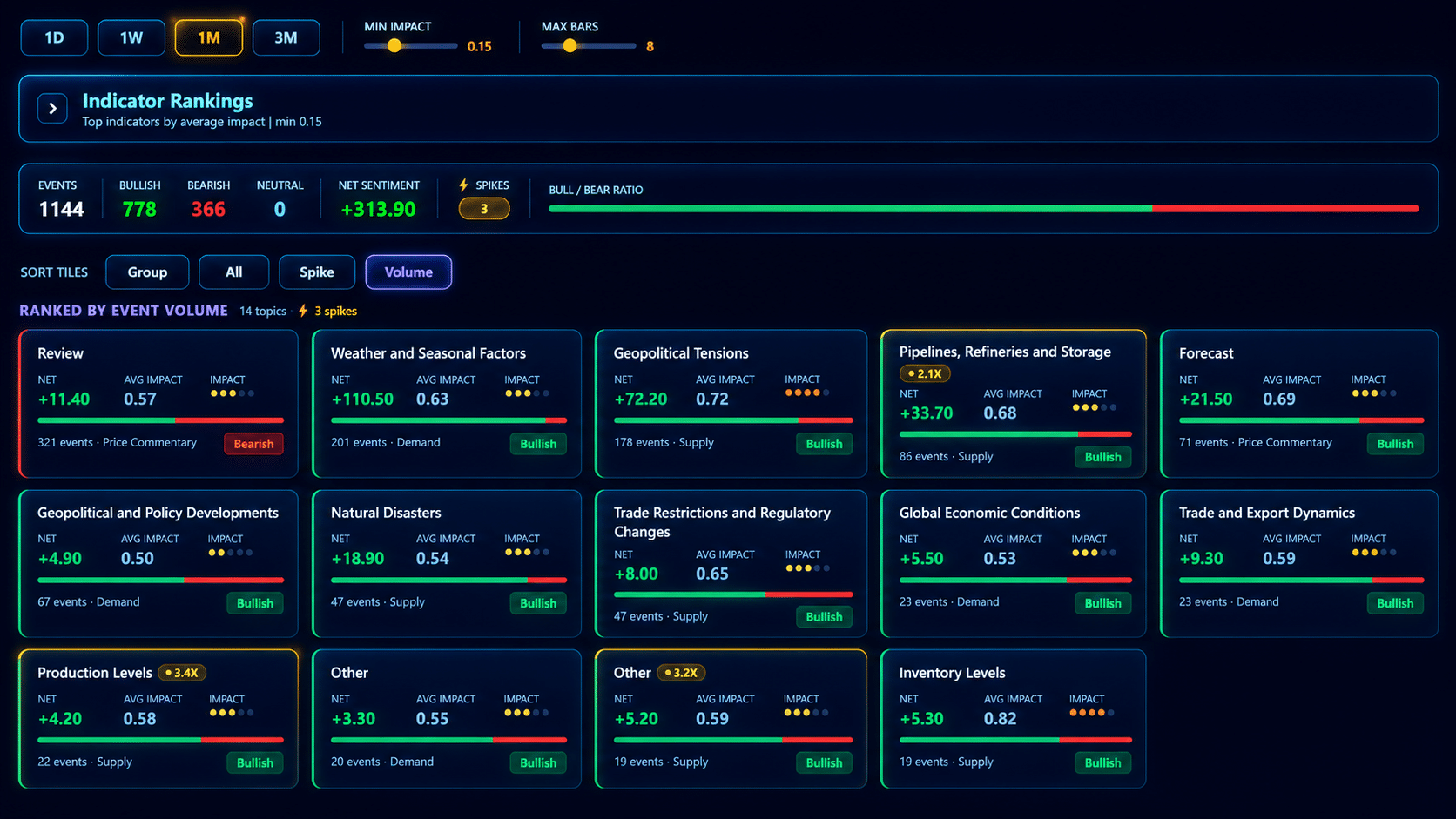
Natural gas markets increasingly move before traditional datasets catch up.
Permutable transforms LNG developments, storage expectations, weather risk and geopolitical narrative into explainable gas intelligence, helping institutional teams anticipate Henry Hub, TTF and LNG repricing before consensus forms.
| What is measured? | What explains the move? | How is it used? |
| Benchmark and regional indices | LNG flows, storage, weather, production, pipelines, terminals, shipping and geopolitical drivers | Research, monitoring, systematic models and risk workflows |
| Direction and magnitude | Source-linked events and story development | Historical replay, alerts, API, Excel and data feeds |
| Henry Hub, TTF and LNG markets | Narrative persistence, divergence and cross-market transmission | Scenario analysis, regional comparison and custom configurations |
| Conventional workflow | With Permutable |
| Gas headlines disconnected from individual benchmarks and regions | Benchmark, regional and driver-level signals |
| One generic natural gas sentiment score | Separate LNG, storage, weather, production, infrastructure and geopolitical series |
| No clear evidence behind a signal movement | Source-linked events, headlines and timestamps |
| Historical analysis vulnerable to hindsight | Strict point-in-time construction |
| Different structures for historical research and live monitoring | Consistent historical and production schema |
| Manual monitoring across multiple sources | API, Excel, files and institutional feeds |
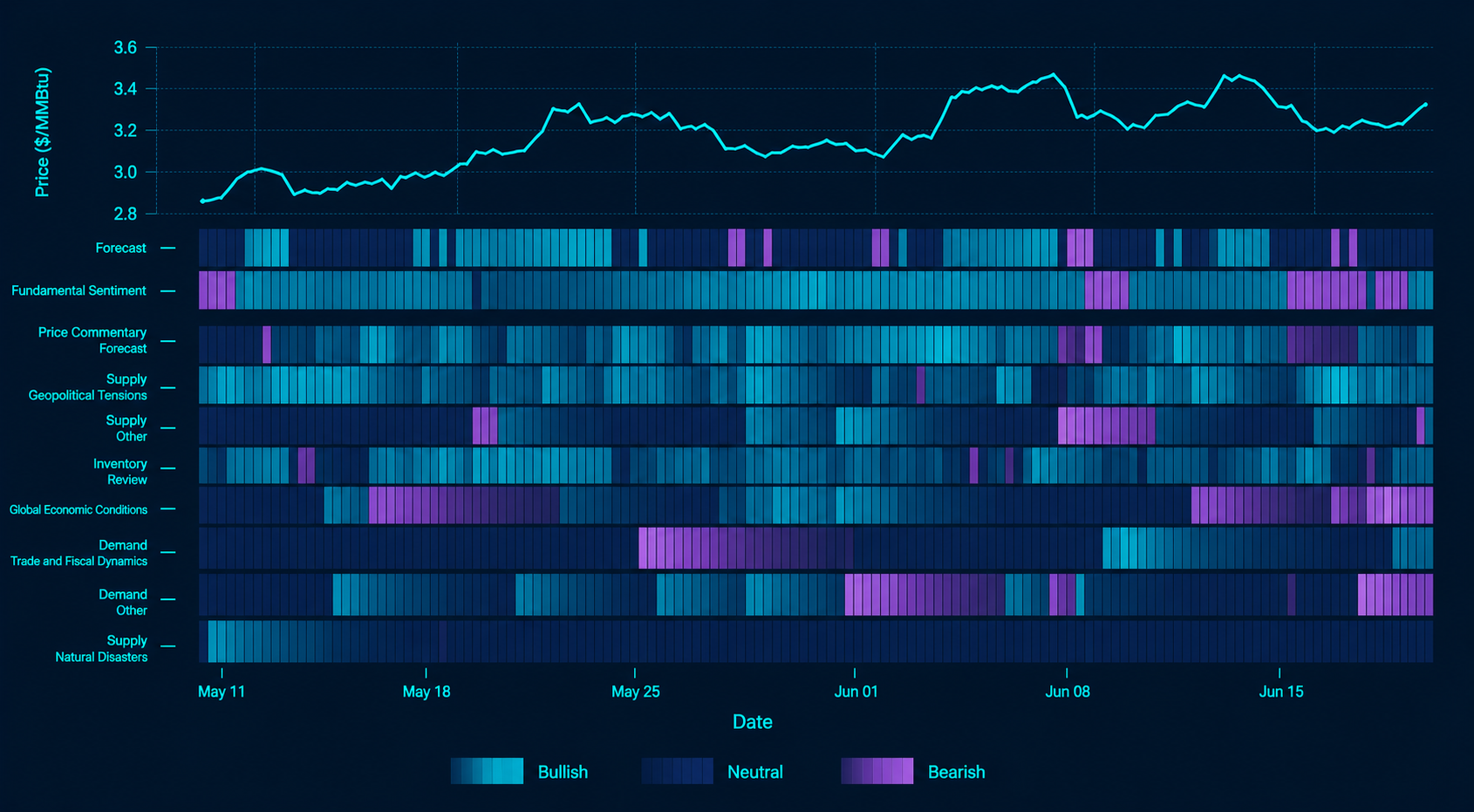
Historical observations should reflect only the information available at their original timestamps, allowing the same signal structure to be examined historically and monitored in production.
Permutable’s natural gas dataset includes historical and live benchmark indices, regional indicators, driver-level signals, event records and source-linked observations. The data can be organised by market, geography, facility, topic and direction of pressure, allowing users to examine both the aggregate signal and the underlying developments contributing to it.
Coverage includes Henry Hub, TTF and LNG-linked markets, alongside intelligence relating to US production, European storage, global LNG supply, pipelines, export terminals, shipping, weather and regional infrastructure. Permutable can also configure coverage around specific benchmarks, facilities, countries, routes or market drivers.
Signals can be structured around LNG flows, storage levels, weather conditions, production, pipeline availability, terminal disruption, shipping, sanctions, geopolitical risk, energy policy and regional supply-demand conditions. These drivers can be monitored separately or combined to show how the balance of market pressure is changing.
Permutable provides more than 11 years of historical point-in-time intelligence, with exact availability depending on the benchmark, driver and configuration selected. Historical series are designed to support research, event studies, model development and comparison with live production signals.
Yes. Each historical observation is constructed using only the information available at its original timestamp. Events, sources and signal values are preserved without incorporating information published later, helping users evaluate historical behaviour without hindsight or look-ahead bias.
Standard natural gas indices are updated hourly. Event and source records are processed throughout the day, while delivery frequency can be configured around the requirements of research, monitoring, alerting or production workflows.
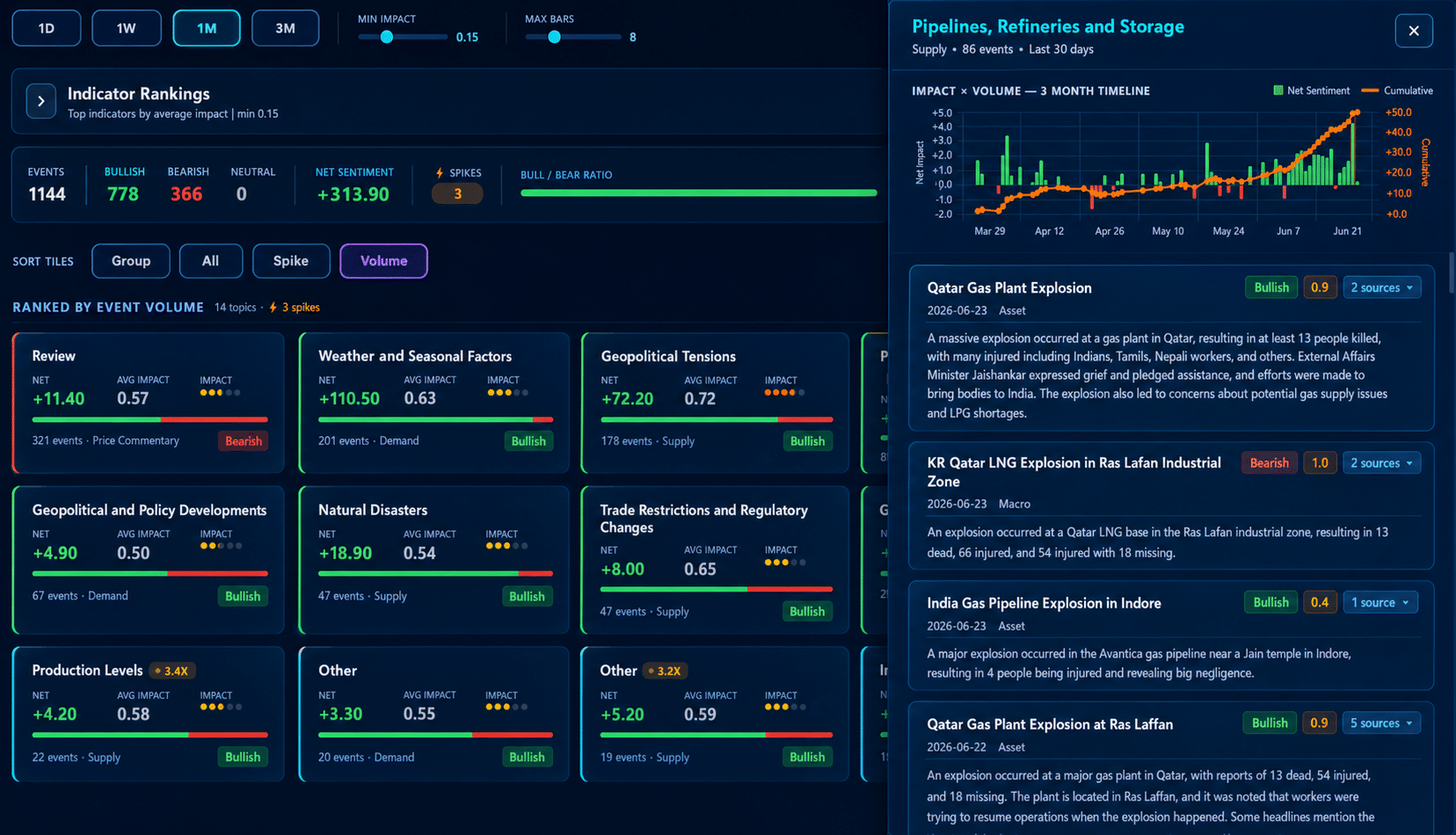
Yes. Users can access the source-linked events, headlines, entities, facilities, topics and timestamps contributing to a signal. This makes it possible to investigate why an indicator changed, distinguish isolated reports from persistent narratives and trace the evidence behind a historical or live observation.
Natural gas intelligence can be delivered through API, Excel, structured files and institutional data feeds. Historical and live outputs use a consistent schema, helping teams move from research and validation into monitoring or production without rebuilding the underlying data structure.
Yes. Institutions can request a sample containing benchmark and driver-level signals, source-linked events and example records from a defined natural gas market window. Samples can be tailored around Henry Hub, TTF, LNG, infrastructure disruption, storage, weather or another relevant market question.