
Unlocking market insight: Key use cases of our sentiment analysis API
12 Sep 2025
12 Sep 2025
This article is aimed at systematic traders, energy and commodity traders, investment banks and asset managers seeking to understand how Permutable AI’s sentiment analysis API can be applied to trading strategies, research, and risk management.
In today’s markets, the ability to move faster than competitors rests not only on data access but on knowing which signals matter most. While traditional datasets such as prices, volumes and economic releases remain essential, they are fundamentally backward-looking. They tell you what has already happened. At Permutable, we have seen time and again that market inflection points are driven not just by fundamentals, but by narratives – the stories circulating across news, reports, and policy debates. Capturing and quantifying those narratives in real time is where our sentiment analysis API provides a genuine edge.
Having worked alongside trading teams, banks and asset managers, we understand the challenge: markets move on expectations, not history. Our sentiment analysis API translates global news and discourse into measurable, explainable indicators that can be integrated directly into workflows, strategies, and models.
Markets are forward-looking machines. A weak US jobs print does not simply show labour market deterioration; it raises questions about Federal Reserve policy, interest rates, and global flows into or out of risk assets. Similarly, a drone strike on an export hub is not just an isolated event; it ripples through oil futures, freight costs, insurance pricing, and cross-commodity hedges.
The challenge is separating noise from signal. This is precisely what our sentiment analysis API is designed to achieve. It processes vast volumes of global news and classifies sentiment around macroeconomic, political and market topics, creating indices that update in near real time.
For systematic and quantitative traders, sentiment data is often viewed as unstructured and hard to model. Our experience shows otherwise. By providing sentiment indices in a structured, backtestable format, our API enables quants to:
Incorporate sentiment as an alpha factor within existing strategies.
Detect regime shifts in real time, such as a change in the market’s response to central bank language.
Apply sentiment as a volatility filter, adjusting leverage or position sizing when signals point to heightened uncertainty.
Backtest against historical data, demonstrating how narrative intensity has impacted past market movements.
In practice, our sentiment analysis API can be used to anticipate moves around central bank meetings, sanctions announcements, and major data releases – events where sentiment, not just numbers, dictates positioning.

Commodity and energy markets are uniquely sensitive to geopolitical and environmental narratives. Our sentiment analysis API has proved valuable to commodity desks by flagging:
Geopolitical shocks, such as sanctions or supply chain disruptions, often before they are fully priced.
Weather narratives, including La Niña and hurricane season, where early warnings influence natural gas and LNG positioning.
Supply-demand talk, as coverage of inventories, refinery outages or OPEC+ policy drives rapid swings in futures curves.
Cross-commodity spillovers, where sentiment in one market (e.g. oil) cascades into others (e.g. shipping or refined products).
For energy clients, this means positioning ahead of sharp moves when, for instance, narrative intensity spikes around Russian supply disruptions or when weather-driven demand risk rises suddenly.

Banks must provide differentiated research and advisory to their clients. Here, our sentiment analysis API supports this in several ways:
Macro research: overlay sentiment indices on GDP, inflation or policy themes to provide a forward-looking perspective.
Event detection: pick up signals around elections, sanctions debates or geopolitical disputes ahead of official releases.
Client briefings: enrich morning notes and strategy reports with explainable sentiment indicators.
Transaction support: integrate sentiment into financing, hedging or deal analysis where policy or geopolitical risk is relevant.
In practice, research teams can use our API to strengthen house views by demonstrating how narrative sentiment is diverging from data, providing clients with actionable perspective on risks and opportunities.
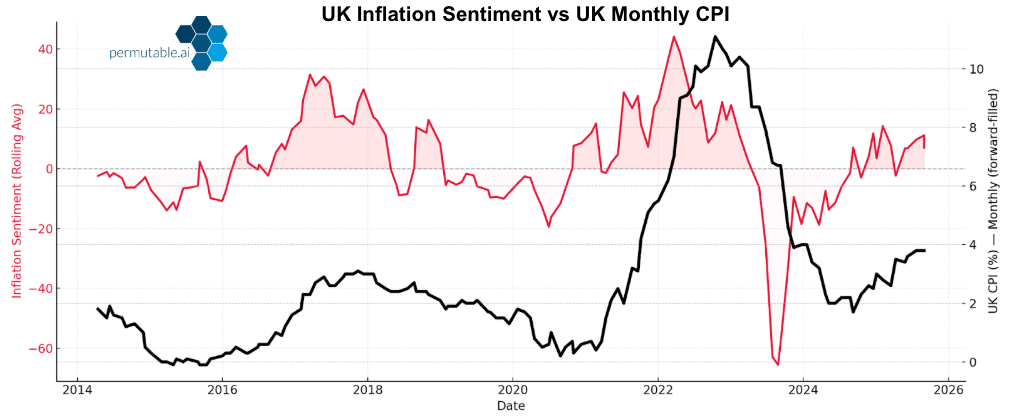
For asset managers, portfolio resilience depends on identifying divergences before they become costly. Our sentiment analysis API supports:
Risk monitoring, spotting when rallies are fuelled by sentiment rather than fundamentals – a hallmark of bubble risk.
Portfolio overlays, adding sentiment as a non-price factor to diversify exposures.
Hedging strategies, where sentiment alerts around policy or geopolitical risk guide protective positioning.
Global macro allocation, quantifying narrative momentum across currencies, commodities, and equities.
In our experience, this will be particularly valuable when providing the ability to detect when optimism is fading before prices turn, enabling them to rebalance portfolios with greater precision.
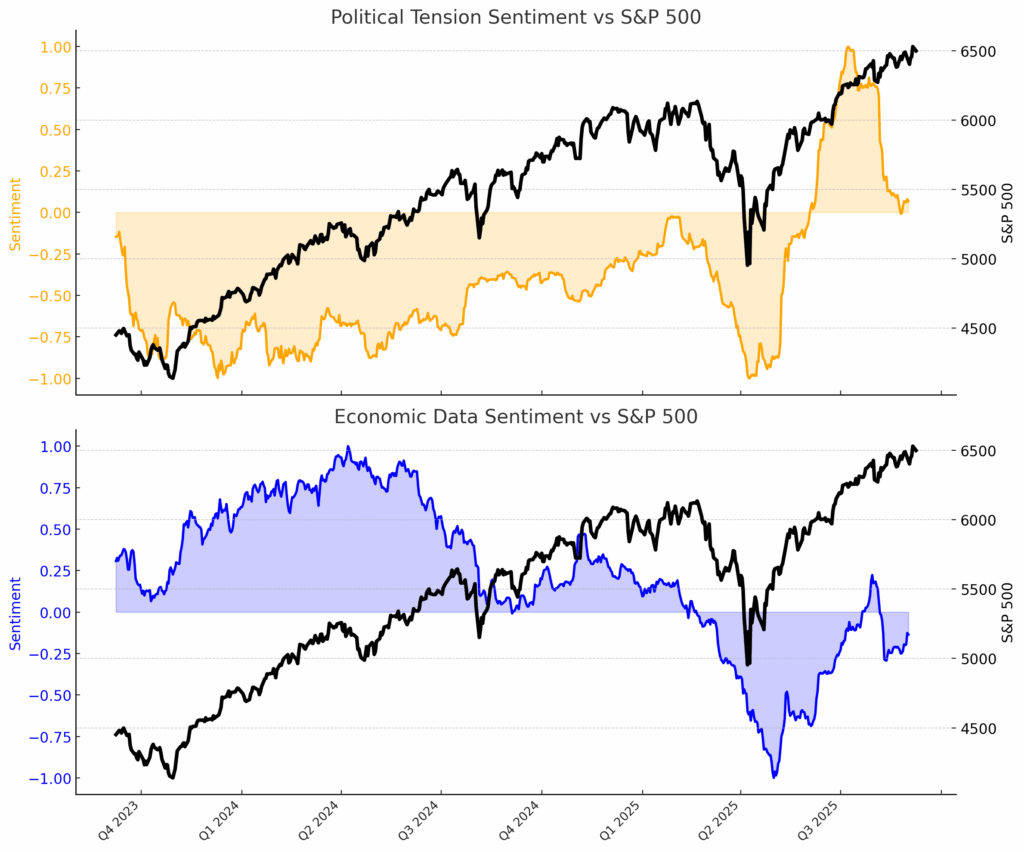
The strength of our sentiment analysis API lies in three things:
Explainability – each signal is traceable to underlying narrative clusters, ensuring clarity for compliance and risk oversight.
Speed – updates occur in near real time, enabling faster decision-making.
Integration – our sentiment API is designed for enterprise-grade workflows, making it easy to plug into trading systems, analytics platforms, or research dashboards.
This combination of transparency, timeliness and usability makes our API more than just a data feed – it is a strategic tool.
| Audience | Use Case | Value Delivered |
|---|---|---|
| Systematic Traders | Signal generation (sentiment as alpha factor) | Unlock new tradeable signals beyond price & volume data |
| Regime detection | Identify when market responses to events (e.g. Fed policy) shift behaviour | |
| Risk filters | Adjust leverage/position sizing during sentiment-driven volatility spikes | |
| Backtesting with historical sentiment | Validate strategies with explainable, narrative-driven datasets | |
| Energy & Commodity Traders | Geopolitical shock detection | Anticipate sanctions, supply disruptions & OPEC+ headlines before pricing shifts |
| Weather/climate sentiment | Flag early La Niña/El Niño or hurricane risks driving gas & LNG | |
| Supply-demand narrative monitoring | Spot changes in inventory, refinery, or output narratives ahead of official data | |
| Cross-commodity sentiment | Track spillovers (e.g. oil sentiment impacting refined products or shipping) | |
| Investment Banks | Macro research enrichment | Strengthen research with forward-looking sentiment overlays on GDP, inflation & policy |
| Event detection | Detect elections, sanctions & geopolitical shifts in near real time | |
| Client advisory | Enhance strategy notes with explainable, sentiment-driven insights | |
| Deal & financing support | Use sentiment as a layer in M&A, commodity financing & treasury risk assessments | |
| Asset Managers | Risk monitoring | Flag divergences between sentiment-driven rallies & weak fundamentals |
| Portfolio construction | Add sentiment as a non-price factor for diversification & alpha | |
| Hedging strategies | Position defensively around political or macro shocks flagged by sentiment | |
| Global macro allocation | Track narrative-driven momentum across currencies, equities, and commodities |
Ultimately, the reason our clients integrate our sentiment analysis API is simple: markets move on expectations, not history. By quantifying narratives and sentiment, institutions can:
Position ahead of market-moving events.
Anticipate volatility before it shows up in the data.
Capture opportunities when sentiment alignment drives momentum.
In a world where information overload is the norm, being able to distinguish true signal from noise is what separates reactive trading from proactive strategy. At Permutable, we are proud to provide the tools that allow systematic traders, commodity desks, investment banks and asset managers to navigate complexity with precision and confidence.
To explore our how sentiment analysis API can support your strategy contact us at enquiries@permutabe.ai.
The Sentiment Analysis API is a real-time intelligence tool that quantifies global news and narratives across macroeconomics, geopolitics, energy, commodities and markets. It provides structured, explainable sentiment indices that can be integrated into trading systems, research workflows and risk models.
It processes vast volumes of global news and discourse using AI-driven natural language processing. The output is a set of topic-specific sentiment indices (e.g. inflation, energy supply, sanctions, policy rates) that update in near real time, giving users forward-looking insights.
It is built for institutional clients – including systematic traders, commodity and energy traders, investment banks, and asset managers – who need to anticipate market shifts rather than react to lagging data.
Unlike generic sentiment feeds, our API is explainable (traceable back to source narratives), fast (near real-time updates), and enterprise-ready (API-first integration for research, trading, and risk systems).
Yes. Historical datasets are available for strategy validation, performance testing, and research, allowing traders and analysts to understand how narratives shaped past market moves.
The API covers global macroeconomics, commodities, energy, geopolitics, monetary policy, and financial markets — providing indices tailored to the needs of traders, banks, and asset managers.
By capturing market narratives ahead of price and volume data, sentiment analysis highlights when shifts in expectations are likely to drive momentum, enabling traders to position earlier and manage risk more effectively.
The Sentiment Analysis API is available via enterprise-grade integration. To request a demo or access documentation, contact: enquiries@permutable.ai.
A sentiment analysis API in trading transforms unstructured market news and narratives into structured signals, helping traders anticipate price moves by measuring shifts in sentiment.
Systematic traders can integrate sentiment indices into models as alpha factors, volatility filters, or regime-detection tools, improving strategy precision and risk control.
Energy and commodity prices are highly sensitive to narratives around supply, demand, geopolitics and weather. Sentiment analysis detects these narratives in real time, giving traders an early signal before fundamentals shift.
Yes. Sentiment analysis strengthens macro research, supports client advisory, and provides early-warning signals around elections, sanctions, or policy changes that influence markets.
Asset managers can use sentiment data for portfolio construction, risk monitoring, and hedging strategies, particularly to identify divergences between narrative-driven rallies and weakening fundamentals.
Absolutely. Historical sentiment datasets allow backtesting, validation, and research — showing how past narratives shaped price action and improving confidence in new models.

Analysis
06 Oct 2026
Copper Sentiment Data for Institutional Commodities Desks: How Sentiment Flagged the 2026 Supply Squeeze Early
Read more >
30 Sep 2026
The Hawkish Turn: G10 Central Bank Policy Outlook into Q4 2026
Read more >
Guide
30 Sep 2026
The complete guide to early macro regime sentiment signals for hedge funds and institutional investors
Read more >