
Macro research: 7 strategic use cases of our market sentiment intelligence
09 Jul 2025
09 Jul 2025
This article provides a comprehensive exploration of use cases around structured data and AI-driven intelligence macro research for institutional investors, providing actionable insights for enhanced decision-making and risk management. It is written for asset managers, hedge funds, commodity traders, and macro portfolio strategists seeking to leverage advanced data analytics and real-time intelligence to gain competitive advantages in global markets.
In today’s complex markets, the ability to process, analyse, and act upon vast streams of macroeconomic intelligence has become the defining characteristic separating successful institutional investors from their competitors. The traditional approach to macro research – relying on static reports, delayed economic indicators, and retrospective analysis – is rapidly becoming obsolete in an environment where milliseconds can determine the difference between profit and loss. Enter real-time intelligence capabilities, which can transform raw unstructured data into actionable insights, providing institutional trading desks with the foresight required to navigate complex global markets with unprecedented precision and speed.
Macro research has been fundamentally reshaped by advances in artificial intelligence, natural language processing, and real-time data analytics. Where once analysts spent countless hours manually sifting through reports and attempting to gauge market sentiment, today’s institutional investors can leverage structured data streams that deliver comprehensive intelligence across thousands of sources simultaneously. This transformation has created new opportunities for those willing to embrace advanced AI-driven analytics whilst simultaneously raising the stakes for institutions that fail to adapt to this new paradigm.
The ability to predict market movements ahead of economic data releases represents one of the most valuable applications of modern macro research capabilities. By analysing real-time sentiment patterns surrounding key macroeconomic indicators – including inflation metrics, GDP growth figures, unemployment statistics, and purchasing managers’ indices – institutional investors can position themselves strategically before consensus market reactions occur. This approach leverages the understanding that market sentiment often shifts in the hours and days preceding official data releases, creating opportunities for astute institutional investors to capitalise on these predictive signals.
It is worth nothing here that the sophistication of contemporary sentiment analysis extends far beyond simple positive or negative classifications. Advanced natural language processing can identify nuanced shifts in economic commentary, central bank communications, and policy maker statements that may signal impending changes in economic conditions. For hedge funds and asset managers, this capability translates into the ability to adjust portfolio positioning with greater precision and timing than ever before possible.
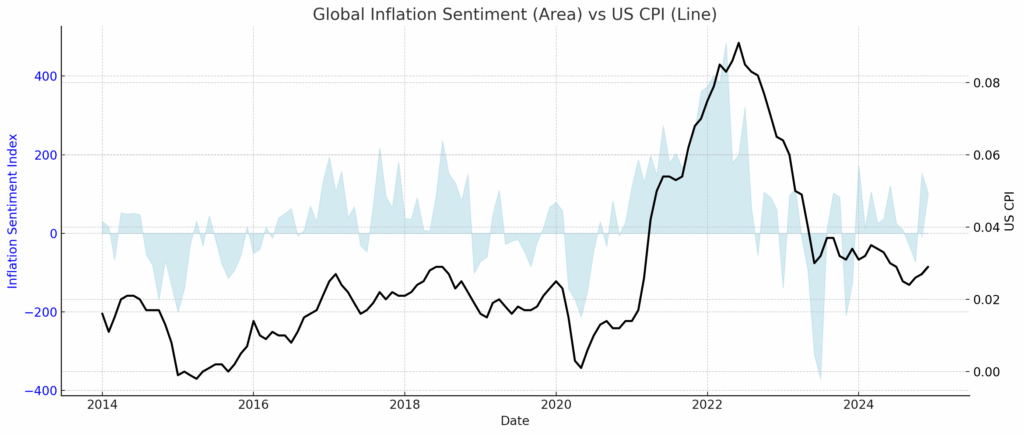
Above: This chart demonstrates our AI’s capability to anticipate US Consumer Price Index movements through sophisticated global inflation sentiment analysis spanning over a decade. The blue shaded area represents our proprietary inflation sentiment index, whilst the black line tracks actual US CPI data. The chart reveals the predictive power of sentiment analysis, particularly evident during the 2021-2022 inflation surge where our sentiment indicators began signalling heightened inflation concerns well before CPI reached its peak of 9%. Notice how sentiment volatility intensified throughout 2021, providing early warning signals of the inflationary pressures that would subsequently dominate Federal Reserve policy decisions. The recent normalisation of both sentiment and actual inflation data since 2023 illustrates how our real-time intelligence enables institutional investors to anticipate monetary policy shifts and position accordingly. This exemplifies the strategic advantage available to macro research professionals who integrate structured sentiment analysis into their inflation forecasting models.
Central bank communications have evolved into one of the most closely watched aspects of global financial markets, with individual words and phrases capable of triggering significant market movements. The challenge for institutional investors lies not merely in monitoring these communications but in interpreting their true meaning and anticipating their market impact. Here, modern AI-driven macro research capabilities enables much improved and real-time tracking of sentiment shifts across Federal Reserve, European Central Bank, and Bank of England communications, providing early warning signals for policy changes that may not be immediately apparent through traditional analysis methods.
This monitoring extends beyond scheduled policy announcements to encompass speeches, interviews, and informal communications from central bank officials. The ability to process and analyse these diverse communication streams in real-time provides institutional investors with crucial insights into potential shifts in monetary policy direction, quantitative easing programmes, and forward guidance frameworks that can significantly impact asset prices across multiple markets.
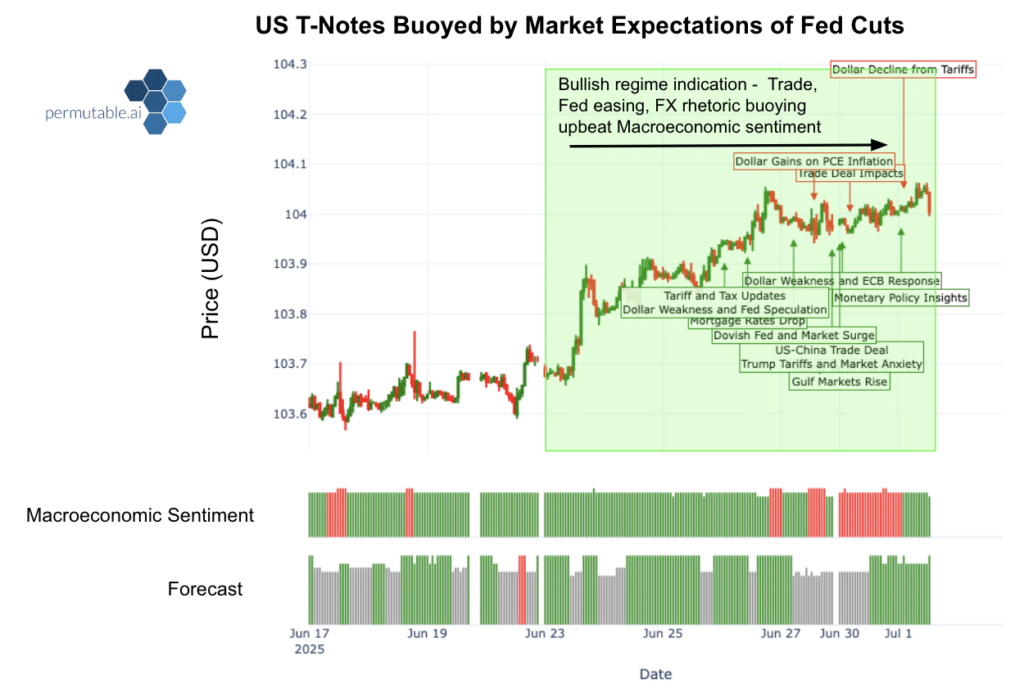
Above: This chart demonstrates how our macroeconomic sentiment analysis correlates with US Treasury Note price movements during a critical period of Federal Reserve policy speculation. The green-shaded “bullish regime” period shows sustained positive sentiment around trade negotiations, Fed easing expectations, and favourable macroeconomic data releases driving T-Note prices higher. Key annotations highlight specific events – from tariff developments to ECB policy responses – that our real-time intelligence platform identified as market-moving catalysts. The lower panels display our proprietary sentiment indicators and forecasting models, illustrating how institutional investors can leverage structured data streams to anticipate bond market movements ahead of consensus positioning. This exemplifies the strategic advantage available to macro research professionals who integrate AI-driven sentiment analysis into their fixed income strategies.
Government fiscal policy decisions represent another key area where advanced macro research capabilities provide substantial advantages to institutional investors. Analysis of fiscal stimulus packages, budget announcements, and tax policy changes requires not only understanding the immediate implications of these measures but also gauging global market reactions and cross-border spillover effects. Sophisticated AI-driven sentiment analytics such as those we provide at Permutable can track sentiment and response patterns across multiple jurisdictions, enabling investors to identify sector rotation opportunities, assess credit exposure implications, and evaluate sovereign risk factors with greater accuracy.
Ultimately, the complexity of modern fiscal policy analysis demands tools capable of processing vast amounts of information from diverse sources whilst maintaining the ability to identify subtle connections between seemingly unrelated policy measures. We have found that this capability proves particularly valuable for our macro portfolio clients who must navigate the interconnected nature of global fiscal policies and their cascading effects across various asset classes.
Political stability and sovereign credit risk assessment have become increasingly complex in an era of rapid information flows and heightened global connectivity. Traditional credit rating agencies often lag behind real-time developments, creating opportunities for institutional investors equipped with advanced monitoring capabilities to identify emerging risks before they are reflected in official ratings or market prices. Real-time tracking of sentiment around political unrest, leadership changes, and governance issues across emerging and frontier markets provides crucial early warning signals for potential credit deterioration or default risk.
Here, the integration of structured data from diverse sources enables comprehensive monitoring of political developments that may impact sovereign creditworthiness. This capability proves particularly valuable for investors with exposure to emerging market debt, as it allows for proactive risk management rather than reactive responses to credit events.
Natural disasters represent one of the most immediate and significant drivers of commodity price movements and infrastructure disruptions. The ability to receive early warnings and comprehensive impact assessments for hurricanes, floods, earthquakes, and wildfires provides commodities traders and infrastructure investors with crucial advantages in rapidly evolving market conditions. Advanced sentiment analytics can not only identify the immediate physical impacts of natural disasters but also assess their broader economic implications across supply chains and regional markets.
Importantly, the sophistication of modern disaster impact assessment extends beyond simple geographical mapping to encompass complex supply chain analysis, infrastructure vulnerability assessments, and regional economic impact modelling. This comprehensive approach enables investors to understand not merely where disasters occur but how they propagate through interconnected global systems, affecting commodity prices, insurance markets, and regional economic conditions.
Geopolitical tensions and trade policy developments have emerged as primary drivers of market volatility in recent years, requiring institutional investors to maintain constant vigilance across multiple dimensions of international relations. The monitoring of trade war developments, tariff implementations, sanctions regimes, and diplomatic tensions demands sophisticated analytical capabilities that can process information from diverse sources whilst identifying patterns and connections that may not be immediately apparent.
The complexity of modern geopolitical analysis requires tools capable of tracking sentiment across multiple languages, jurisdictions, and communication channels simultaneously. This capability proves essential for investors seeking to position themselves appropriately in foreign exchange markets, equity sectors, and sovereign debt markets as geopolitical relationships evolve and shift.
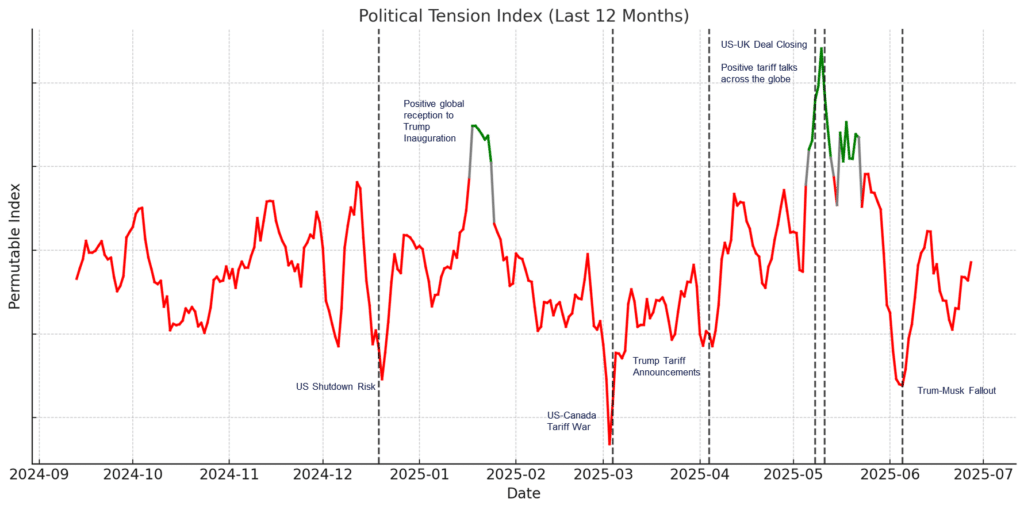
Above: Our 12-month Political Tension Index as featured in Trader’s Magazine demonstrating our AI’s capability to quantify and track breaking political tensions in 2025 through sophisticated sentiment analysis. The red line captures baseline political risk levels, whilst the dramatic green spikes highlight periods of acute tension requiring immediate institutional investor attention. Key events are annotated to show how our real-time intelligence platform identified critical moments – from US government shutdown risks and Trump’s inauguration reception to recent US-UK trade negotiations and the Trump-Musk political fallout. The index successfully captured the volatility surrounding US-Canada tariff disputes and provided early warning signals for the significant political tension spike in May 2025. This visual representation exemplifies how institutional investors can leverage structured political intelligence to anticipate market volatility, adjust risk exposures, and identify alpha opportunities before these geopolitical developments reach broader market consensus – a crucial advantage for macro research professionals navigating today’s complex political landscape.
The development and refinement of systematic event-driven trading strategies requires access to comprehensive historical datasets that capture the full spectrum of market-moving events and their associated sentiment patterns. The availability of structured data spanning multiple years across thousands of sources enables institutional investors to develop, test, and refine trading strategies with unprecedented precision and statistical confidence which is what we offer our clients with our 10 year data availability.
This historical analysis capability extends beyond simple backtesting to encompass sophisticated stress testing and scenario analysis that can help investors understand how their strategies might perform under various market conditions and event scenarios. The depth and breadth of available historical data enable strategy developers to identify subtle patterns and relationships that may not be apparent through shorter-term analysis or limited data sets.
Perhaps the ultimate application of advanced macro research capabilities lies in integration into real-time trading systems and risk management frameworks. The ability to feed real-time sentiment data and event information directly into trading algorithms represents a fundamental shift in how institutional investors can respond to evolving market conditions. This layered integration enables dynamic adjustment of portfolio exposures based on real-time developments rather than static risk parameters or delayed market reactions.
The sophistication of modern algorithmic integration extends beyond simple buy and sell signals to encompass complex risk adjustment mechanisms that can modify position sizes, hedge ratios, and exposure limits based on evolving macro and geopolitical conditions. This capability provides institutional investors with unprecedented agility in responding to market developments whilst maintaining appropriate risk controls.
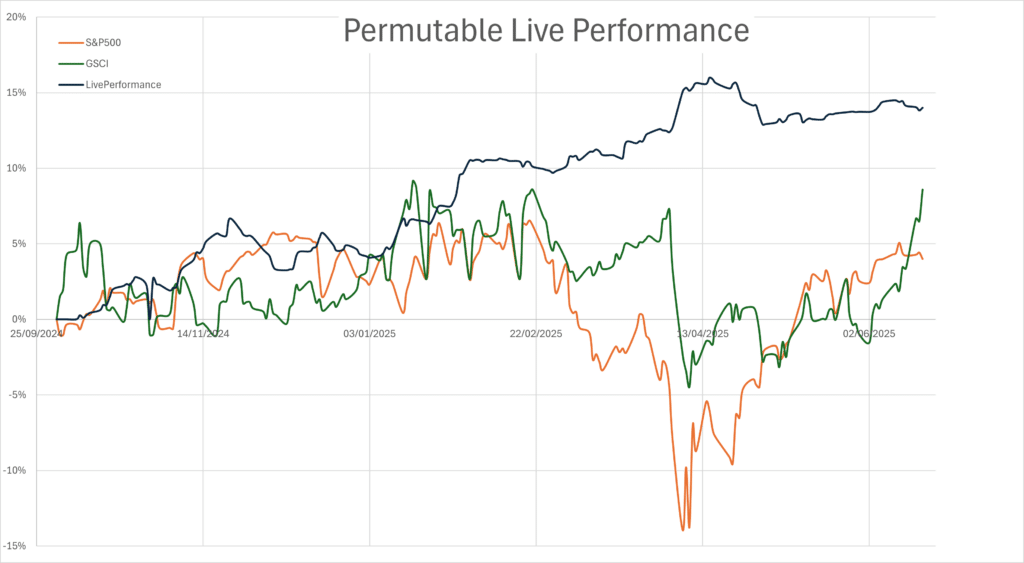
Above: This live performance chart showcases the tangible value of integrating our real-time intelligence into institutional investment strategies. The black line represents our Live Performance strategy, which has consistently outperformed both the S&P 500 (orange) and S&P Commodity Index (green) over the tracking period from September 2024 to July 2025. Most notably, our AI-driven approach delivered superior risk-adjusted returns during periods of heightened market volatility, particularly during the significant S&P 500 drawdown in early 2025 where traditional equity markets experienced double-digit losses. The strategy’s ability to maintain positive performance whilst major indices declined demonstrates the protective value of incorporating structured sentiment analysis and geopolitical intelligence into portfolio construction. This performance validates the strategic advantage available to institutional investors who leverage our comprehensive macro research capabilities, transforming market uncertainty into consistent alpha generation – a critical differentiator for asset managers, hedge funds, and macro strategists navigating today’s complex global investment landscape.
In our view, the transformation of macro research through advanced AI-driven data analytics represents more than a technological evolution – it represents a fundamental shift in how institutional investors can understand and navigate global markets. The seven use cases outlined above demonstrate the breadth and depth of opportunities available to asset managers, hedge funds, commodity traders, and macro portfolio strategists willing to embrace these advanced capabilities. As global markets continue to evolve and become increasingly interconnected and volatile, it is our belief that the institutions that successfully leverage these tools will find themselves with substantial competitive advantages in an increasingly complex investment landscape.
Finally, the future of macro research lies not in replacing human expertise but in augmenting it with powerful AI-driven analytical capabilities of the kind we provide at Permutable that can process vast amounts of information whilst identifying patterns and relationships that would be impossible to detect through traditional methods. For institutional investors, the question is not whether to adopt these advanced capabilities but how quickly they can be integrated into existing investment processes to capture the substantial opportunities they represent.
Gain a clearer edge in volatile markets with real-time macroeconomic intelligence tailored for institutional decision-making. Speak to our team by emailing enquiries@permutable.ai to explore how Permutable’s AI-driven insights can help you anticipate macro shifts and protect alpha.
30 Sep 2026
The Hawkish Turn: G10 Central Bank Policy Outlook into Q4 2026
Read more >
Guide
30 Sep 2026
The complete guide to early macro regime sentiment signals for hedge funds and institutional investors
Read more >
Analysis
23 Sep 2026
How does the 2026 energy shock reach 2027? From shipping routes to policy rates
Read more >