The RBA interest rate outlook points to an extended hold rather than an early easing turn. Australia’s inflation pressure has eased sharply, but the broader economy has not weakened enough to justify easier policy. Permutable’s Global Macro Sentiment Indices show softer inflation and housing alongside resilient spending, firmer employment sentiment and elevated capacity utilisation, while rising business costs continue to complicate the picture.
The inflation scare that drove Australia’s renewed tightening cycle has faded faster than expected, but the economy has not rolled over with it.
Inflation outcomes have softened, labour conditions have eased from their earlier extremes and housing expectations have weakened. At the same time, household spending remains resilient, employment conditions have firmed again and business capacity remains stretched.
This report’s central conclusion is that another rate increase is no longer the natural next step. Instead, the current configuration supports an extended period on hold.
At the time of the report, the cash rate stood at 4.35%, unemployment at 4.4%, household spending was 6.0% higher year on year and the Australian two-year government bond yield stood at 4.59%.
The RBA has enough evidence that restraint is working to remain on hold.
Inflation outcomes have been softer than earlier feared, labour conditions have eased from their extremes and housing expectations have weakened. Another increase is therefore no longer the natural next step.
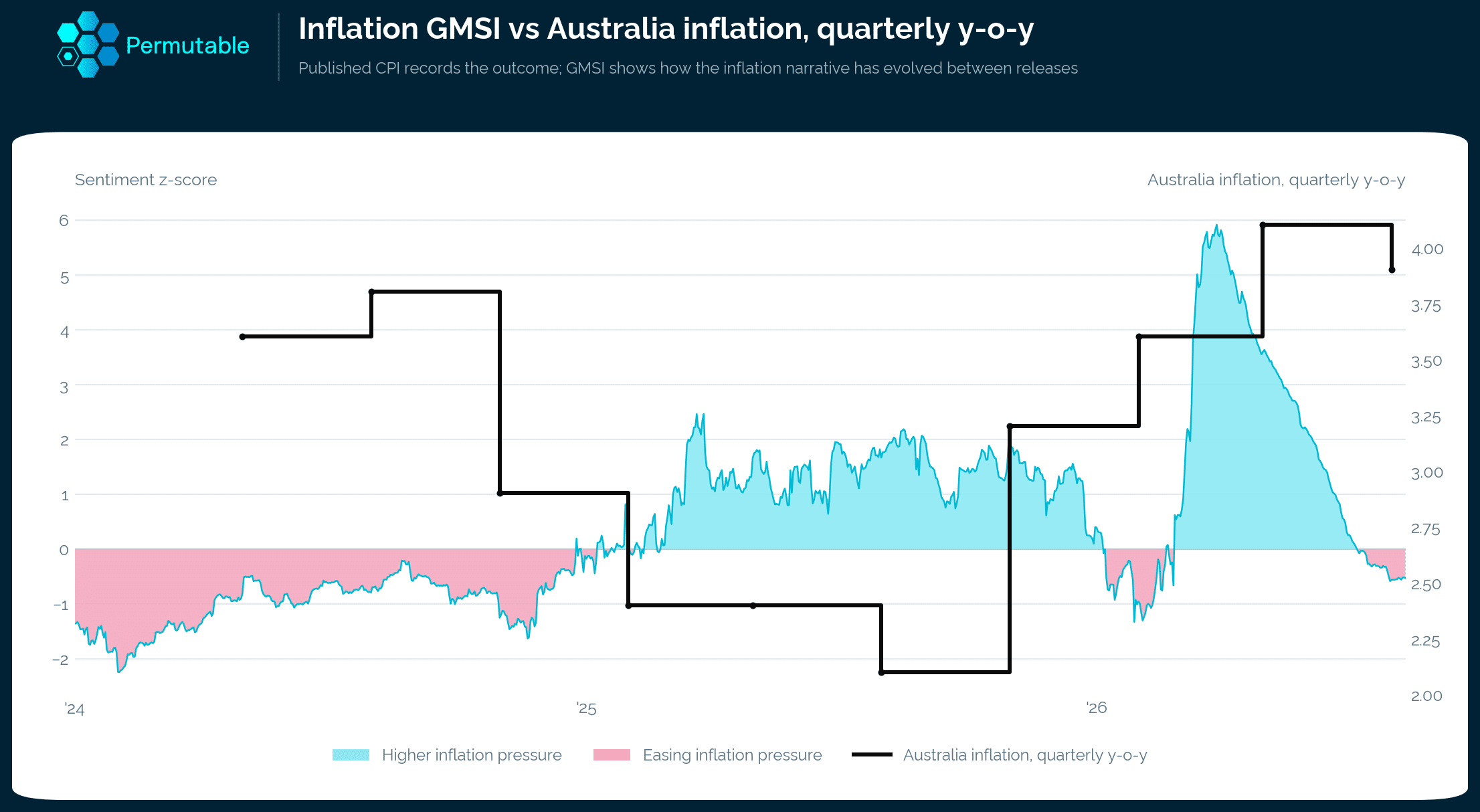
Permutable’s inflation GMSI rose to almost +6z in late March before subsequently falling below zero. The quarterly inflation-rate series eased much less sharply, reaching 3.9% year on year in June.
Interest-rate GMSI also moved back towards neutral following its early-2026 peak. The report interprets this as a shift in the policy debate from whether further tightening is required towards how long the existing level of restraint should remain in place.
That gives the RBA time to wait, although inflation close to 4% still leaves little room to ease.
Household demand has weathered higher rates better than expected.
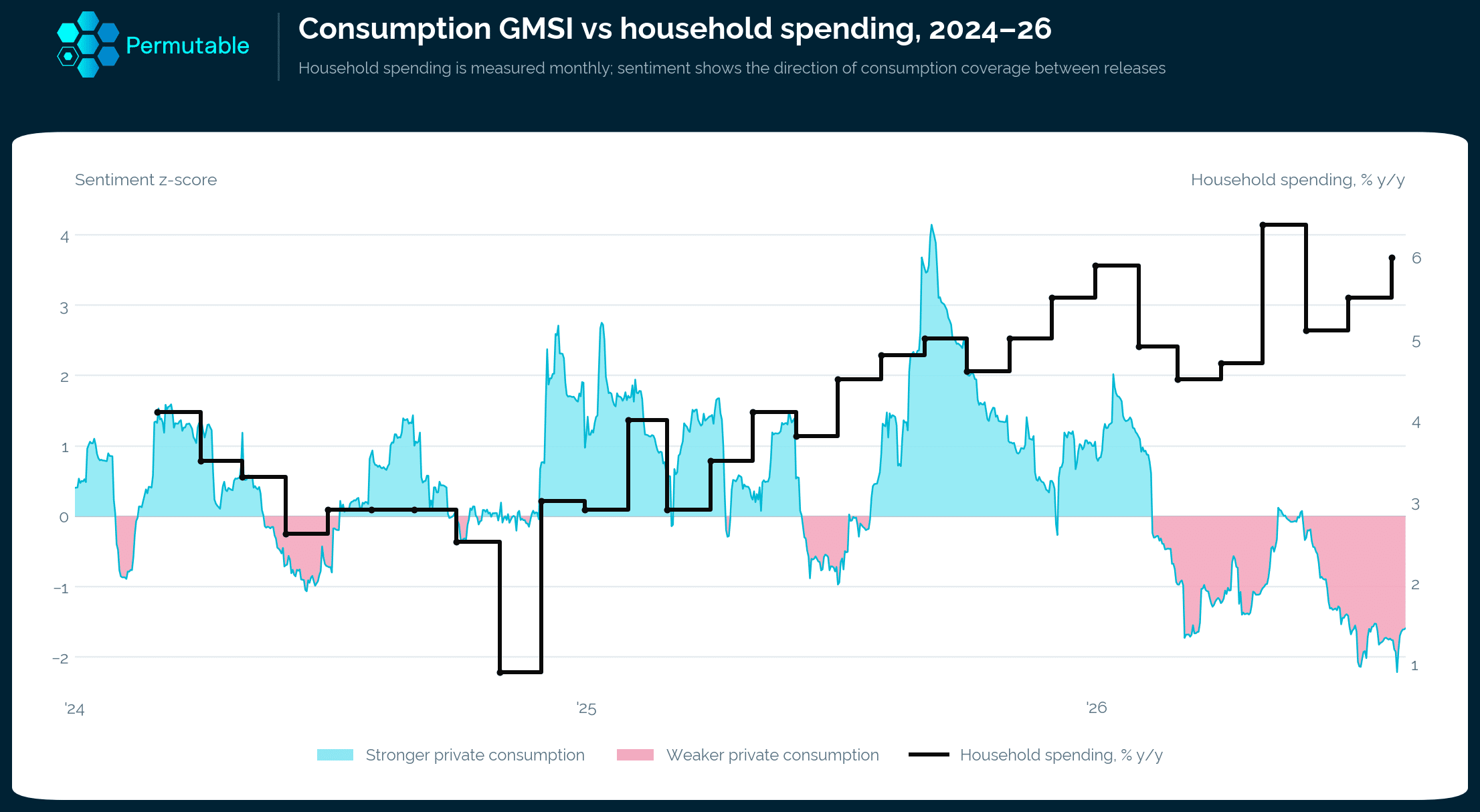
Spending rose 0.8% in June and 1.3% over Q2, while real volumes increased 0.7% over the quarter.
The sentiment picture is weaker. Consumption GMSI stood at around −1.6z after reaching −2.2z in early August.
The report identifies a clear condition to watch: persistent weak coverage followed by softer spending would indicate that demand momentum had rolled over.
For now, consumers are still spending and do not provide a reason for the RBA to ease.
The labour market has eased from its earlier extremes without showing the sharp deterioration that would require policy support.
The unemployment rate edged back to 4.4% after reaching 4.5%, while Permutable’s employment GMSI recovered to around +0.8z.
The unemployment axis in the report is inverted so that the two series move in the same economic direction.
Conditions have therefore loosened compared with their earlier extremes, but there is little evidence in the report of the kind of sharp deterioration that would require policy support.
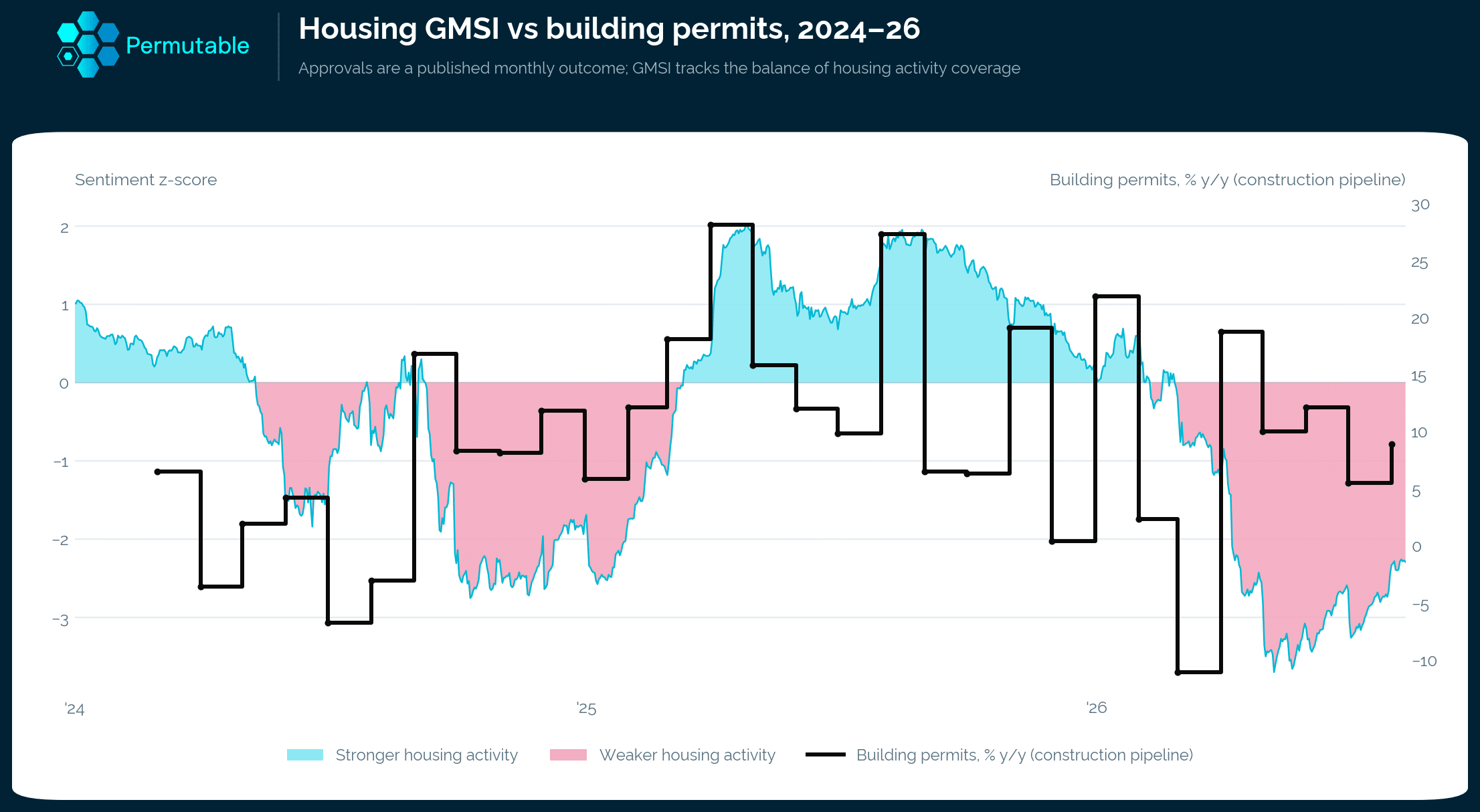
Housing GMSI remained near −2.3z, making it the weakest current macro signal identified in the report.
Home values fell 0.7% in July and stood 1.6% below their March peak, while home-loan enquiries weakened.
Building permits remained volatile and are used in the report to describe the construction pipeline.
The document notes that housing-finance approvals are the preferred direct measure of rate transmission when a point-in-time series is available. The supplied Q1 figure was −3.8% quarter on quarter.
Business confidence held at −6 in July, even as business conditions edged up to +4.
The firmer activity reading was accompanied by a renewed build-up in cost pressure. Capacity utilisation rose to 83.0%, labour costs increased 2.2% quarter on quarter, purchase costs rose 2.3% and final product prices increased 1.1%.
Forward orders fell to −3, however, suggesting that demand remains fragile beneath the surface.
For the RBA, the report describes this as an awkward mix: enough softness to justify patience, but still too much pressure on capacity and costs to support an early easing turn.
Policy-outlook GMSI and the Australian two-year yield both reversed sharply as the outlook was repriced in early 2026.
The latest configuration is different.
Policy-outlook GMSI fell from around +4z to near neutral, while the Australian two-year government bond yield remained around 4.6%.
The report states that markets are not pricing a rapid easing cycle. Instead, they continue to embed a higher-for-longer path even though the incremental shift towards further restriction has faded.
The common thread is an economy losing some momentum without becoming weak.
Housing has softened first, consumption coverage has deteriorated and inflation pressure has eased substantially from its early-year extreme.
At the same time, household spending remains firm, employment sentiment has recovered and capacity utilisation remains elevated.
That combination gives the RBA enough evidence that restraint is working to leave rates unchanged, but little justification for easier policy.
Australia has weathered the inflation storm better than feared. The RBA now has the luxury of waiting – but not yet of standing down.
Read the full three-page GMSI analysis covering inflation, interest rates, household consumption, employment, housing, business conditions and the Australian two-year government bond yield.
Explore Global Macro Sentiment Indices
30 Sep 2026
The Hawkish Turn: G10 Central Bank Policy Outlook into Q4 2026
Read more >
Guide
30 Sep 2026
The complete guide to early macro regime sentiment signals for hedge funds and institutional investors
Read more >
Analysis
23 Sep 2026
How does the 2026 energy shock reach 2027? From shipping routes to policy rates
Read more >