The RBA’s hike and a Fed back in tightening mode frame the run into Q4. Our Global Macro Sentiment Indices (GMSI) show how the G10 policy debate has turned, and where it is still building.
The Reserve Bank of Australia lifted the cash rate by 25bp to 4.60% on 29 September, a unanimous decision that takes it to its highest level since October 2011 and marks its fourth hike this year. The Board noted that global energy prices are now “much higher than had been assumed” in its August forecasts, and it will do what is necessary, “including increasing the cash rate target further if needed”.
The RBA is not moving in isolation. The Fed resumed tightening in September. US 10-year yields rose by about 49bp between the end of August and 28 September, to 5.24%, their highest since 2007. With Brent above US$100 a barrel and inflation rising again, the conversation across the G10 has turned firmly towards tightening.
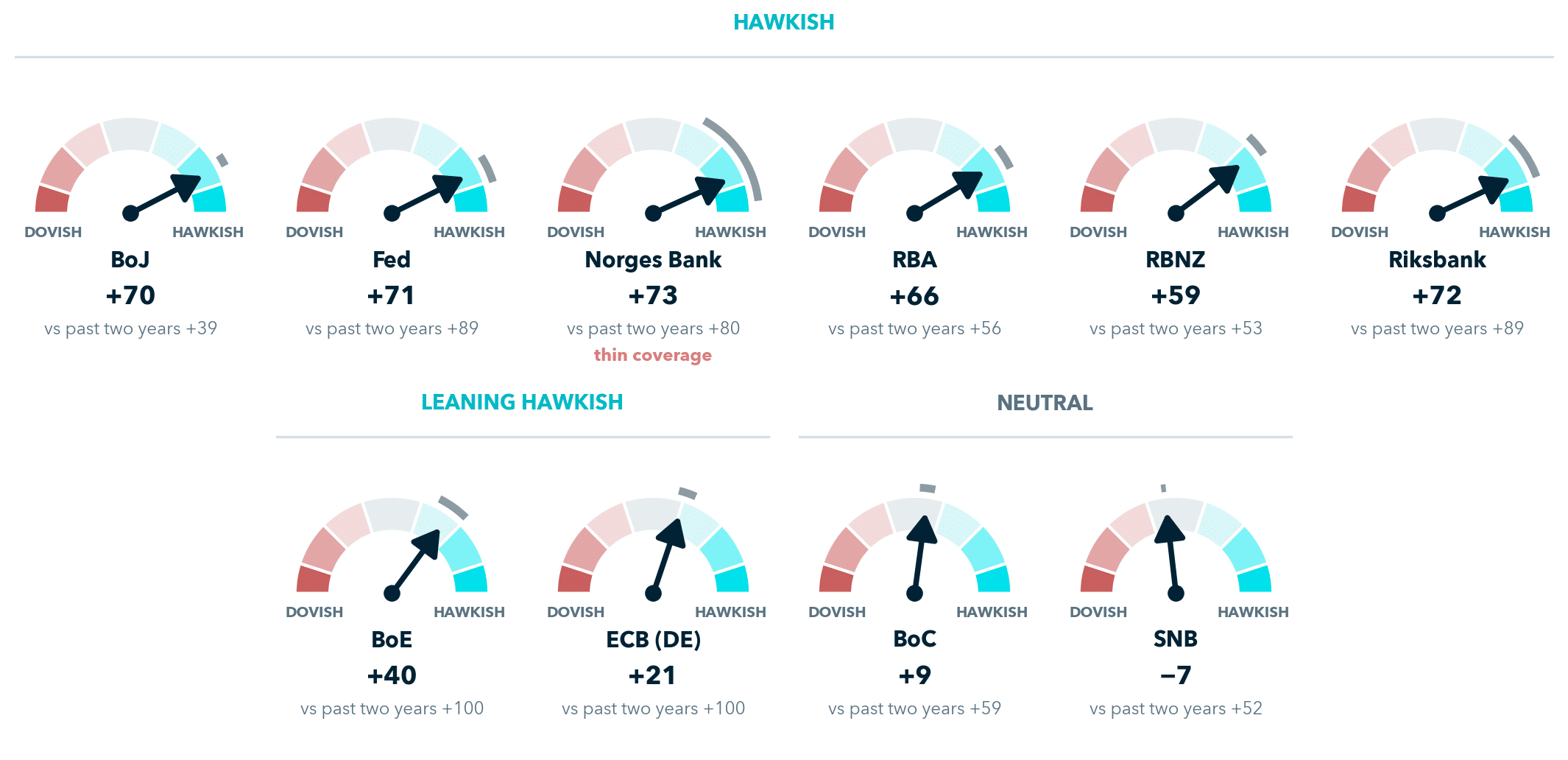
Our Global Macro Sentiment Indices read news on each economy’s monetary-policy outlook every hour and score each headline from −1, fully dovish, to +1, fully hawkish. Because it is built from news rather than prices, directional sentiment gives an independent, real-time read to set alongside market pricing and forecasts.
Read the full analysis here: GMSI_g10_policy_outlook_Q4_2026
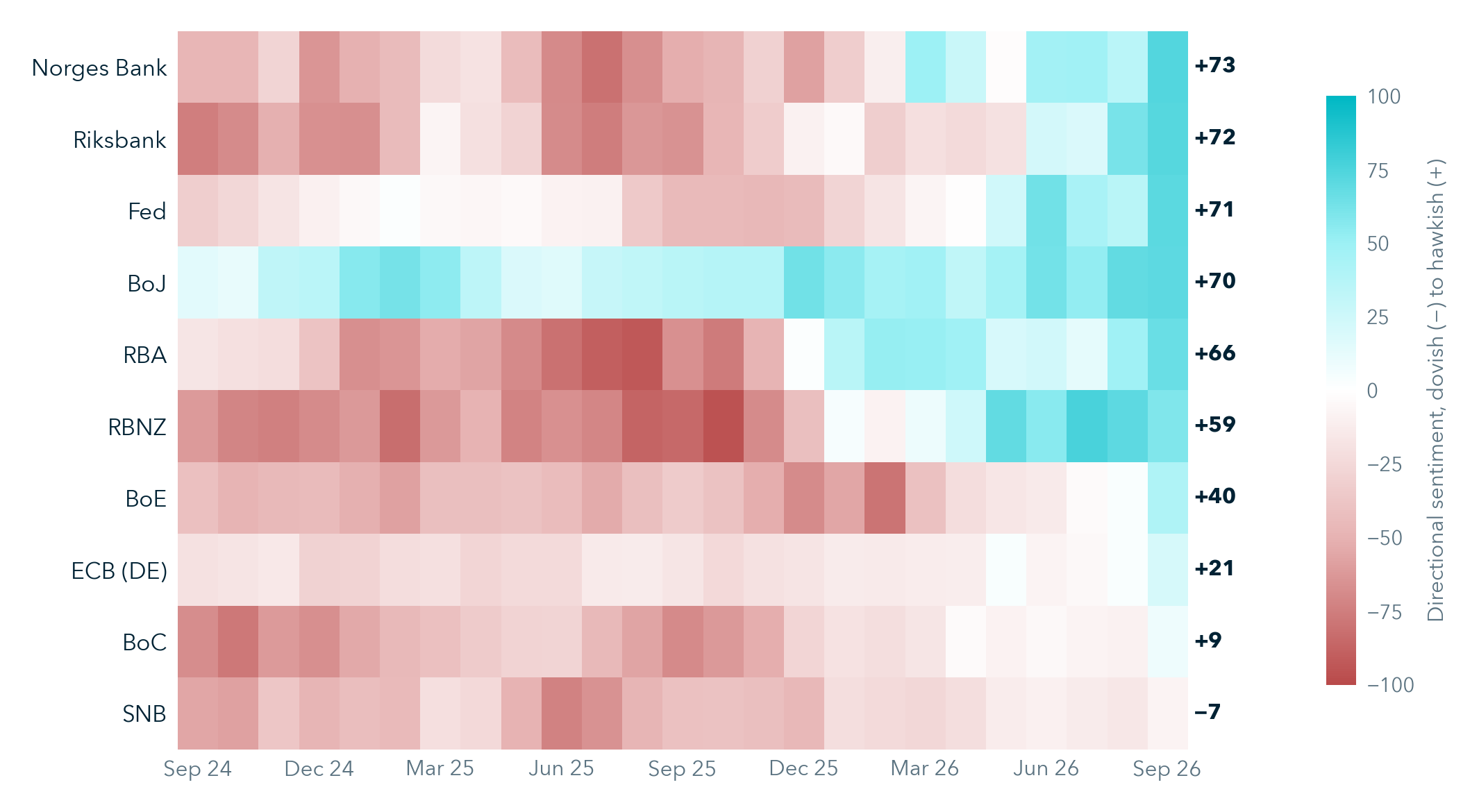
Through most of 2025 directional sentiment leaned dovish across the G10 central banks eased. It began to turn around the new year, first in Australia, then in Norway and New Zealand by the spring, and more broadly through the summer as the energy shock took hold. Japan is the exception, hawkish throughout as the Bank of Japan continued to normalise policy.
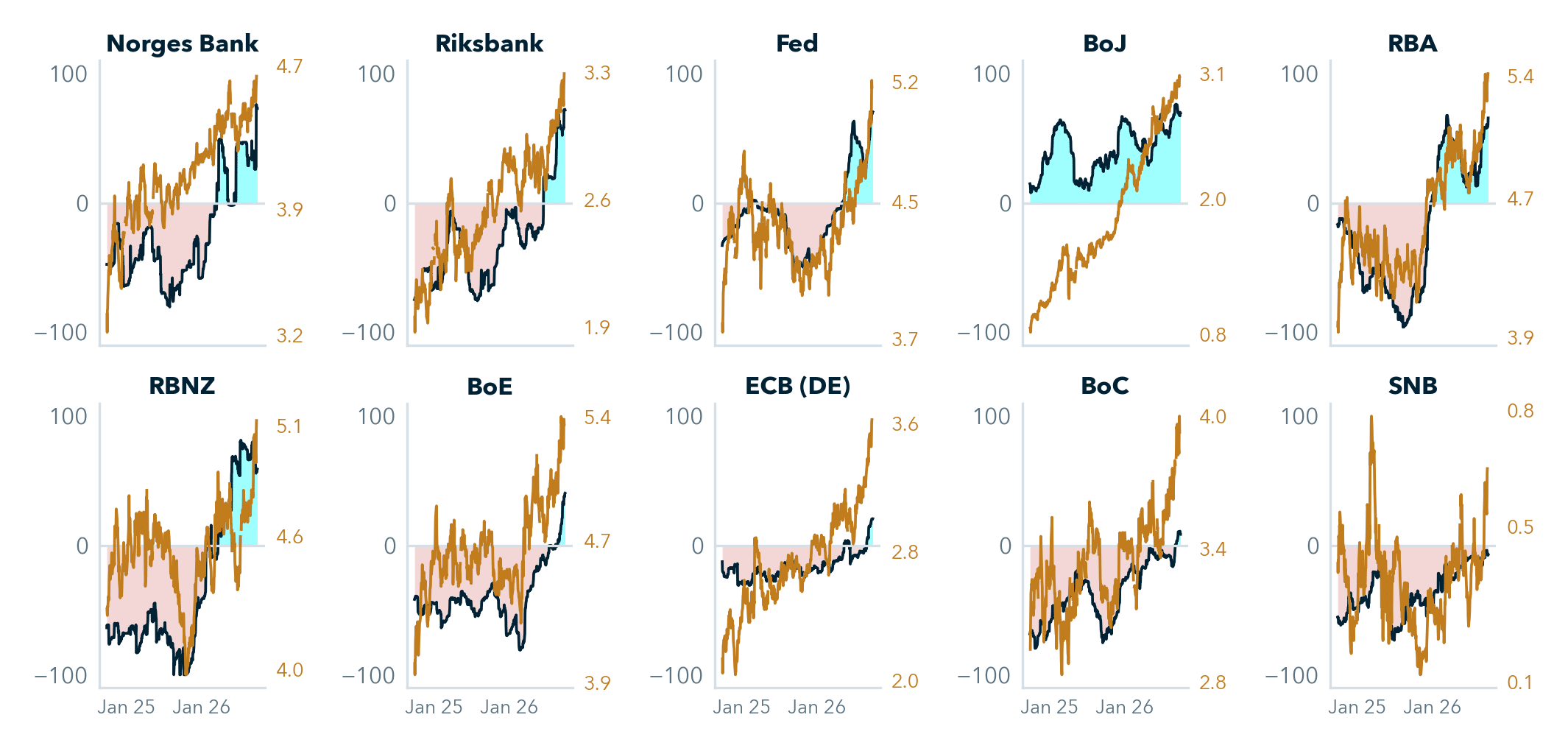
Where sentiment turned hawkish, local yields rose alongside it, most clearly in Australia, New Zealand, Sweden and the UK. That is co-movement rather than cause and effect, and sentiment does not lead the next move in yields. Its value lies in reading the narrative behind a move as it happens, and in confirming or challenging a view as the story develops.
The Q4 decision run opens on 28 October with the Fed, the Bank of Canada and the RBNZ, and runs through to the SNB on 10 December. On balance, we see hawkish pressure as most likely to keep building in Europe, where sentiment is most unusual against its own past two years.
| Central bank | Next | Sentiment | vs past two years | Our read |
|---|---|---|---|---|
| Bank of Canada | 28 Oct | +9 | +59 | Hike odds rising, but sentiment is still neutral |
| Federal Reserve | 28 Oct | +71 | +89 | Resumed hiking, with further moves in play |
| RBNZ | 28 Oct | +59 | +53 | Another hike may be needed this year |
| ECB (Germany proxy) | 29 Oct | +21 | +100 | A hold looks likely, with December in focus |
| Bank of Japan | 30 Oct | +70 | +39 | A hold looks likely, with December in view |
| RBA | 3 Nov | +66 | +56 | Door left open to further tightening |
| Sveriges Riksbank | 4 Nov | +72 | +89 | Several hikes flagged, so November is in play |
| Bank of England | 5 Nov | +40 | +100 | Split six to three in September, November looks live |
| Norges Bank | 5 Nov | +73 | +80 | Hiked in September and ready to act again, on thin coverage |
| Swiss National Bank | 10 Dec | −7 | +52 | On hold at 0%, with a hold expected |
Directional sentiment runs from −100 to +100. vs past two years compares it with the bank’s own last two years, where +100 is the top of its range.
Every headline on an economy’s monetary-policy outlook receives a directional score from −1, fully dovish, to +1, fully hawkish. Each reading uses only data dated up to that day, and gauges built on news from fewer than 20 of the past 30 days carry a warning for each G10 central bank applicable.
The index measures the balance of the policy debate. It is not a forecast of decisions or yields, and nothing here is investment advice.

Analysis
16 Oct 2026
Gold outlook 2026: Why US rates outweigh geopolitical risk
Read more >
Analysis
14 Oct 2026
Beneath US headline inflation: tracking pressure across energy, food, services and housing
Read more >
Analysis
13 Oct 2026
France’s debt alarm hits a decade high and drowns out the rest of the G20
Read more >