China Sentiment Outlook Q4 2026: exports carry the load as consumers hold back and chip risk lingers
17 Sep 2026
17 Sep 2026
China’s sentiment outlook is showing two distinct speeds. While factories and exporters are operating at full capacity, households and domestic businesses are approaching with caution.
Recent data highlights this disparity. In August, industrial output rose 5.2 per cent year on year, a slight improvement from July and slightly above forecasts. Conversely, retail sales rose only 0.4 per cent. Additionally, fixed-asset investment fell by 7.2 per cent in the first eight months of the year, marking its steepest decline since April 2020, with property investment down nearly one-fifth. It is not all grey. Investment in high-tech industries is still growing, and home prices in some of the biggest cities have begun, tentatively, to steady. August was also a miserable month for weather, with four typhoons battering the east coast.
Prices tell a similar tale. Factory-gate prices, which fell for more than three years, have been rising since March and stood 3.8 per cent higher in August than a year before. Consumer prices rose 0.8 per cent. Deflation is over. But the warmth has come mostly from higher energy and commodity prices, not from Chinese shoppers loosening their purse strings.
None of this will have surprised anyone watching the news flow rather than waiting for the monthly releases.
Official statistics are inherently delayed. The activity figures for August were released in mid-September, capturing a month that had already passed. By the time trends emerge in the data, markets have typically been debating them for weeks.
Permutable’s Global Macro Sentiment Indices are built to close that gap. They read coverage of each corner of the economy, in real time, with each reading using only what was known on that date: nothing is rewritten with hindsight, and nothing from the future leaks back in. This approach offers a sense of early insights into the economic outlook.
The readings are simple to follow. For investment and exports, a positive score means coverage is describing stronger activity. For inflation, it means rising price pressure, welcome or not. Supply chains run the other way: a positive score means greater disruption risk, so a fall in sentiment is good news.
Read that way, this year’s signals tell a story the official data has only lately caught up with.
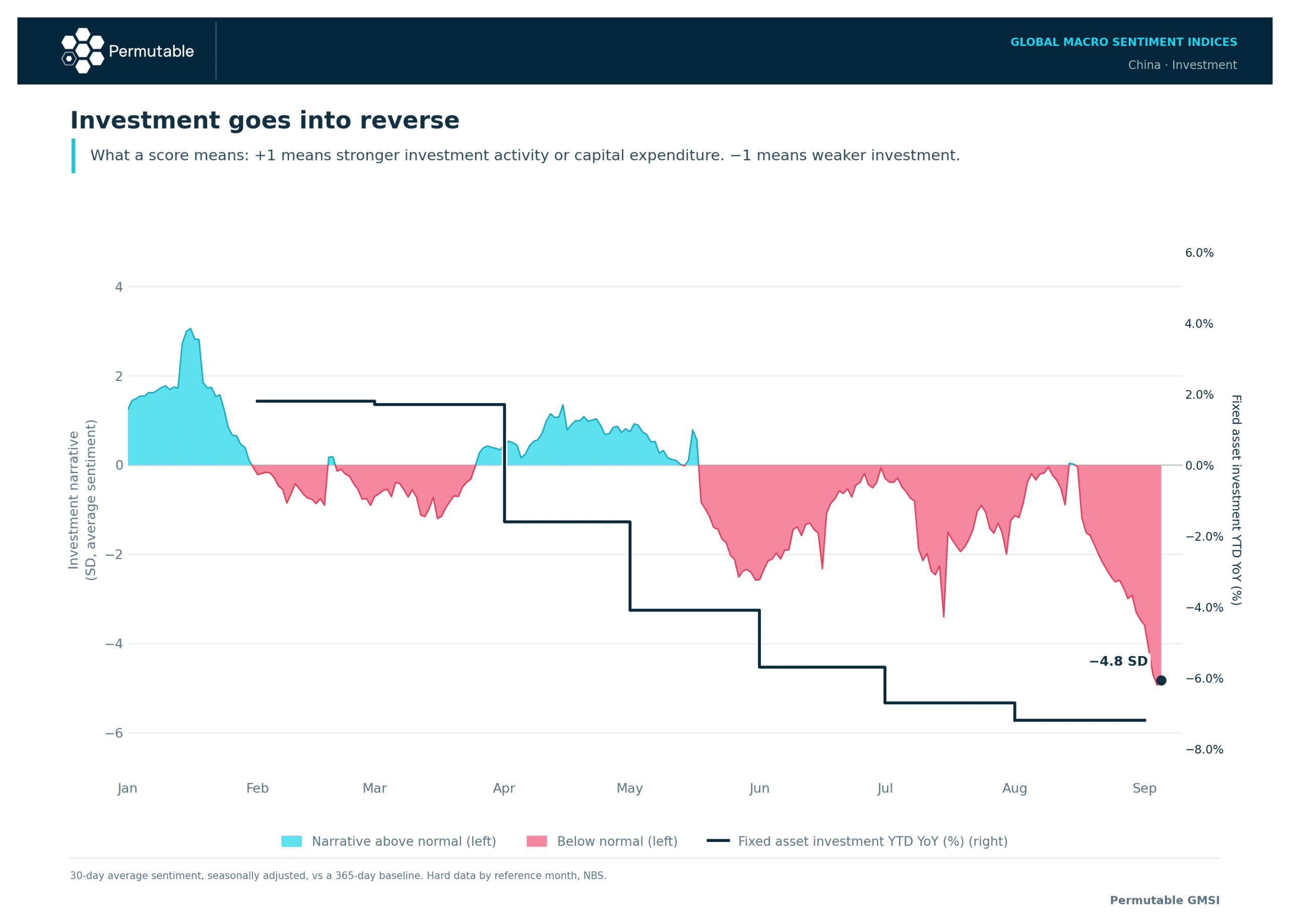
Investment sentiment was positive in the opening weeks of the year and again through April. In mid-May it dropped below its norm and has stayed there, with one brief exception, ever since. The year-to-date decline in fixed investment has deepened at every release since.
By early September the signal had reached its lowest point of the year. The series is ordinarily placid, which flatters the size of that final lurch; the direction is the thing, and it has pointed down all summer.
The lenders tell the same story. New loans returned to positive territory in August after July’s contraction, but at ¥60bn they came in below expectations of the ¥400bn analysts expected and a tenth of the ¥590bn extended a year earlier. Some of this is deliberate, as Beijing steers credit away from property and local government, as well as seasonal effects. Much of it is simply that firms and families see little worth borrowing for.
Policy has been watchful rather than bold. Benchmark lending rates have not moved for 15 months. Instead, the government has accelerated bond issuance and widened interest subsidies for smaller firms and consumers. That can direct credit. Whether it can create an appetite for it is another matter.
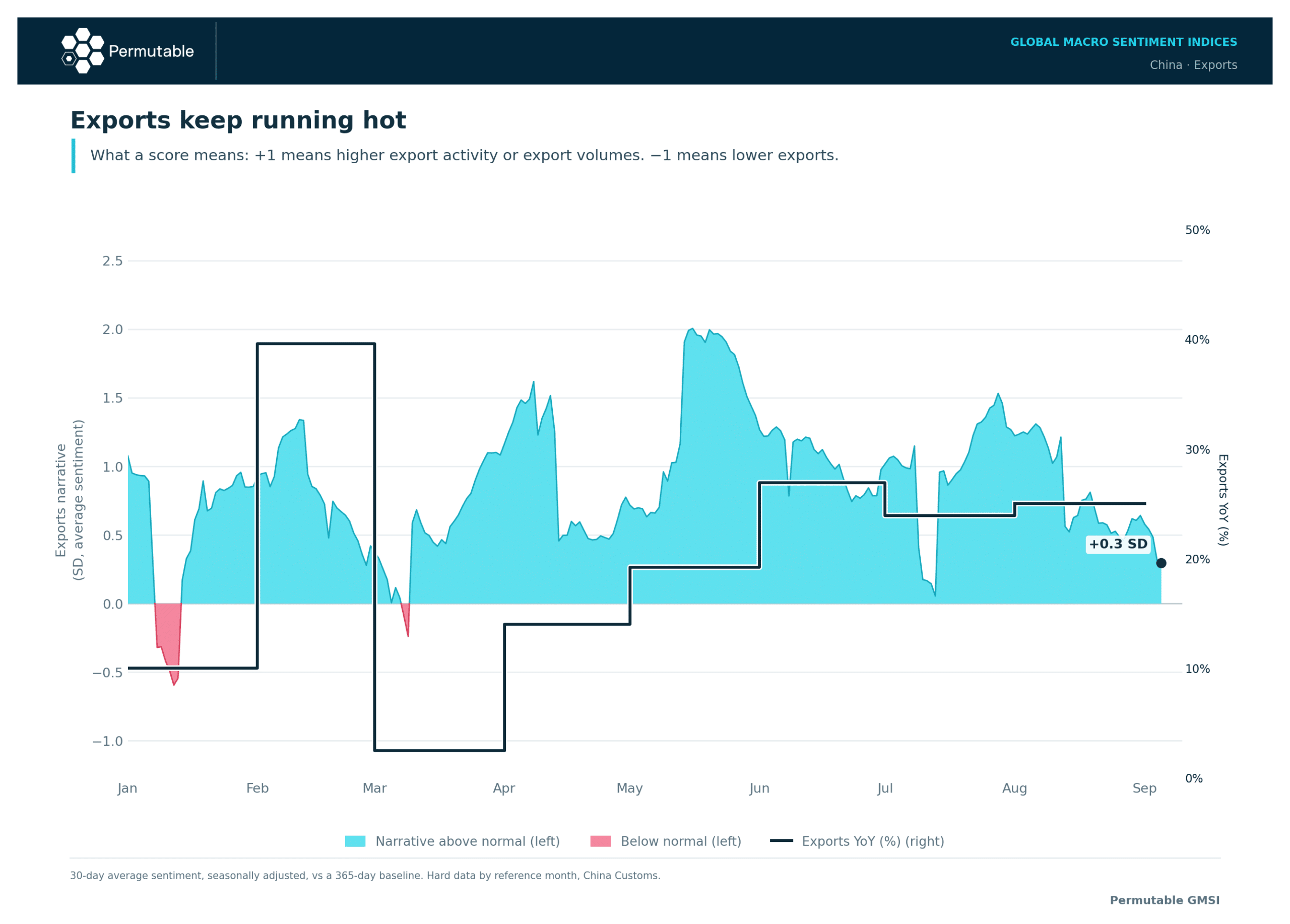
Exports have been the year’s reliable performer, and the coverage has said so almost without interruption. Shipments rose 25 per cent in August from a year earlier. The signal peaked in mid-May, held firm through June, and has eased since. It remains above its norm but below its average for the year: an export sector still doing well, in a news cycle that has stopped being astonished by it.
Imports have grown quickly too, by 28.2 per cent, though chiefly because commodities and technology inputs cost more rather than because anyone at home is buying more. Leaning on foreign demand has kept growth respectable. It also leaves China more exposed to tariffs, export controls and any cooling in the global technology cycle.
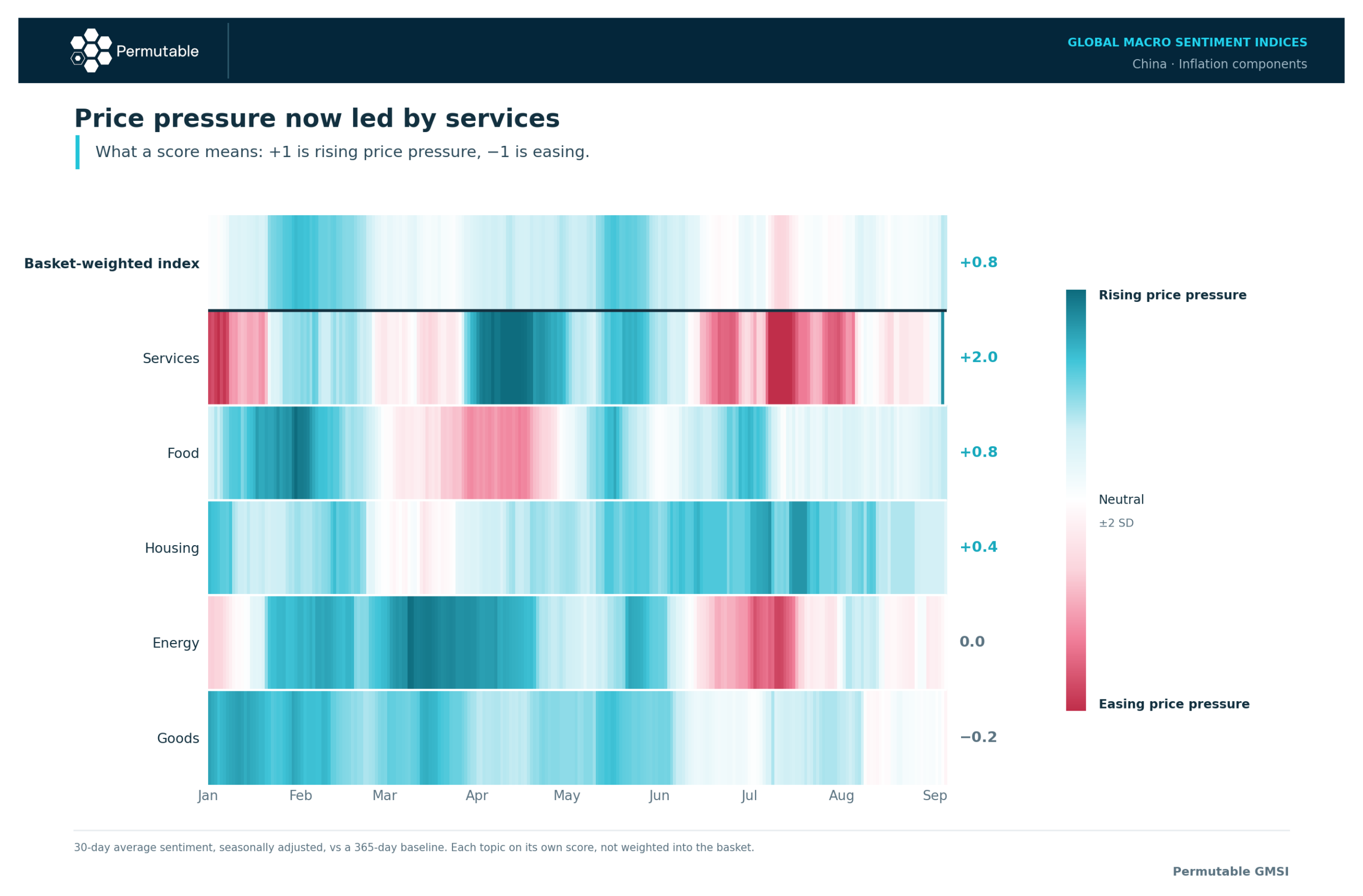
Inflation sentiment has sat above its norm for most of the year. What drives it has rotated. In spring it was energy, as conflict in the Middle East lifted oil and freight costs; energy has since fallen back to neutral, and goods have cooled with it. Food and housing have kept up a modest push through the summer.
The official figures bear out the broad shape. Consumer inflation rebounded to 0.8 per cent in August from 0.5 per cent in July, lifted by dearer technology and fuel: communication equipment prices were up 10.6 per cent on a year earlier and transport fuel 8.3 per cent. Factory-gate inflation rose to 3.8 per cent, with coal and crude oil extraction prices climbing sharply. The coverage has moved on from energy faster than the data has.
Food and housing are where narrative and numbers part ways. Coverage has leaned towards firmer prices, yet food prices fell 1.4 per cent, the fifth straight monthly decline, and rents slipped 0.6 per cent. Pork remains the heaviest weight, though its decline has eased for three months running. Together, food and housing make up roughly half the household basket, and both are still holding prices back.
The newest move is in services. Coverage of service prices ran well below its norm through much of June, July and early August, then jumped in the closing days of the period to become the strongest reading of any category. If it holds, it matters: service prices are the best available read on demand at home.
It is early. The move is days old, and the official data show only low, positive inflation across tourism, healthcare and everyday services. Core inflation edged up to just 1.0 per cent. For now, China’s prices look set to settle in a low, positive range, with the warmth still coming largely from outside.
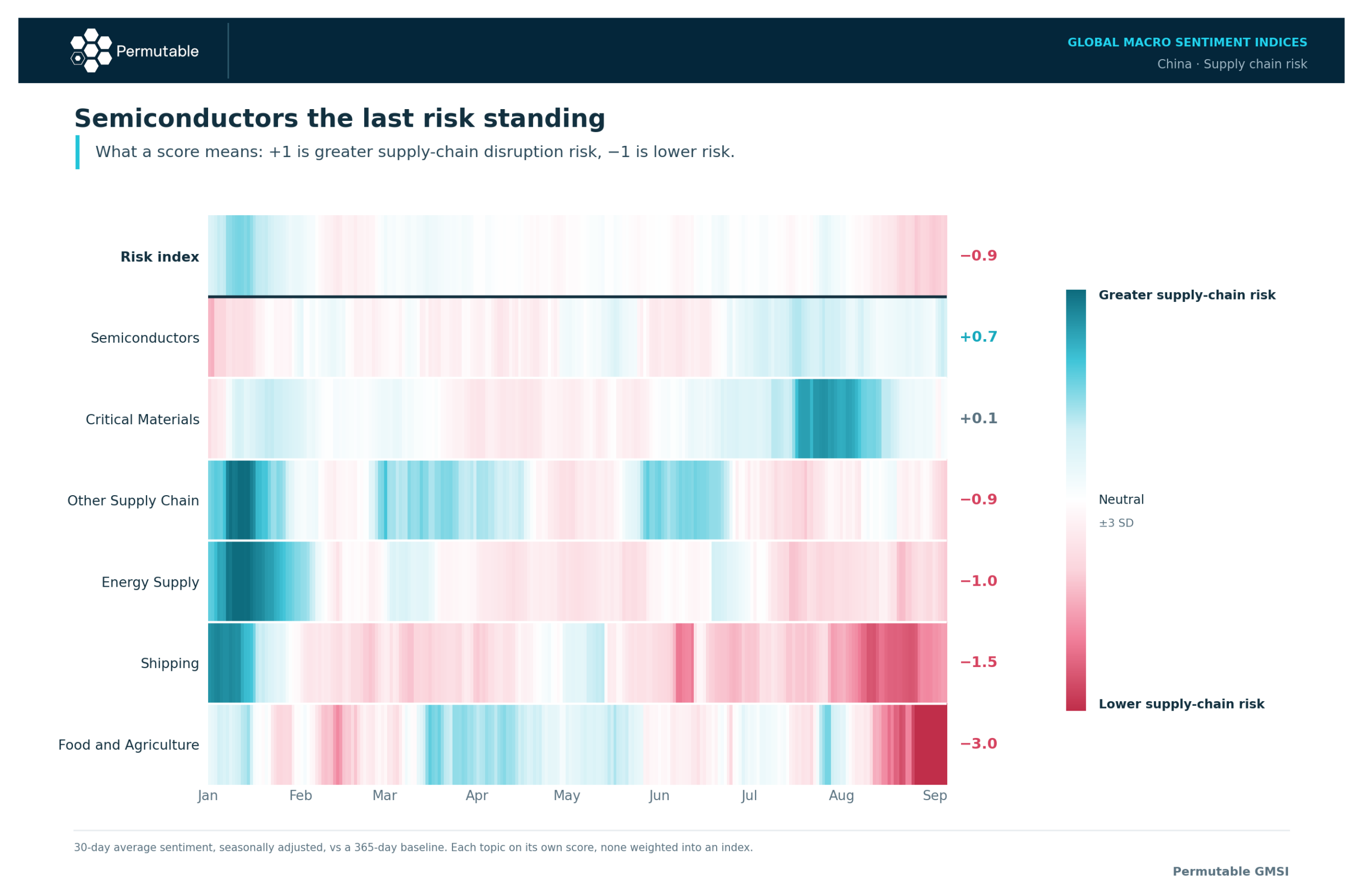
Laid side by side, the six supply-chain risks resolve into a clear picture. In January, shipping, energy supply and general disruption worries were all running hot. By late July the anxiety had migrated to critical materials, which flared and then subsided through August. Today, shipping, energy supply, and the residual category all sit below their usual levels, and so does the composite.
The composite flatters, though. Much of its calm comes from food and agriculture, a thinly covered topic where small shifts in tone can drive big moves. Set it aside and conditions still look calmer than usual, but by roughly half as much.
Semiconductors are the exception, and the exception is instructive. Chip coverage has been above its norm since July and is now the highest of the six, sustained by export controls, tight supply of advanced memory and the contest over high-end technology. China is paying more for what it needs. Chips aside, it is not struggling to obtain them.
Because these signals are daily, they will register the next turn while the statisticians are still collecting.
First, watch services inflation. If services keep leading the price signal and core inflation firms behind them, the warmth is spreading beyond commidity costs. If the signal fades, headline inflation should ease as the energy effect washes out.
Second, watch investment and housing. A sustained move back towards neutral would be the earliest sign that confidence at home is steadying and that Beijing’s targeted support is finding purchase.
Third, watch exports. They have carried the economy this year. If they were to weaken, the sector holding growth up would lose its grip.