Measuring narrative momentum across global markets: A guide for institutional investors
14 Aug 2026
14 Aug 2026
This article explains how Permutable measures changes in global narratives and converts them into point-in-time macro and commodity signals. It is aimed at institutional portfolio managers, traders, quantitative researchers and risk teams to explore the value of measuring narrative momentum to identify persistent shifts, examine how they transmit into assets, test them historically and trace every signal back to the underlying source evidence used in investment decisions.
A portfolio manager may need to assess a central-bank statement, an inflation release, a shipping disruption and a change in sanctions policy within the same session. Each arrives through different sources, regions and languages. The task is to establish whether the underlying narrative is strengthening, fading or beginning to affect another part of the market.
Conventional news monitoring provides an incomplete answer. Headlines are usually read in isolation, feeds are grouped by topic rather than market transmission, and the assessment made at the time can be difficult to reconstruct later. High coverage does not necessarily indicate a meaningful change: it may simply reflect repeated reporting of the same event.
At Permutable, we measure these changes as point-in-time signals. The aim is to give discretionary and systematic researchers a consistent view of how a narrative developed, what evidence was available at the time and which assets or macroeconomic variables may be exposed to it.
Changes in market expectations often develop between official releases. Language around inflation, growth, monetary policy or political stability may shift gradually across countries and sources before appearing in an economic release, a forecast revision or an asset price.
The direction of coverage is more informative than volume alone. So is its origin. Domestic reporting can produce a markedly different reading from international coverage, particularly where policy credibility, political stability or capital flows are already under scrutiny.
Through our Global Macro Sentiment Indices, we measure narrative direction across 95 countries and more than 26 macroeconomic topics. Domestic and international perspectives are separated, and each observation preserves the information set available at that point in time. Researchers can see when a change first appeared, whether it persisted and how it related to subsequent moves in rates, foreign exchange or other macro assets.
Point-in-time construction is essential here. A historical signal built using information published after the event may look convincing in a backtest, but it says little about what an investor could actually have known. Preserving the original information set provides a more credible basis for testing whether a narrative shift preceded the market response.
These indices sit alongside economic data and market analysis. They measure how expectations are developing between releases; they do not replace the releases themselves or the judgment applied to them.
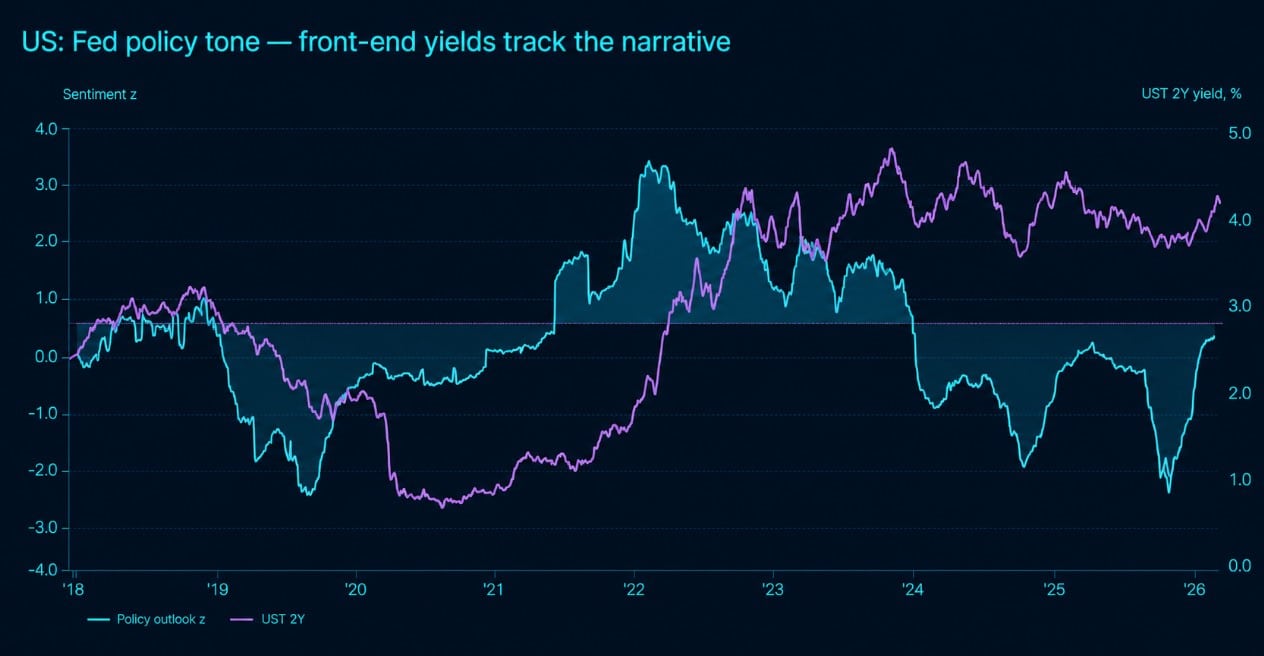
Above: Permutable’s point-in-time US policy-outlook sentiment compared with the US two-year Treasury yield, showing how shifts in policy narrative can emerge before they are fully reflected in market pricing.
Commodity markets show why the distinction between a headline and its transmission matters. Price may be responding to physical supply, expected demand, freight constraints, sanctions, weather, refinery activity, inventory changes or geopolitical risk. Several pressures can be present at once, with very different consequences for the asset.
Sanctions provide a useful example. An increase in sanctions pressure may raise the cost and complexity of moving a commodity without materially reducing export volumes. Geopolitical coverage can add a risk premium even when shipping flows, refinery operations and inventories remain largely unchanged. Neither is equivalent to a physical loss of supply.
Price captures the market’s net assessment of these forces. It does not reveal where the pressure originated, how broadly it is being reported or whether it is becoming more persistent.
Permutable’s commodity indices provide asset-level measures across energy, agriculture and metals, including Brent, WTI, natural gas, gold, copper and aluminium. Reporting is classified according to its relevance to individual assets and to the channels through which an event could reach them, including supply disruption, demand, transport, policy and geopolitical risk.
This allows researchers to frame the market question more precisely. An oil rally accompanied by a sharp deterioration in physical-supply sentiment carries a different implication from one driven mainly by geopolitical attention. Weakening copper-demand coverage across several regions is more consequential than a change confined to one market. A disruption that continues to gather momentum after the first report may warrant closer attention than one whose coverage quickly subsides.
For trading desks, this provides a way to monitor whether the balance of evidence around an asset is changing. Research teams can identify which developments require further work, while risk managers can compare a price move with the narratives surrounding it and judge whether the shock appears narrow, temporary or increasingly broad.
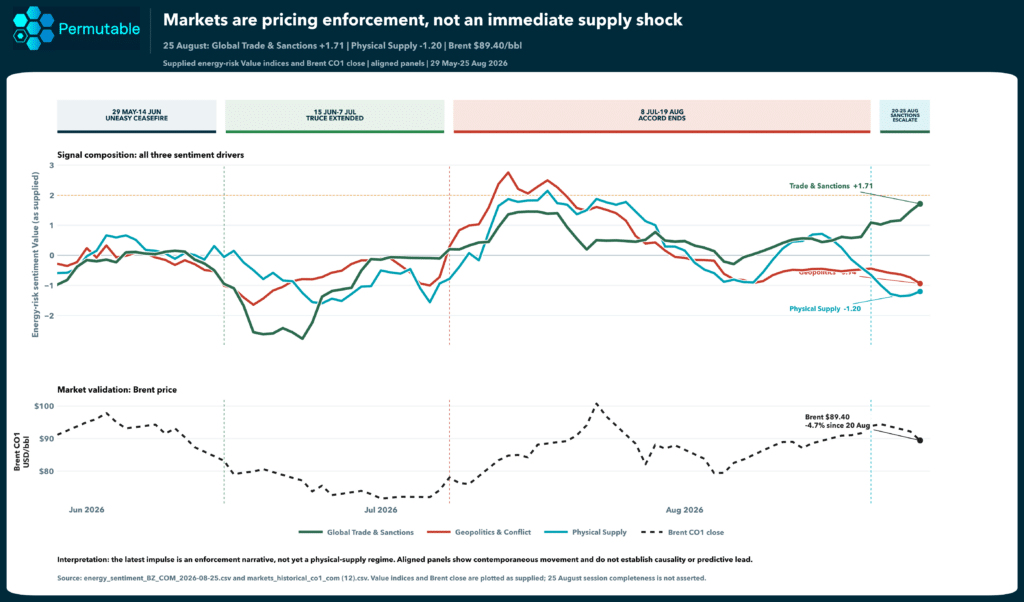
Above: Sanctions, geopolitical risk and physical-supply pressure do not always move together. Permutable’s energy-risk indices separate these underlying drivers from the headline move in Brent.
Narrative data only becomes useful when it can be incorporated into the processes through which research is conducted. That requires stable definitions, reliable timestamps, sufficient history and a route back to the source material.
At Permutable, we convert unstructured reporting into normalised macro and asset indices that can be examined by country, topic, asset, narrative driver and source perspective. The data can be delivered through an API and used in quantitative research environments, dashboards, alerts and portfolio reviews.
A researcher might compare narrative direction with price or volatility, test whether a change in sentiment preceded returns, or measure how quickly a narrative decayed after an event. The same data can be used to investigate divergences between price and the surrounding information environment, or to observe pressure passing from one channel to another – for example, from geopolitical risk into physical supply and then into inflation expectations.
Each of these uses depends on the historical record being genuine. Researchers need to know what a signal showed on a particular date using only the material then available. Without that discipline, hindsight can enter the dataset and overstate the apparent value of the signal.
Our point-in-time archive extends back to 2015, covering different policy, volatility and commodity regimes. Observations are timestamped and linked to their underlying sources. An unusual reading can therefore be investigated rather than accepted at face value, and the evidence behind a conclusion can be documented for later review.
Narrative data is not an instruction to buy or sell an asset. Nor is it a substitute for fundamental research, market data or portfolio-risk analysis. Its purpose is narrower: to measure part of the information environment that has historically been difficult to observe with any consistency.
A researcher can examine whether inflation pressure is rising across domestic sources, whether geopolitical concern is beginning to affect physical-supply reporting, or whether sentiment around an asset is diverging from its price. The institution decides whether that information is relevant to its mandate, investment horizon and risk framework.
No research team can read the full global information set as it develops. What can be done is to measure changes in the balance of reporting, identify the markets through which those changes may be transmitted and preserve the evidence needed to examine the signal afterwards.
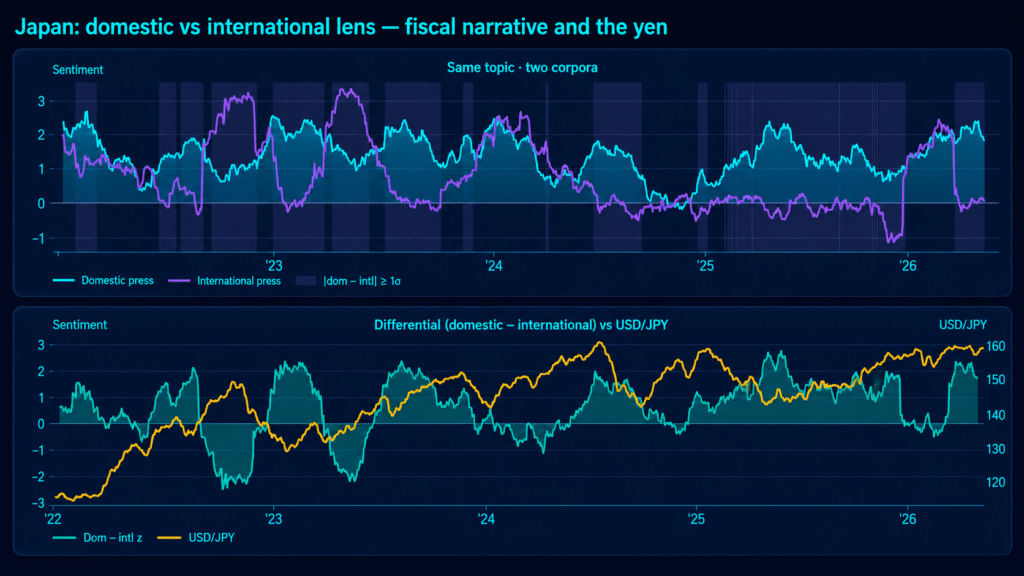
Above: Domestic and international fiscal narratives can diverge materially. Permutable’s Japan fiscal sentiment data tracks that gap alongside USD/JPY to show where the change in perception is originating.
Markets rarely move for one reason, and the headline explanation that emerges afterwards is often cleaner than the reality at the time.
The more useful question is not simply whether sentiment is positive or negative, but what is changing underneath it: which narrative is strengthening, where that pressure is coming from, whether it is persistent, and whether it is beginning to transmit into prices, rates, currencies or physical markets.
That is where point-in-time market intelligence becomes useful. It gives investors a way to reconstruct how expectations developed before an outcome was known, separate competing drivers and test whether a narrative shift had genuine market relevance.
For discretionary and systematic investors alike, the objective is the same: not to replace market judgement, but to make the formation of that judgement more observable, testable and timely.