
How shipping risk became the dominant driver in global oil markets
12 Mar 2026
12 Mar 2026
In this article we dive into how real-time shipping sentiment signalled the Hormuz crisis before Brent repriced, and what the data is telling energy traders and risk teams right now. For those tracking geopolitical regimes and building trade signals around narrative transitions, this is what using sentiment intelligence to gain structural edge in energy markets looks like in practice.
Oil markets are pricing a mobility premium. A logistics crisis so severe that the volume of supply has become secondary to the passage of Barrels. Without a route for barrels, the Strait Squeeze has turned one of the world’s most liquid commodity markets into a study in physical constraint.
The IEA estimates global output could fall by 8 million barrels per day in March, surpassing the 1973 Arab oil embargo, as the Strait of Hormuz, the 33km chokepoint carrying one-fifth of global seaborne oil, completes its transition from contested to closed. Tankers now run a gauntlet of missile strikes, drone attacks and explosive unmanned vessels. The moment insurers withdraw coverage, the barrels that exist perfectly well underground lose their path to market. Supply on paper and supply at the terminal are two very different balance sheets.
That gap widened materially in the last few hours. Iran’s new Supreme Leader Khamenei vowed via state television to continue blocking the Strait and avenge those killed in U.S. and Israeli strikes. Three further civilian cargo vessels were attacked in the same window. A U.S.-owned tanker was struck off Iraq by an explosive unmanned speedboat. A Chinese vessel took an unidentified projectile near the Strait with all crew evacuated. Iran has simultaneously extended missile strikes to escape routes for tankers and its neighbours in Bahrain, Oman, Dubai, Qatar.
This is no longer a shipping disruption with geopolitical overtones. It is a geopolitical confrontation with oil infrastructure as the primary theatre.
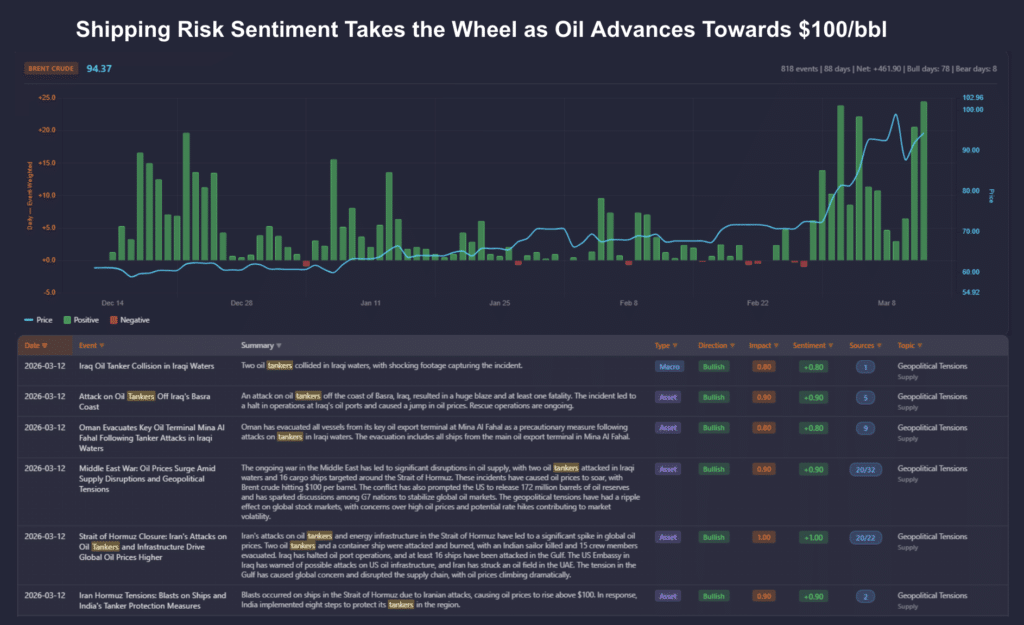
Geopolitical regimes rarely reprice in a single step. The information phase precedes the market phase, event flows densify, narrative conviction builds, and our sentiment signal accumulates well before it surfaces in spot prices.
That is precisely what happened here. By the 11th and 12th of March, our maritime sentiment had registered its highest aggregate readings of the entire three-month period, flagging the intensity of the crisis at its peak, in real time. The IEA’s 400 million barrel reserve release landed and the signal accelerated regardless. Where policy saw a pressure valve, sentiment saw through it. The narrative and the price are moving in opposite directions.
The market is not pricing inventory. It is pricing access to a tanker, an open port, and a route that still exists by morning. Our signal has been tracking that question since February. The terminal screens are only just catching up.
The reserve release is not inconsequential. But it is a volumetric instrument applied to a routing problem. Strategic reserves solve supply problems. They do not solve mobility risk.
The defining development of the past 48 hours is not the magnitude of the disruption. It is the geography. Iran has begun targeting the escape routes.
The redundancy architecture producers and operators spent decades constructing, alternative routes, bypass terminals, distributed export infrastructure, is being methodically dismantled. Strategic reserves replenish a number on a balance sheet. They cannot reconstruct a port that drones just hit.
For energy traders and risk teams deploying sentiment as a live signal layer, the current bullish shipping risk intensity is at its highest in three months and accelerating into the policy response.
The signal is accessible at the instrument level. A single API endpoint surfaces the sentiment series in real time, ready for integration into live models, risk dashboards and systematic trading frameworks.
The price driver is now the integrity of the physical infrastructure chain connecting wellhead to buyer, the mobility premium in its rawest form. That is the question the IEA cannot resolve with a reserve deployment, and it is precisely what sentiment has been flagging since February.
Narrative transitions first. Price discovery follows. The structural edge is in reading the regime as it forms, identifying the accumulation phase before the market.
Shipping sentiment flagged this transition in January. It held convictions through February. It is now registering its highest intensity readings of the cycle, undeterred by the largest coordinated policy response the IEA has ever deployed. The mobility premium is not fading. Iran’s Supreme Leader has just publicly committed to ensuring it does not.
Until tanker traffic normalises across the full Arabian Sea corridor, the premium stays structurally embedded in the price. There is no observable indication that normalisation is imminent or the US is going to back down.
The signal reflects this. The question is whether your risk framework is positioned to act on it.
The mobility premium was visible in the sentiment data weeks before Brent moved. For energy traders and risk teams who want to monitor shipping risk, track narrative regime transitions and build trade signals around the intelligence that moves before price does, this is the infrastructure to do it.
Request a demo and explore our real-time commodity sentiment intelligence at enquiries@permutable.ai
Analysis
26 Aug 2026
Why US sanctions on Iran are not lifting Brent crude
Read more >
Guide
14 Aug 2026
Measuring narrative momentum across global markets: A guide for institutional investors
Read more >
Analysis
27 Jul 2026
Saudi supply risk and import costs drive energy inflation sentiment higher
Read more >