
Founder analysis: How our real-time war sentiment data predicted the Iran oil price surge
19 Jun 2025
19 Jun 2025
On the evening of June 12th, our War Sentiment Index – one of 22 proprietary macro indices we’ve developed at Permutable AI – began detecting unusual patterns in media coverage surrounding Middle Eastern tensions. What unfolded over the next 16 hours demonstrates precisely why we built these systems and why they’re becoming indispensable for serious traders.
The timeline tells a compelling story. At 08:14, our algorithms detected the first signals of US-Israeli intent to strike Iran, with Brent crude trading at $69. By 08:30, as Iran defied warnings over uranium enrichment, our sentiment scores were already showing significant negative spikes, though oil prices remained unchanged. The key point came at 21:00 when strike warnings escalated, pushing Brent to $70 – a clear market recognition of rising tensions.
But here’s where traditional analysis falls short and where our war sentiment data proved its worth in predicting the oil price surge. At 00:07 the following day, as Israeli Air Force strike announcements broke simultaneously across Reuters, Bloomberg, CNN, and other major outlets, oil had already spiked to $74. Our War Index had been tracking this escalation in real-time, providing subscribers with actionable intelligence hours before the market fully priced in the geopolitical risk.
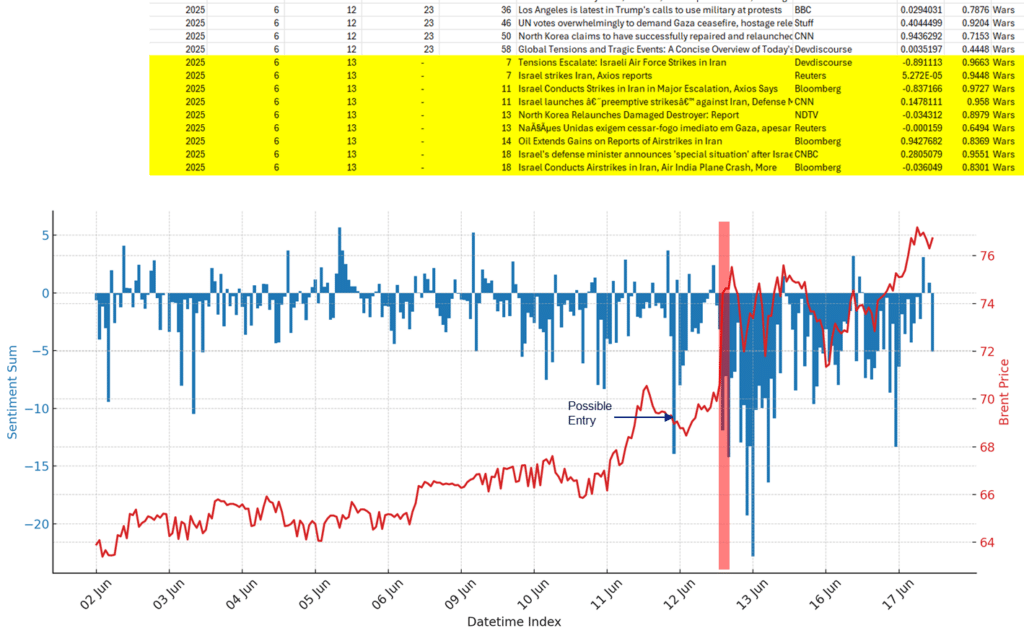
Above: Real-time tracking of the Iran-Israel escalation: Our War Sentiment Index captured the oil price surge from $69 to $74 as geopolitical tensions escalated. The blue bars show daily sentiment scores while the red line tracks Brent crude prices, with the highlighted red zone marking the critical strike period on June 13th.
Our War Sentiment Index operates on a sophisticated framework that processes thousands of articles daily, assigning sentiment scores ranging from -1 to +1 for each piece of conflict-related content. This isn’t simple keyword matching or basic natural language processing – we’ve built a powerful LLM-driven system that understands context, evaluates source credibility, and weighs the geopolitical significance of different types of coverage.
What made the Iran situation particularly interesting from a data science perspective was the consistency and intensity of the negative sentiment across all major media outlets. We recorded the highest concentration of war-related media coverage in the past 12 months, with war sentiment data showing unprecedented uniformity in their negative outlook. This convergence of sentiment indicators created what we call a “high confidence signal” – the kind of reading that demands immediate attention from risk management teams and accurately predicted the subsequent oil price surge.
The correlation between our War Index and Brent crude over the past year reveals patterns that would be impossible to detect through manual analysis. Major sentiment spikes consistently preceded significant oil price movements, including the recent oil price surge, with our data showing clear predictive value for traders who understand how to interpret these signals correctly.
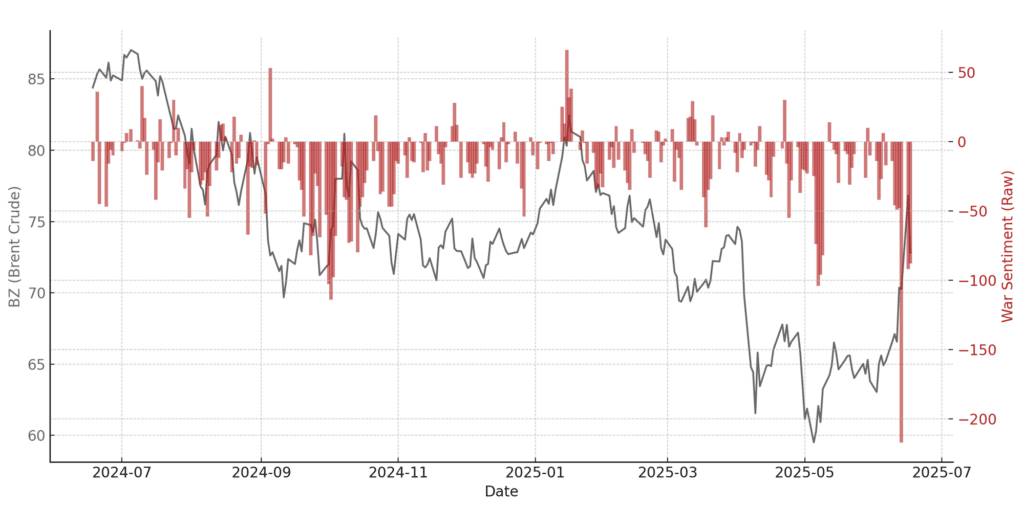
Above: One-year correlation between Brent crude prices (black line) and our War Sentiment Index (red bars). The chart demonstrates consistent predictive patterns where major sentiment spikes preceded significant oil price movements, including the recent Iran-related surge, validating our AI-driven approach to geopolitical market intelligence.
The Iran escalation highlighted a fundamental problem with conventional geopolitical analysis: by the time traditional intelligence reaches trading desks, the oil price surge has often already occurred. News travels at the speed of light, but understanding the significance and market implications of that news requires sophisticated analytical frameworks that can process vast amounts of information in real-time.
Our multi-factor analysis dashboard shows how various fundamental and geopolitical factors ranked during the critical week. While supply disruptions, inventory levels, and demand patterns all played roles, the dominant driver was clearly geopolitical tension—something that traditional fundamental analysis struggles to quantify and predict without sophisticated war sentiment data.

Above: Multi-factor analysis dashboard from our Trading Co-Pilot intelligence suite showing the ranking of fundamental and geopolitical factors during the Iran crisis week. The heatmap visualisation reveals how geopolitical tensions (shown in red) dominated other market drivers like supply disruptions and demand patterns, with our sentiment algorithms providing clear early warning signals.
This case study shows how artificial intelligence is fundamentally changing the landscape of financial intelligence. We’re moving from an era where traders relied on delayed reports and subjective analysis to one where real-time war sentiment data and automated analysis provides measurable competitive advantages.
With the sophistication of modern markets comes the demands of equally sophisticated analytical tools. Here, our 22 macro indices monitor everything from central bank communications to supply chain disruptions, each providing unique insights that, when combined, create a comprehensive picture of market-moving forces.
The Israel-Iran situation won’t be the last geopolitical crisis to impact global markets, and the speed at which these events unfold will only continue to accelerate. Our clients who are already using our sentiment and alternative data sources will have the intelligence required to predict the next oil price surge ahead of market consensus, increasingly outperforming those relying solely on traditional methods.
At Permutable AI, we’re not just building tools for today’s markets – we’re preparing for tomorrow’s complexity. As geopolitical tensions continue to drive market volatility, having real-time, quantified intelligence isn’t just an advantage – it’s becoming essential for survival in increasingly competitive global markets.
The question isn’t whether AI-driven sentiment analysis will become standard in professional trading – it’s how quickly smart traders will adopt these tools and data feeds into their workflows before their competitors do.
To explore how real-time geopolitical sentiment data can enhance your trading strategies and risk models, contact us at enquiries@permutable.ai to request a tailored demonstration.

Guide
07 Oct 2026
Commodity signal evaluation: from information flow to portfolio evidence
Read more >
Guide
14 Aug 2026
Measuring narrative momentum across global markets: A guide for institutional investors
Read more >
Analysis
27 Jul 2026
Saudi supply risk and import costs drive energy inflation sentiment higher
Read more >