
This piece is aimed at professional traders, asset managers, and energy analysts seeking to understand why trading performance in the oil markets has largely been flat in 2025, despite volatility, and what this means heading into 2026.
Oil markets in 2025 have been defined by paradox. On one hand, volatility has been elevated, with sharp intraday and week-to-week price moves triggered by geopolitics, OPEC+ decisions, and shifting macroeconomic expectations. On the other, benchmark prices for Brent and WTI have remained stubbornly range-bound, oscillating largely between $80 and $90 per barrel. For many traders, this has translated into a year of flat performance, with the clash between fundamentals and non-fundamentals has created a market where directionality is hard to capture and consistency in returns even harder.
Fundamentally, the supply-demand balance in 2025 should have pointed towards a softer market. OPEC+ announced phased output increases, while non-OPEC producers – most notably the United States, Brazil, and Canada – have pushed production to near-record levels. The International Energy Agency estimates global oil supply rose by over 1 million barrels per day during the summer months.
On the demand side, growth has been uneven. OECD consumption plateaued, with pockets of contraction linked to weak industrial output and energy efficiency gains. Emerging markets provided some support, but overall demand growth slowed to below 1 million barrels per day – significantly weaker than in previous recovery years.
Inventories also told a bearish story. Commercial stocks in advanced economies rose well above their five-year average, while floating storage increased in key shipping hubs. Refinery maintenance and logistical bottlenecks temporarily masked some of these builds, but the signal was clear: the oil markets were far from structurally tight.
Yet, despite these fundamentals, price behaviour did not follow a straightforward path. The reason lies in the persistent and sometimes overwhelming influence of non-fundamental drivers.

Above: From Permutable’s Trading Co-Pilot: Brent crude Q4 2025 outlook highlights the competing forces shaping the oil markets. While our base case expects prices to hold around $69/bbl, scenarios range from bullish tightening and supply shocks pushing above $75–78, to range-bound consolidation or macro weakness pulling prices lower towards $61. The analysis underscores how geopolitical risk premia and OPEC+ policy will remain decisive for institutional traders as we move into the final quarter of the year.
Several external forces repeatedly disrupted the link between fundamentals and price action:
Geopolitics: From strikes on Russian refineries to the resumption of Kurdish crude exports and tensions around the Strait of Hormuz, geopolitical developments injected sharp bursts of volatility into the oil markets. However, these shocks were often short-lived, with prices quickly reverting to fundamental ranges.
Market sentiment: Hedge funds and commodity trading advisors (CTAs) moved rapidly in and out of positions, amplifying short-term trends. Momentum-driven flows created intraday surges or collapses that failed to extend beyond a few sessions.
Macro conditions: The strength of the US dollar and uncertainty over global interest rate policy added another layer of complexity. A firm dollar acted as a headwind for non-dollar importers, muting demand. Meanwhile, concerns about slowing global growth further undermined bullish positioning.
Energy transition policies: Regulatory announcements and accelerating commitments to decarbonisation also weighed on long-term demand expectations. Even if near-term balances suggested resilience, policy signals made investors reluctant to extend exposure too aggressively.
The interaction of these forces explains why oil markets left so many traders flat in 2025. Several dynamics proved especially challenging:
Range-bound price action
Oil markets lacked follow-through. Brent repeatedly tested the upper $90s, only to retreat back towards $85. These failed breakouts punished trend-followers and created repeated whipsaws.
Contradictory signals
Fundamentals pointed one way, sentiment another. Inventories suggested oversupply, while refining margins remained robust. This lack of alignment made conviction trades risky.
False volatility
Implied volatility was high, but realised volatility lacked persistence. Option sellers were punished by surprise geopolitical shocks, while option buyers often saw premiums decay when moves reversed.
Geopolitical spikes fading quickly
Traders who positioned for extended disruptions found that supply often returned faster than anticipated, undercutting positions.
In short, the oil markets in 2025 produced noise rather than trend, frustrating both discretionary and systematic approaches reliant on directionality.

Above: From Permutable’s Trading Co-Pilot: Brent surged through late July on sanctions pressure and OPEC restraint, entering a bullish regime despite mixed macroeconomic sentiment. The model identified an optimal entry point ahead of the rally, with rising demand in India and supply concerns amplifying upside momentum. By combining fundamental, macroeconomic, and sentiment-driven signals, Trading Co-Pilot demonstrates how institutional traders can capture regime shifts and position ahead of market consensus.
As we look ahead, the key question is whether oil markets in 2026 will deliver more trend and less noise. Several themes for price drivers stand out:
Supply discipline remains pivotal. OPEC+ will continue to walk a tightrope between supporting prices and avoiding market share losses. A pause or reversal in production hikes could trigger a stronger bullish move.
Non-OPEC growth will test resilience. If US shale, Brazil, and Canada sustain elevated output, oversupply concerns will persist. Any slowdown in production growth, however, would shift balances quickly.
Demand risks are skewed downwards. Sluggish global growth and accelerating energy transition policies could cap upside, even if supply tightens. However, a stronger-than-expected rebound in Asian demand would provide a counterweight.
Geopolitical risk is the wild card. Escalation in the Middle East or renewed disruption to Russian exports could send prices significantly higher. Conversely, any de-escalation would reinforce the current range-bound dynamics.
Financial conditions matter. A softer dollar and lower rates could boost risk appetite and provide additional support to commodities. Tightening would have the opposite effect.
The experience of 2025 demonstrates that relying on traditional fundamentals alone is no longer sufficient in the oil markets. To navigate an environment where sentiment, geopolitics, and financial flows repeatedly disrupt expected patterns, institutional traders need sharper, more adaptive tools.
This is where Permutable’s proprietary Energy Indices and Trading Co-Pilot provide a significant advantage. Our Energy Indices distil thousands of daily data points from global news, supply chain reports, and market signals into actionable sentiment and risk metrics. By quantifying geopolitical risk, refining margin pressures, and regional demand signals in real time, these indices offer traders a clearer picture of the forces that fundamentals alone may miss.
Our Trading Co-Pilot builds on this intelligence by providing institutional traders with an integrated platform that combines sentiment analytics, macro data, and predictive modelling. This allows traders to:
Identify hidden risks and opportunities before they are priced into futures curves.
Align positioning with real-time market psychology, not just lagging fundamentals.
Test scenarios rapidly, understanding how OPEC+ moves, refinery outages, or currency shocks might affect price trajectories.
Strengthen risk management, using forward-looking sentiment and volatility alerts to avoid being caught in false breakouts or fading geopolitical shocks.
In short, our tools are designed to close the gap between traditional data and the realities of modern oil markets. For institutional traders, this means transforming the noise of 2025 into actionable signals – and positioning with more confidence as we move into 2026.

Above: This chart illustrates our crude oil index, where narrative flows around geopolitical tensions aligned closely with subsequent price moves. In this case, the narrative data acted as a leading indicator, surfacing signals hours to days ahead of observable price shifts. For systematic traders, this kind of relationship provides fertile ground for backtesting and model integration. By incorporating narrative indices, a trading desk can enhance its ability to detect structural drivers and dynamics before they manifest fully in market prices.
The oil markets of 2025 illustrate the complexity of trading in an environment where fundamentals and non-fundamentals constantly clash. Elevated volatility offered the illusion of opportunity, but the absence of sustained trends left many traders flat.
For 2026, the lesson is clear: success will require more than just reading supply-demand balances. Integrating geopolitical intelligence, macroeconomic analysis, and sentiment-driven data into trading strategies will be essential. The oil markets will remain challenging, but for those able to adopt a multi-dimensional approach, they will also continue to offer opportunity.
Discover how our Energy Indices and Trading Co-Pilot can help you cut through the noise of the oil markets and trade with greater clarity and confidence. Get in touch with our team today at enquiries@permutable.ai to learn how our data intelligence can support your strategies going into 2026.

Guide
14 Aug 2026
Measuring narrative momentum across global markets: A guide for institutional investors
Read more >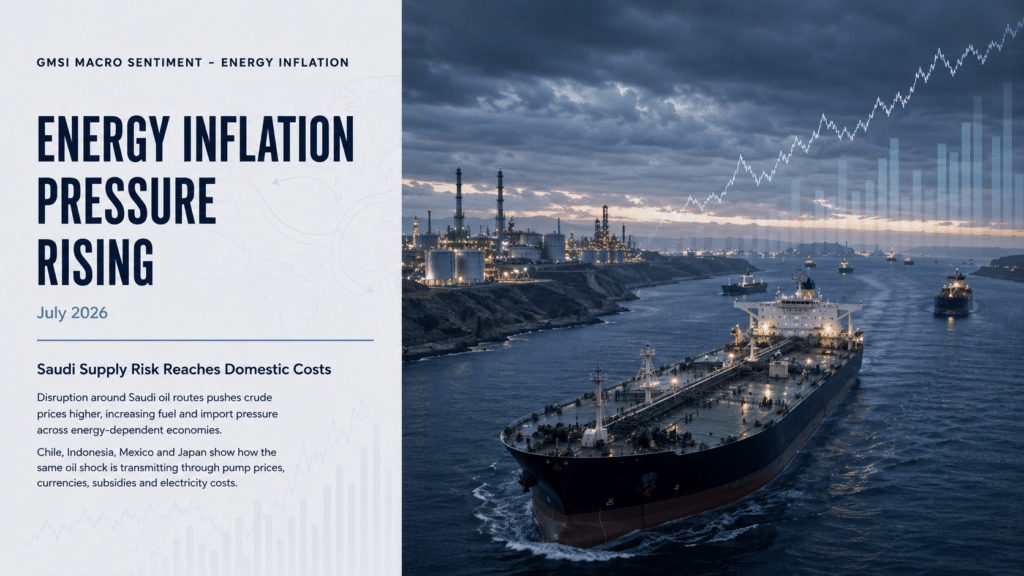
Analysis
27 Jul 2026
Saudi supply risk and import costs drive energy inflation sentiment higher
Read more >
Analysis
15 Jul 2026
The Price of Passage: How Geopolitical Sentiment Led the Repricing of Gulf Crude-Flow Risk
Read more >