
Top Crude Oil Market Intelligence Providers for Institutional Traders in 2026
01 Oct 2025
01 Oct 2025
This guide is designed for institutional energy traders, portfolio managers, analysts, and data-driven investors seeking to understand the evolving landscape of crude oil market intelligence – from established providers to next-generation AI-driven platforms like Permutable. It compares leading global intelligence solutions, outlining their strengths, limitations, and the emerging technologies reshaping how crude oil market signals are captured and acted upon. First published: 1 October 2025. Last updated: July 2026
Crude oil market intelligence providers help trading desks, energy analysts, risk teams and institutional investors monitor the forces that move Brent, WTI and refined products. The strongest platforms combine benchmark prices, physical market data, supply-demand fundamentals, geopolitical context, shipping and flow data, refinery intelligence and, increasingly, AI-driven narrative and sentiment signals.
Established providers such as S&P Global Commodity Insights, Argus Media, Energy Intelligence and Rystad Energy remain important for benchmarks, fundamentals and research, while newer intelligence layers such as Permutable help institutional teams detect market-moving narratives, sentiment shifts and risk signals in real time.
Of course, platforms such as Bloomberg L.P., Reuters and S&P Global Platts remain essential tools for professional traders. They provide authoritative reporting, pricing and market context that every desk relies on.
However, they were designed primarily for human consumption. Traders still need to search, filter and interpret information manually, which creates friction at exactly the moment speed matters most.
At Permutable, we complement these platforms by acting as an intelligence layer on top. Rather than replacing trusted sources, we automatically monitor them alongside thousands of others, extract the relevant signals and surface only what is likely to impact price. The result is the same breadth of coverage, but delivered as prioritised, structured insight instead of information overload.
| Provider | Best for | Main strength |
|---|---|---|
| Permutable | Institutional teams needing real-time oil narrative and sentiment intelligence | AI-driven signal detection, sentiment analysis, macro context and API delivery |
| S&P Global Commodity Insights / Platts | Benchmark pricing and physical oil market reference data | Crude benchmarks, assessments and market structure |
| Argus Media | Physical oil trading, regional price assessments and contract reference | Independent PRA coverage and regional market depth |
| Energy Intelligence | Strategic oil market research and policy context | Editorial depth, OPEC analysis and geopolitical interpretation |
| Rystad Energy | Upstream fundamentals and long-term supply modelling | Production data, project-level modelling and energy transition analysis |
| Enverus | North American upstream, production and operational intelligence | Asset-level and geospatial energy data |
| Energy Aspects | Human-led oil research and market commentary | Fundamental analysis and institutional research |
| Kpler | Commodity flows, shipping and cargo tracking | Physical flows, vessels and seaborne trade visibility |
| Vortexa | Real-time oil flows and freight analytics | Cargo movement, storage and trade-flow intelligence |
| FactSet / BTU Analytics | US energy fundamentals and financial workflows | Regional oil, gas and power analytics within financial data workflows |
| Team | What they need | How intelligence is used |
|---|---|---|
| Discretionary oil traders | Fast read on what is moving Brent and WTI | Narrative shifts, OPEC sentiment, refinery outages, supply risk |
| Systematic funds | Structured signals for models | Point-in-time sentiment, event and volatility indicators |
| Risk teams | Early warning of market stress | Geopolitical risk, sanctions, demand shocks and concentration alerts |
| Macro strategists | Cross-asset context | Links between oil, inflation, FX, rates and policy |
| Energy analysts | Explanation of price drivers | Supply-demand, refinery, transport and policy context |
| Procurement and hedging teams | Better timing and risk management | Forward-looking signals around volatility, disruption and cost pressure |
At Permutable, we believe the next generation of crude oil market intelligence will be defined by speed, context, and comprehension. Traditional market data tells you what has happened – we tell you why it’s happening, as it happens.
Our technology transforms crude oil market complexity into a competitive trading edge. Processing over 500,000 news articles and market events daily, our proprietary AI continuously analyses global petroleum data, delivering real-time, actionable insights across Brent Crude, WTI Crude, Heating Oil, RBOB Gasoline, and Gas Oil.
Our automated narrative intelligence engine scans thousands of verified sources per minute to detect supply disruptions, demand shifts, refinery events, and market structure changes – providing traders with instant visibility on what’s driving prices and sentiment. These high-frequency signals allow institutional traders to anticipate volatility, quantify market mood, and execute with precision – often before the wider market reacts.
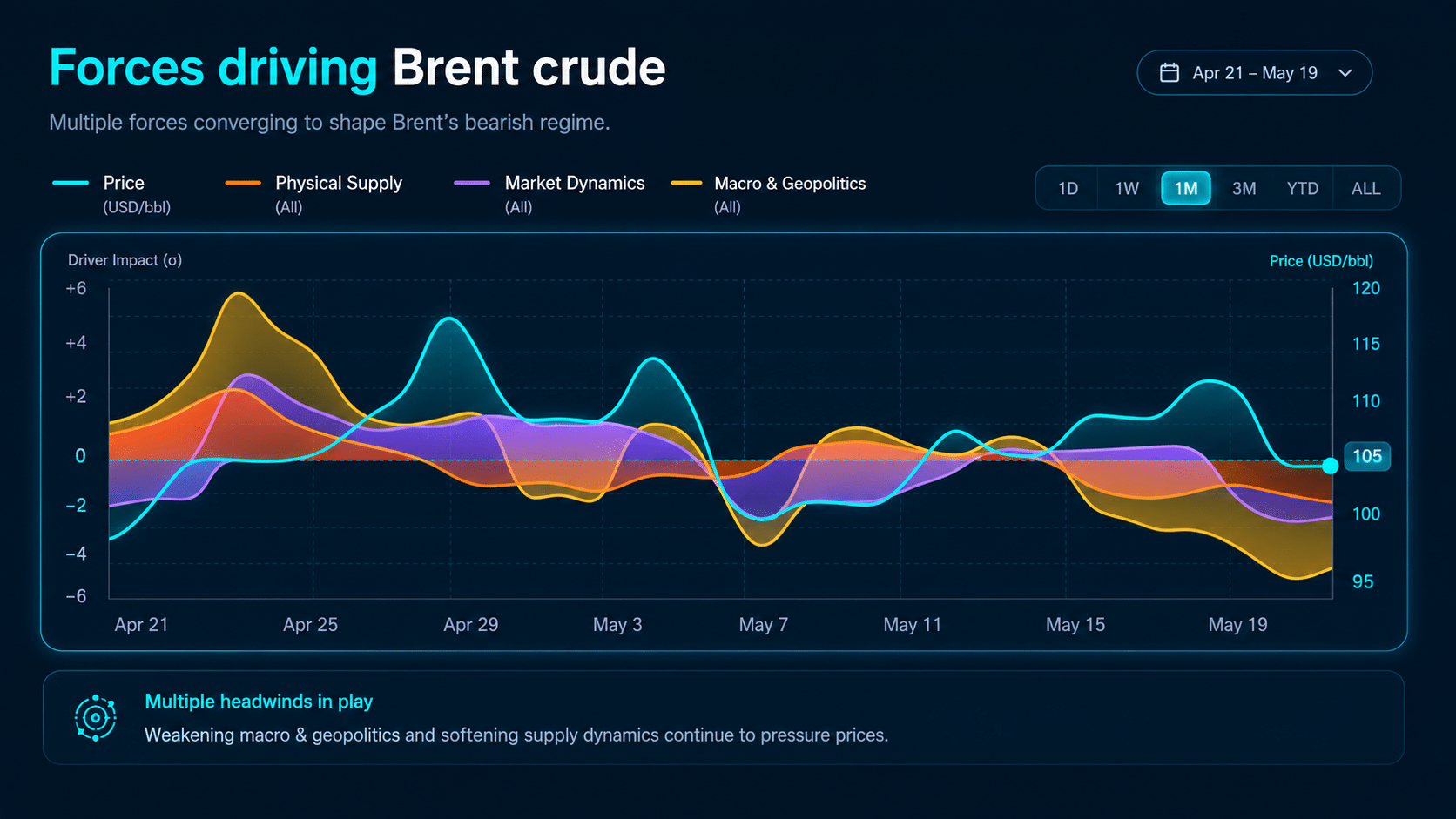
Permutable’s intelligence engine combines macroeconomic context, sentiment analysis, and high-speed event processing to deliver verified insight in milliseconds. Covering everything from OPEC+ policy shifts to refinery maintenance patterns and currency correlations, we help traders uncover hidden relationships that drive price action.
Gain instant analysis from thousands of verified global sources, with real-time summaries highlighting emerging narratives, geopolitical tensions, and operational risks such as sanctions, outages, or refinery incidents.
Access six-month predictive projections with dynamic confidence intervals to anticipate structural shifts in crude markets. Traders can stress-test strategies, quantify macro risk, and prepare for potential outcomes before they materialise.
Our structured data and sentiment signals are available via Permutable’s API, enabling seamless integration into institutional trading systems for model calibration, backtesting, and automated strategy development.
Our automated analysis engine continuously monitors and interprets five core market domains in real time:
Supply Dynamics — OPEC+ output, strategic reserves, refinery operations.
Demand Intelligence — transportation fuels, industrial consumption, seasonal trends.
Geopolitical Risk — sanctions, regional conflicts, and trade flow disruptions.
Refinery Analytics — crack spreads, maintenance schedules, product yields.
Price Discovery — futures, physical differentials, and arbitrage opportunities.
By combining these pillars with live sentiment detection, we provide an integrated intelligence layer that helps institutional traders detect, quantify, and act on market-moving signals.
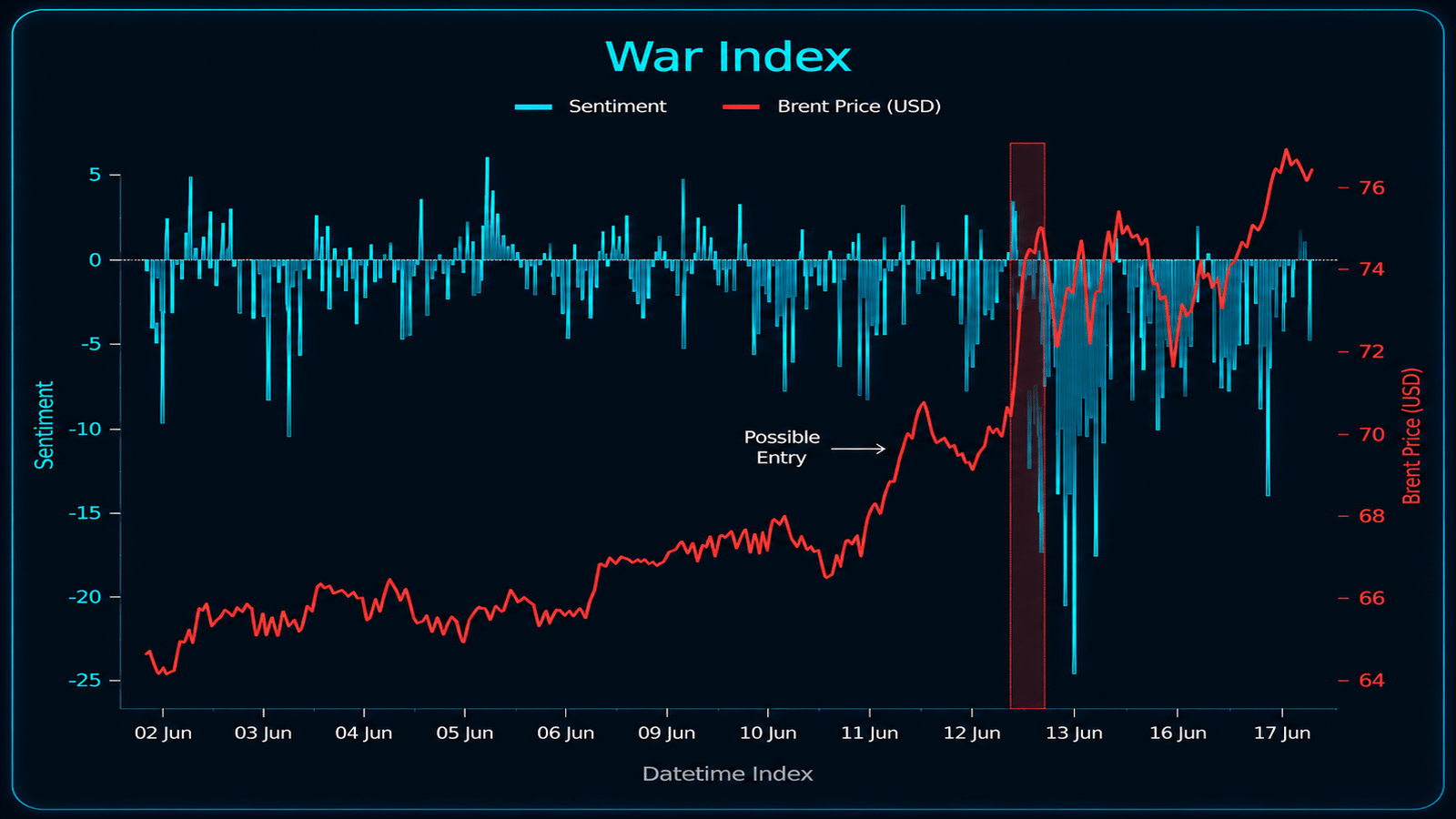
Real-Time Market Commentary – Automated executive summaries and weekly market roundups from thousands of sources.
High-Volume Event Processing – Live detection of supply disruptions, geopolitical tensions, and sentiment swings.
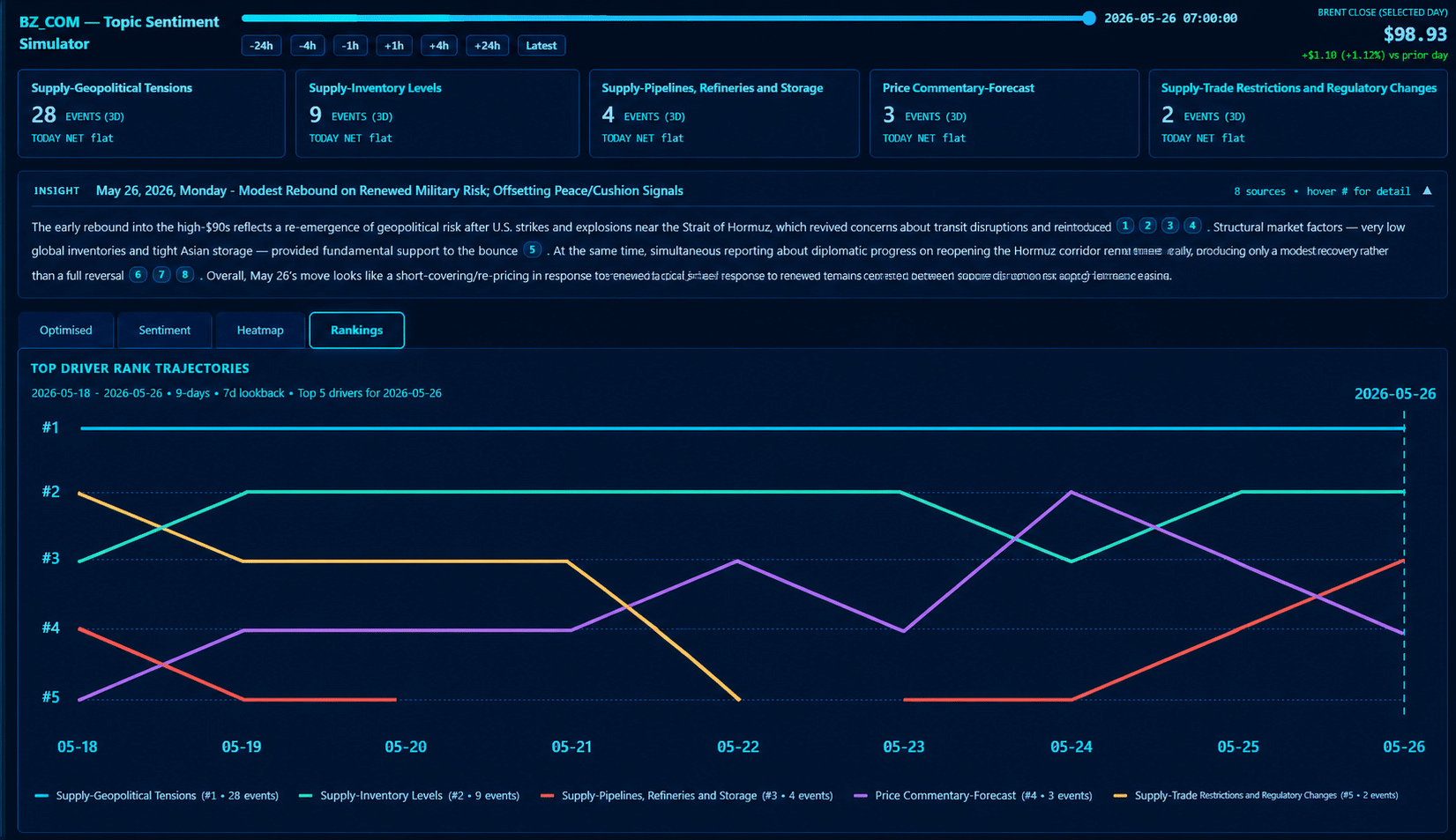
Automated Forecasting – Six-month forecasting models with probability-weighted price projections and scenario analysis.
High-Frequency Data Feeds – Granular, real-time demand/supply factor analysis and story signal detection for model inputs.
All data is accessible through our API, offering millisecond-latency delivery, webhook support, and compatibility with Python, R, and Java.
Permutable provides continuous, real-time coverage of:
Brent Crude – Global benchmark crude.
WTI Crude – US benchmark crude.
Heating Oil – Distillate fuel tracking demand cycles and refinery yield changes.
RBOB Gasoline – Reformulated gasoline blendstock for seasonal and demand monitoring.
Gas Oil – European diesel benchmark for industrial and freight sectors.
Institutional users can access intelligence feeds, sentiment indicators, and forecasting dashboards across all of these assets — turning data noise into actionable trading clarity.
Real-time, AI-driven intelligence rather than lagging data.
Integrated macro, sentiment, and asset-level signals in one platform.
Cross-asset correlation for predictive market context.
Transparent, explainable AI models for institutional adoption.
As a next-generation entrant, historical data depth is still expanding compared to legacy providers.
In essence, Permutable delivers what traditional providers can’t: instantaneous crude oil market intelligence that merges global macro events, sentiment, and quantitative data into one unified analytical lens.
S&P Global Commodity Insights, still widely recognised as Platts, remains one of the most influential names in global energy data. Its price assessments for Brent and WTI set the standard for physical and derivatives trading, underpinning contracts and financial instruments worldwide.
Institutions and traders relying on benchmark pricing, compliance, or valuation models rather than forward-looking intelligence.
Argus Media is a highly regarded independent price reporting agency (PRA) with global coverage across energy commodities, refined products, petrochemicals, and freight. Its reports are widely used for physical trading, contract settlement, and regional analysis.
Physical traders, refiners, and procurement teams needing validated market structure data to manage operations and contract negotiations.
Energy Intelligence, through its renowned Oil Market Intelligence (OMI) publication, offers long-form, contextual insights into global supply-demand balances, policy developments, and strategic movements within OPEC and non-OPEC producers.
Strategists and policy analysts who prioritise context, commentary, and geopolitical interpretation over high-frequency data.
Rystad Energy, headquartered in Norway, has become a cornerstone for upstream modelling, production forecasts, and transition analytics. Known for its technical rigour, Rystad’s data underpins many institutional and governmental outlooks.
Institutional investors, research teams, and policymakers needing strategic energy modelling rather than short-term trading intelligence.
Enverus (formerly Drillinginfo) specialises in operational, production, and investment analytics, blending financial, satellite, and geospatial data to map energy flows and supply dynamics — particularly in the North American market.
Energy producers, investors, and analysts focused on North American supply fundamentals and operational intelligence.
Energy Aspects is a boutique research house delivering data-backed commentary on oil, gas, and power markets. Its research is widely followed by hedge funds, traders, and institutional investors seeking nuanced market interpretation.
Funds and strategists seeking human expertise paired with fundamental depth, rather than high-frequency automation.
BTU Analytics, now integrated into FactSet, focuses on US oil, gas, and power markets with a fundamentals-first approach. It serves institutional clients needing clear, concise energy data and regional insight.
Cons
Crude oil intelligence is not one single category. Most institutional teams use a stack of providers, with each layer answering a different part of the trading, research and risk workflow.
| Intelligence layer | Typical providers | What it helps answer |
|---|---|---|
| Exchange prices and futures | ICE, CME, NYMEX | Where Brent, WTI and refined products are trading |
| Benchmark assessments | S&P Global Commodity Insights, Argus Media | What reference prices are used for physical contracts and valuation |
| Physical flows and shipping | Kpler, Vortexa | Where crude and refined products are moving |
| Supply-demand fundamentals | Rystad Energy, Energy Aspects, Enverus, FactSet / BTU | What is happening to production, inventories, demand and balances |
| Strategic research and policy context | Energy Intelligence, Energy Aspects | Why OPEC, sanctions, policy or geopolitical events matter |
| Real-time narrative and sentiment intelligence | Permutable | Which market narratives, risks and sentiment shifts are building before they are fully priced |
Choosing the right crude oil market intelligence provider depends on where the gap sits in your workflow: pricing, physical market visibility, fundamentals, research context or real-time narrative detection. If you need benchmark crude prices, use a price reporting agency. If you need physical cargo visibility, use a flow analytics provider. If you need long-term supply-demand modelling, use a fundamentals provider. If you need to know which market narratives and sentiment shifts are building in real time, use an intelligence layer such as Permutable alongside those sources.
| Criterion | Why it matters |
|---|---|
| Benchmark credibility | Needed for contract reference, valuation and compliance |
| Physical market coverage | Important for crude grades, differentials, freight and regional balances |
| Flow visibility | Helps track cargo movement, shipping disruption and trade rerouting |
| Supply-demand fundamentals | Supports medium-term price views and balance forecasting |
| Real-time narrative detection | Helps identify market-moving stories before they become consensus |
| Sentiment and event signals | Useful for volatility monitoring and systematic research |
| Point-in-time history | Required for backtesting and signal validation |
| Delivery method | API, Excel, dashboards and data feeds affect workflow adoption |
| Explainability | Institutional users need to understand why a signal changed |
| Complementarity | Most oil desks need a stack, not a single all-purpose tool |

Guide
14 Aug 2026
Measuring narrative momentum across global markets: A guide for institutional investors
Read more >
Analysis
27 Jul 2026
Saudi supply risk and import costs drive energy inflation sentiment higher
Read more >
Analysis
15 Jul 2026
The Price of Passage: How Geopolitical Sentiment Led the Repricing of Gulf Crude-Flow Risk
Read more >