How can workflow provide an edge in volatile markets and reduce opportunity cost of limited clarity?
03 Mar 2026
03 Mar 2026
This article examines how structured workflow provides a competitive edge in volatile markets by reducing the opportunity cost created by limited clarity. It is aimed at hedge fund portfolio managers, macro strategists, quantitative teams and risk desks seeking to convert high-volume narrative flow into structured, trade-relevant signals and act before regime shifts are fully priced into markets.
What happens to trading performance when volatility spikes, information floods the market, yet tradable clarity remains out of reach – and how much opportunity is lost while teams wait for conviction that never fully arrives? The outcome is consistent. Uncertainty creeps into the process, conviction is eroded by unfiltered noise, and action is delayed until the risk is already priced and the timing advantage has vanished.
To address this, we have built a solution that slots directly into institutional workflow, whether a team wants structured data feeds through our Systematic Asset Indices, macro context through our Regional Macro Indices, or the full stack delivered through our Trading Co-Pilot.
It is designed for exactly these moments. It does not add to the noise, it converts fast-moving narrative flow into structured, trade-relevant signals, restoring visibility and tightening the path from interpretation to execution.
Central to this is the notion that workflow matters as much as the regime you are trading. In fast markets, the dividing line between proactive and reactive is rarely talent. It is infrastructure and the right toolkit.
Without it, desks tend to recognise regime change only once price has done the repricing and consensus has formed around the explanation. With it, systematic inputs and a discretionary interface work in tandem, giving teams a coherent view across assets and macro – allowing them to catch the inflection point, watch the shift develop, judge whether it is persisting, and act while the market is still figuring out what narrative to trade off.
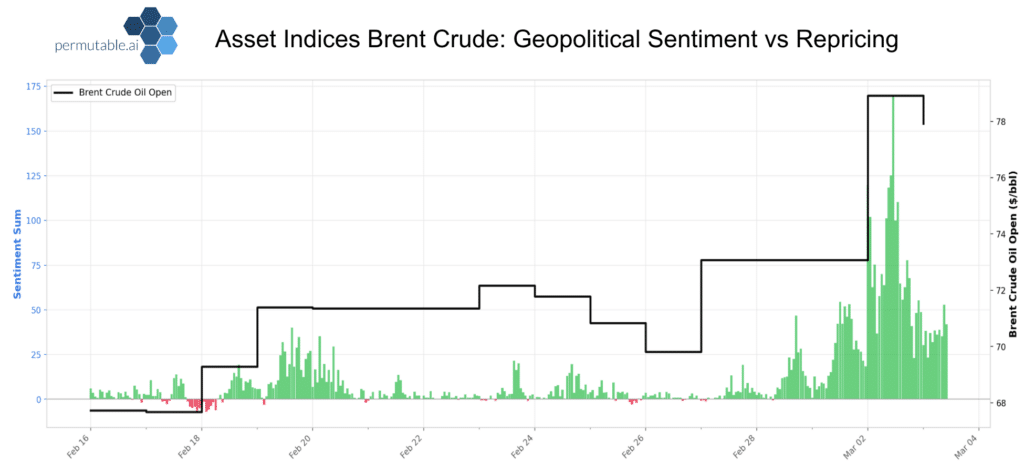
The energy market is the primary transmission channel of the current conflict. Strait of Hormuz transit risk, tanker insurance repricing and Gulf supply node disruption are generating continuous, high-volume headline flow, the majority of which is noise.
The operational problem for desks and quantitative models alike is extraction: identifying which part of that flow carries genuine signal on supply constraint, and whether that signal is persisting or fading.
Most desks are currently solving this through a combination of analyst coverage, Bloomberg headline monitoring and periodic research updates. The limitation is not effort, it is frequency. Analyst synthesis is episodic.
From Episodic Research to Continuous Signal
The Systematic Asset Indices replace that episodic layer with a continuous one, ingesting unstructured sentiment data from energy market headlines in real time and processing it into structured, quantified signals that are directly consumable as model inputs or desk-level monitoring feeds.
For the energy complex specifically, this means systematic tracking of sentiment across crude, refined products, LNG and associated supply chain narratives, covering tanker availability, rerouting risk, and production precaution versus physical closure, as they develop rather than after they have settled.
Persistence Is the Signal
The signal value in this environment lies in persistence and the monitoring of inflection points. A single-session spike in energy disruption sentiment is a volatility event. Elevated sentiment that sustains across multiple sessions, broadens geographically across Gulf supply nodes, and transmits into LNG and refinery margin narratives is a regime move. When the tankers change course, the signal moves before the price does.
That distinction is not visible in price alone and it is not resolvable through periodic research. Desks using the Indices have visibility on narrative momentum building in real time, typically several hours ahead of the point at which that momentum is reflected in analyst consensus or price-implied positioning. It is precisely this continuous, structured feed that quantifies narrative momentum as it builds and delivers it into models and trading infrastructure.
A Structured Input for Risk Infrastructure
For risk desks specifically, the Indices provide a structured sentiment input that can be incorporated directly into factor models and stress testing frameworks, offering a more responsive lead indicator of supply regime change than price-based signals alone.
Note the persistence of crude sentiment above the disruption threshold from day three onward. That is the signal that separates a spike from a structural move.
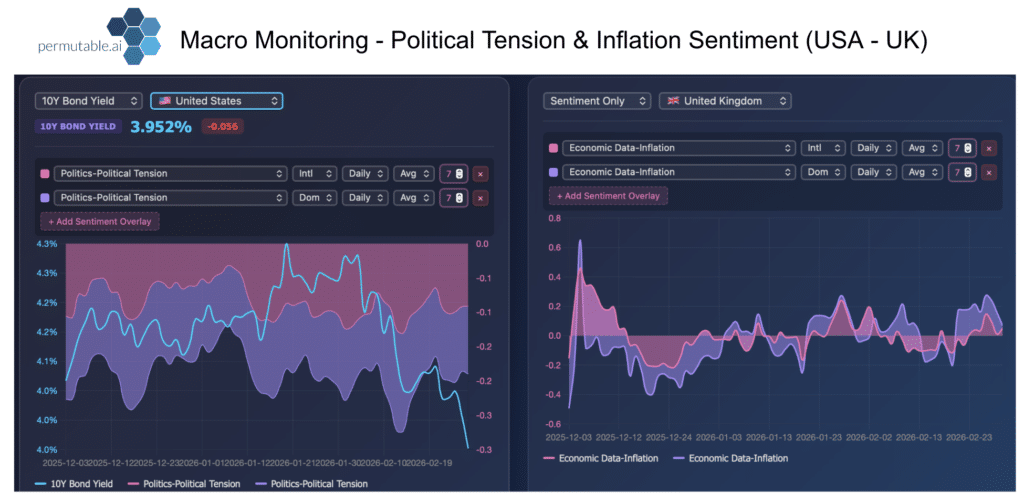
Price moves in energy are the first-order effect. The more consequential analytical challenge, and the one that determines medium-term positioning, is mapping second-order transmission: where an energy shock blends into macro regime change, and which countries, currencies and central bank reaction functions are caught in the crosscurrent.
The Structural Limits of Traditional Macro Monitoring
Standard macro monitoring, whether through wire services, central bank communications or sell-side research, covers this terrain but with two structural constraints. Coverage is concentrated in major economies and English-language sources, and synthesis is retrospective rather than continuous.
Our Regional Macro Indices address both directly. As a real-time data feed spanning more than 50 countries with multilingual source coverage across 26 discrete macro topics, it provides institutional desks with the country-level signal that wire services and research coverage consistently are unable to solve, turning unstructured information into a structured signal. In the current conflict context, that breadth is material.
Second-order transmission does not respect G10 boundaries, and the macro risk embedded in import-dependent emerging market economies is often precisely where the most asymmetric positioning sits.
Three Transmission Channels That Define the Regime
The analytical focus in the present tentative backdrop resolves to three transmission channels.
Inflation
A sustained energy shock does not remain contained within the energy complex. It feeds directly into CPI expectations, particularly in import-dependent economies across Europe and Asia. When oil prices catch a geopolitical tailwind of this magnitude, the inflationary pressure that follows is rarely contained at the pump.
The Indices track inflation sentiment at country level in real time, allowing desks to monitor where the energy-to-inflation transmission is being priced into forward expectations and whether central bank communication is shifting in response, before that shift appears in formal guidance or consensus forecasts.
Central bank reaction
The critical question for rates positioning is whether policymakers frame the shock as transitory supply noise or a renewed inflation impulse requiring a policy response. Central banks navigating a geopolitical storm of this nature face an uncomfortable choice: tighten into a slowdown or tolerate an inflation overshoot. That framing varies materially by country and becomes visible in real time through the macro sentiment feed well before it crystallises into formal guidance.
Desks with access to the country-level data can track the divergence in central bank tone across the Federal Reserve, the ECB and major emerging market central banks as the energy shock develops, giving them a read on the rates landscape that is several days ahead of what sell-side research will reflect.
Political risk and safe haven rotation
Country-level macro risk sentiment, covering geopolitical exposure, fiscal strain and political vulnerability, drives the initial safe haven rotation and determines which currency pairs and sovereign bond markets carry the most asymmetric risk in an escalation scenario.
In a geopolitical storm, not every port offers shelter equally, and the Indices make that distinction visible at country level in real time, giving desks a structured basis for FX and rates positioning that goes considerably beyond headline geopolitical proximity.
The point at which multiple country signals elevate simultaneously is where a bilateral tension becomes a systemic pricing event. That is the threshold the heatmap is designed to make visible before the broader market has charted the same course.
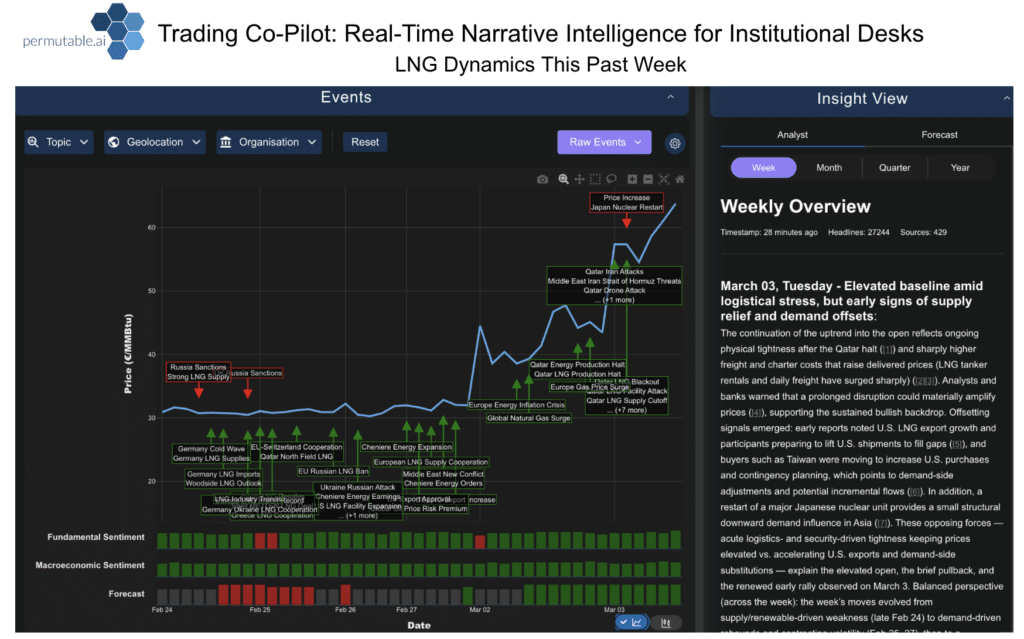
The data layer answers what is moving and why. The execution and analytical layer answers what to do about it and when. Trading Co-Pilot is the interface that bridges that gap, a continuously updating visual environment that compiles thousands of headlines per day into the market-moving signals that matter, without requiring manual synthesis.
Solving the Scale Problem in Modern Markets
In the past week alone, our Trading Co-Pilot processed 404,956 headlines across 43,006 events, drawn from 66 languages. No desk can synthesise that volume manually at the speed the market requires.
The alternative, relying on a curated selection of tier-one sources and analyst summaries, reduces noise but sacrifices coverage precisely where geopolitical and supply chain risk tends to surface first: regional sources, non-English language reporting and specialist trade publications that precede mainstream financial coverage by several hours.
By the time that signal reaches a standard research workflow, the ship has often already sailed. Co-Pilot compresses the full breadth of that flow into a continuously updated visual read, structured, ranked and oriented around what is actually driving the market rather than what is simply generating the most volume.
Three Structured Lenses on Market Drivers
In a live escalation environment, the Trading Co-Pilot provides a real-time read on the commodity complex through three structured lenses: Fundamental, Sectoral and Macroeconomic Risk, each expressed in terms of market sentiment. Every lens is continuously refreshed as news flow develops, giving desks an asset-aware view that reflects the actual drivers of commodity price at any given moment.
The event feed surfaces the most consequential developments as they land, ranked by market relevance rather than recency. Sentiment analysis runs continuously across the incoming flow, providing a quantified read on whether the dominant narrative is intensifying or fading.
As conditions shift, real-time insights flag when the balance of drivers is changing, when supply disruption sentiment begins transmitting into demand destruction signals, or when macroeconomic risk factors start overriding commodity-specific fundamentals.
Compressing Interpretation Time as a Structural Edge
For desks managing positions across a fast-moving energy and geopolitical landscape, our Trading Co-Pilot removes the latency between news flow and structured interpretation. The interface is designed for speed.
A desk should be able to form an accurate read on the state of the market within seconds rather than minutes, and track how that read is evolving as conditions develop. In environments where the window between signal and consensus is measured in hours, that compression of interpretation time is a structural advantage.
In energy-led geopolitical shock environments, the cost of a wait-and-see posture compounds quickly. The window between signal formation and market repricing is where positioning carries asymmetric value. Once consensus is fully priced, the convexity is gone, liquidity is thinner and the clean expressions have moved. At that point, the opportunity has sailed and the market has moved on to pricing the next chapter.
The Systematic Asset Indices, Regional Macro Indices and Trading Co-Pilot operate as a continuous, integrated workflow built for exactly this environment. Each layer addresses a distinct part of the problem and feeds directly into the next.
Systematic Asset Indices: persistent, quantified sentiment signals extracted from high-volume energy market headline flow, updated continuously and consumable directly as model inputs or desk-level monitoring feeds.
Regional Macro Indices: second-order transmission tracked across more than 50 countries and 26 macro topics, covering inflation expectations, central bank tone and political risk in real time, across languages and markets that standard research routinely misses.
Trading Co-Pilot: thousands of daily inputs compressed into a single continuously updated visual interface, structured, ranked and market-relevant. An analytical read on what is driving price, available in seconds.
Three layers. One integrated workflow. No gap between signal and execution.
The next escalation will not announce itself. Every hour a desk operates without structured signals in this environment is an hour the market is pricing something they cannot yet see. In fast-moving regimes, flying blind is not a neutral position. It is a losing one.
The desks that act with conviction in fast-moving markets are not better informed, they are better equipped. When the geopolitical weather turns, the advantage belongs to those who saw the front moving in, not those waiting for the storm to arrive before adjusting their sails.
Structured commodity sentiment data, continuous country-level macro feeds and a real-time visual interface are not enhancements to existing workflow. In volatile regimes, they are the workflow.
Permutable AI’s Systematic Asset Indices, Regional Macro Indices and Trading Co-Pilot are available now, with API integration that sits cleanly alongside existing market data infrastructure. Institutional teams can access a sample data pull from the current escalation window, a live walkthrough of the Co-Pilot interface, or full technical integration documentation – whichever is the most useful starting point for evaluation.
To request API access or to arrange a walkthrough to discuss integration, contact us at enquiries@permutable.ai