This institutional guide explores how hedge funds can integrate alternative macro signals into systematic and discretionary strategies. It compares leading providers including Permutable, RavenPack, Bloomberg and Macrobond, with a focus on regime detection, integration, and live trading validation. The article is aimed at hedge fund managers, CIOs, quantitative researchers and institutional allocators evaluating macro signal infrastructure. Originally published: 3 March 2026. Last updated: 6 July 2026 to reflect the launch of Permutable’s Global Macro Sentiment Indices, updated provider evaluation criteria and institutional workflow use cases.
Over the past decade, hedge funds have dramatically expanded their data inputs. Yet while alternative data in equities has matured, the integration of alternative macro signals remains uneven across the industry.
Traditional macro indicators – CPI, payrolls, GDP, central bank meetings – are backward-looking by design. They confirm what has already happened. Markets, however, increasingly reprice based on narrative shifts, geopolitical developments, policy tone changes, and cross-asset contagion dynamics long before official releases validate the move.
The strategic question for institutional investors is no longer whether alternative macro signals matter. It is how to integrate them rigorously, transparently, and in a way that improves real trading outcomes.
This guide provides a fair institutional comparison of leading platforms – beginning with our offering here at Permutable.
Best alternative macro signal providers for hedge funds in 2026
| Provider type |
Best suited for |
Strength |
Limitation |
| Permutable |
Macro sentiment, narrative intelligence, cross-asset signals |
Point-in-time macro signals, country coverage, API delivery, explainability |
Best suited to teams that can use structured signal data |
| RavenPack |
Structured news analytics |
Established event and news analytics infrastructure |
Often requires internal modelling to create differentiated macro signals |
| Bloomberg |
Core market data and workflow infrastructure |
Broad institutional adoption, pricing, news and analytics |
Alternative macro signals usually need specialist layers on top |
| Macrobond |
Traditional macroeconomic time-series research |
Deep economic data and visualisation |
Less focused on live narrative or sentiment signal generation |
| AlphaSense |
Document and research discovery |
Strong qualitative research workflows |
Not primarily a point-in-time macro signal provider |
Permutable: Alternative macro signals built for institutional deployment
At Permutable, our macro intelligence has been built specifically to address a structural gap in macro investing: the absence of structured, real-time alternative macro signals that are both explainable and deployable.
While many providers distribute news feeds or generic sentiment scores, we focus on providing macro narrative intelligence – extracting structured signals from global information flows and mapping them directly to tradable assets.
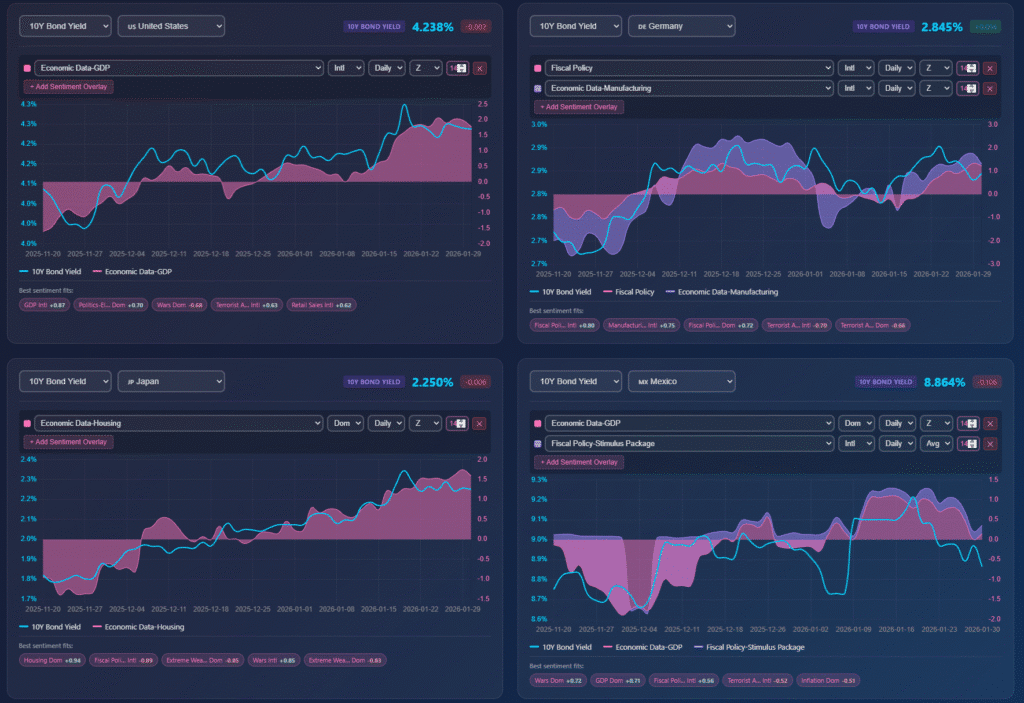
Moving beyond headline sentiment
Most sentiment systems treat information in isolation: a single country, a single asset, a single headline.
At Permutable, our approach models relationships across multiple macro entities simultaneously – countries, commodities, policymakers, institutions and sectors. This multi-entity modelling framework captures context.
For example:
-
Is rising inflation rhetoric isolated to one region, or spreading across central banks?
-
Is geopolitical tension concentrated, or cascading into energy markets?
-
Is policy tone shifting gradually, or accelerating abruptly?
These contextual dynamics form the backbone of robust alternative macro signals. Markets do not move on isolated data points – they move on narrative momentum.
Regime detection, not noise
Institutional macro investing is ultimately about regimes.
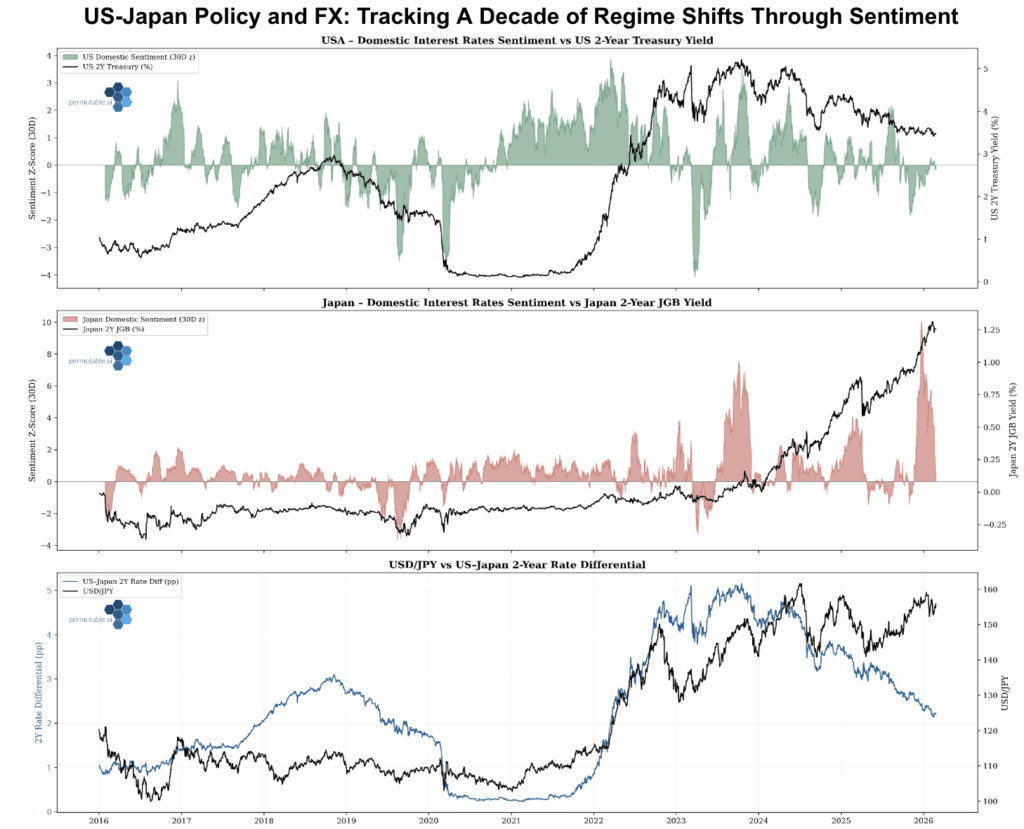
Trend-following strategies perform differently under inflationary versus disinflationary conditions. Commodity strategies behave differently during supply shocks versus demand contractions. Risk assets reprice when policy tone shifts.
Our country-level alternative macro signals are structured to detect these shifts early – identifying narrative acceleration, divergence, and cross-asset spillovers before they become consensus positioning.
This makes the signals suitable for:
-
Systematic regime filters
-
Risk overlays
-
Volatility positioning frameworks
-
Cross-asset allocation adjustments
Proven in live trading
A core question institutional investors ask when evaluating alternative macro signals is simple: Has this been deployed beyond the research environment?
Permutable’s alternative macro signals have been applied within a live, rules-based commodity trading strategy. Signals have been used across liquid markets including energy (natural gas and crude oil), precious metals and agricultural contracts.
Live deployment matters. Backtesting is essential for model development and validation, but live markets introduce conditions that cannot be perfectly simulated – real-time narrative acceleration, liquidity shifts, unexpected geopolitical developments and behavioural responses from other participants.
Operating in a live environment allows signals to be evaluated under:
-
Sustained volatility regimes
-
Rapid narrative shifts
-
Cross-asset transmission dynamics
-
Real-time decision cycles
For institutional allocators and hedge funds, this distinction is meaningful. It demonstrates that the infrastructure has operated under real information flow conditions, not solely within historical replay.
Built for institutional integration
Alternative macro signals only create value when they integrate cleanly into existing workflows. At Permutable we deliver structured outputs via API, designed to slot into institutional infrastructure. Teams can:
-
Backtest signals across historical regimes
-
Integrate into Python or R research environments
-
Incorporate outputs into systematic models
-
Overlay signals within portfolio monitoring and risk frameworks
-
Map structured signals to tradable instruments
Equally important is explainability. Institutional governance processes increasingly require transparency around data lineage, methodology and signal construction. Structured, auditable outputs are critical for due diligence, model review committees and risk oversight.
Permutable’s Global Macro Sentiment Indices alternative macro signals
Permutable’s newly launched Global Macro Sentiment Indices are designed to make alternative macro signals usable in institutional workflows. The indices convert large-scale macro narratives into structured country-level and theme-level signals across inflation, growth, monetary policy, fiscal policy, trade, labour markets and geopolitical risk.
The data is built point-in-time, allowing teams to analyse what was knowable at a given moment rather than relying on revised or hindsight-adjusted information. This matters for macro research, signal validation and systematic testing, where look-ahead bias can materially distort results.
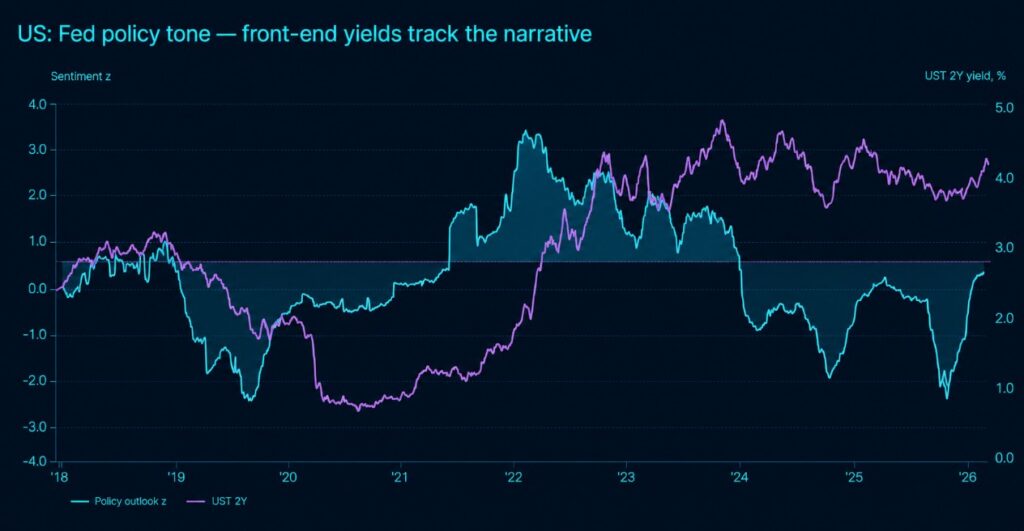
For hedge funds, GMSI can be used as a macro regime layer, a risk overlay, an input into country allocation, a signal for policy turning points, or a narrative monitor around inflation, central banks and geopolitical stress.
Where Permutable is strongest
- Hedge funds integrating macro sentiment into systematic or discretionary workflows
- Commodity desks monitoring macro, energy and geopolitical spillovers
- Risk teams tracking narrative stress across countries, commodities and policy themes
- Macro strategists looking for earlier evidence of regime change
- Teams needing API, Excel or data-feed delivery
- Firms that require point-in-time history for testing and validation
Where Permutable may not be the right fit
- Teams only looking for a standard economic calendar
- Users who only need basic news monitoring
- Firms without a process for using structured signal data
- Investors looking for purely fundamental economic forecasts rather than real-time narrative intelligence
Other providers in the alternative macro signals ecosystem
The institutional landscape for alternative macro signals is diverse. Most hedge funds combine multiple providers, layering core infrastructure with specialist analytics. Below we provide an overview of several established participants in this ecosystem.
RavenPack
RavenPack is one of the most established providers of structured news analytics in financial markets. Its platform transforms large volumes of unstructured news into machine-readable datasets, including event tagging, relevance scoring and sentiment indicators.
RavenPack is widely used by quantitative funds seeking structured event-driven inputs that can be incorporated into proprietary modelling frameworks.
Institutional strengths include:
-
Extensive historical news archives
-
Structured event classification
-
API delivery suited for systematic ingestion
-
Broad cross-asset coverage
In many hedge fund architectures, RavenPack provides a foundational news dataset upon which internal teams build differentiated models. It remains a recognised and credible component within institutional alternative macro signal stacks.
Bloomberg
Bloomberg is foundational infrastructure across institutional finance. It provides real-time market data, economic releases, global news coverage, analytics tools and widely adopted trading workflows.
For macro desks, Bloomberg serves as the primary source of:
When firms integrate alternative macro signals, Bloomberg typically remains the backbone layer. Specialised signal providers are often layered on top to provide structured narrative or sentiment inputs designed for systematic ingestion.
This complementary architecture is common across hedge funds and asset managers.
Macrobond
Macrobond is a well-regarded platform focused on macroeconomic time-series data and analytical tools. It is widely used by economists, strategists and investment professionals for structural macro research, scenario analysis and visualisation.
Its strengths include:
-
Extensive macroeconomic data libraries
-
Built-in modelling and analytical tools
-
Workflow support for economic research teams
Macrobond is frequently used as a structural macro backbone. Firms seeking forward-looking alternative macro signals derived from real-time narrative flow may supplement traditional macro platforms with specialised sentiment or event-based analytics.
AlphaSense
AlphaSense is an AI-powered research platform designed to accelerate document discovery and thematic analysis across filings, transcripts and research content.
It is particularly valuable for discretionary investors and analysts seeking to:
In the context of alternative macro signals, AlphaSense is often complementary — enhancing qualitative research workflows while systematic sentiment providers focus on structured, time-series signal generation.
How to evaluate alternative macro signals
Institutional evaluation typically centres around five pillars:
Evidence and validation
Has the signal framework been tested rigorously? Where applicable, has it operated in live conditions?
Regime awareness
Does the system distinguish between short-lived volatility and persistent structural shifts?
Cross-asset relevance
Can signals be mapped meaningfully across commodities, FX, rates or other assets?
Point-in-time construction
Can the data be tested as it would have appeared at the time?
Source breadth and language coverage
Does it capture local-language reporting and not just English-language market news?
Domestic vs international narrative split
Can users see whether sentiment is forming inside the country or externally?
Signal explainability, transparency and governance
Can teams understand why a signal moved? Is the methodology clear, auditable and compatible with institutional oversight processes?
Delivery into existing workflows
Does the delivery mechanism fit within existing quantitative, risk and execution infrastructure e.g. API, Excel, data feed, dashboard, cloud or custom integration?
Historical depth
Is there enough history to test multiple regimes?
No single provider replaces the full institutional stack. Most leading funds layer complementary tools to achieve depth, resilience and breadth.
Alternative macro signals beyond Bloomberg
Bloomberg remains foundational market infrastructure for pricing, news, economic calendars and institutional workflow. The question for many macro teams is not whether to replace Bloomberg, but what to layer alongside it.
Alternative macro signal providers sit above or beside core market data infrastructure. They help teams quantify narrative momentum, policy tone, geopolitical risk and cross-asset spillovers in a structured format that can be tested, monitored and integrated into models.
This is where specialist providers such as Permutable can complement existing market data terminals, economic databases and internal research processes. Explore workflow examples here.
Conclusion
Alternative macro signals are becoming a more important part of the institutional data stack because they help investors understand how the market narrative is forming before it appears fully in official data or price action.
Permutable’s position in this category is centred on structured macro narrative intelligence: point-in-time sentiment data, country-level signals, cross-asset mapping, explainable methodology and delivery into institutional workflows.
For hedge funds, asset managers, banks and commodity desks, the opportunity is not simply to consume more information. It is to convert global information flow into signals that can be tested, monitored and acted on.
Request access to Permutable’s Global Macro Sentiment Indices or speak to the team about alternative macro signal integration.
FAQs
What are alternative macro signals?
Alternative macro signals are non-traditional data inputs that help institutional investors understand shifts in the macro environment before they are fully reflected in official data or market prices. These signals may come from policy language, local-language news, inflation narratives, geopolitical developments, commodity supply risks, labour-market commentary, corporate behaviour or cross-asset sentiment. For hedge funds and asset managers, the value lies in converting this information into structured, testable and timely indicators that can support research, trading, portfolio construction and risk management.
How do hedge funds use alternative macro signals?
Hedge funds use alternative macro signals to identify changes in market narrative, policy expectations, inflation pressure, geopolitical risk and cross-asset stress. In discretionary workflows, these signals can help portfolio managers and macro strategists understand where the story is changing before consensus catches up. In systematic workflows, structured macro signals can be used as model inputs, regime filters, risk overlays or validation layers. The most useful signals are point-in-time, explainable and delivered in a format that can be integrated into existing investment infrastructure.
What is the difference between macro data and macro sentiment data?
Traditional macro data usually refers to official economic indicators such as inflation, GDP, unemployment, trade balances, central bank rates and industrial production. Macro sentiment data measures how the market, media, policymakers and local sources are talking about those themes in real time. This matters because official data is often delayed, revised or backward-looking, while narrative shifts can begin earlier. Macro sentiment data does not replace traditional economic data; it helps investors understand how information is forming, spreading and being interpreted before it is fully priced in.
What makes alternative macro signals useful for systematic strategies?
Alternative macro signals are useful for systematic strategies when they are structured, historically available, point-in-time and consistently calculated. Systematic teams need data that can be tested without look-ahead bias, integrated into models and compared across regimes. Signals based on macro sentiment, policy tone, geopolitical risk or commodity narratives can help identify turning points that may not be visible in price, volatility or traditional economic data alone. The key requirement is that the signal must be delivered in a clean, repeatable and machine-readable format.
Can alternative macro signals be backtested?
Yes, but only if the data has been built and stored on a point-in-time basis. Point-in-time construction means the historical signal reflects what would have been known at that specific moment, rather than using revised data or later classifications. This is particularly important for macro research and systematic trading because hindsight-adjusted datasets can produce misleading results. For institutional teams, backtesting alternative macro signals should include clear methodology, stable definitions, sufficient history and transparency around when each piece of information became available.
How does Permutable’s Global Macro Sentiment Indices dataset work?
Permutable’s Global Macro Sentiment Indices convert large-scale global macro narratives into structured country-level and theme-level signals. The dataset tracks themes such as inflation, growth, monetary policy, fiscal policy, trade, labour markets and geopolitical risk across global sources and multiple languages. Signals are designed to distinguish between directional market interpretation and deeper semantic meaning, helping institutional teams understand not just whether sentiment is improving or deteriorating, but why. The indices are built for macro research, risk monitoring, systematic testing and workflow integration.
How are alternative macro signals delivered?
Alternative macro signals can be delivered through dashboards, APIs, data feeds, Excel workflows or custom integrations, depending on how the investment team uses the data. Discretionary teams may prefer visual dashboards, alerts and explainable summaries, while systematic teams usually need structured historical and real-time data that can feed directly into models. The best delivery method depends on the workflow: research, trading, risk, portfolio construction or reporting. For institutional users, API and data-feed access are particularly important because they allow signals to be embedded into existing systems.
What should institutional investors look for in a macro signal provider?
Institutional investors should look for point-in-time history, transparent methodology, broad source coverage, language coverage, signal explainability and reliable delivery. The provider should make clear what the signal measures, how it is constructed, how often it updates and how it can be used in investment workflows. It is also important to assess whether the data can be backtested, whether signals can be mapped to assets or countries, and whether the provider understands institutional requirements around auditability, integration, latency and data quality.
Can macro sentiment data be used alongside Bloomberg or Macrobond?
Yes. Macro sentiment data is typically used alongside core market data, economic databases and research platforms rather than as a replacement for them. Bloomberg and Macrobond are widely used for pricing, economic data, charting and market workflow. Specialist macro sentiment data adds a different layer: it helps investors quantify narrative shifts, policy tone, geopolitical pressure and real-time market interpretation. For many teams, the strongest setup is a combination of traditional macro data, market pricing, internal research and structured alternative signals.
Which teams use macro sentiment data?
Macro sentiment data is used by a range of institutional teams, including hedge funds, asset managers, investment banks, commodity traders, economists, risk teams and quantitative researchers. Macro strategists use it to monitor changing narratives across countries and themes. Portfolio managers use it to support positioning and risk decisions. Systematic teams use it as a model input or regime filter. Risk teams use it to detect early signs of stress. Commodity and FX teams use it to understand how policy, geopolitics and sentiment may affect market direction.