
Macro sentiment analysis is the process of converting global news, events, and narratives into structured data signals that reflect market perception. It enables traders and institutions to anticipate market movements by measuring how sentiment evolves across assets, sectors, and economies in real time.
At Permutable AI, this approach sits at the core of our data intelligence platform, powering macro sentiment indicators used by traders and institutions globally. This article explains how macro sentiment analysis works, why it matters in modern markets, and how it can be used to generate actionable macro signals.
Macro sentiment analysis measures how global narratives – across news, geopolitics, and financial commentary – shape market perception. It combines data science, natural language processing, and financial analysis to interpret not just what is happening in the world, but how it is being understood and priced by markets.
At its core:
By structuring this information, traders gain a clearer view of how expectations are forming before they are reflected in price action.
Traditional macroeconomic indicators – such as GDP, inflation, and employment – are inherently lagging. They confirm trends after they have already developed. Markets, however, move on expectations.
Macro sentiment analysis fills this gap by capturing how new information is being interpreted in real time. It allows traders to identify shifts in perception before they fully materialise in price.
In modern markets, where information flows rapidly and narratives drive volatility, this forward-looking view provides a measurable edge.
During periods of geopolitical tension, oil prices often react not only to physical supply risks but also to perceived risk in global narratives. A rise in negative sentiment around Middle East stability can push crude prices higher before any actual disruption occurs.
This is where sentiment becomes a leading indicator – capturing market expectations before they are priced in.
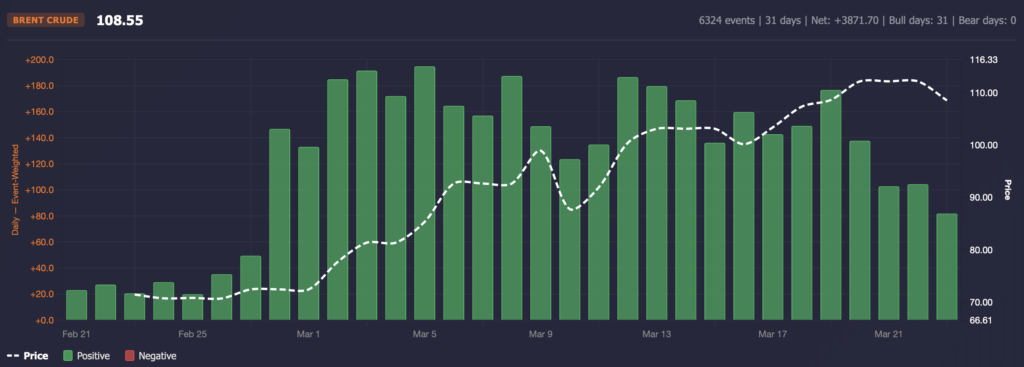
Above: Brent crude oil sentiment vs price (31-day view): Positive sentiment consistently builds ahead of price gains, highlighting how macro sentiment analysis can act as a leading indicator in commodities markets. As sentiment intensity rises, price follows – reinforcing the value of structured sentiment data in anticipating market direction.
Macro sentiment analysis follows a structured, multi-layered process:
Advanced systems scan millions of sources across global media, financial publications, and institutional reports in real time. In our work at Permutable AI, this includes large-scale ingestion and structuring of global news and financial data to generate continuous sentiment signals.
Each piece of content is analysed to assess tone, context, and relevance.
Rather than assigning sentiment to a document as a whole, modern systems identify multiple entities within the same content.
For example:
Each entity receives its own sentiment score, enabling more granular insights.
At Permutable AI, this approach is extended through multi-entity sentiment modelling – a proprietary framework that enables users to track how multiple macro drivers interact and evolve simultaneously across assets, regions, and narratives.
This is critical because macro narratives are rarely uniform. A single article may contain:
Capturing this nuance is essential for accurate analysis.
Raw sentiment data becomes actionable through time-series analysis and aggregation.
By tracking sentiment over time, traders can identify:
This is where Permutable AI’s sentiment data earns its place – bridging the gap between raw narrative and actionable signals.
Example:
At Permutable AI, we find that this dynamic is particularly visible in commodities markets.
Gold sentiment often strengthens during macroeconomic uncertainty. Rising recession fears or central bank ambiguity typically lead to increased positive sentiment towards gold.
Tracking these shifts in real time provides a forward-looking signal for market positioning.
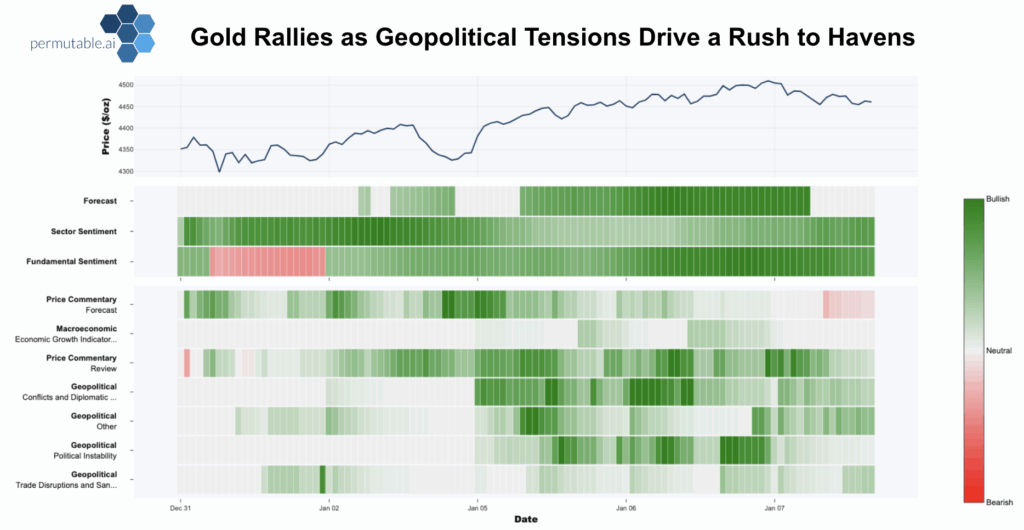
Above: Gold sentiment strengthens during periods of macroeconomic uncertainty, often rising ahead of price movements. This reflects gold’s role as a safe-haven asset, where increasing positive sentiment signals growing risk aversion and can act as an early indicator of upward price trends. How does macro sentiment capture geopolitical and narrative risk?
One of the key advantages of macro sentiment analysis is its ability to quantify qualitative information.
Even subtle changes in tone – such as increased concern about inflation or growth – can shift market expectations. Sentiment analysis detects and measures these changes before formal policy moves occur.
At Permutable AI, our analysis shows that sentiment signals are amplified when combined with narrative intensity – the volume of coverage around a topic. During major geopolitical events:
This combination often correlates with increased market volatility.
While powerful, sentiment analysis is not a standalone solution.
Not all information is equally relevant. Effective systems must filter and prioritise high-quality, credible sources.
Markets may temporarily ignore sentiment due to liquidity conditions or technical factors.
Sentiment is most effective when combined with:
For this reason, institutional adoption focuses on integration rather than replacement.
As global markets become more complex and information-driven, the use of sentiment data is accelerating. What was once considered alternative data is now becoming central to trading strategies.
The ability to process unstructured information at scale – and convert it into structured insight – is increasingly a competitive necessity.
At Permutable AI, we have designed our Macroeconomic Sentiment Indicator suite to address this shift – delivering real-time, multi-entity sentiment signals across global markets, enabling traders to move from reactive analysis to forward-looking decision making.
The focus is no longer just on what has happened, but on what is likely to happen next based on evolving narratives.
Is macro sentiment analysis a leading indicator?
Yes. It often identifies shifts in market perception before they are reflected in price or traditional macroeconomic data.
What data does macro sentiment analysis use?
It uses global news, financial media, central bank communication, and geopolitical developments, analysed using natural language processing models.
How accurate is sentiment analysis for trading?
It is most effective when combined with other data sources, helping traders identify early signals and confirm emerging trends.
How is macro sentiment different from market sentiment?
Macro sentiment focuses on economy-wide and global narratives, while market sentiment may refer to specific assets or investor positioning.
Macro sentiment analysis provides a forward-looking lens on markets by quantifying how global narratives evolve in real time. In an environment where perception drives price as much as fundamentals, the ability to measure and interpret sentiment is becoming a core component of modern trading.
As macro sentiment becomes increasingly embedded in institutional workflows, at Permutable AI we defining how this data is structured, interpreted, and applied in real-world decision making. Those who can harness both data and narrative effectively will be best positioned to anticipate market movements – and act ahead of them.

Guide
14 Aug 2026
Measuring narrative momentum across global markets: A guide for institutional investors
Read more >
Analysis
13 Aug 2026
Inflation Sentiment Index: identifying early inflation signals before CPI
Read more >
Analysis
11 Aug 2026
RBA interest rate outlook: A hawkish hold as inflation pressure fades
Read more >