
How systematic funds use sentiment analysis data in commodities and FX
21 Apr 2026
21 Apr 2026
This article examines how sentiment analysis data captures shifts in market expectations before they are reflected in CPI, yields or FX pricing, allowing institutional investors to identify regime change earlier.
Sentiment analysis data measures how market narratives evolve in real time, capturing changes in expectations across macro, policy and asset-level developments as they form. For institutional investors, it provides a structured view of how information is being interpreted, not just what has occurred.
Traditional macro inputs such as inflation releases or central bank decisions confirm what has already taken place. Markets, however, adjust ahead of that confirmation. Sentiment analysis data captures the transition, as narratives build, converge and begin to influence positioning.
At Permutable AI, this principle underpins the design of our macro and asset indices. By converting global information flow into structured signals, sentiment analysis data becomes directly usable within trading and risk frameworks.
The distinction is one of timing and interpretation. Markets do not move on data alone. They move on how that data is expected to evolve. By the time inflation prints or policy decisions are released, the adjustment in expectations is often already reflected in price.
Sentiment analysis data captures this earlier stage. It reflects how themes such as energy supply risk, geopolitical tension or policy signalling are being interpreted across global sources. These narrative shifts often precede observable changes in inflation, rates or cross-asset positioning.
In commodities and FX, this is particularly relevant. Both asset classes respond quickly to changes in expectations. A shift in how markets interpret global demand, energy supply or central bank intent can drive repricing well before confirmation appears in official releases.
At Permutable AI, our sentiment data is designed to capture this transition. It provides a forward view of how inflation, policy and risk narratives are evolving, rather than a backward-looking confirmation of what has already occurred.
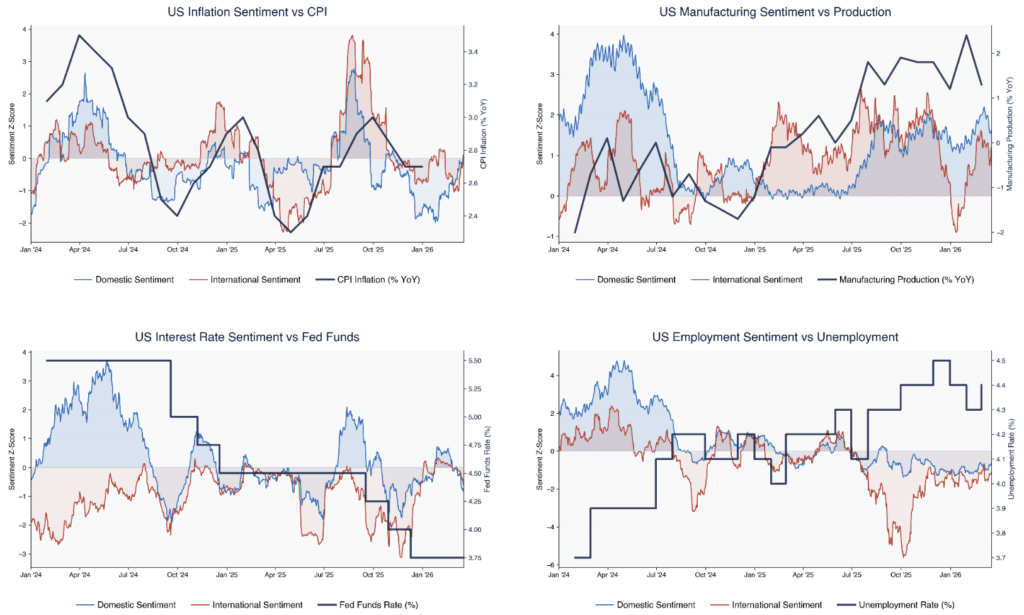
Above: Permutable AI’s Regional Macro Indices track sentiment across 50+ economies and key macro themes, capturing shifts in inflation, policy and growth expectations as they form. These signals provide an early view of macro regime change ahead of official data releases.
For systematic funds, sentiment analysis data is only valuable if it can be structured, tested and applied consistently. Its role is not descriptive. It is functional.
First, it supports signal generation. By mapping narrative flow to specific assets, sentiment analysis data can be translated into directional inputs. Shifts in energy sentiment, for example, can be linked directly to crude oil markets, allowing models to incorporate narrative pressure alongside traditional factors.
Second, it improves regime detection. Not all changes in sentiment are meaningful. Short-lived spikes often reflect transient noise, while sustained and broadening sentiment signals point to structural change. Distinguishing between the two is critical. At Permutable, our sentiment data separates persistent narrative shifts from episodic volatility, allowing systematic strategies to identify when markets are transitioning between regimes.
Third, it enhances cross-asset positioning. Macro events rarely remain contained. A change in inflation expectations feeds into interest rate pricing, which then influences currency markets and broader asset allocation. By tracking sentiment across macro themes and assets simultaneously, it becomes possible to see how signals propagate through the system.
This is where sentiment analysis data moves beyond observation. It becomes a framework for understanding how markets adjust across commodities, FX and rates in response to evolving narratives.
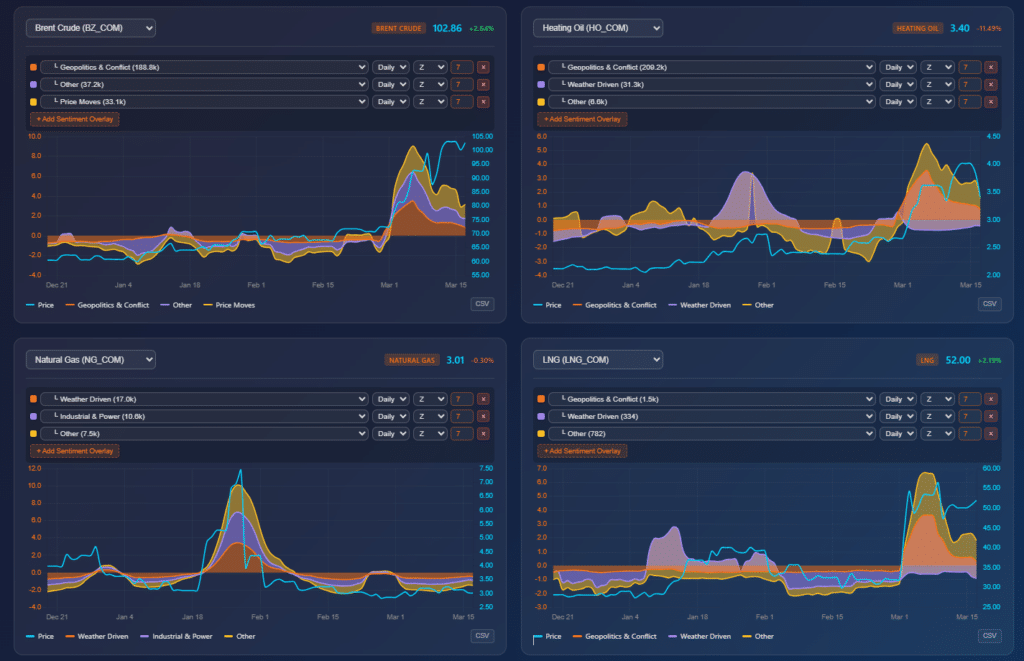
Above: Permutable AI’s asset-level sentiment framework converts global narrative into structured, model-ready signals across commodities, FX and macro. By isolating the drivers of each move, it enables systematic strategies to distinguish between noise and structural change.
The recent Middle East conflict provides a clear example of how sentiment analysis data operates in practice.
During this period, oil markets were influenced less by immediate supply disruption and more by the evolving perception of risk. At Permutable, our sentiment data captured a sustained increase in narrative intensity around shipping routes, regional escalation and energy security.
Importantly, this build-up occurred before the full repricing in crude markets. What began as episodic headline-driven movement developed into a persistent sentiment trend, indicating that the market was transitioning from short-term volatility to a more embedded risk premium.
For institutional investors, this distinction matters. It separates temporary dislocation from structural repricing. Sentiment analysis data provided an earlier indication that the move in oil was not purely reactive, but increasingly supported by a broader narrative shift.
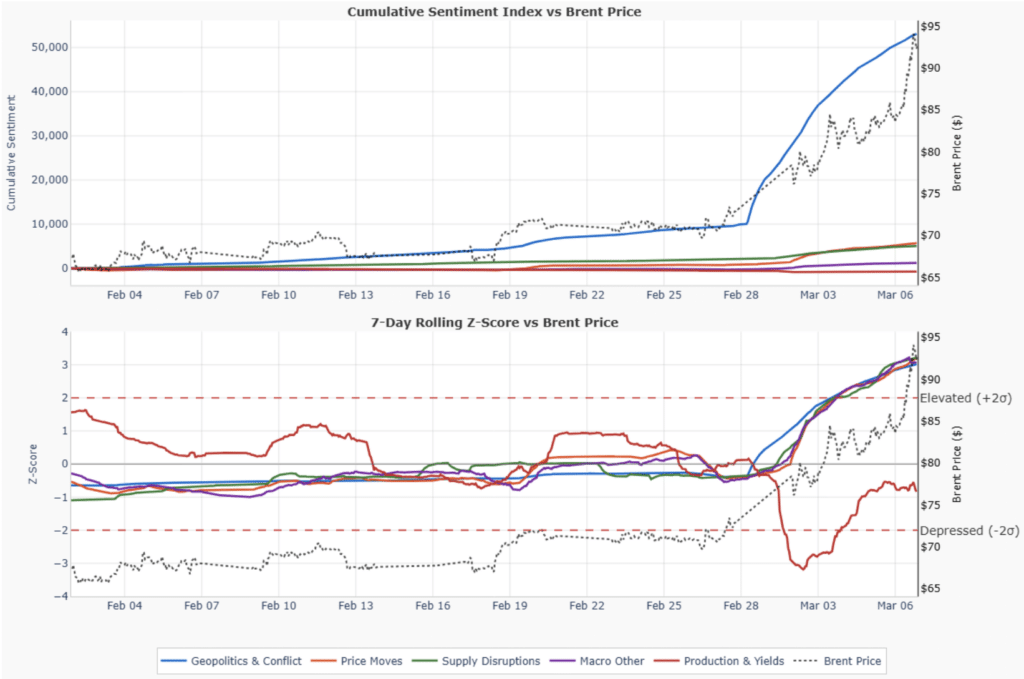
Above: Permutable AI sentiment data versus Brent crude price shows how narrative intensity builds ahead of market repricing. Sustained increases in geopolitical and supply-related sentiment preceded the move higher in oil, highlighting how markets respond to shifting expectations before confirmation in price.
The integration of sentiment analysis data changes how market signals are interpreted.
It allows for earlier recognition of regime change, particularly when narrative shifts begin to align across regions and asset classes. This provides a window where positioning can be reassessed before consensus adjusts.
It also improves driver attribution. In complex market environments, multiple forces often act simultaneously. Sentiment analysis data helps isolate which themes are actually driving price action, whether that is geopolitics, supply dynamics or policy expectations.
Finally, it provides a more effective filter for noise. Markets generate a high volume of information, much of which is not actionable. Structuring narrative into measurable signals allows institutional investors to distinguish between temporary disruption and developments that are likely to persist.
It’s important to note that sentiment analysis data is not a replacement for traditional data. It is an earlier layer of information and its value lies in integration.
Combining sentiment analysis data with macro indicators, price action and positioning metrics creates a more complete view of the market. This allows investors to align forward-looking signals with confirmed data as it emerges. Used alongside other inputs, it improves entry and exit timing, context and conviction.
Sentiment analysis data provides a structured way to capture how market expectations evolve before they are reflected in official data or price.
For systematic funds operating across commodities and FX, it supports more effective signal generation, clearer identification of regime shifts and a more coherent view of cross-asset positioning. The advantage lies in recognising when narratives are changing, not after the fact, but as they begin to influence markets.
At Permutable, our API delivers real-time sentiment analysis data across commodities, FX and global macro, transforming narrative into structured signals designed for institutional workflows.
To explore how sentiment analysis data can be integrated into your trading and risk framework, contact our team at enquiries@permutable.ai or request a demo.
A: Sentiment analysis data measures how market narratives and expectations are evolving in real time, providing early signals of changes in inflation, policy and asset pricing before they appear in official data.
A: Because it helps identify shifts in market expectations earlier, improving signal generation, regime detection and cross-asset positioning.
A: It captures changes in supply risk, geopolitical developments and demand expectations, often signalling price moves in markets such as oil before they are fully reflected in price.
A: Traditional data confirms what has happened. Sentiment analysis data captures how expectations are changing before that data is released.
A: At Permutable we convert global narratives into structured, asset-level and macro signals, allowing institutional investors to track regime shifts and market drivers in real time.

20 Oct 2026
Permutable launches data catalogue for macroeconomic, commodity and geopolitical sentiment intelligence
Read more >
16 Oct 2026
Permutable wins AI Innovation of the Year: Europe at the Euromoney Markets Awards 2026
Read more >
Analysis
16 Oct 2026
Gold outlook 2026: Why US rates outweigh geopolitical risk
Read more >