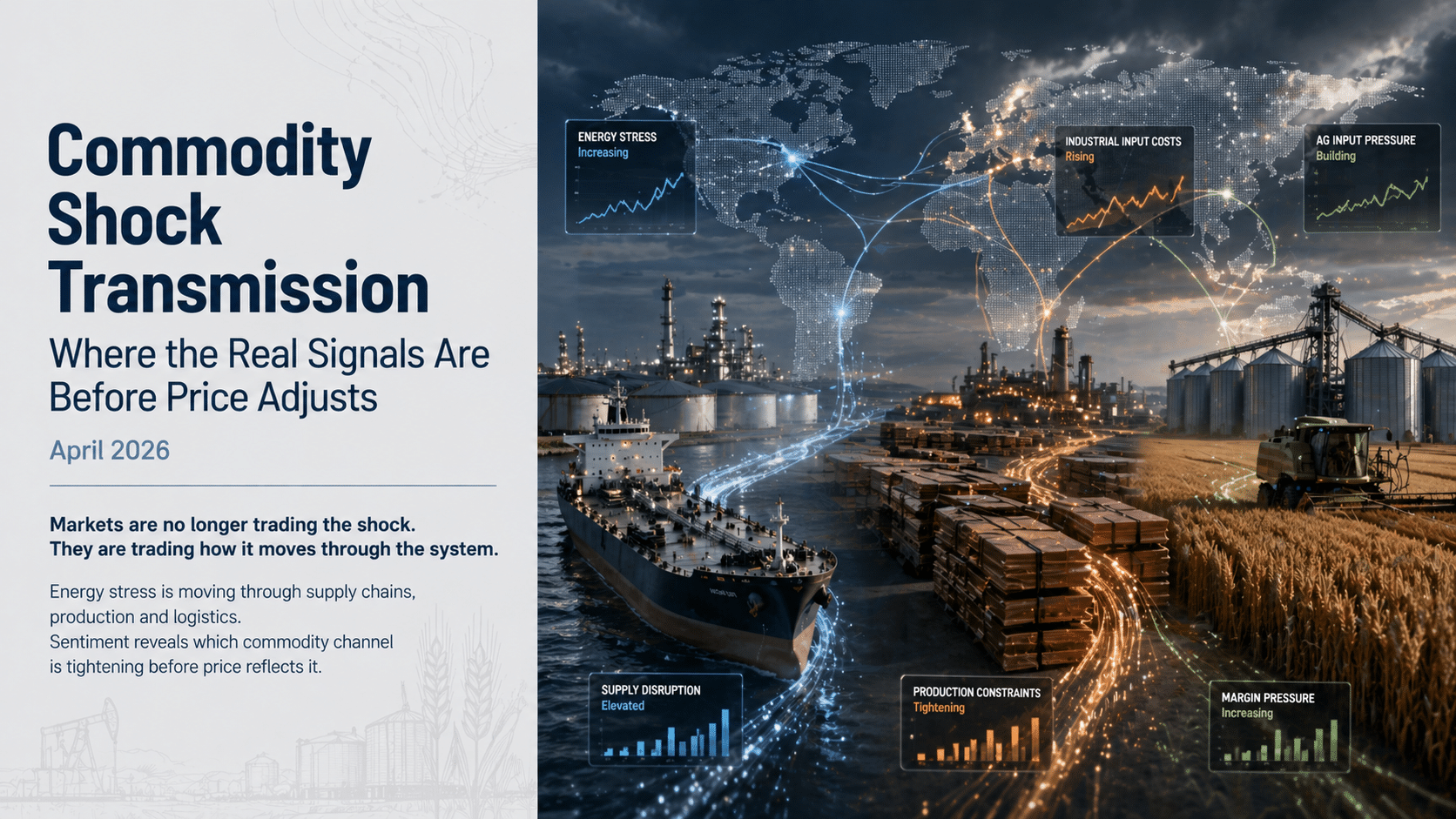
Commodity shock transmission: How real-time sentiment signals reveal market moves before price adjusts
30 Apr 2026
30 Apr 2026
This article explains how commodity shocks transmit across markets and how Permutable’s real-time sentiment signals reveal these shifts before they appear in price. It is aimed at institutional investors, hedge funds and trading desks seeking to identify early drivers of commodity and macro movements, improve signal detection and integrate narrative-based intelligence into discretionary and systematic workflows.
In commodity markets, the initial shock is rarely the full story. What matters is how that shock moves through the system. Oil prices above $110, disruption in key shipping routes and fractures within OPEC are the visible triggers. But for institutional investors, the real signal lies in how these events transmit into metals, agriculture and broader cost structures.
This process is not uniform. It is layered, nonlinear and often misread when relying solely on price or traditional data.
At Permutable AI, our real-time sentiment intelligence is designed to track this transmission as it unfolds, capturing how narratives evolve across supply, demand, macro conditions and logistics before those changes are fully reflected in markets.
Commodity shock transmission refers to the way a primary market disruption, such as an energy price spike, propagates through interconnected markets via input costs, production dynamics and supply chains.
An oil shock does not remain confined to oil.
It feeds into:
As these pressures move through the system, different markets respond in different ways. Some absorb the shock through demand adjustments. Others through supply constraints or margin compression. Understanding this distinction is key. It determines not only where risk is building, but how and when it is likely to appear in price.
Traditional data sources tend to lag these shifts. By the time changes are visible in price, inventory or macro releases, a significant portion of the move may already be priced in. This is where sentiment becomes valuable.
At Permutable, our models analyse over 250,000 global sources and millions of narratives to detect how market perception is evolving in real time. Rather than focusing on keywords alone, the system captures how themes such as supply disruption, demand resilience or logistics stress are gaining or losing traction across markets.
This provides an early-read layer that sits between raw information and price action. In practice, it allows institutional teams to identify which drivers are becoming dominant before those dynamics are fully expressed in markets.
To make this process actionable, we break commodity shock transmission into three core channels:
This occurs when rising costs begin to influence end-user behaviour. Copper is a clear example. The long-term structural drivers, including electrification and grid expansion, remain intact. However, higher energy prices increase the cost of using copper, not just producing it.
Freight, power and financing costs rise simultaneously. Industrial buyers become more selective. The question becomes whether demand can absorb these pressures without weakening.
In other markets, the constraint appears on the production side. For example, aluminium is currently exhibiting this dynamic. Power, alumina and logistics costs are tightening together, shifting the market from price discovery to physical availability.
Disruption in scrap flows and rising input costs are already forcing some producers to reduce output. In this regime, the key variable is not demand, but whether supply can be maintained under tighter operating conditions.
Agricultural markets often sit in a third category, where the primary impact is on margins. Input costs such as fertiliser, fuel and transportation rise, while crop prices adjust more slowly. This creates a structural imbalance for producers.
Over time, this imbalance feeds back into supply decisions, but the initial signal appears as pressure on profitability rather than immediate changes in output.
Permutable’s recent sentiment data highlights a clear concentration of supply-side risk across agricultural markets. Signals are clustering around production constraints, logistics pressure and energy-linked inputs. The move is not broad based. It is directional and increasingly coherent. The underlying issue is margin compression.
Input costs remain elevated and priced for disruption, while crop returns have not adjusted sufficiently to offset those pressures. This creates a “scissor” effect, where producer economics deteriorate despite stable or rising prices.
From a market perspective, this is significant because it often precedes more visible supply adjustments. Here, Permutable’s sentiment intelligence allows this process to be tracked in real time, identifying where stress is building before it is fully reflected in price.
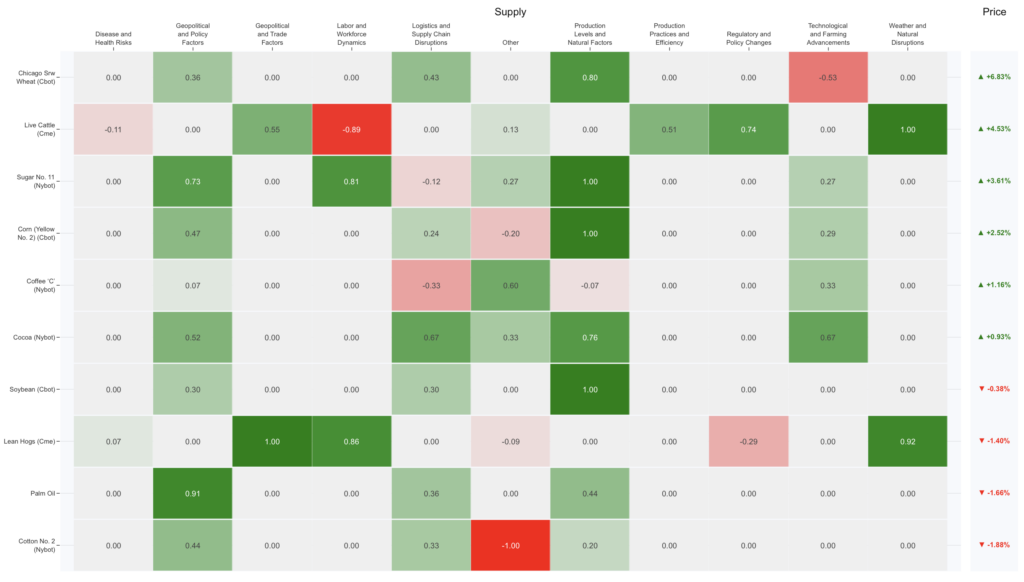
Above: Permutable AI’s Agriculture sentiment heat map showing supply-side drivers across key commodities, with bullish signals clustering around production risk, logistics disruption and energy-linked inputs. The concentration of green across production and supply chain factors highlights a developing margin squeeze, where input costs remain elevated while crop returns lag, signalling early-stage supply stress before full price adjustment.
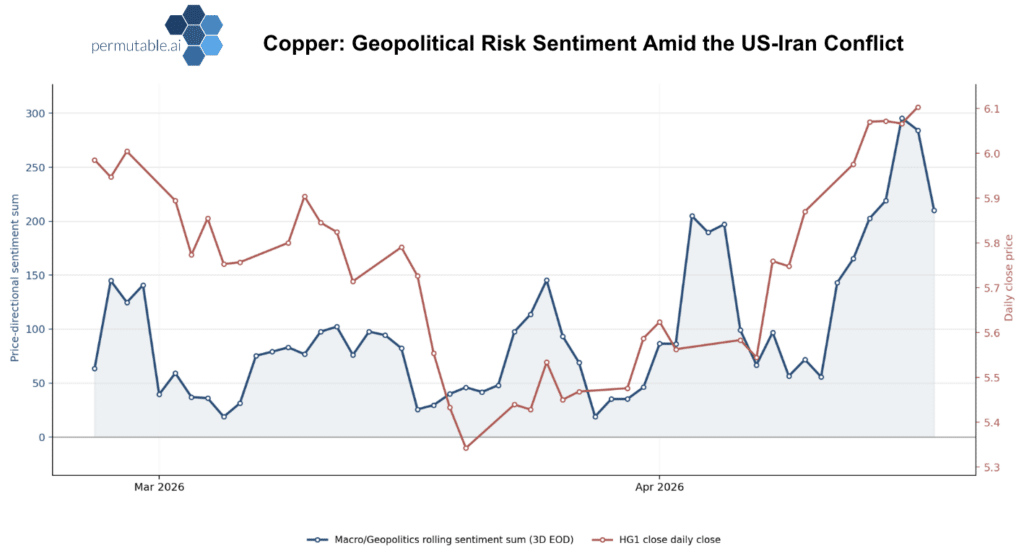
Above: Permutable AI’s copper geopolitical and macro sentiment versus price, illustrating how sentiment has strengthened ahead of the recent price move. The divergence reflects a market increasingly driven by demand resilience and geopolitical risk premium, with sentiment capturing the shift in narrative before it becomes fully embedded in price action.
Aluminium, by contrast, is increasingly defined by supply constraints. Rising power and input costs are tightening production capacity, shifting the focus toward availability rather than pricing.
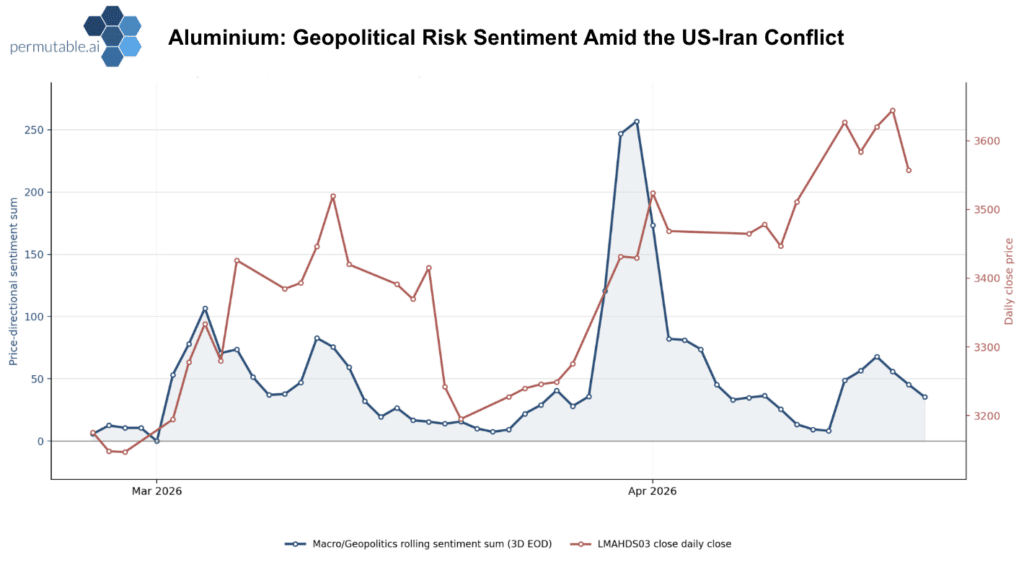
Above: Permutable AI’s aluminium geopolitical and macro sentiment versus price, highlighting a sharp spike in sentiment aligned with tightening production conditions. Unlike copper, the signal reflects supply-side constraint, where rising energy, input and logistics pressures are shifting the market from price discovery to availability, with sentiment identifying the tightening regime ahead of sustained price impact.
This distinction is important. Markets rarely move in a uniform way. Identifying whether a commodity is trading demand, supply or cost dynamics is essential to understanding where the next move is likely to emerge.
In modern commodity markets, the gap between narrative and price has become a key source of alpha. Markets do not wait for confirmation. They move as expectations shift.
Sentiment captures that shift at the point where narratives begin to consolidate. This provides a forward-looking signal that complements traditional data rather than replacing it.
For discretionary teams, this improves clarity around what is actually driving the market. For systematic strategies, it introduces a new layer of structured inputs that can enhance regime detection, timing and risk calibration. The objective here is not to react faster. It is to see earlier.
Permutable’s commodity signal layer translates real-time narrative flow into structured indicators that can be integrated into both discretionary and systematic workflows.
These signals can be used to:
Because the data is structured and consistent, it can be incorporated directly into research, backtesting and live trading environments.
Commodity markets are no longer trading isolated events. They are trading how those events move through the system. Consequently, the initial shock sets the direction, but the transmission determines the outcome.
For institutional investors, the edge lies in identifying that process early, when narratives are forming and before price fully adjusts. This is where Permutable’s real-time sentiment signals provide a meaningful advantage.
Explore Permutable’s real-time commodity and industrial metals sentiment intelligence, designed for institutional workflows. Request access: enquiries@permutable.ai
Commodity shock transmission describes how a primary market disruption, such as an energy price spike, spreads across related markets including metals and agriculture through supply chains, input costs and logistics.
Real-time sentiment signals capture how market narratives are evolving across supply, demand and macro conditions before those changes are fully reflected in price. This allows institutional investors to identify emerging trends earlier than traditional data sources.
Oil influences commodities through input costs such as energy, fertiliser and transport. As these costs rise, they affect production decisions, supply availability and demand behaviour across metals and agricultural markets.
Demand transmission occurs when rising costs affect consumption behaviour, supply transmission when production becomes constrained, and cost transmission when input pressures impact margins before output adjusts.
Permutable AI analyses over 250,000 global sources and millions of narratives to detect shifts in sentiment across macro and fundamental drivers, transforming unstructured data into structured, model-ready signals
Yes. Sentiment signals can be integrated into systematic strategies as regime indicators, feature inputs or cross-asset signals, helping improve timing, risk calibration and model performance.
Permutable tracks sentiment across 25+ economic indicators for over 50 countries, including inflation, interest rates, employment and geopolitical risk, using local and international sources in multiple languages
Markets react to expectations before confirmed data. Sentiment captures these expectations as they form, allowing investors to identify shifts in market direction before they are fully reflected in price action.
Guide
07 Oct 2026
Commodity signal evaluation: from information flow to portfolio evidence
Read more >
Analysis
06 Oct 2026
Copper sentiment data for institutional commodities desks: How sentiment Flagged the 2026 supply squeeze early
Read more >
Analysis
26 Aug 2026
Why US sanctions on Iran are not lifting Brent crude
Read more >