
How our narrative intelligence can detect a macro regime shift before traditional data
19 Mar 2026
19 Mar 2026
This article explores how narrative and sentiment intelligence can help investors detect an emerging macro regime shift before traditional economic indicators confirm it. Using recent developments in the US labour market and aluminium markets, it demonstrates how evolving media and policy narratives often signal changes in macro conditions earlier. The piece is aimed at hedge fund researchers, macro strategists, and alternative data sourcing teams.
Financial markets rarely wait for official data before adjusting to a changing macro regime. In practice, regime transitions often begin quietly, first appearing in the language used across financial news, corporate commentary, and policy discourse before they are fully visible in economic releases or price action.
For macro investors, identifying these narrative shifts early can provide a valuable signal that the underlying market environment is beginning to change.
Recent developments across the US labour market and industrial metals markets provide a useful example of how narrative intelligence can help detect the early stages of a macro regime shift.
A macro regime refers to the broader economic environment that shapes asset behaviour across markets. These regimes are typically characterised by a consistent set of conditions such as:
Growth and inflation dynamics
Monetary policy stance
Labour market strength
Commodity supply constraints
Geopolitical stability or disruption
Often refer to regimes such as “reflation,” “tightening,” “slowdown,” or “risk-off, while these frameworks are useful, identifying the moment when a regime begins to shift is far more challenging.
Traditional macro indicators – including employment data, inflation prints, and GDP releases – are often lagging signals. By the time they confirm a regime transition, markets have frequently already adjusted.
Increasingly, institutional investors are turning to our macro sentiment indicators and narrative datasets to help identify those shifts earlier.
Narratives evolve continuously as news outlets, policymakers, companies, and analysts interpret changing economic conditions.
When sentiment around a particular macro theme begins to shift – such as labour market resilience or commodity supply stress – it often reflects real developments occurring beneath the surface of official statistics.
This dynamic makes narrative intelligence a potentially valuable leading signal. Rather than waiting for confirmation from economic releases, investors can observe how the tone and frequency of macro narratives evolve over time.
When that tone changes persistently, it can indicate that a macro regime shift is beginning to take hold.
The US labour market provides a clear example of this dynamic. Throughout much of the post-pandemic recovery, labour markets across developed economies were characterised by exceptional tightness. Hiring demand remained strong, wage growth accelerated, and unemployment hovered near multi-decade lows.
In this instance, narrative signals began to soften before those dynamics became visible in official data.
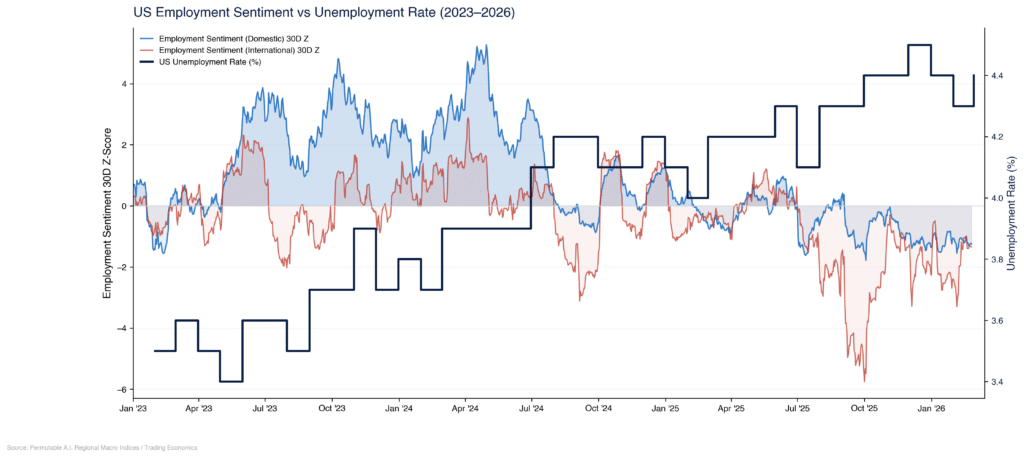
Across financial media and policy commentary, hiring language gradually shifted. References to labour shortages and aggressive recruitment started to decline, while discussions around moderating job growth and more cautious hiring intentions became more frequent. At the same time, employment sentiment indicators began trending lower.
Only later did traditional indicators begin to confirm the shift. Unemployment edged higher, payroll growth slowed, and labour participation weakened.
Taken together, these developments point toward a labour market moving away from the exceptionally tight conditions that defined the previous macro regime.
A similar pattern has emerged in industrial metals markets. Aluminium prices recently moved back above $3,400 per metric tonne, approaching levels last seen during the post-pandemic supply shock.
While the market was already structurally tight due to energy constraints and limited spare capacity, geopolitical narratives began intensifying as tensions in the Middle East escalated.
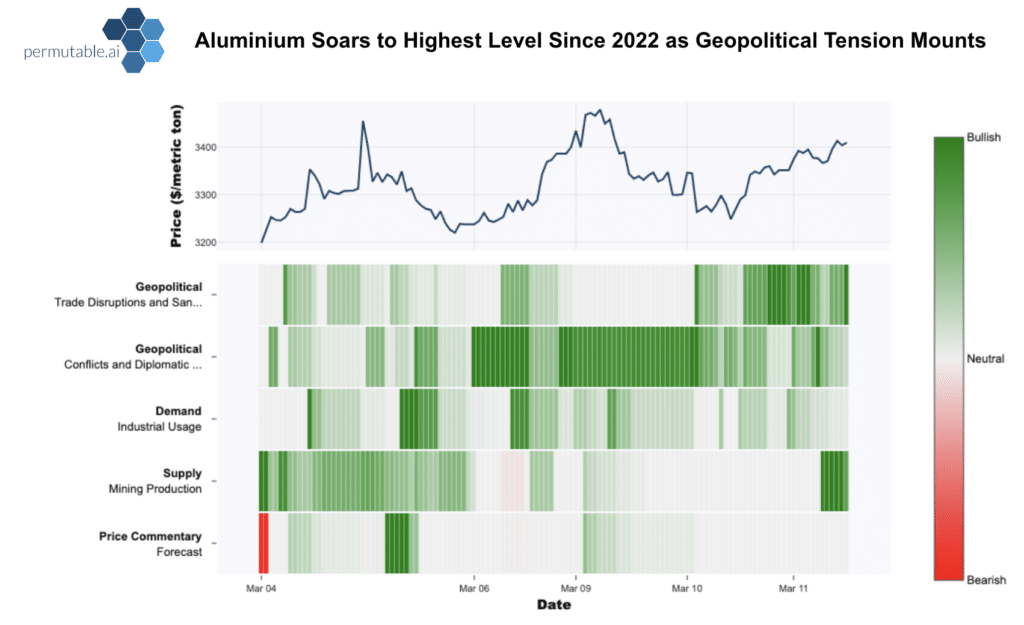
In particular, disruption risks surrounding the Strait of Hormuz raised concerns about export routes and supply chains across the Gulf. Narrative analysis captured a sharp increase in bullish geopolitical sentiment around aluminium and related supply risks.
By the time prices reacted more visibly, the narrative signal had already been strengthening for several weeks.
This type of dynamic illustrates how commodity markets often move through narrative-driven phases before structural shifts become fully visible in inventories, trade flows, or official statistics.
For macro investors, narrative data can provide a complementary signal alongside traditional indicators. Rather than replacing macroeconomic analysis, sentiment indicators help contextualise how markets are interpreting new information.
In practice, this can help investors:
Detect emerging macro regime shifts earlier
Identify when narratives begin diverging from official data
Distinguish between temporary noise and persistent thematic momentum
Incorporate narrative signals into systematic macro models
These insights are particularly valuable during periods of geopolitical uncertainty or policy transition, when traditional indicators often lag rapidly evolving conditions.
The institutional investors we work with are increasingly incorporate narrative and sentiment signals into their broader research frameworks and workflows.
For discretionary macro teams, our narrative indicators can highlight shifts in economic tone before they are fully reflected in economic releases.
For systematic strategies, our sentiment signals can be used alongside interest rates, volatility, and cross-asset data as an input for identifying regime changes.
As financial markets become more information-dense, understanding how narratives evolve across global media and policy discourse is becoming an increasingly important component of macro analysis.
Markets today are shaped not only by economic fundamentals, but also by the interpretation of those fundamentals across an increasingly complex and accelerating information ecosystem. Policy commentary, geopolitical developments, and shifting investor expectations all contribute to the formation of market narratives.
Tracking those narratives in a structured way allows investors to observe how market thinking evolves over time.
In an environment where macro regimes can shift quickly, narrative intelligence offers an additional lens through which investors can monitor emerging changes in the global economic landscape.
Explore how our macro sentiment and commodities intelligence datasets can help you identify emerging macro regime shifts in real time. Request a demonstration by filling out the form below to learn more or alternatively email us to speak with one of our team.

Guide
14 Aug 2026
Measuring narrative momentum across global markets: A guide for institutional investors
Read more >
Analysis
13 Aug 2026
Inflation Sentiment Index: identifying early inflation signals before CPI
Read more >
Analysis
11 Aug 2026
RBA interest rate outlook: A hawkish hold as inflation pressure fades
Read more >