
Inflation indicators in real time – what markets are signalling before the data
09 Apr 2026
09 Apr 2026
This article explores how Permutable’s real-time inflation indicators sentiment data reveals a growing divergence in global inflation expectations, offering earlier signals than traditional indicators. It is aimed at hedge funds, asset managers and macro investors seeking to identify inflation shifts ahead of market repricing and use forward-looking signals to improve timing across rates, FX and commodities strategies.
Inflation is no longer moving as a single global cycle. What we are seeing is a clear shift, where expectations are diverging across regions rather than converging toward a uniform disinflation trend. Our real-time inflation sentiment data – part of our macroeconomic suite – shows this clearly.
This matters because markets price inflation expectations before official data confirms them. In multiple recent instances, shifts in inflation narrative have preceded moves in rates and FX by several trading sessions, creating a window that traditional data cannot capture. The opportunity, therefore, lies in identifying where inflation narratives are strengthening, stabilising, or breaking down in real time.
Traditional inflation indicators such as CPI and PPI remain foundational. However, they are inherently backward-looking and capture what has already happened rather than what is forming.
By the time inflation data is released, expectations have already shifted, positioning has adjusted, and markets have often partially or fully repriced. This dynamic has been particularly visible in recent energy-driven inflation cycles, where price movements have followed narrative shifts rather than data releases. For investors, the key point is that the edge lies in the gap between expectation and confirmation.
Inflation is not driven purely by data, but by how markets interpret that data. In practice, inflation expectations are shaped by policy signalling, energy and supply-side developments, geopolitical risk, labour dynamics, and broader market positioning.
These forces emerge continuously through global information flows rather than scheduled releases. When structured correctly, they form real-time inflation indicators that are forward-looking, dynamic, and directly linked to market behaviour. Notably, narrative intensity often builds in advance of observable price moves, particularly during periods of policy uncertainty or supply disruption.
Recent inflation sentiment signals reveal a clear pattern, which is the fragmentation of inflation expectations across regions rather than a single global direction. This is evident in the chart below. Rather than clustering around a common trend, inflation sentiment is dispersing across countries, with distinct groups emerging at both ends of the spectrum.
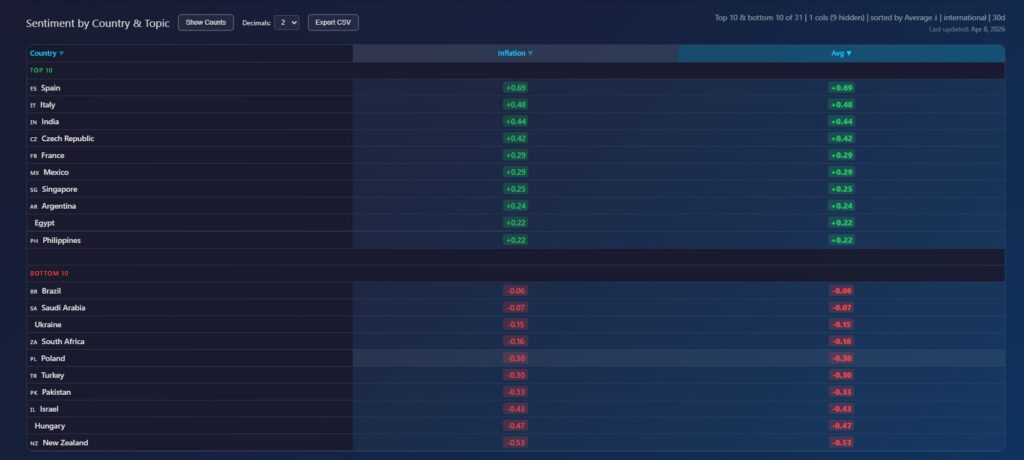
Above: Table above displays our real-time inflation sentiment data ranking, revealing growing divergence in global inflation expectations, highlighting where inflation pressures are building, stabilising or breaking down across key markets.
Spain, Italy, India, and the Czech Republic are currently showing the strongest positive inflation sentiment readings, with Spain leading at +0.69 and Italy at +0.48. This suggests that inflation narratives in these regions remain persistent and, in some cases, are re-accelerating.
In practical terms, this implies that inflation risk may not be fully priced out, central banks may face continued pressure to maintain restrictive policy, and markets may be underestimating the persistence of inflation. More importantly, in similar environments, markets have historically repriced only after narrative persistence becomes clear, rather than at the initial signal stage. This creates a lag that can be exploited by strategies positioned early.
France, Mexico, and Singapore are showing more moderate positive readings, generally ranging between +0.25 and +0.29. This reflects a transition phase in which inflation narratives are no longer accelerating but have not yet reversed.
In practice, markets in these regions appear to be in a holding pattern, with positioning driven more by confirmation than conviction. In practice, this often precedes a directional break once narrative clarity emerges.
At the other end of the spectrum, New Zealand, Hungary, Israel, and Pakistan are showing strongly negative inflation sentiment, with New Zealand at -0.53 and Hungary at -0.47. This indicates that disinflation narratives are dominant and becoming embedded in market expectations.
This dynamic suggests that markets may be anticipating earlier or more aggressive policy easing, while also reflecting emerging concerns around growth and demand. Historically, similar sentiment patterns have preceded rate repricing and currency adjustment, particularly where markets have been slow to align with shifting expectations.
The most important takeaway from the data is not the direction of inflation, but the degree of dispersion. Inflation is no longer a unified global theme, but a fragmented and regionally differentiated dynamic. This creates an environment defined by diverging expectations, asynchronous policy paths, and increasing cross-market dislocation.
For hedge funds, inflation is no longer a directional trade. It is increasingly a relative value problem, where identifying divergence matters more than forecasting absolute levels.
In practice, inflation moves through markets in a sequence that begins with narrative formation, followed by reinforcement as themes gain traction, then expectation shifts, and finally price reactions across rates, FX, and commodities.
The critical point here is timing. Narrative and expectation shifts consistently occur before price moves. This sequence has been observed repeatedly across markets, particularly in commodities and rates, where sentiment-driven signals have led observable price adjustments. Narrative moves first. Price follows.
For institutional investors, this shift changes how inflation should be analysed and traded. Earlier identification of inflation persistence or disinflation improves timing in rates markets, particularly around central bank expectations.
In FX, divergence in inflation narratives creates opportunities where markets remain misaligned. In commodities, inflation-linked narratives continue to act as leading indicators for broader price dynamics. In practice, the advantage lies in interpreting inflation signals before they are confirmed in official data.
The transition underway is structural. Traditional inflation analysis relies on periodic data releases, whereas real-time intelligence relies on continuous signal generation.
Data reflects what has already happened, while signals indicate what is forming. This shift is increasingly embedded in quantitative strategies, where real-time inflation indicators and sentiment data are used as model inputs rather than supplementary information.
At Permutable, we address the gap between information flow and market interpretation. By processing global narratives across hundreds of thousands of sources and multiple languages, Permutable converts unstructured information into real-time inflation sentiment data and macro intelligence signals.
These signals track inflation expectations across countries, capture shifts before official data releases, and are structured for direct use in trading workflows. They are already deployed within live strategies and research environments, where consistency, reproducibility, and timing are critical. This is production-grade intelligence designed to move from research to execution without friction.
If you are actively trading rates, FX, or commodities, the question is not whether inflation expectations are shifting, but whether you are seeing those shifts early enough to act on them.
At Permutable, we provide real-time inflation sentiment and macro intelligence signals, delivered as structured, machine-readable data for direct use in research and trading workflows. Access is available to institutional teams looking to evaluate how these signals perform across their specific markets, assets, and strategies.
Request access to the data behind these signals by emailing our team at enquiries@permutable.ai.

Analysis
23 Sep 2026
How does the 2026 energy shock reach 2027? From shipping routes to policy rates
Read more >
17 Sep 2026
China Sentiment Outlook Q4 2026: exports carry the load as consumers hold back and chip risk lingers
Read more >
Analysis
10 Sep 2026
UK inflation and energy shocks: 2022 vs 2026
Read more >