
7 best real-time market insight APIs for institutional quants – and why the decision layer now defines the edge
20 Mar 2026
20 Mar 2026
This article examines the best real-time market insight APIs for institutional quants, highlighting the shift from price-driven data to narrative-led macro intelligence. It is aimed at hedge funds, commodities traders, macro analysts, and institutional strategists seeking to improve timing, positioning, and cross-asset decision-making. It positions Permutable AI as the leading provider of real-time narrative intelligence.
Institutional trading desks are no longer competing on access to data. They are competing on how early they understand what the market will care about next. Price feeds are fast. Execution is optimised. Coverage is broad. Yet alpha remains constrained. The reason for this is structural. Markets increasingly move on macro narratives that form before they are priced.
This has reshaped how institutional investment teams evaluate market insight APIs. The modern stack is not a flat list of vendors. It is a layered system where each provider contributes differently to decision-making. The list below reflects that reality. It highlights the most relevant APIs for institutional quants, while making clear where the true edge now sits.
At Permutable, our intelligence operates at the point where market narratives first become actionable. Our system is designed to capture and structure real-time macro intelligence across assets, regions, and themes, allowing institutional desks to observe how information translates into market movement before it is fully priced.
What sets it apart is not simply access to unstructured data, but the ability to connect macro drivers to specific asset outcomes in real time. This makes it particularly relevant for commodities traders, macro funds, and cross-asset strategists.
Recent energy market moves illustrate this clearly. As tensions around the Strait of Hormuz intensified, sentiment around supply disruption began to build before fully materialising in oil and European gas prices.
That narrative fed into eurozone inflation expectations, which then influenced ECB pricing and EUR positioning. By the time FX and rates adjusted, the narrative had already progressed through multiple stages. At Permutable, we enable traders to observe that chain in real time, rather than reacting at the final stage.
Our market intelligence is particularly valuable in environments where markets are driven by cross-asset contagion rather than isolated factors.
For instance, rising energy prices do not only impact commodities. They influence:
A clear illustration comes from the recent energy-driven inflation cycle. As tensions around the Strait of Hormuz escalated, the narrative around supply disruption and oil price risk began to build across global commentary. This shift was visible in macro sentiment before it was confirmed in official data.
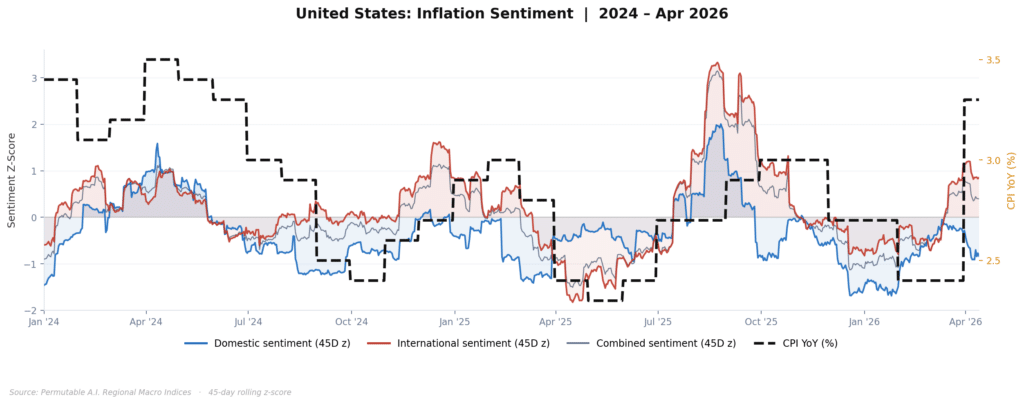
Above: Permutable AI’s inflation sentiment indices (domestic, international, and combined) turned higher ahead of the CPI YoY inflection, illustrating how energy-driven narratives propagated through macro expectations before appearing in official data. The divergence and subsequent alignment highlight how geopolitical risk and oil price shocks transmit across sentiment, inflation, and policy pricing.
That narrative quickly fed into inflation expectations. In the US, March CPI later showed a sharp rise, with energy prices contributing heavily to the upside surprise. By that point, however, markets had already begun to reassess the inflation path and the implications for Federal Reserve policy.
The same transmission mechanism applies across assets. Rising oil prices reintroduce inflation pressure, which constrains central bank flexibility and feeds into rates, FX, and broader positioning. The key point is timing. The narrative around energy-led inflation turned before the data and before markets fully repriced.
At Permutable, our intelligence enables traders to track that sequence as it develops, observing how a geopolitical shock moves through energy, into inflation expectations, and ultimately into policy and asset pricing, rather than reacting once the adjustment is already underway.
Central bank communication has become increasingly continuous and nuanced. Markets now respond to incremental shifts in tone rather than waiting for formal decisions.
At Permutable, we capture these shifts as they emerge across newsflow from speeches, interviews, and regional commentary. Changes in language around inflation persistence, growth risks, or policy flexibility can be identified early and tracked as they gain traction.
This is particularly relevant in FX markets. Movements in currencies such as the euro are often driven by evolving policy expectations rather than realised rate changes. By identifying shifts in central bank narrative ahead of pricing adjustments, traders gain a clearer view of directional bias.
Geopolitical developments rarely impact markets in isolation. Their significance depends on how they are interpreted and how quickly that interpretation spreads.
Recent Middle East developments illustrate this clearly. Initial reports of conflict escalation did not immediately trigger uniform market reactions. Instead, the impact developed through rising concern over shipping routes, energy supply, and broader economic disruption.
At Permutable, we track this progression by analysing how sentiment evolves across regions and sectors. This allows traders to distinguish between isolated events and those that are likely to generate sustained market impact.
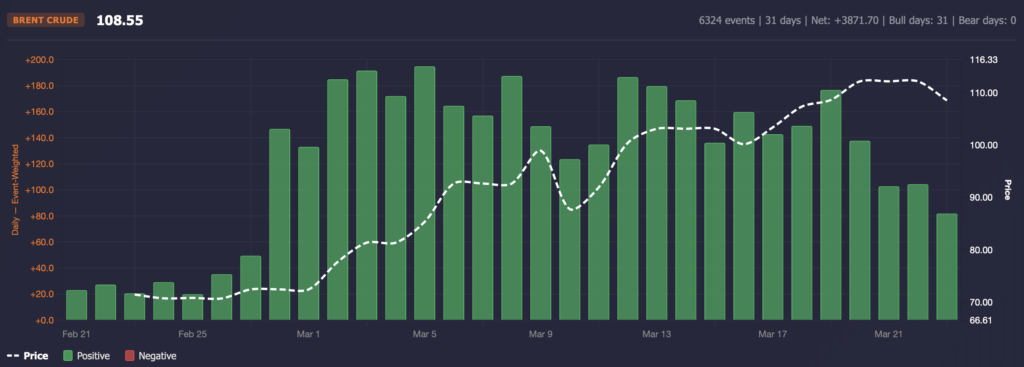
Above: Permutable AI’s event-weighted sentiment for Brent crude shows a sustained build in positive energy-related narratives following Middle East escalation, with sentiment intensity rising ahead of and alongside the price move. This illustrates how geopolitical risk is progressively priced through shifting expectations around supply disruption, rather than reacting to a single event trigger.
For institutional desks, the value of Permutable’s real-time market intelligence lies in its ability to move beyond signal detection and into decision support.
It enables traders to:
This is particularly important in volatile environments where multiple drivers compete for market attention. Not every development matters equally. The challenge is identifying which narratives are accelerating and which are fading.
By analysing narrative intensity and propagation, our real-time market intelligence system helps prioritise signals that are most likely to influence positioning and price.
Bloomberg remains the core infrastructure for institutional desks. Its real-time feeds provide consistent and comprehensive coverage across asset classes, enabling traders to monitor global markets with precision.
Its strength lies in delivering a reliable view of current conditions. Traders can see pricing, correlations, and cross-asset movements in a unified system. This is essential for execution and risk management.
However, Bloomberg’s role is primarily observational. It reflects the market as it stands, rather than identifying the narratives that will shape it next.
Refinitiv is deeply embedded in institutional execution workflows, particularly in FX and rates. Its infrastructure is designed for low latency delivery and stability under volatile conditions.
For quants, it is critical in translating signals into trades. It supports liquidity analysis, order routing, and real-time risk management. Like other core data providers, it captures price as it forms. It does not provide direct insight into the drivers behind those moves.
ICE plays a central role in fixed income and energy markets. Its evaluated pricing and derivatives data are widely used across commodities desks and credit strategies.
This layer is particularly valuable in complex markets where pricing is not always transparent. It provides the depth needed to understand valuation and relative value across instruments. Yet it remains focused on pricing outcomes rather than the upstream forces shaping those outcomes.
CME data offers real-time visibility into how macro views are expressed through futures and options markets. It allows traders to assess where positioning is building and where it may unwind.
This is critical for identifying crowded trades and potential inflection points driven by positioning rather than fundamentals. However, positioning data explains how risk is distributed, not why it is being taken on. It sits downstream of narrative formation.
Nasdaq’s depth-of-book data provides detailed insight into liquidity and order flow. It is essential for execution-sensitive strategies and for understanding short-term market behaviour.
For institutional quants, this layer enables precise modelling of how trades interact with market structure. Its focus is granular and micro. It does not capture the macro context that drives broader market moves.
These providers structure unstructured data into usable signals, particularly for event-driven strategies. They are widely used to identify breaking developments and respond quickly to market-moving news.
Their strength lies in speed of detection. Traders gain early visibility into events that may impact pricing. However, their focus tends to be event-centric. The broader challenge for institutional desks is understanding how those events connect and evolve into sustained market narratives.
This list reflects how institutional trading has evolved. Price data remains essential. Positioning data remains critical. But both operate downstream of the forces that actually move markets.
Narratives form first. Positioning follows. Price confirms. The earlier a desk can observe that sequence, the greater its timing advantage.
This is why the top position is not occupied by a traditional market data provider. It reflects the growing importance of the decision layer, where macro context and sentiment are translated into actionable insight.
Institutional teams are increasingly evaluating APIs based on a different set of criteria.
They are asking whether a system helps them:
These are not questions that price feeds alone can answer. They require visibility into how narratives emerge, spread, and begin to influence positioning.
No institutional desk replaces its core infrastructure. Bloomberg, Refinitiv, and ICE remain central. CME and Nasdaq provide essential insight into structure and flow. What has changed is the addition of a new layer that sits above them.
At Permutable AI, we represent that layer. Our AI-driven real-time intelligence does not compete with traditional providers on price or latency. It addresses a different problem. It captures the earliest stage of market movement, where narratives form and begin to shape expectations.
In a market defined by uncertainty and rapid repricing, that capability is becoming foundational. Not because it replaces existing data, but because it explains it. The institutional edge is no longer defined by who sees the market first. It is defined by who understands it first.
The most relevant APIs fall into three layers: core market data such as Bloomberg and Refinitiv, derivatives and positioning data such as CME Group, and narrative intelligence platforms such as Permutable AI.
Markets increasingly move on expectations rather than confirmed data. Narrative intelligence helps traders identify shifts in inflation, geopolitics, and policy before they are reflected in price, improving timing and positioning decisions.
Institutional desks use sentiment and macro intelligence to track emerging themes, assess cross-asset linkages, and distinguish between short-term noise and structural market shifts, particularly in commodities and FX.
Unlike traditional providers that focus on price and execution, Permutable AI tracks how narratives evolve across assets and regions, helping traders understand what is changing and why before markets fully reprice.
Yes. Price data remains essential for execution and validation. However, it is increasingly complemented by narrative and sentiment data, which provide earlier signals of market direction.
These APIs are designed for hedge funds, macro analysts, commodities traders, systematic investors, and institutional strategists who require real-time, cross-asset intelligence to inform trading and risk decisions.

16 Oct 2026
Permutable wins AI Innovation of the Year: Europe at the Euromoney Markets Awards 2026
Read more >
Analysis
16 Oct 2026
Gold outlook 2026: Why US rates outweigh geopolitical risk
Read more >
15 Oct 2026
Permutable brings inflation sentiment data across 95 countries to Macrobond
Read more >