9 API pitfalls for quant funds: From latency to trust in real-time market intelligence APIs
17 Apr 2026
17 Apr 2026
This article explores the most common failure points in a real-time market intelligence API, from latency and data gaps to schema drift and lack of transparency. Aimed at quant hedge fund researchers and data infrastructure leads, it provides a practical framework for evaluating market data APIs and selecting reliable, scalable, and explainable feeds for systematic trading workflows.
For quant hedge fund researchers and data infrastructure leads, the real-time market intelligence API has become foundational infrastructure. It powers signal generation, informs execution, and increasingly underpins machine learning models across multi-asset strategies.
However, the industry has evolved faster than the infrastructure standards that support it. Many market data APIs optimise for speed, yet fall short on reliability, consistency, and transparency. The result is a growing gap between data availability and data trustworthiness.
From an engineering and research perspective, the question is no longer simply about latency. It is about whether a real-time market intelligence API can be trusted under real-world trading conditions.
In institutional workflows, latency without integrity introduces risk. A feed that is fast but inconsistent can degrade model performance more than a slower but stable alternative.
For modern quant hedge fund data infrastructure, trustable latency combines:
Without these, even the most sophisticated strategies are exposed to hidden fragility.
Many providers promote low latency but fail to disclose variance. Jitter introduces unpredictability that breaks assumptions in execution and signal timing.
Polling-based market data APIs create unnecessary delays and missed updates. Real-time systems require streaming-first delivery.
Inconsistent timestamps across feeds can distort sequencing and invalidate event-driven strategies.
Missing data without alerting is one of the most dangerous failure modes. Models assume continuity where none exists.
Unannounced changes to API structure can break production pipelines instantly, particularly in automated environments.
Cross-venue inconsistencies in symbols and formats reduce the reliability of aggregated signals.
Outliers and corrupted ticks are common in low-latency financial data feeds. Without filtering, they create false positives.
Single-source dependencies expose systems to outages and data loss, particularly during volatile market conditions.
A real-time market intelligence API that does not clearly explain its sourcing and methodology introduces model risk and limits auditability.
To address these risks, quant teams must adopt a more rigorous approach to evaluating API reliability and scalability.
A high-quality real-time market intelligence API should provide:
These are not optional features. They are baseline requirements for institutional-grade systems.
A defining trend in real-time market insights is the move from raw data to structured intelligence.
Rather than ingesting fragmented alternative data APIs, quant teams increasingly demand outputs that are:
This reduces engineering overhead and accelerates research cycles. More importantly, it ensures that signals derived from a real-time market intelligence API are consistent and explainable.
At Permutable, we have designed our Trading Co-Pilot API to address the exact challenges outlined above, offering a real-time market intelligence API purpose-built for quant workflows.
The system transforms global news flow into structured, model-ready outputs:
Articles → Headlines → Sentiment indices → Events → Insights, signals, forecasts
This architecture ensures consistency across all layers, from raw data to derived signals.
Granular, real-time data mapped to tickers and macro themes, enriched with sentiment and topic classification
Aggregated, numeric signals designed for systematic strategies and backtesting
Structured, timestamped market events that bridge raw data and actionable intelligence
Directional views and forward-looking outputs derived from underlying sentiment and event data
Permutable’s real-time market intelligence API is engineered to meet institutional requirements:
Rather than stitching together multiple market data APIs, quant teams can access a unified intelligence layer designed for both research and production.
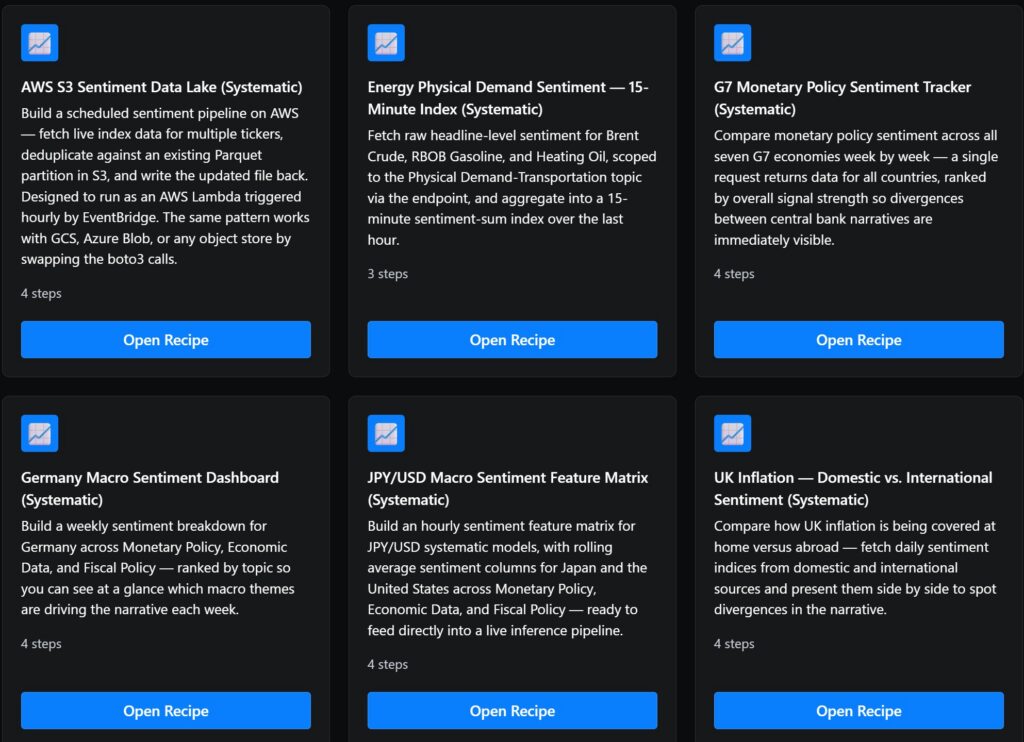
Above: Example recipes powered by a real-time market intelligence API, showing how structured sentiment, event detection, and forecasting can be operationalised into repeatable quant research and trading workflows across commodities and digital assets.
In today’s market environment, the edge is no longer defined solely by speed. It is defined by the ability to trust the data that drives your models.
A high-quality real-time market intelligence API does more than deliver data quickly. It ensures that every datapoint is complete, consistent, and explainable. For quant hedge funds operating at scale, that trust is not just infrastructure. It is a direct source of alpha.
If you are evaluating real-time market intelligence APIs for your quant workflows, Permutable offers institutional-grade infrastructure designed for reliability, scalability, and explainability.
Request access to our API to explore how structured sentiment, event intelligence, and forecasting can enhance your research and execution pipeline.