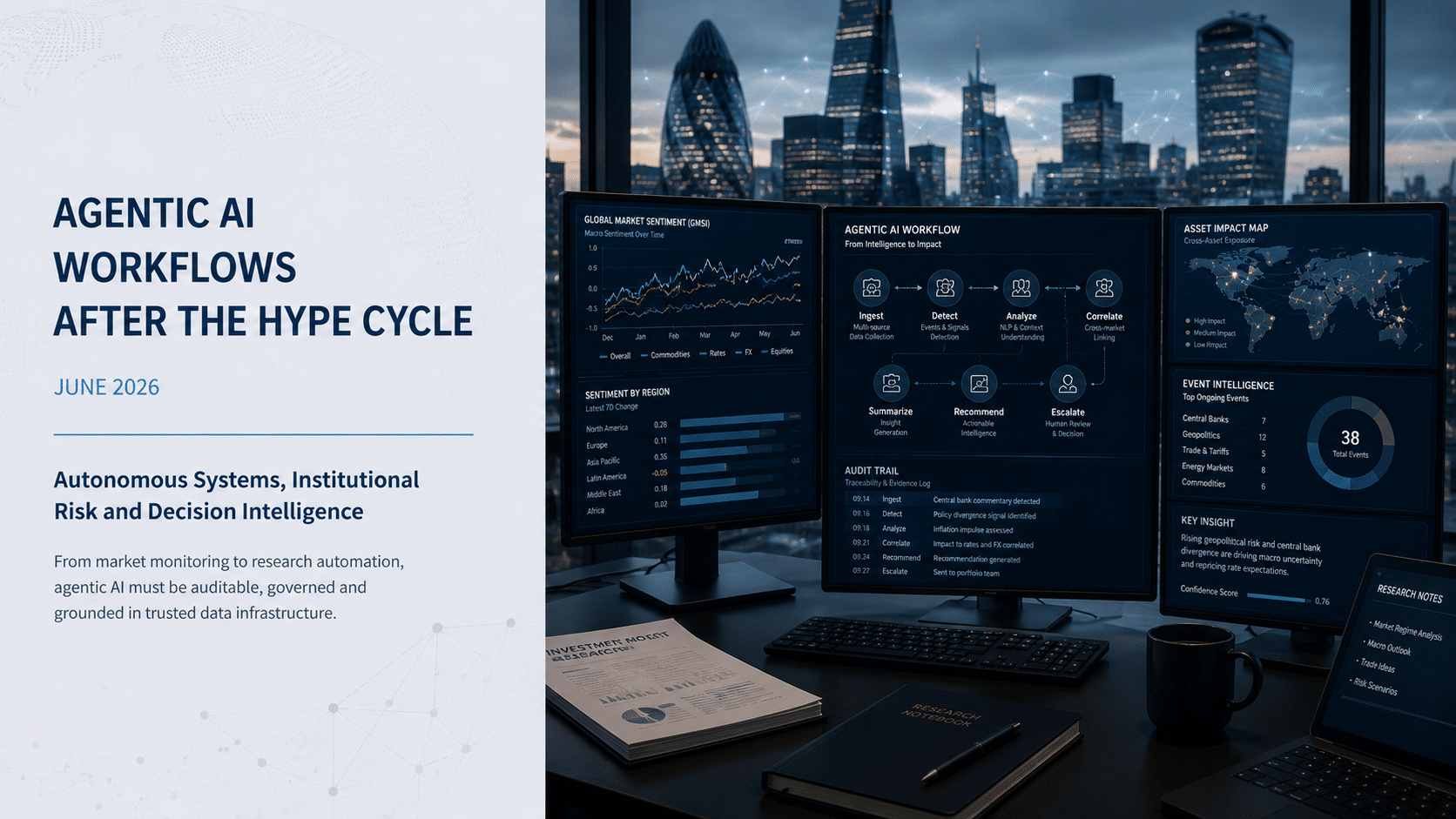
Agentic AI workflows after the hype cycle: autonomous systems, institutional risk and decision intelligence
16 Jun 2026
16 Jun 2026
Permutable CEO and Founder Wilson Chan explores what agentic AI means for institutional finance after the hype cycle. The article is aimed at institutional investors, quantitative researchers, trading teams, risk leaders and fintech decision-makers, covering autonomous workflows, market intelligence, research automation, auditability, governance, human oversight and trusted data infrastructure.
Following our recent Eagle Alpha webinar, Transforming Investment Workflows With Agentic AI one thing was clear: institutional investors are moving past the theoretical debate around AI agents and asking more practical questions. Where can these systems create value? Where do the risks sit? And what kind of data infrastructure is needed before agentic AI workflows can be trusted in real investment environments?
That is the right conversation to have.
Every technology cycle has its moment of theatre. With agentic AI, we are in that moment now. The language is big. The claims are bigger. Agents will run companies. Agents will trade markets. Agents will replace analysts. Agents will do the work of entire departments. Some of this will prove useful. Some of it will not survive contact with real institutional workflows.
The question for financial markets is not whether agentic AI sounds exciting. It does. The question is whether agentic AI workflows can be made reliable, auditable and useful inside environments where decisions carry real financial, regulatory and reputational consequences. That is where the conversation needs to move next.
In practical terms, agentic AI workflows refer to systems that can pursue a defined objective through a sequence of steps, rather than simply answering a single prompt. A conventional AI tool might summarise a report. An agentic system might monitor incoming news, detect a change in market sentiment, retrieve relevant source material, compare it with historical data, draft a research note, flag the affected assets and escalate the finding to a human analyst.
This is an important distinction because Agentic AI is not just generation. It is workflow automation with reasoning, memory, tool use and some degree of autonomy.
But autonomy exists on a spectrum. In institutional markets, the most useful near-term applications will not be fully autonomous systems making unchecked decisions. They will be supervised agents operating within defined boundaries: monitoring, summarising, checking, comparing, routing and recommending. That may sound less dramatic than the hype. However, it is also far more investable.
Institutional markets are information-heavy and time-sensitive. Analysts, portfolio managers, traders, risk teams and compliance officers are all dealing with the same structural problem: too much information, too little time and too many fragmented systems.
A single market-moving event may appear first as a local-language news report, a policy comment, a shipping update, a weather alert, a regulatory filing or a social media post. The challenge is not only to find it. The challenge is to understand whether it matters, which assets it may affect and whether the signal is strong enough to justify action. This is where agentic AI workflows have genuine relevance.
In research, they can reduce the time spent searching, filtering and summarising. In trading, they can help monitor narratives across assets and geographies. In risk, they can identify exposures linked to emerging events. In compliance, they can create better audit trails around why a decision was reviewed, escalated or rejected.
The opportunity is not to remove human judgement. It is to give human judgement better context, faster.
Monitoring: Markets now move through a continuous stream of unstructured information. Agentic systems can watch multiple sources, detect anomalies and surface the developments that deserve attention.
Summarisation: This is not simply producing shorter text. Good institutional summarisation means preserving source context, uncertainty, timestamps and relevance. A summary that removes the caveats is not efficient. It is dangerous.
Signal detection: Agents can help connect unstructured information to structured market indicators: sentiment, entity exposure, asset relevance, directional pressure and narrative momentum. This is especially important in commodities and macro markets, where the signal often sits outside traditional price data.
Automation: Analysts spend too much time moving between systems, collecting evidence and rebuilding context. Agents can gather the supporting material, compare it with previous events and prepare the first draft of an investment or risk view.
Decision support: This is the most important and the most misunderstood. Decision support does not mean the machine decides. It means the machine improves the quality, speed and traceability of the human decision. For institutional markets, that distinction is key.
The risks are not theoretical. They are operational. Model drift is one. Market language changes. Geopolitical narratives change. Source quality changes. A model that worked in one regime may behave poorly in another. Hallucination is another. In consumer settings, a hallucinated answer is frustrating. In financial markets, it can be costly. Any system used in institutional workflows must be able to show its sources and separate evidence from inference.
Auditability is a another risk. If an AI system recommends an escalation or produces a signal, the institution needs to know why. What data was used? Which sources contributed? What changed? What assumptions were made? Without that trail, agentic AI becomes another black box. Human oversight is also non-negotiable. The right model is not “human out of the loop”. It is human in control, with clear thresholds for review, escalation and intervention.
Finally, there is regulatory control. Financial institutions cannot adopt agentic AI workflows as if they were simple productivity plug-ins. These systems need governance, testing, access controls, monitoring and accountability. The more autonomy they are given, the stronger the control framework must be.
The market has spent much of the last two years discussing models. Models matter. But in institutional finance, data infrastructure matters more. An agent is only as useful as the data environment it operates within. If the data is noisy, delayed, poorly labelled or disconnected from source material, the agent will simply automate confusion at scale.
This is why at Permutable, we have focused on building intelligence infrastructure rather than another generic AI interface. Our work is centred on turning fragmented, unstructured information into structured, source-linked intelligence that can be used in real workflows.
That includes macro sentiment, market monitoring, entity-level signals and our Global Market Sentiment Index, or GMSI. The aim is not to replace the analyst, trader or portfolio manager. It is to give them a clearer view of how market narratives are forming, shifting and spreading across assets and regions.
For agentic AI workflows to work in institutional markets, they need this kind of foundation. They need clean data pipelines, source traceability, multilingual coverage, timestamped evidence, structured outputs and historical context. Without that, autonomy becomes a risk multiplier.
The next phase of agentic AI will be less about spectacular demos and more about disciplined deployment. The institutions that benefit will not be the ones that hand over decision-making to autonomous systems without controls. They will be the ones that identify specific agentic AI workflows where agents can reduce friction, improve coverage and strengthen decision intelligence. In markets, speed matters.
But speed without provenance is not intelligence. Automation without oversight is not progress. And AI without trusted data infrastructure is not a strategy.
Agentic AI workflows have a real future in institutional finance. But that future will be built carefully: with better data, better controls, better auditability and a clear understanding of where human judgement must remain central. That is where the hype ends and the work begins.
20 Oct 2026
Permutable launches data catalogue for macroeconomic, commodity and geopolitical sentiment intelligence
Read more >
16 Oct 2026
Permutable wins AI Innovation of the Year: Europe at the Euromoney Markets Awards 2026
Read more >
Analysis
16 Oct 2026
Gold outlook 2026: Why US rates outweigh geopolitical risk
Read more >