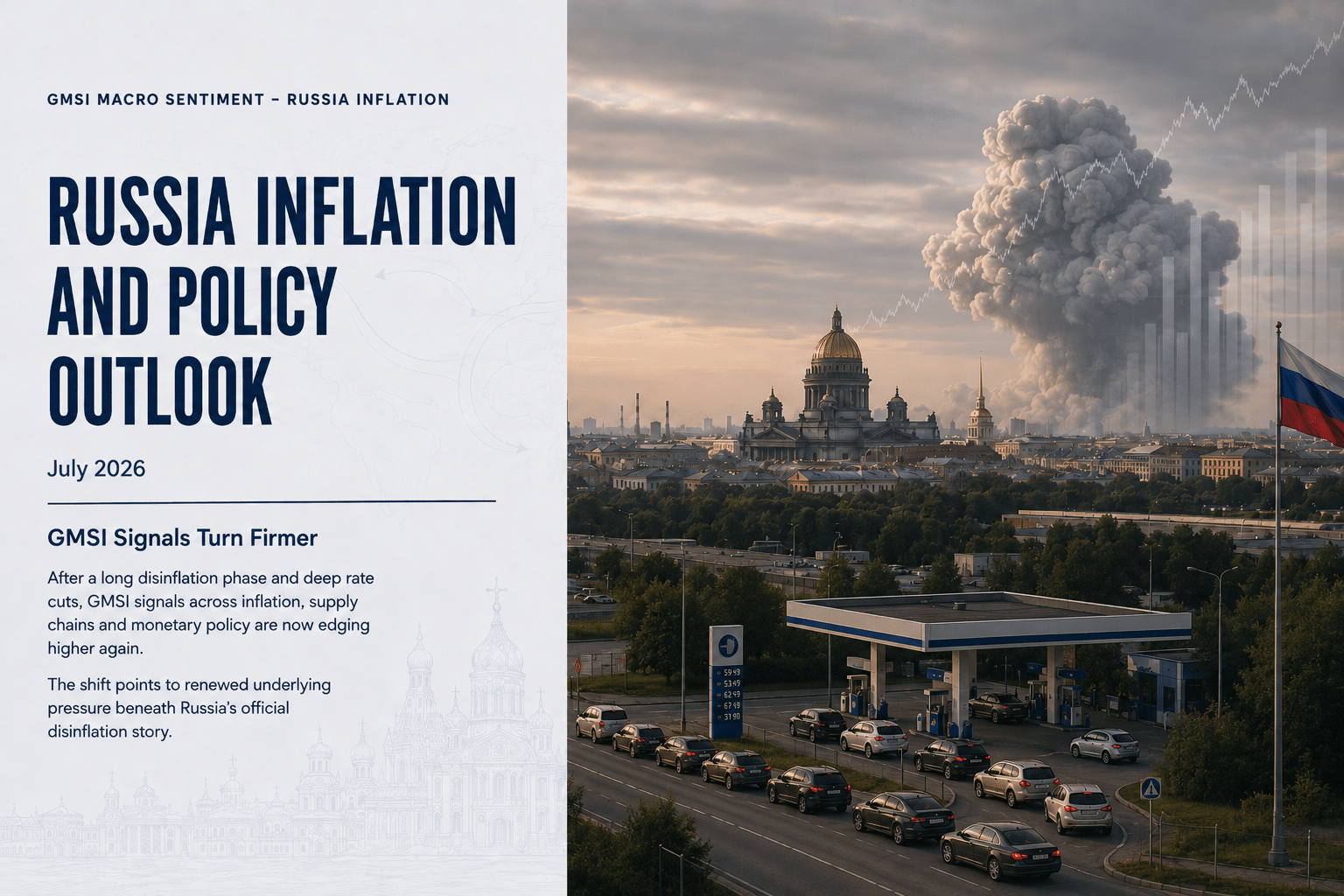
The tide turns on Russia inflation outlook as drone strikes spread from refineries to warehouses
27 Jul 2026
27 Jul 2026
In this article we examine a growing divergence in Russia inflation outlook using the Global Macro Sentiment Indices. The Bank of Russia has cut its key rate substantially since 2025 as price pressures eased. Yet the latest GMSI signals across monetary policy, supply chains and inflation are now moving the other way, pointing to renewed pressure beneath the official disinflation.
For most of the past eighteen months Russia inflation outlook has been running a disinflation story that looked, until recently, close to completion. Annual inflation fell from above 10% in early 2025 to roughly 5.3% by the beginning of this summer, allowing the central bank to lower its key rate from 21% to 14%.By June, however, inflation was back at 6%. The tide had begun to turn. The four sentiment panels below show how that reversal was already taking shape across monetary policy, supply chains, prices and political tension, leaving the earlier disinflation story looking increasingly fragile.
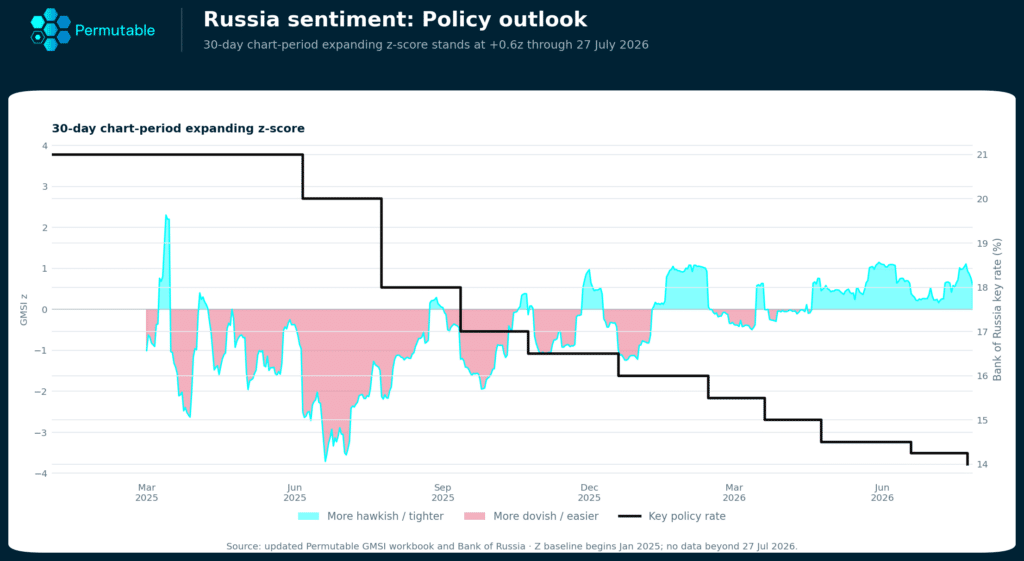
On the policy-outlook chart, the run of rate cuts appears as a long descending staircase. Yet directional sentiment focused on macroeconomic implication shows that coverage has pivoted the other way, shifting through the first half of 2026 towards the hawkish side of neutral to stand at +0.6z, even as the Bank of Russia has continued to ease. The signal tracks the direction of policy commentary rather than a market instrument, so it is best read as evidence that the expected policy path is becoming tighter while the current rate still falls.
The July decision brought that tension into the open. The central bank lowered the key rate, but raised its inflation forecast, lifted the projected rate path and said further cuts would proceed more slowly, citing inflation expectations, impaired production capacity and a more expansionary fiscal outlook. It also warned that a wider structural deficit could keep policy tighter than its baseline assumes. That matters, because it means the pressure on rates is not only a temporary supply story: fiscal demand is reducing the room to look through the shock.
The pressure runs in the other direction as well. In the run-up to the meeting, businesses squeezed by high borrowing costs pushed for relief, and calls from Moscow had called for further cuts. The Bank is therefore not simply weighing inflation against growth. It is trying to slow its own easing cycle while much of the corporate sector presses for cheaper credit.
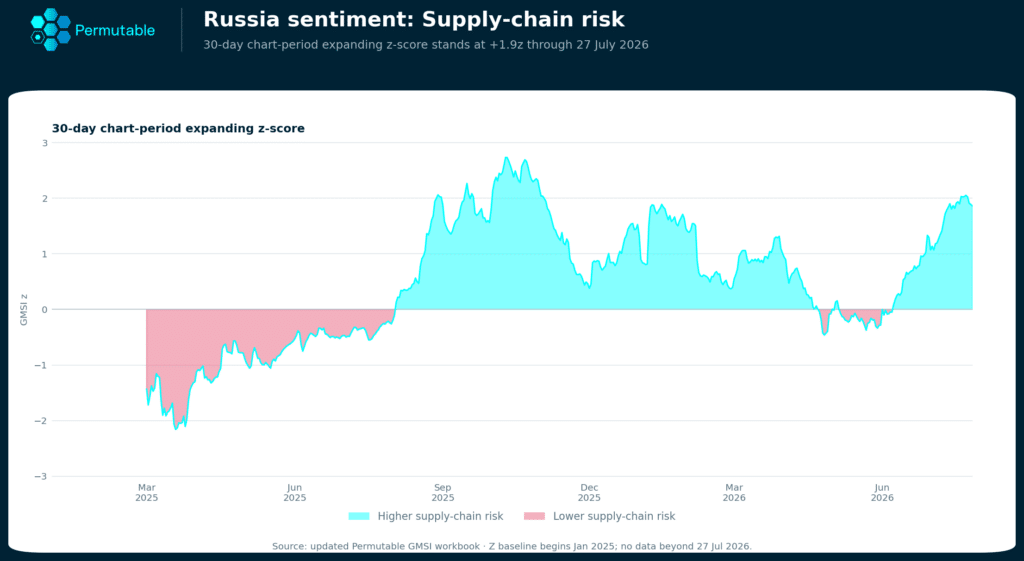
The pressure now sits in supply. The supply-chain risk panel has climbed to +1.9z, close to the top of its two-year range, after rising sharply since June. At first, the move reflected attacks on refineries, oil depots and transport routes, alongside fuel shortages and tighter diesel supply. What has changed is where the disruption bites. For much of the war, the economic strain was concentrated in the oil complex. It has now moved closer to the infrastructure of everyday consumption.
Since 18 July, Ukrainian drones have struck warehouse facilities operated by Wildberries, Russia’s largest online retailer. The first attacks hit logistics hubs in Kotovsk and Elektrostal, killing workers and injuring dozens. Further sites were later affected in southern Russia and near St Petersburg. By late July, warehouses representing roughly 10% of the company’s logistics capacity had reportedly been attacked, while separate estimates placed the share potentially out of service nearer 8%.
These are not peripheral targets. Russia’s leading online marketplaces handle goods and services worth the equivalent of roughly 8.5% of GDP and support about four million jobs. They have become part of the country’s consumer infrastructure, particularly in regions where physical retail is thinner. Strikes on refineries raise costs upstream; strikes on warehouses bring the disruption closer to the shelf.
The attacks have also landed on a retail system with limited spare capacity. Russia’s number of physical shops fell over the past year, the first nationwide decline reported in a quarter of a century, with thousands of outlets disappearing from Moscow and St Petersburg. That does not imply national shortages. It does leave fewer alternatives when a major distribution hub is disrupted, particularly outside the largest cities.
The same imbalance is visible in fuel distribution. Supplies have been redirected from Siberia and supplemented with imports from Belarus to stabilise the Moscow region, while shortages have persisted elsewhere. The result is a more uneven geography of disruption-and a growing sense that the economic burden is no longer confined to refineries, ports or the front.
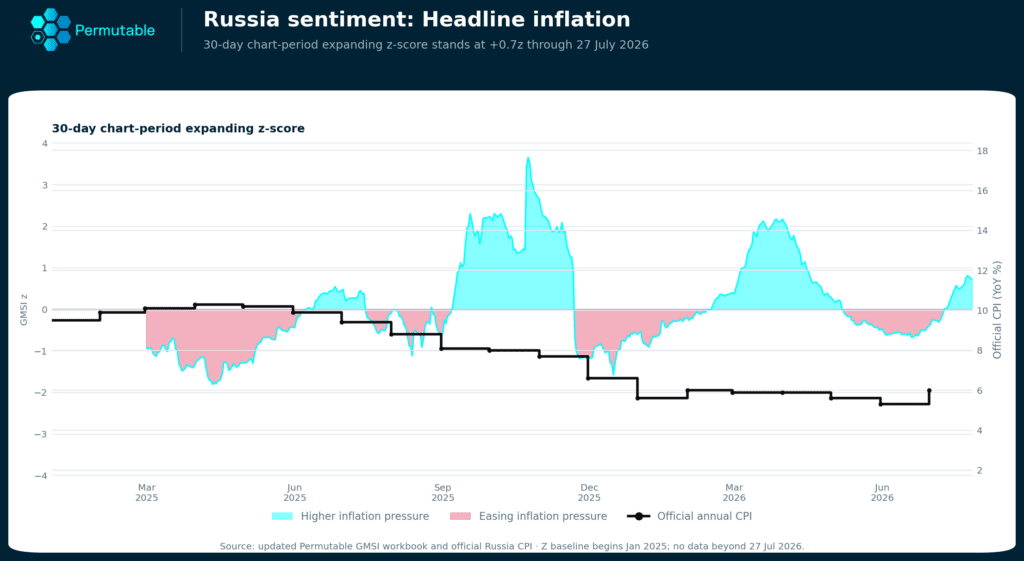
Bottlenecks and constraints on the domestic supply chains are beginning to coincide with renewed price pressure. The headline-inflation sentiment has risen to +0.7z after spending much of the disinflation below neutral, turning before the published series. Annual inflation, having fallen to around 5.5% earlier in the summer, stood closer to 6% by late June.
Much of the pressure predates the warehouse attacks. Inflation was already firming through fuel as repeated strikes on refining infrastructure soured the availability of supply. Reports of shortages and queues at petrol stations became more common palace in parts of the country. Petrol prices rose by 6.88% m-o-m in June, while diesel costs also increased during the agricultural season, with farmers being particularly worse off and having limited scope to reduce consumption.
The Bank of Russia has acknowledged that higher fuel costs are spreading into a broader range of goods and services, prompting it to raise its 2026 inflation forecast to 6–7%. Its assessment remains measured: much of the increase is considered temporary, underlying inflation is put at 4-5%, and weaker demand is expected to limit further pass-through. Fuel, fruit and vegetables have accounted for much of the recent volatility, reflecting both seasonal supply conditions and the higher cost of transporting perishable goods quickly through the distribution network. The inflation outlook is becoming increasingly uneven as the pressure is no longer confined to a single category.

The attacks on warehouses form one part of a wider rise in the domestic economic cost of the war. The political-tension panel remains close to the top of its two-year range, although the recent increase is not driven by logistics alone. The underlying coverage extends to mobilisation and preparations for possible unrest, disputes over wage arrears and staff shortages, public dissatisfaction and reported friction within the political system.
The panel is shown as a rolling sentiment sum rather than a standardised score because the signal has remained elevated for so long that z-scoring compresses the change that matters. At around 2,640, it remains well above the levels recorded in early 2025, even after easing from its June peak.
The reading comes with one caveat: much of the late-July coverage is international reporting on these themes rather than a direct measure of Russian public reaction. Its political significance lies less in any single headline than in the growing visibility of the war’s social cost. Fuel shortages, transport disruption, delayed wages and the prospect of further mobilisation are becoming harder to contain within the economic sphere alone.
The Central Bank had good reason to continue cutting. Inflation had fallen materially, domestic demand was weakening and business expectations for output had softened. Lending growth had slowed to a crawl, consumer-facing firms were under pressure and high borrowing costs were suppressing discretionary spending.
The forces now pushing in the opposite direction are largely supply-driven: damaged refining capacity, more expensive transport and disruption to the distribution of consumer goods. Interest rates cannot repair a refinery or replace a warehouse. But cutting too quickly while those shocks feed into expectations risks turning a temporary rise in prices into persistent inflationary pressure. Households’ own expectations tell the story, perceived inflation rose to 14.7% in July from 12.4% in June, far above the Bank’s revised forecast of 6-7%.
Keeping policy restrictive carries costs of its own. Credit conditions remain tight, businesses are pressing for cheaper borrowing and consumer-facing activity is weakening. At the same time, a more expansionary budget as the conflict persists would leave monetary policy carrying a greater share of the burden.
Where the government and central bank go next will depend in part on whether strikes against refineries and warehouses continue. Damaged capacity creates immediate disruption, but much of it can eventually be rebuilt. The greater risk is that a prolonged deterioration in supply chains pushes costs further into services and hardens wage demands. That would be far more difficult to reverse. The first signs of renewed price pressure have therefore left the Bank in an increasingly precarious position, with its tolerance for further inflation likely to be tested at the next meeting.
Read through the official data alone, Russia in mid-2026 appears to be an economy in which disinflation has progressed far enough to permit lower interest rates. The point in time sentiment from the GMSI offers a less settled reading. The decline in inflation was genuine, but it is meeting a fresh round of supply pressure just as the central bank has begun to ease. The first shock came through fuel and refining capacity and has spread into freight, food and services, while the attacks on major warehouses have exposed the vulnerability of the consumer-distribution network. None of this yet amounts to a return to the inflation regime of 2024 or early 2025. It does make the final stage of disinflation harder, and the next rate cut less straightforward.
Analysis
14 Oct 2026
Beneath US headline inflation: tracking pressure across energy, food, services and housing
Read more >
Analysis
13 Oct 2026
France’s debt alarm hits a decade high and drowns out the rest of the G20
Read more >
Analysis
12 Oct 2026
Macro sentiment in rates research: Can macro sentiment add information to front-end rates research?
Read more >