
Beneath US headline inflation: tracking pressure across energy, food, services and housing
14 Oct 2026
14 Oct 2026
This article examines how Permutable’s Global Macro Sentiment Indices separate US inflation narratives across energy, food, services, goods and housing. It explains the distinction between economic direction and reporting tone, and how these signals can be examined alongside CPI, policy expectations and market pricing. Aimed at institutional macro analysts, rates strategists, portfolio managers and researchers assessing inflation between official releases.
A US headline inflation reading brings together pressures that can be moving in different directions. Energy, food, services, goods and housing each contribute to the aggregate, but the composition of that pressure is central to interpreting the inflation cycle. For macro desks, the question extends beyond whether inflation is rising or falling to which components are driving the change.
Permutable’s Global Macro Sentiment Indices separate these components within the information flow. The resulting series provide a high-frequency view of inflation narratives between official releases, allowing researchers to examine emerging pressure alongside CPI, monetary-policy expectations and market pricing.
The US inflation breakdown, as presented in the latest edition of our Permutable Perspective, Edition 4 (request a copy here) plots component-level sentiment alongside annual CPI inflation. Energy, food, services, goods and housing are shown separately, using point-in-time 30-day signals.
The distinction here between the two measures is key. CPI records the official inflation outcome; the sentiment components track the information forming around the underlying sources of price pressure. Reading them together allows a desk to investigate how the inflation narrative is developing while the official series remains between releases.
The decomposition is designed to help separate structural pressures from temporary shocks. It also provides a framework for examining whether changes in news flow are consistent with the inflation picture reflected in market pricing, including breakevens and Treasury positioning.
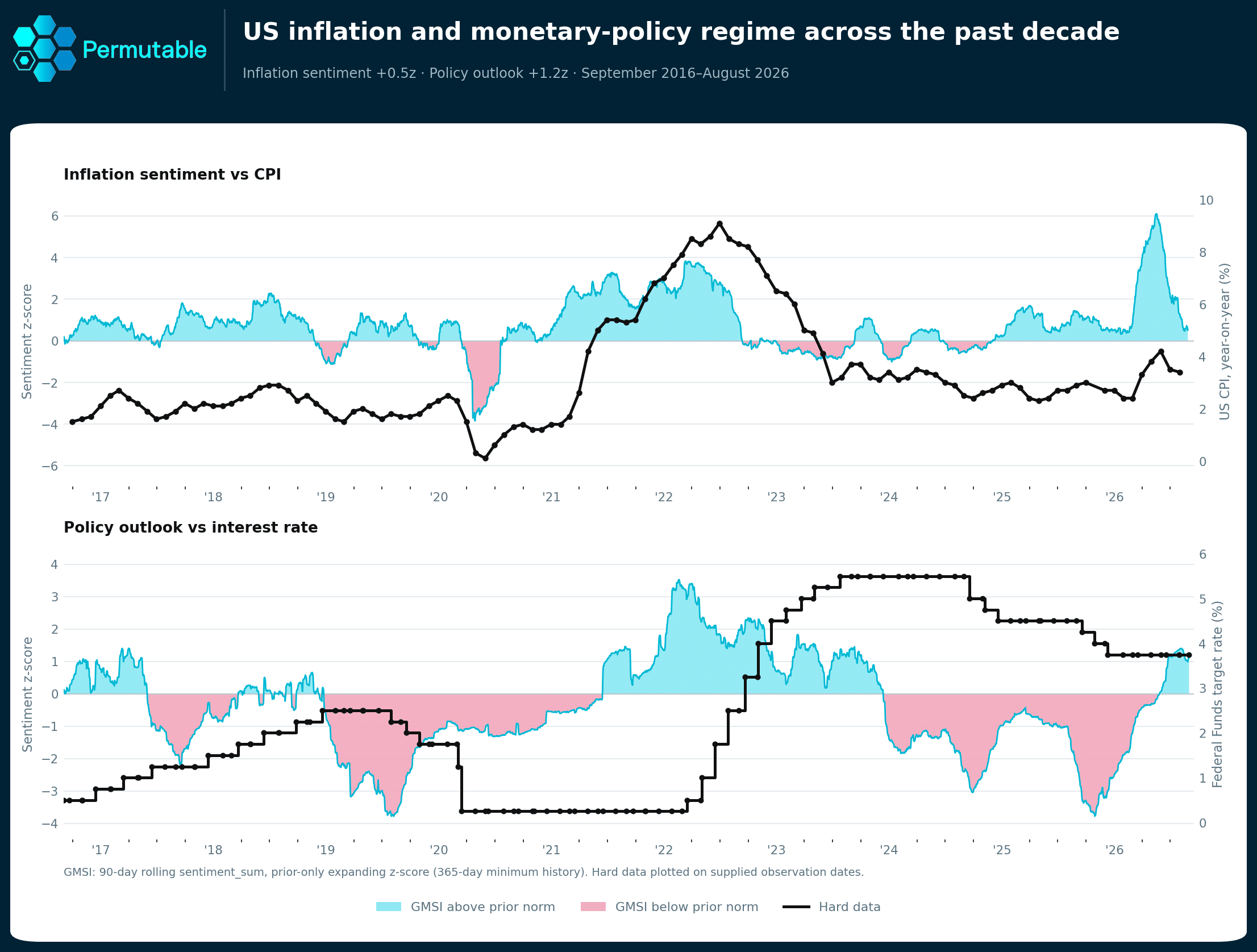
The longer history provides context for those comparisons. The edition’s decade view shows inflation sentiment weakening in 2020, rising through the 2021–22 inflation shock and subsequently moderating. Examining the components beneath that aggregate allows researchers to investigate how the mix of reported pressure changes through the cycle.
Interpreting these series requires separation between economic direction and the tone of reporting.
GMSI’s directional measure follows the direction of the named economic topic. For inflation, a positive directional reading means price pressure is rising. It does not mean the development is favourable. The semantic measure captures whether the language of the reporting is upbeat or alarming.
The edition illustrates this with a headline describing US inflation reaching a fresh 40-year high as food and energy costs soar. Its directional score is positive, at +0.88, because prices are rising. Its semantic score is negative, at −0.82, because the language is alarming.
Both readings describe the same report. Their divergence shows why a general positive-versus-negative interpretation can obscure the economic information.
For inflation research, separating these dimensions helps preserve the distinction between the reported direction of price pressure and the mood surrounding it.
Inflation components sit within a broader macroeconomic framework. GMSI tracks growth, inflation and policy pressure across more than 95 economies, with hourly updates and more than 11 years of point-in-time history. Domestic and international views allow local reporting to be examined separately from external perceptions.
For a macro desk, this creates a way to follow inflation developments alongside the policy narrative. The edition brings US inflation sentiment and policy outlook together with Treasury yields, examining whether individual developments form part of a broader shift in the macro regime.
Historical observations retain their source, country, topic and directional definitions. Researchers can therefore investigate the component series through time and trace readings to the underlying evidence.
The application is a more detailed view of inflation between releases: which pressures are being reported, how their direction differs from the tone of coverage, and how those developments sit alongside policy expectations and market repricing.
For the US inflation component chart, directional-versus-semantic worked example, and accompanying US inflation and policy analysis, request a copy of Permutable Perspective, Edition 4 to your inbox.
Email enquiries@permutable.ai with the subject “Permutable Perspective Edition 4 – Inflation”. Include the economies or inflation components your desk follows if you would also like to discuss the relevant GMSI coverage.

Analysis
13 Oct 2026
France’s debt alarm hits a decade high and drowns out the rest of the G20
Read more >
30 Sep 2026
The Hawkish Turn: G10 Central Bank Policy Outlook into Q4 2026
Read more >
Guide
30 Sep 2026
The complete guide to early macro regime sentiment signals for hedge funds and institutional investors
Read more >