In this insight, we explore the story surrounding the slowdown in the UK housing market through the lens of sentiment, looking at the sequence and timing of events and how the Global Macro Sentiment Indices (GMSI) could have seen it coming early. Housing is where much of Britain’s household wealth, debt and confidence is concentrated. It is also slow to report on itself. Mortgage approvals arrive after the decisions they record, and completed-sale house price indices arrive later still. By the time the evidence is formally assembled, the market may already have moved on. Point in time sentiment captures the narrative while it is forming, allowing us to get a real time read on how the story has unfolded in 2026 and where it is still running ahead of the numbers.
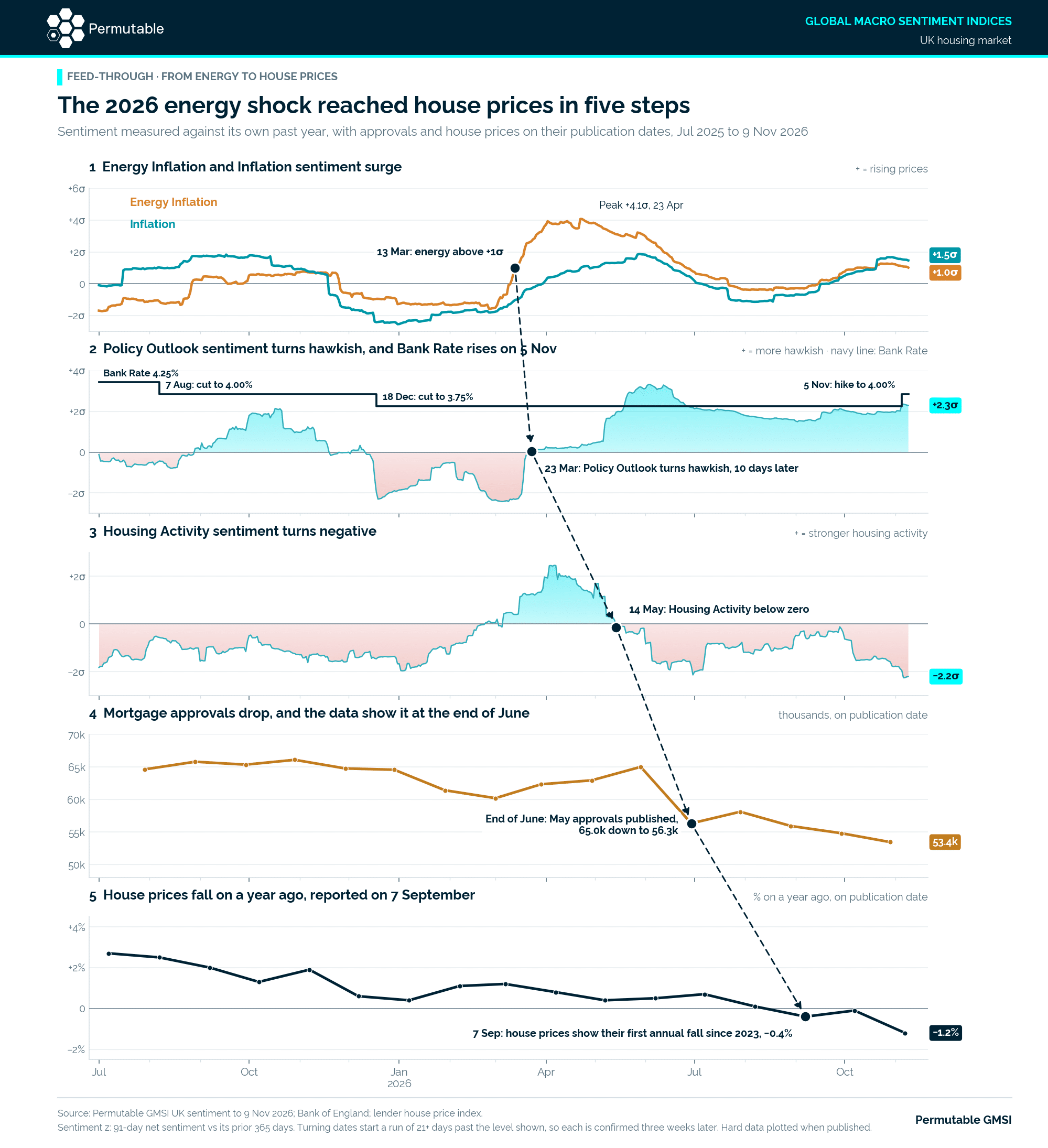
The sequence began, with the price of energy. In mid-March, Energy Inflation sentiment, which rises when the narrative points to higher energy prices, began a surge that would carry it to its strongest reading since the autumn of 2021, following the US-Iran conflict. Broader Inflation sentiment followed at a more measured pace, as the rise in energy costs worked its way into the wider price outlook.
The policy outlook responded swiftly. In early March, Policy Outlook sentiment, which reads positive when expectations turn more hawkish, was firmly negative, and the market still anticipated further easing after December’s cut. Within ten days of the energy shock it had crossed into hawkish territory, and it has stayed there ever since. Bank Rate itself did not move until November. For more than seven months, the narrative did the tightening on the Bank’s behalf.
Housing absorbed the blow for a time. Housing Activity sentiment, positive when the market points to stronger activity, enjoyed a buoyant spring before rolling over in mid-May, a turn that was confirmed in early June. At that moment the official record still looked reassuring, with the latest mortgage approvals at their strongest level of the year. The numbers then caught up in sequence what the sentiment had already seen coming. The fall in approvals was published at the end of June, around a month later, and the first annual decline in house prices since 2023 was reported in early September, roughly a quarter later. By the time the slowdown was formally on the record, the sentiment had long since confirmed the market backdrop.
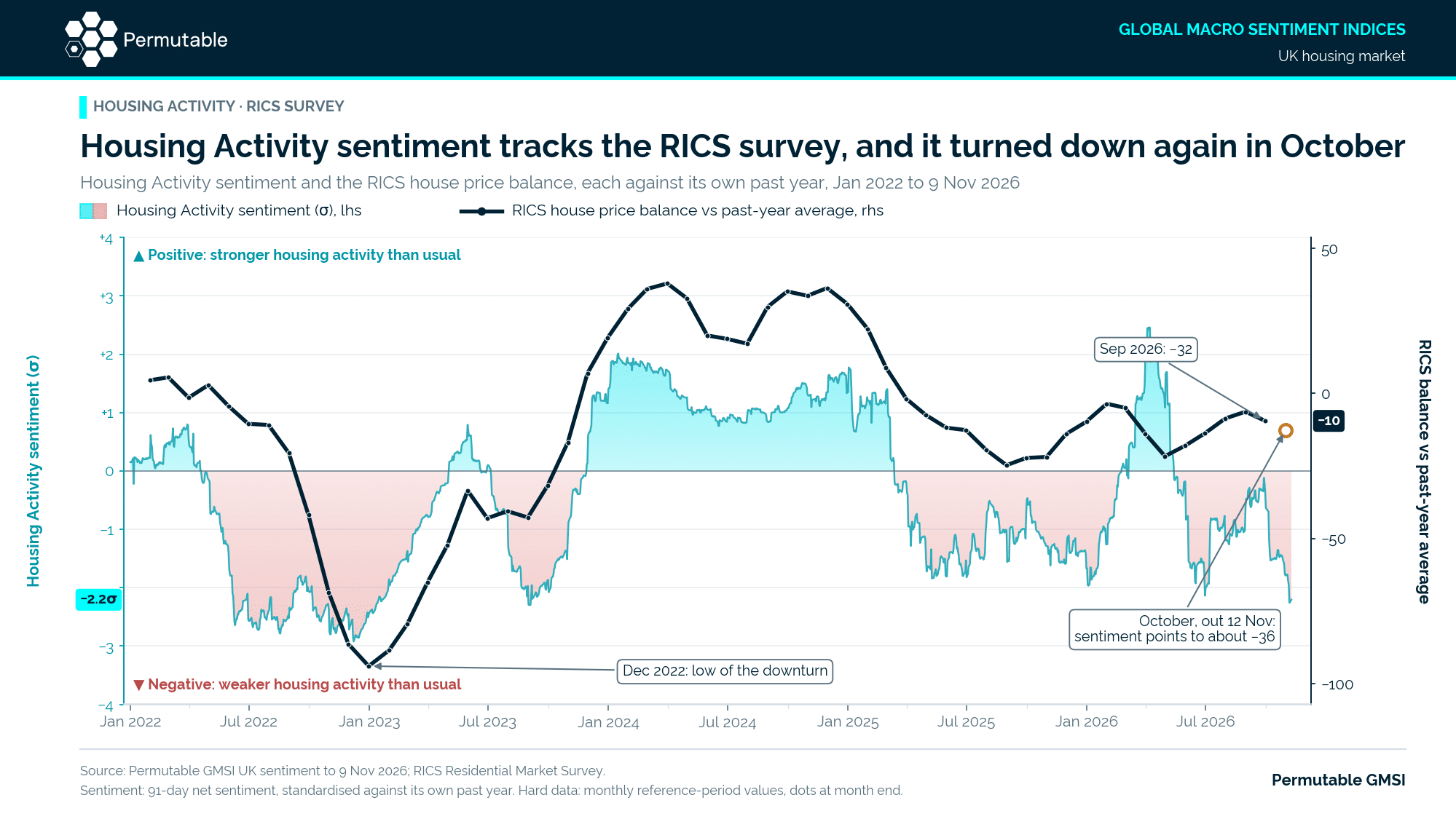
A narrative is only valuable if it measures something real, and the evidence here proves the point. Over the past decade, Housing Activity sentiment has moved in close step with the RICS monthly survey, the leading read of the market, and with Bank of England mortgage approvals. Since 2022 it has called the direction of approvals in around three months out of four, typically a month before the official figure is published.
Housing Activity sentiment fell sharply through the month and now stands at its weakest since September 2023, which points to a further deterioration in the RICS price balance, from −32 in September to around −36 when forecast using sentiment, when the survey is released on 12 November. The Budget offered no reprieve. Housing Activity sentiment continued to slide after the Chancellor’s support for first-time buyers on 28 October, while Interest Rates sentiment climbed into the Bank’s first rate rise since 2023. Help with a deposit, it seems, is of limited comfort while the cost of servicing the loan continues to rise.
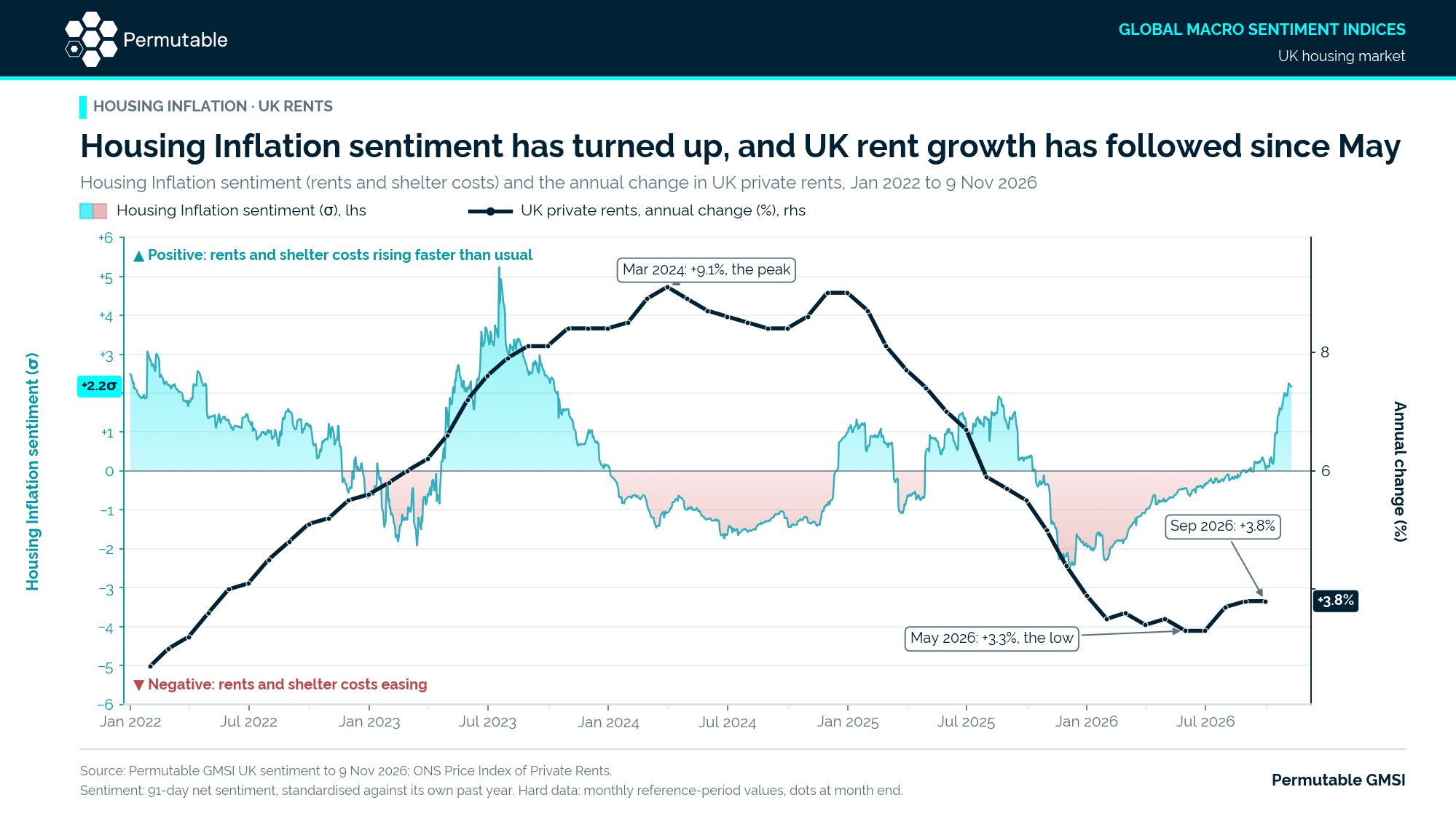
A slowdown in the UK housing market has not delivered more affordable housing options. With typical two-year fixed mortgage rates nearing 6%, and the monthly repayment on an average home rising almost entirely because of borrowing costs, many would-be buyers have chosen to remain tenants. Housing Inflation sentiment, which tracks the rents and shelter costs that households face and rises when those costs are climbing, has swung from deeply negative at the start of the year to firmly positive. Official rent growth turned in tandem in May, after more than two years of moderation.
This is the less advertised consequence of a rate-driven slowdown. Would-be buyers can wait for better terms, but tenants cannot defer the rent. With a further rise in tax on rental income due from next April, the supply of rented homes faces additional pressure just as demand for them strengthens.
The value of the GMSI in this case study lies not in a single reading, but in the ability to construct multiple indices that connect the story. Energy, policy, rates, housing and rents were measured systematically, using the same method every day, with each interpreted in its own economic direction. This produces an orthogonal view of the economy, built from the narratives shaping market expectations rather than the prices and activity eventually recorded in official statistics. It turns the noise of daily market chatter into a sequence of regime shifts that could be followed from one theme to the next, and into a signal clear enough to support conviction rather than speculation. That matters well beyond housing. The same narratives shape growth and inflation expectations, guide the path of policy rates and set the risk premium on sterling assets. Tracking them live places analysts at the forefront of the economic pulse, rather than in the queue for the next official release.
The latest GMSI readings offer little prospect of near-term relief for the UK housing market. Policy Outlook and Interest Rates sentiment remain firmly hawkish, while Housing Activity sentiment has fallen to its weakest level in more than three years. Housing Inflation sentiment, meanwhile, continues to rise, suggesting that weaker activity has yet to ease concerns over housing costs.
Want to monitor where the next turn in UK housing market appears next? Explore Permutable’s Global Macro Sentiment Indices in our Data Discovery catalogue to find datasets for tracking the UK policy outlook, housing activity and inflation by subtopic in your own research.