
This Nvidia US chip export controls case study presents four three-month scenarios modelled by Permutable’s Copilot on 16 November 2026. The model assigned equal 30% weights to share-price stabilisation and a governance-led decline. For institutional investors, portfolio managers and research teams, the analysis explains how earnings, regulatory developments and cloud deployments could shift the outlook and what to watch next.
At Permutable, we provide market intelligence for institutional investors, with a focus on macro and commodities. However recently, Nvidia offered an opportunity to apply our scenario analysis to an individual equity. The chip giant has been navigating a leadership transition, rapidly growing data centre sales and US scrutiny of chip exports to China. How might those developments shape the shares over the next three months?
On 16 November, after co-founder Jensen Huang stepped down as chief executive and before Nvidia’s quarterly results, we ran a three-month scenario analysis using our Copilot. The model gave 30% weight to stabilisation and 30% to a governance-led decline. The two scenarios carried equal weight, but their expected prices were $45 apart. The distinction came down to what happened next on governance and export controls.
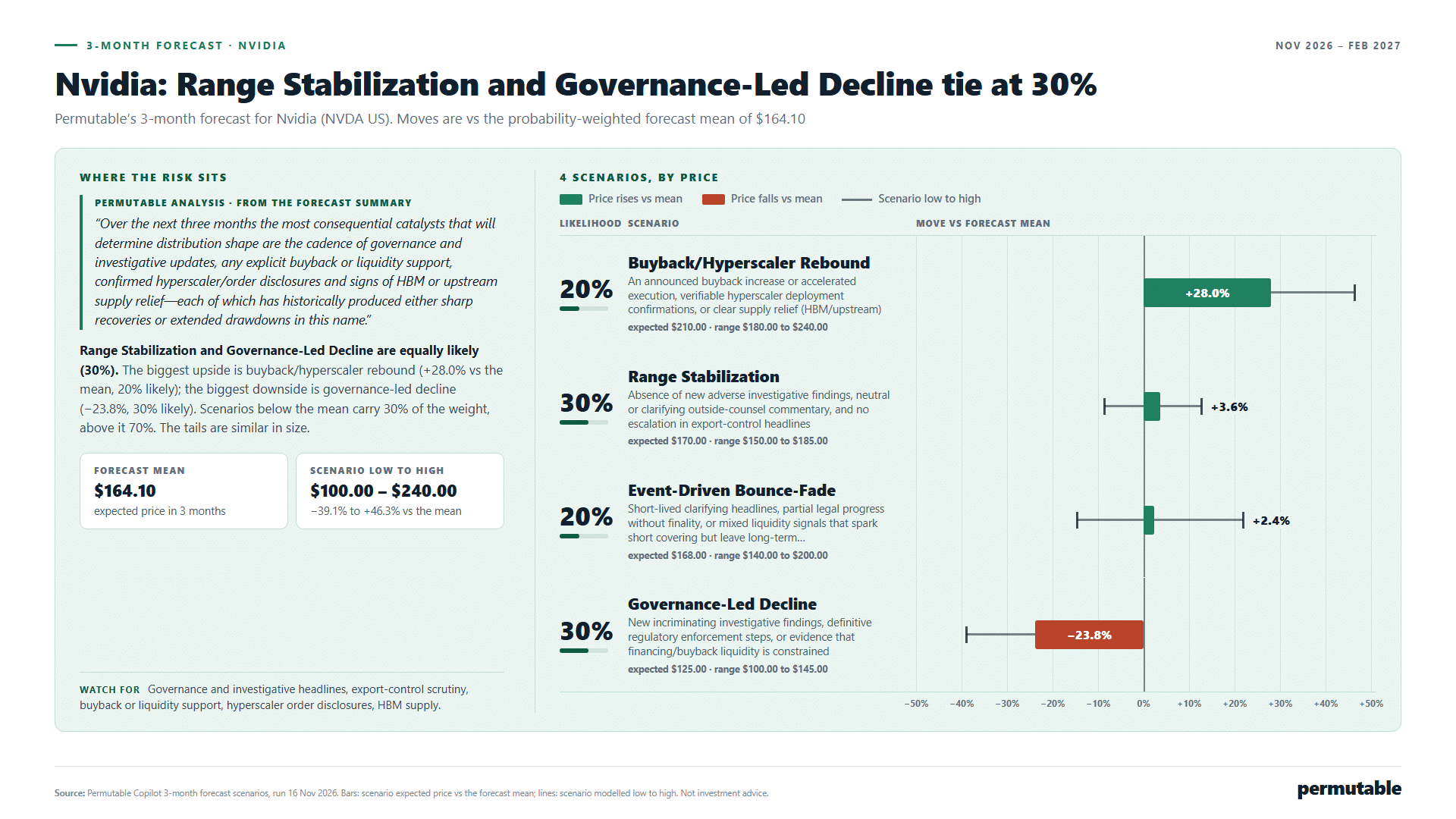
Above: Nvidia US chip export controls case study. Permutable Copilot’s 16 November 2026 run gave 30% weight each to stabilisation ($150 – $185) and a governance-led decline ($100–$145). The bars compare scenario prices with the $164.10 forecast mean.
On 17 November, Nvidia reported $115.8 billion in fiscal third-quarter revenue, up 103% year on year. Data centre revenue rose 110% to $107.6 billion. The company also said it had begun shipping its Vera Rubin NVL72 systems, with racks already running at several cloud providers, including Google Cloud and Microsoft Azure.
Nvidia guided to fourth-quarter revenue of $130 billion, plus or minus 3%, and explicitly excluded data centre compute revenue from China from that outlook. Five days after the earnings release, US Treasury Secretary Scott Bessent said Washington was seeking answers about Nvidia’s chip sales to China and who oversaw compliance. For investors assessing the implications, the guidance provides a starting point. The question is what any subsequent policy or enforcement action could change beyond the assumptions management has already made.
The 16 November run laid out four scenarios through February 2027. Each paired a modelled price range with developments that could support it.
| Three-month scenario | Model weight | Expected price | Modelled range |
|---|---|---|---|
| Shares stabilise as governance concerns ease and export-control scrutiny does not escalate | 30% | $170 | $150 – $185 |
| Governance-led decline following adverse findings or formal enforcement action | 30% | $125 | $100–$145 |
| Short-lived rebound following partial clarification | 20% | $168 | $140–$200 |
| Stronger rebound supported by buybacks, confirmed cloud deployments or easing chip supply constraints | 20% | $210 | $180–$240 |
Source – Permutable Copilot’s three-month scenario analysis, run on 16 November 2026, before Nvidia’s earnings release and Bessent’s comments.
The model’s probability-weighted forecast mean was $164.10. The governance-led decline was centred about 24% below that mean, while the strongest rebound was centred about 28% above it. These percentages use the modelled mean as their reference point. The model gave more weight to the sharp decline than to the strongest rebound, even though the rebound sat further from the mean. The two figures answer different questions for a portfolio manager: how much weight the model gave an outcome and how far its expected price sat from the weighted average.
On governance, it’s a fine line between continued scrutiny and a formal development. Nvidia announced a board committee to oversee national security and export controls on 17 November. Bessent’s comments on 22 November made clear that Washington still had questions. The downside scenario envisaged a further step, such as adverse investigative findings or formal enforcement action. A period without escalation, or disclosures that clarify the outstanding questions, would be more consistent with stabilisation.
On the upside, the evidence to track is deployment and execution. Nvidia named cloud partners already running Vera Rubin systems and reported roughly $227.3 billion remaining under its share repurchase authorisation at quarter-end. Further confirmed deployments would give investors more evidence of how quickly the new systems are being put to work. The pace of actual repurchases would show how much of that authorisation Nvidia is using.
The value of a dated scenario analysis is that it gives investment teams a record of which developments they were watching before the next headline arrived. Nvidia’s earnings added evidence about the pace of data centre growth. The subsequent comments from Washington kept export compliance in focus.
Putting each development against an explicit scenario gives a portfolio manager a practical question to bring to the next risk discussion: which outcome has become more plausible, and what evidence would change our view again?
The Nvidia case study illustrates how we use scenario analysis today. We lay out plausible outcomes, identify what could drive each one and give investors a way to reassess them as new evidence comes in.
Our longer-term ambition is to build a living model of global markets, where central banks, investors and businesses are represented by specialised agents. Researchers could then test how a policy decision or supply shock might ripple through the economy as those actors respond.

Analysis
22 Nov 2026
Japan inflation outlook 2026: Stubborn inflation, a stalling economy and a BoJ set to hike
Read more >
Analysis
11 Nov 2026
UK housing market: how sentiment saw Britain’s housing slowdown coming
Read more >
Analysis
04 Nov 2026
Macro sentiment in rates research: Can macro sentiment add information to front-end rates research?
Read more >