Agentic AI workflows in institutional finance: FAQ
17 Jun 2026
17 Jun 2026
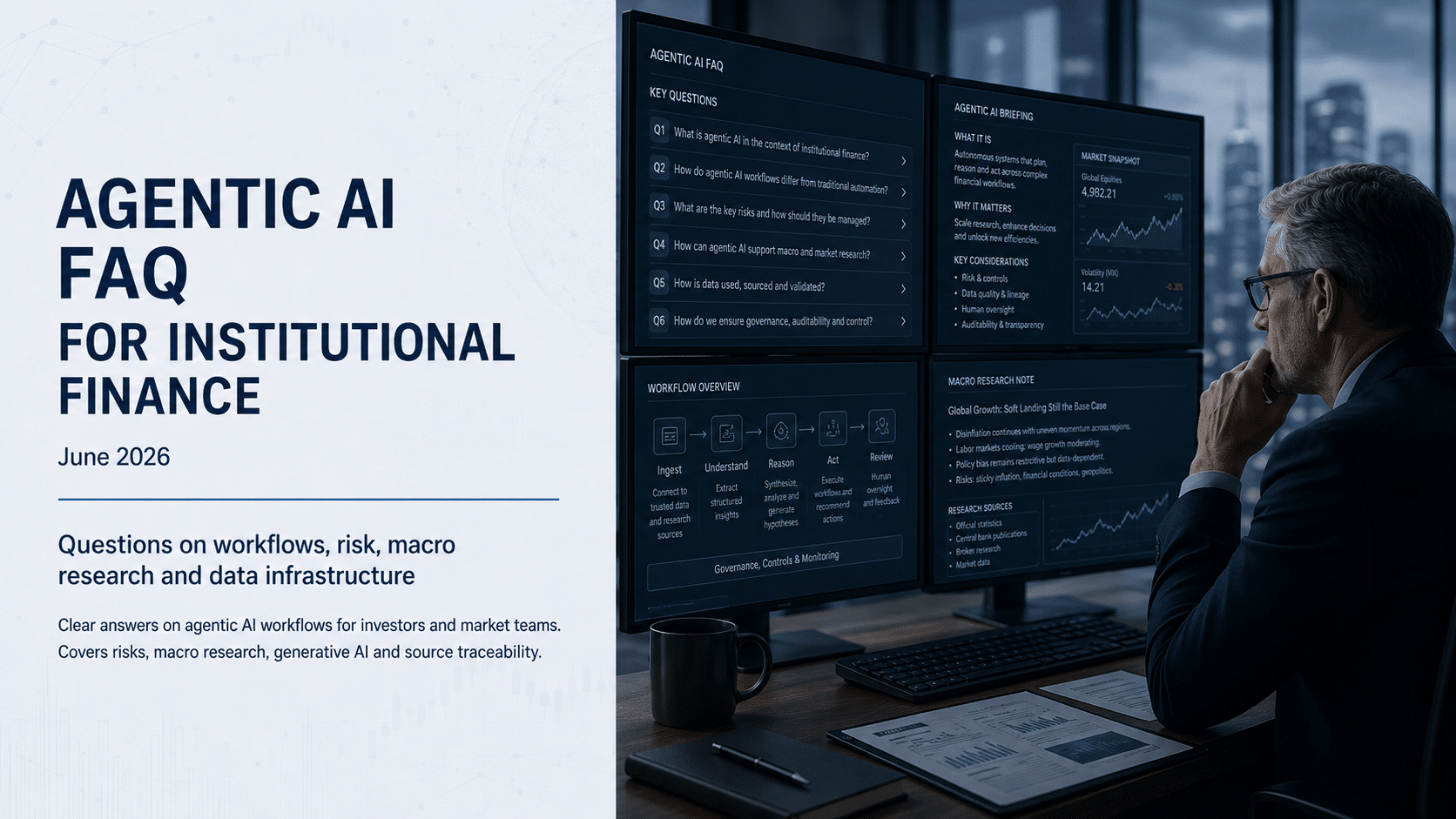
This FAQ explains agentic AI workflows in institutional finance, linking to Permutable’s Eagle Alpha webinar on AI agents and autonomous workflows. It is aimed at institutional investors, trading teams, data buyers, risk leaders, fintech decision-makers and market researchers seeking clear answers on agentic AI, generative AI, macro research, auditability, data infrastructure and decision intelligence.
This FAQ accompanies Permutable’s recent Eagle Alpha webinar, Beyond Automation: The Future of Agentic AI Workflows, which explored how AI agents are beginning to move from experimentation into real institutional use cases.
The discussion raised a number of important questions for investors, trading teams, data buyers and fintech leaders. What does agentic AI actually mean? How is it different from generative AI? Where can it support market research, risk monitoring and decision intelligence? And what controls are needed before agentic AI workflows can be trusted in financial services?
The answers below are designed to provide a clear, practical reference point for institutional readers looking to understand the role of agentic AI workflows in modern market intelligence, macro research and investment decision-making.
Agentic AI refers to AI systems that can pursue a defined objective through a sequence of steps. Instead of simply responding to a single prompt, an agentic AI system can plan, retrieve information, use tools, compare data, summarise findings and recommend a next action.
In institutional finance, this might mean monitoring market news, identifying a shift in sentiment, retrieving source material, linking the development to relevant assets and escalating the finding to a human analyst or portfolio manager.
Agentic AI is best understood as workflow automation with reasoning, memory, tool use and controlled autonomy.
Agentic AI workflows are structured processes where AI agents complete defined tasks across multiple stages. These workflows may include monitoring, classification, summarisation, signal detection, research support, risk escalation and decision support.
For example, an agentic AI workflow in macro research could monitor central bank commentary, detect a change in inflation language, compare it with historical policy signals, identify affected assets and prepare a source-linked briefing for an investment team.
In financial markets, agentic AI workflows are most useful when they operate within clear boundaries, with human oversight and auditability built in.
Generative AI creates outputs such as text, summaries, code, images or analysis in response to a prompt. Agentic AI goes further by taking a goal and working through a sequence of actions to complete it.
A generative AI system might summarise a central bank speech. An agentic AI system might monitor multiple central bank speeches, identify changes in tone, compare those changes with market sentiment, flag affected currencies and prepare a research note.
The difference is that generative AI produces content, while agentic AI workflows coordinate tasks, tools and information across a process.
Agentic AI matters for institutional investors because markets are increasingly shaped by fast-moving, fragmented and unstructured information. News, policy comments, geopolitical developments, commodity disruptions and macro data can all affect asset prices, but they are difficult to monitor manually at scale.
Agentic AI workflows can help investment teams process more information, identify relevant changes earlier and preserve the source context behind emerging signals.
For institutional investors, the value is not replacing human judgement. The value is improving the speed, coverage and traceability of human decision-making.
Agentic AI can support macro research by monitoring large volumes of global information and linking relevant developments to countries, indicators, asset classes and market narratives.
A macro-focused agentic AI workflow could track inflation commentary, central bank language, fiscal policy, trade risk, labour-market signals and geopolitical developments across multiple regions. It could then organise those signals into structured summaries or sentiment indicators.
This is particularly useful when macro signals emerge gradually through news flow, policy language or local-market narratives before appearing in traditional economic data.
Agentic AI can support trading workflows by helping teams monitor news, detect narrative shifts, surface asset-relevant signals and prepare decision-ready context.
In commodity trading, for example, agentic AI workflows can monitor developments such as LNG disruptions, refinery outages, weather risks, export controls, sanctions, crop conditions and shipping constraints. These developments may affect energy, metals, agriculture and related macro assets.
The role of agentic AI in trading should be decision support, not unchecked autonomous execution. Human oversight, risk controls and source traceability remain essential.
Agentic AI can support risk management by identifying emerging exposures across portfolios, markets and counterparties. It can monitor external events, connect them to relevant assets and escalate risks that require review.
For example, an agentic AI workflow could detect rising geopolitical tension in a commodity-producing region, identify related energy or metals exposures and alert a risk team with source-linked context.
This can improve situational awareness, but it must be governed carefully. Risk teams need to understand why an alert was generated, what data contributed to it and whether the signal is reliable.
The main risks of agentic AI in financial services are model drift, hallucination, poor source quality, weak auditability, excessive autonomy and insufficient human oversight.
Model drift occurs when an AI system becomes less reliable as market conditions, language patterns or data sources change. Hallucination occurs when a system generates unsupported or incorrect information. Weak auditability makes it difficult to understand why a signal, recommendation or escalation was produced.
In institutional finance, agentic AI workflows need governance, monitoring, testing, access controls and clear escalation rules. The more autonomy a system has, the stronger the control framework needs to be.
Auditability matters because institutional investors and financial firms need to understand how AI-generated outputs were produced. If an agentic AI workflow flags a risk, recommends further analysis or contributes to an investment view, the firm needs to know what information was used.
A well-designed system should show the source material, timestamps, data inputs, reasoning path and any assumptions behind the output.
Without auditability, agentic AI becomes a black box. In regulated financial environments, that creates operational, compliance and reputational risk.
Agentic AI needs human oversight because financial decisions involve uncertainty, judgement and accountability. AI systems can process information quickly, but they cannot replace the responsibility of analysts, portfolio managers, traders, risk teams or compliance officers.
Human oversight helps ensure that outputs are interpreted correctly, challenged where necessary and used within appropriate risk limits.
The strongest institutional use cases are not “human out of the loop”. They are human-in-control workflows where AI improves speed, coverage and context.
Agentic AI needs high-quality data infrastructure because agents are only as reliable as the data they use. If the underlying data is noisy, delayed, duplicated, poorly labelled or disconnected from source material, the AI system may automate poor decisions at scale.
High-quality data infrastructure includes clean ingestion pipelines, entity recognition, multilingual coverage, source traceability, timestamped evidence, structured outputs and historical context.
In institutional markets, trusted data infrastructure is what turns agentic AI from a productivity experiment into a decision-intelligence capability.
Source traceability improves agentic AI workflows by allowing users to trace a signal, summary or recommendation back to the original source material.
This is important because financial users need to verify whether an output is based on credible evidence. A sentiment shift, market alert or research summary is more useful when the underlying articles, policy comments or data points can be reviewed.
Source traceability supports trust, validation, auditability and compliance. It also helps reduce the risk of hallucination by grounding outputs in identifiable evidence.
Agentic AI supports decision intelligence by helping teams move from fragmented information to structured, explainable context.
Decision intelligence is not about allowing machines to make unchecked decisions. It is about improving the inputs, speed and transparency of human decisions. In institutional finance, this means helping teams understand what changed, why it matters, which assets may be affected and how confident they should be in the signal.
Agentic AI workflows can strengthen decision intelligence when they combine automation with source-linked evidence and human oversight.
Wilson Chan, CEO and Founder of Permutable, has argued that agentic AI should be judged by its usefulness in real institutional workflows, not by hype-driven claims about full autonomy.
His view is that the most valuable agentic AI workflows in finance will be supervised, auditable and grounded in trusted data infrastructure. Rather than replacing analysts, traders or portfolio managers, agentic AI should improve their ability to monitor markets, detect signals, validate sources and make better-informed decisions.
The central point is that speed without provenance is not intelligence, and automation without oversight is not progress.
Permutable approaches agentic AI workflows through the lens of market intelligence, source traceability and structured data infrastructure.
The company’s intelligence engine is designed to transform fragmented, unstructured information into structured signals that can support macro research, market monitoring, entity-level analysis and sentiment tracking. This includes work around macro sentiment, market narratives and the Global Market Sentiment Index, or GMSI.
For Permutable, the goal is not to create autonomous systems that replace human judgement. The goal is to provide the data foundation that allows agentic AI workflows to operate with greater reliability, transparency and institutional relevance.
The future of agentic AI in institutional finance is likely to be disciplined, supervised and workflow-specific. The most successful use cases will focus on clear operational problems such as monitoring, summarisation, research automation, signal detection, risk escalation and decision support.
Institutional adoption will depend on trust. That means agentic AI workflows will need high-quality data, strong governance, source traceability, auditability and human oversight.
The next phase of agentic AI will be less about impressive demonstrations and more about whether these systems can improve real investment, research and risk workflows.
Agentic AI workflows are moving quickly from concept to implementation, but the most valuable use cases will not be the most autonomous ones. They will be the ones that are clearly defined, well governed, source-linked and designed to support human judgement.
As discussed in the Eagle Alpha webinar, the real opportunity for institutional markets lies in using agentic AI to improve monitoring, research automation, signal detection and decision support without losing auditability or control.
For Permutable, this is where trusted data infrastructure becomes essential. Agentic AI workflows need clean inputs, traceable sources, structured signals and historical context if they are to support credible institutional decision-making. Without that foundation, automation simply adds speed to uncertainty. With it, agentic AI can become a meaningful layer in the future of market intelligence.
20 Oct 2026
Permutable launches data catalogue for macroeconomic, commodity and geopolitical sentiment intelligence
Read more >
16 Oct 2026
Permutable wins AI Innovation of the Year: Europe at the Euromoney Markets Awards 2026
Read more >
Analysis
16 Oct 2026
Gold outlook 2026: Why US rates outweigh geopolitical risk
Read more >