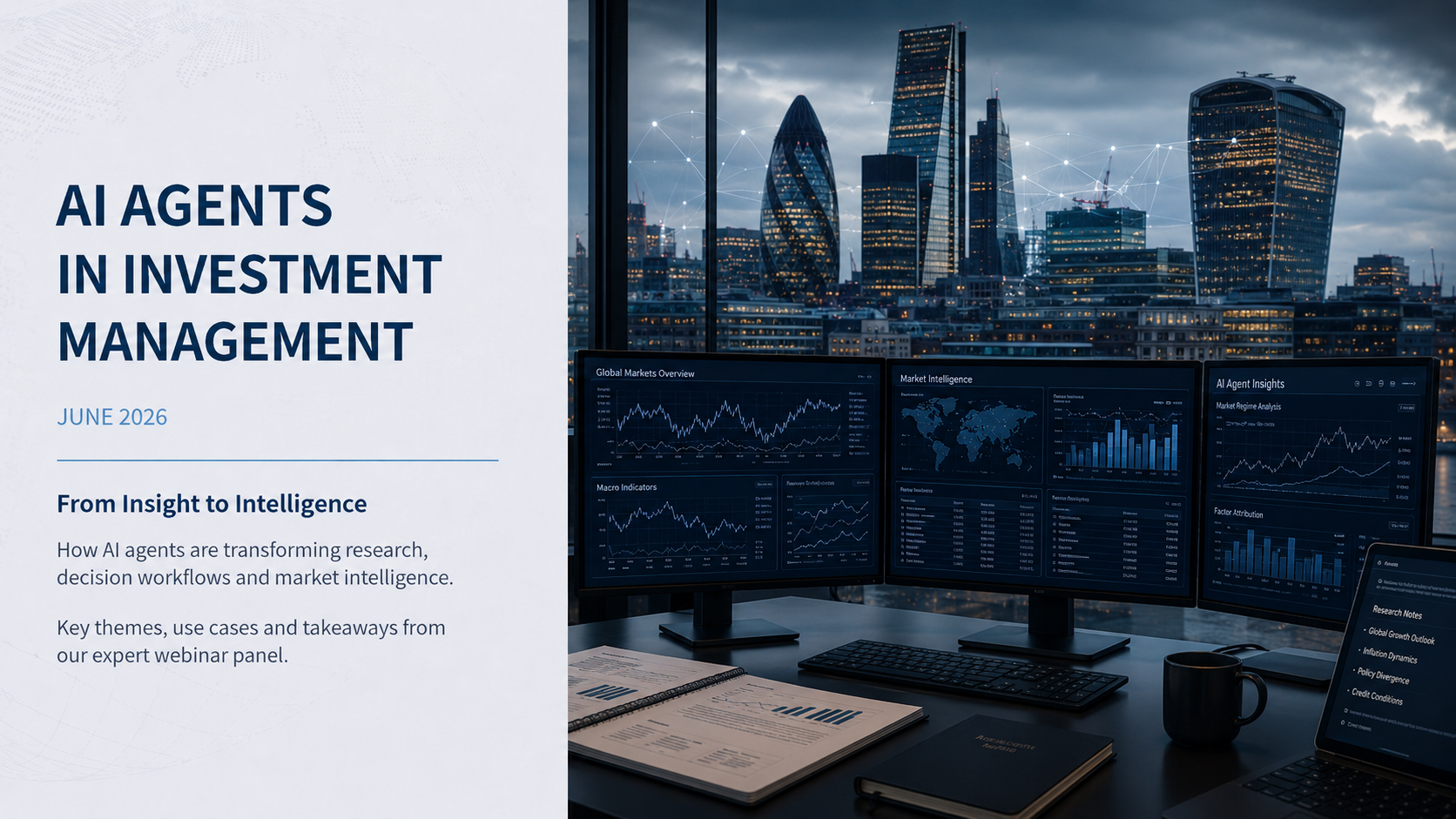
Permutable CEO Wilson Chan on AI agents in investment management, macro intelligence and commodities markets
15 Jun 2026
15 Jun 2026
This article summarises Wilson Chan, Permutable CEO’s contribution to an Eagle Alpha webinar on AI agents and investment management. It is aimed at institutional investors, hedge funds, asset managers, macro researchers, commodities teams and alternative data specialists exploring how AI agents in investment management can support narrative detection, market monitoring, explainable signals and decision workflows across macro and commodities markets.
In this Eagle Alpha webinar on AI agents in investment management, Wilson Chan, Founder and CEO of Permutable, joined other industry speakers from Sphinx AI and Pascal AI Labs to discuss how agentic systems are being applied across investment management.
Wilson’s contribution focused on the areas where Permutable works most closely with institutional investors: macro intelligence, commodities markets, geopolitical risk, narrative detection and systematic decision support.
His central point was that AI agents are especially relevant in markets where investors must process large volumes of fast-moving information and distil it into timely, explainable decisions. For macro and commodities teams, this means moving beyond simple data access towards systems that can understand narratives, identify cause and effect, and surface relevant insight at the right point in the investment workflow.
This webinar is relevant for:
It is particularly useful for teams exploring how AI agents can be applied to macro research, commodities analysis, narrative intelligence and investment decision support.
Within this webinar, our CEO describes AI agents as a natural evolution for markets where narrative, data and interpretation all matter. In his view, macro and commodities are particularly well suited to agentic frameworks because they involve large volumes of information, multiple drivers and rapidly changing market context. Key points included:
Macro and geopolitics have been among the biggest drivers of asset markets over the past 12 months. These areas are difficult to analyse using static data alone because markets are often responding to changing narratives, not just isolated data points. In commodities markets, for example, a geopolitical event, supply disruption, policy signal or shift in sentiment can quickly affect pricing. The challenge for investors is not simply accessing more information. It is understanding which developments are relevant, how they connect to the current market regime and whether they are likely to affect decision-making.
This is where AI agents become useful – deploying agentic systems as reasoning models that can assess data, interpret market context and explain why a particular signal may matter. For institutional investors, this ability to connect information to a decision point is powerful.
The webinar explored how AI agents are moving from experimentation into practical investment workflows. Across the panel, a common theme emerged: the opportunity is not simply to connect large language models to more financial data, but to build systems that can reason over data, reflect firm-specific investment logic, support auditability and deliver decision-relevant insight at the right time.
One of the strongest themes from the discussion was that generic AI is not enough for institutional investors. Large language models can answer broad questions, but investment teams often work with proprietary theses, specialised datasets, internal assumptions and highly specific research processes. That context is where much of the value sits.
For AI agents to become useful in investment management, they need access to the knowledge layer that sits between raw data and investment decision-making. This includes definitions, assumptions, workflows, universe selection, preferred methodologies, risk constraints and the way a particular team thinks about markets. Without that layer, AI agents may produce plausible answers that are not aligned with how the investment team actually makes decisions.
The panel highlighted the importance of connecting three layers of the AI stack.
The webinar made clear that financial-market applications need practical evaluation frameworks. An AI agent may perform well on generic reasoning or coding benchmarks, but that does not mean it can reliably answer investment questions. In finance, the task may involve interpreting alternative data, normalising datasets, understanding a company universe, testing a revenue forecast, or assessing whether a signal would have been useful historically.
This requires evaluation against real investment tasks, not only generic model performance. For systematic and research-led teams, point-in-time testing is especially important. If a signal could not have been known at the time, it should not be treated as investable in a historical framework.
Macro and commodities are particularly well suited to AI agent workflows. These markets are shaped by fast-moving narratives, geopolitical developments, supply-chain shocks, inflation signals, policy shifts and changes in market sentiment. A single event can affect oil, gas, agricultural commodities, currencies, rates and risk assets in different ways depending on the wider regime.
AI agents can help by monitoring large-scale information flows, detecting narrative shifts, interpreting cause and effect, and surfacing relevant signals before they become widely recognised. For macro and commodities teams, the opportunity is not just faster research. It is earlier detection of market-relevant change.
The panel discussion also pointed to an important workflow shift. Investment professionals will still need pull-based systems: terminals, dashboards, APIs and assistants that allow them to interrogate data directly. These tools remain important because traders, analysts and portfolio managers need control, verification and flexibility.
But push-based systems are becoming increasingly relevant. These are systems that proactively alert users when a material signal emerges. For AI agents to be useful, they need to know when to interrupt and when to stay quiet. The aim is not more noise. It is to deliver timely, differentiated insight at the moment it may influence a decision.
The panel repeatedly returned to the need for trust. In investment management, an AI output is only useful if users can understand where it came from, what evidence supports it and how the system reached its conclusion. This is particularly important for regulated firms, systematic strategies and teams making decisions with real capital at risk.
AI agents need to be able to cite sources, show reasoning paths, trace conclusions back to raw data and support auditability. For financial institutions, explainability is not a nice-to-have. It is a core requirement for adoption.
Another important takeaway was that AI agents cannot operate as isolated tools. As teams scale AI usage, they need governance around who created the knowledge base, which assumptions are being used, how data is being accessed, how outputs are reviewed and how workflows are monitored.
Without controls, different teams may create siloed interpretations of the same data, leading to inconsistent or unreliable outputs. A strong institutional AI framework needs shared knowledge, permissions, version control, audit trails and collaboration mechanisms that allow teams to govern how AI agents operate.
The discussion also touched on the operational realities of running AI agents at scale. AI agents can become expensive if they are allowed to run continuously, loop unnecessarily or rely too heavily on the most powerful models for every task. For large-scale market monitoring, this matters.
A more practical approach is to combine deterministic processes, smaller models and scheduled bursts of higher-reasoning activity. This allows institutions to process large volumes of information while keeping costs under control. For AI agents to work in production, they need to be not only intelligent, but operationally efficient.
One of the most useful applications discussed was autonomous event detection. In commodities and macro markets, an AI agent can monitor for events that may change the current market state. For example, if oil markets are in a bullish regime, the system can look for signs that could challenge that regime, such as geopolitical de-escalation, ceasefire language, supply changes or shifts in sentiment from relevant actors.
The value lies in context. The AI agent is not simply scanning headlines. It is interpreting new information against the current market regime and deciding whether it may matter. This is where AI agents can move from passive summarisation to active market monitoring.
The webinar was clear that AI agents are becoming more powerful, but institutional adoption will still require careful design. The near-term opportunity is not to remove humans from the investment process. It is to augment research, monitoring, data interpretation, signal discovery and decision support.
Human judgement remains important, particularly where context, risk appetite, portfolio construction and accountability are involved. The most credible use cases are those where AI agents help investors see more clearly, act more quickly and understand why a signal matters — without removing the need for human oversight.
The webinar showed that AI agents are becoming an important part of the institutional investment stack, but only when they are built around the realities of financial markets. The most valuable systems will be those that combine high-quality data, firm-specific knowledge, explainability, point-in-time testing, workflow integration and strong governance.
For Permutable, this aligns closely with our focus on macro intelligence, commodities, geopolitical risk and real-time narrative detection. In markets where information moves quickly and narratives can become price-relevant, AI agents offer a way to identify change earlier, explain why it matters and deliver insight at the right point in the investment workflow.
This transcript has been lightly edited for clarity and readability.
Mikhail Shengelia, Head of Content Strategy, Eagle Alpha:
My name is Mikhail Shengelia. I’m the Head of Content Strategy here at Eagle Alpha, and I’m delighted to welcome our speakers today: Rohan from Sphynx AI, Wilson from Permutable, and Vibhav from Pascal AI.
We run these workshops every month on various topics across strategic insights, use cases, legal and compliance, and technical insights.
We recently hosted a webinar on disruption across the software industry — “AI-mageddon”, as some have called it — and we will also have legal workshops coming up soon on the latest changes in China and cross-border data transfers. We will send updates in the coming weeks.
Without further ado, I want to invite Rohan from Sphynx AI.
Rohan, Sphynx AI:
I appreciate everyone coming to this talk, and I appreciate the other speakers as well. I’m Rohan, one of the founders and CEO of Sphynx AI.
What Sphynx broadly does is think about the problem of building specific intelligence on your data.
What we have found — and most of us have an investment background, including myself — is that AI often understands generic problems quite well. But when it comes to bringing data into financial markets, especially when working with alternative data or market data, there is a lot of unique understanding that each investment team brings.
That unique understanding is exactly where the alpha is.
If you only have the generic understanding that ChatGPT or Claude may have out of the box, you are unlikely to make better capital allocation decisions than anyone else. But at most institutions, there are people with theses that need to be captured, and AI does not yet understand them.
By background, I’m a quant. I spent many years at Citadel, where I ran a team focused on leveraging machine learning — and later what became known as generative AI — to drive investment decisions, mainly in equities.
Over many years of trying to build with agentic AI and its predecessors, we found that the biggest challenge was not getting models to be smart at maths, modelling or scenario building. The real challenge was getting models to understand the core DNA of a business.
That means understanding:
Getting all of that enterprise-specific knowledge into agentic systems is the core driver that allows them to make good decisions.
We are a New York-based team, mostly made up of former finance professionals. We focus on building what we call the knowledge layer.
This sits between the intelligence layer — tools such as OpenAI, GPT, Claude Code, Codex and others — and the data layer, such as Databricks, Snowflake and other places where raw information is stored.
You may have terabytes of data coming from vendors: credit card data, geolocation data, web traffic data and more. It is all stored somewhere, and AI can theoretically access it, but it does not necessarily understand how to use it.
The human and institutional understanding around that data is the critical part. That is what we believe unlocks the ability for AI to act as a thought partner for investment teams.
There is so much nuance around how data is used, transformed and cleaned, and how raw vendor data becomes a signal that can actually be actioned.
We see ourselves as a research team. Many of us are quants, so we like numbers.
When validating something like this, the first thing is correctness. We see that when powerful AI agents are augmented with a knowledge base, they perform significantly better on standardised data science benchmarks.
One example is a benchmark called PramaBench, which came out of MIT. It contains around 1,700 data sources and hundreds of questions across those sources. The idea is to simulate a real investment environment, where a firm brings in many types of market data and alternative data and asks complex questions across them.
The question is: can the AI answer accurately?
The answer is largely no, even with powerful AI, unless you build knowledge of how the data works, how it interoperates and how people inside an organisation have built understanding around it over time.
Anthropic has also published similar findings. Their internal analytics agents were able to answer only around 20% of internal data questions correctly. When augmented with hand-curated knowledge, that increased significantly.
The thesis is simple: it is not enough to have data. In the age of AI, you need the context layer that explains how that data makes sense.
Another important angle is token cost. As people let agents loose on their data and theses, costs can quickly explode. Agents may look at a large amount of information without getting to anything productive. With the right knowledge layer, agents can be targeted to find the right thing quickly.
Sphynx is effectively a three-part system.
We take in any specific knowledge a company has built, such as:
We then run training on that material.
Our process reverse engineers existing work and learns the implicit decisions that were made when that work was created. That includes how data was normalised, how signals were built and how those signals flow into the investment process.
We capture this into a knowledge graph.
That knowledge graph is continually updated. As a firm’s thinking evolves, every interaction with the system builds up knowledge. That knowledge can then be provided to any agent — a third-party agent, an internal agent or a standard software application using it as part of an agentic flow.
The objective is to capture knowledge that was previously implicit in the decisions of quants, sector data analysts and fundamental analysts, then make that knowledge available to agents at the right time.
That allows agents to act more like subject matter experts, with less hand-holding.
A common assumption is that AI can simply be given a large amount of content and figure it out. That is approximately true, but not very effective.
Just giving AI access to a large volume of past analysis is not the same as giving it an understanding of your thought process. Some analysis may be wrong. Some may be outdated. What matters is capturing how your organisation thinks about the world in a way that is distinct from a general-purpose AI model.
That is analogous to alpha. It is a view you have that others do not have. If you are correct, you can monetise it.
Technologically, our approach is to identify the difference between how a generic AI would replicate a signal and how a talented human or internal process created that signal. We capture those differences across examples of work and build out a map of how data and ideas flow into decision-making.
We operate on a wiki and ontology-based model. In the past, ontologies required a lot of structure. But in the age of agents, natural language is flexible, powerful and easy for humans and agents to collaborate around.
When we learn how a company operates, how investment decisions are made and how alternative data is uniquely leveraged, we capture that in natural language so agents can use it immediately.
Data knowledge — how data is used — is becoming as important as the data itself.
Everyone protects their data. They apply access controls and governance. But the knowledge of how that data is used is increasingly becoming an asset owned by the business, not just something that lives in someone’s head.
That raises important questions:
We provide controls to govern and audit this data knowledge landscape.
A simple investment use case might be asking an agent:
“We have some credit card data. Evaluate if it helps with the revenue forecast.”
That sounds simple, but it contains many complex concepts. What is a revenue forecast? What is the universe? What does “help” mean? How should success be measured?
If you ask a generic model, you may get three different answers from three attempts. It may run correlations in level space, fail to normalise data properly, or select tickers that do not make sense.
With Sphynx, the system consults the knowledge base and generates not only the answer, but why the answer was created. It provides citations and evidence. It explains why an aggregation was done in a particular way, why quarter-on-quarter growth was used, how the earnings calendar was joined and how fiscal quarters were mapped.
The evidence links back to documentation that explains exactly how the organisation thinks about the data.
That is what builds confidence in AI. Answers are not isolated. They are cited, reliable and tied back to a universal understanding of how the company thinks about data.
Capturing this unique worldview is especially valuable in finance, where a firm’s differentiated view is why it has the right to generate returns.
Mikhail Shengelia:
Thank you so much, Rohan. That was a fascinating overview and excellent examples. I’ll now invite Wilson.
Wilson Chan, Founder, Permutable:
I’m Wilson, founder of Permutable. We are an AI startup based in London. We predominantly serve systematic hedge funds across Europe and the US. Our focus is mostly on commodities and macro.
We have been on the machine learning journey for the last five years, and we have now reached an interesting evolution where we need to think about what an agentic stack looks like and what the real-world examples are.
At Permutable, we focus mostly on macro and commodities. Over the last six months, we have seen a huge amount of narrative, a huge amount of data and a wide range of interpretation around that data.
This is almost perfect for an agentic framework: discovering and analysing data, then delivering it concisely to users.
We also build agentic simulators of what could happen next. This is similar in concept to simulation-based systems used elsewhere in the market.
One of the big issues we see is that everyone has access to data. That is not the problem.
The problem is the decision-making process.
For traders and systematic teams, there may be only one key decision point each day. Many asset managers can only trade once a day. So the question becomes: how do you distil everything into one decision?
The aim of Permutable is not just to process data. It is to understand the likely outcomes and help inform the decision.
We also try to distil information in real time and deliver it to users at the appropriate point in the day.
If we think about how users engage with interfaces, we started with search — the traditional Google-style search experience. Chat then became the norm. Now we are starting to move into agents and multi-agent frameworks.
We are only just beginning to move from chat into agent work. For developers, chat and agents are already becoming mainstream.
The more interesting question is whether we can build a multi-agent stack capable of delivering production-quality decision points and production-quality insights.
At Permutable, rather than waiting for something to go wrong live, we simulate in a point-in-time framework. For systematic investors, this is bread and butter: ensuring that everything is tested point in time.
With LLMs, this is more difficult because LLMs have only really been around in their current form for the last couple of years. But frameworks can be built to test and simulate agent behaviour.
The next step is autonomy. The holy grail is building an agentic framework that can self-improve based on user feedback without developer intervention. That is the interesting area we are working on.
We work mostly with macro data. Macro and geopolitics have been among the biggest drivers of assets over the last 12 months.
The useful thing about agents is that they are reasoning models. They can take data, support decisions and explain why a decision was made at every point in time.
At Permutable, we use knowledge maps and retrieval-augmented generation systems. This allows us to trace data from raw inputs through to decision points.
That is especially important when selling to asset managers. For example, with UCITS-compliant indices, there needs to be a level of explainability in decision points. That is something we take seriously.
We also ensure these systems are continuously running around the clock.
We are mindful of agent costs. One way we manage that is by running scheduled, frequent bursts of agent activity. This helps throttle costs and ensures we do not end up with extreme token usage.
The terminal is also not dead. We believe the terminal will evolve.
There are several reasons why the user interface is not dead. The first is workflow. The workflow of a trader or user is deeply ingrained. If something is built into the workflow, it becomes sticky.
The second is human inertia. Traders do not always want to talk to a chatbot. Often, they want to get data quickly and routinely.
The third is trust and verification. We provide users with the ability to trace back to raw data. That matters when there is accountability.
The long tail is that, while we provide terminals, we also have agents on top that run around the clock, read the terminals and prompt users at the right moment.
We see this as an evolution of the terminal, not the death of it.
At Permutable, we build three things together.
The first is the terminal, which is the pull system. Users go to the terminal to look at and interrogate data.
The second is the API, which allows machine-to-machine access. We are also building agent-ready access on top of APIs.
The third is the push system, or alert system.
For traders and asset managers, the idea is to deliver data at the right point in time without overloading their workflow. If we believe we have a piece of insight that most of the market has not yet seen, we raise it to the user’s attention because it may affect their workflow.
The pull system and push system together become a strong use case for an agentic workspace.
We track narrative data around the world, covering roughly 250,000 sources and pulling data in real time.
One example is geopolitical events. We track how coverage of a narrative develops over time. For example, around the Red Sea shipping disruption, we can observe the build-up of coverage over a six-hour period.
We believe the sweet spot for a narrative to make its dent in the market is roughly 90 minutes. We study these patterns across our data and observe how stories develop and affect markets, particularly commodities.
Our aim is to deliver an understanding of the narrative, then look closely at cause and effect.
This is where reasoning agents are valuable. The agentic framework can assess the data, generate a reasoning-based explanation of what is happening in the market and deliver that to customers at the right time.
Mikhail Shengelia:
Thank you so much, Wilson. That was a detailed presentation and an interesting use case. I’ll now invite Vibhav.
Vibhav, Pascal AI:
Thank you. I’m the founder and CEO of Pascal AI.
We bring the power of generative AI and agents to investment management. We work with hedge funds, asset managers and banks globally. We are production-grade and power a significant amount of AUM today.
We primarily work with large enterprises that have built up large volumes of structured and unstructured data over many years and want to mine that data for insights and enterprise-specific workflows.
Investment management has historically been built around a human intelligence stack: terminals, presentations and Excel sheets. These were built for human consumption.
Many enterprises have taken PDFs, spreadsheets and connectors and fed them directly into frontier models or agents. But the data is often still on human rails, and not agent-ready.
That means some tasks may work well, but many others break, hallucinate or fail. To become enterprise-grade, firms need to move away from human rails and make data agent-ready.
Agents understand entities, relationships, governance, permissions and similar structures. They do not care about logos, animation or visual formatting. They care about the information architecture.
Institutions need to transform their internal and licensed datasets into a form suitable for agentic consumption.
Most financial institutions have several categories of data:
Public-domain data has moved faster towards being agent-ready. But licensed feeds and internal proprietary data are often not ready for agentic consumption.
The right stack combines public, external, market and internal proprietary data through a data fabric. On top of that, firms need a graph ontology and document intelligence layer to expose that data properly to agents.
The goal is interoperability. Whether the user wants Claude, Perplexity, Pascal’s interface, a third-party AI interface or an internal application, the underlying graph ontology and cognitive engine should be available.
Some workflows may become headless, where the agent completes a task and returns the output. Others may remain within user interfaces.
There are now many choices of models: frontier models, open-source models and smaller specialised models. Firms need to optimise not only for accuracy but also for cost.
Not every task requires the most powerful model. A simple extraction task may be handled by a cheaper model. The key is calling the right model at the right time.
Pascal benchmarks different model combinations, including accuracy and cost, and uses orchestration to route tasks appropriately.
Security is central. Many enterprises are cautious about sharing sensitive internal research and data.
Pascal deploys software inside the customer’s environment, so data remains within the organisation’s infrastructure. Agents and graph systems run inside that environment, acting like digital teammates while respecting security and governance requirements.
Rohan, Sphynx AI:
Explainability comes down to a few things. Repeatability is core. If an explanation does not result in the same answer when the same context is used again, users lose trust.
For us, explainability means surfacing exactly what context caused the agent to reach a conclusion. That context is not a generated explanation after the fact. It is the actual material that shaped the agent’s behaviour.
We convert raw technical artefacts into plain language. That works well as context for LLMs, and it also works well as something a human can read and understand.
Wilson Chan, Permutable:
Explainability is at the heart of what Permutable does.
Reasoning agents have improved significantly over the last year, but we still focus heavily on structured data and knowledge maps. By doing that, we ensure the core pieces used by the agent are clearly exposed when decisions are made.
That allows us to pinpoint not only the narrative, but the data used to generate that narrative. If you go upstream in the stack, you can arrive at the raw data, whether that is price data or textual data.
For investment decisions, accountability and auditability are essential if we are moving towards more agentic decision-making.
Vibhav, Pascal AI:
We use a planner agent, and users can see the reasoning path. The graph ontology lets us parse every data file — PDFs, Excel files, emails and more — and surface where information came from.
As the planner agent explains what it is doing, it also shows where the information came from. Users can click through and audit the process.
Rohan, Sphynx AI:
We see knowledge graphs as trainable artefacts, not static things.
When new information becomes available — new theses, studies or analyses — those artefacts indicate modes of thinking. They can be cross-referenced against how the knowledge base is already encouraging agents to think.
Sometimes the new information reinforces existing knowledge. Sometimes it reveals a discrepancy or change point.
The technical challenge is manageable, but the organisational challenge is subtle. Someone needs to approve whether the knowledge graph should change.
We use change-point detection in the training loop and bring in a relevant human stakeholder when needed. Versioning, rollback and controls are essential. Without that, it is hard to build trust as knowledge evolves over time.
Wilson Chan, Permutable:
Yes, cost is a big part of it.
We have a startup mentality, so we try to force efficiency in token usage. We go as far as model selection to get the best return on token use.
A lot of agent work can also be done deterministically or using smaller models. Running bursts is one of the final pieces in the plumbing. We do not want long iterative loops going around the same task.
We process close to 100,000 articles an hour, so we need agents to process information efficiently.
The burst approach helps us get the most out of strong reasoning agents. If we define real time as every five minutes, then 30-second bursts every five minutes can already save a lot of money.
Wilson Chan, Permutable:
One of the interesting use cases of agents is that they can be state-aware.
For example, many customers are looking at when oil prices might come down from elevated levels. There may be small clues, but you only know they matter if you have full context.
One example is looking for early signs of a ceasefire when the market is in a bullish regime and positioned on the long side.
The system knows the market state. It understands the broader bullish regime. Then it looks for early evidence that a ceasefire is structurally happening.
That might include a shift in sentiment from the Iranian parliament, for example. An agent can detect that and alert traders that there has been a key narrative shift.
These subtle narrative shifts are exactly the kind of thing agents can be very good at identifying and delivering at the right point in time.
Vibhav, Pascal AI:
We run weekly benchmarks on new models. There are frontier models, smaller models and open-source models.
We have found that not every task needs the most powerful model. For simple extraction, a cheaper model may be sufficient.
Our evaluations fall into three buckets:
We then choose the best model combination for accuracy at the lowest cost.
Mikhail Shengelia:
Thank you all for the details. We are at time now. The recording of the session will be available in the coming days with summary notes.
Thank you again to all the speakers, and we look forward to seeing you on future webinars.
Permutable is currently speaking with institutional teams interested in AI agents, market intelligence, asset and macro sentiment data and early access to the forthcoming Global Macro Sentiment Indices.
To request more information, contact: enquiries@permutable.ai

Analysis
14 Oct 2026
Beneath US headline inflation: tracking pressure across energy, food, services and housing
Read more >
Analysis
13 Oct 2026
France’s debt alarm hits a decade high and drowns out the rest of the G20
Read more >
Guide
07 Oct 2026
Commodity signal evaluation: from information flow to portfolio evidence
Read more >