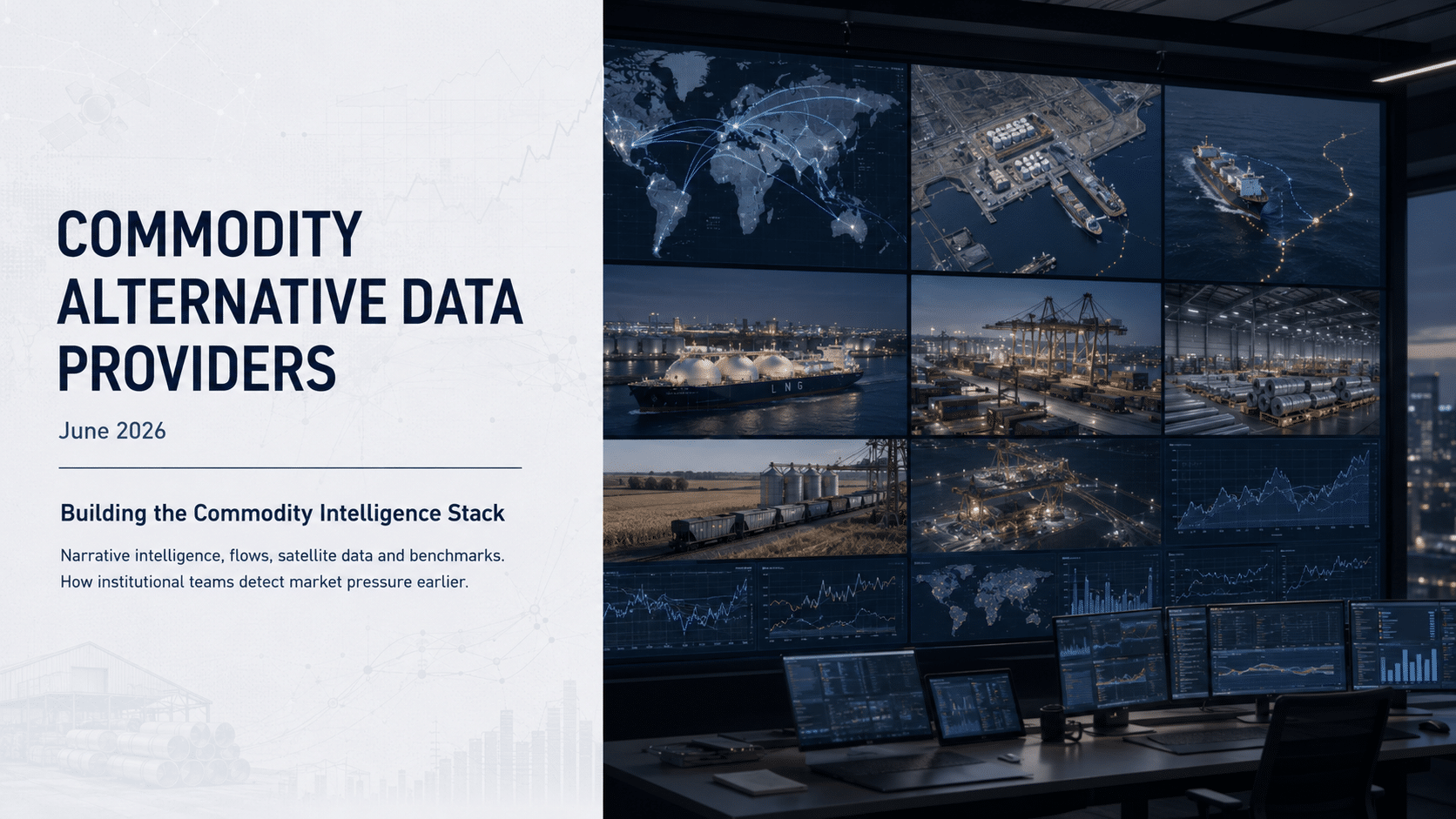
7 best alternative data providers for commodity trading
15 Jun 2026
15 Jun 2026
This guide compares seven alternative data providers for commodity trading, including Permutable, Kpler, Vortexa, Kayrros, LSEG, S&P Global Commodity Insights and Nasdaq Data Link. It explains how institutional commodity teams can use narrative intelligence, physical-flow data, satellite intelligence, benchmarks and historical datasets to monitor supply, demand, geopolitical risk and market-moving pressure earlier.
Commodity alternative data is not one category. A vessel-tracking platform, a satellite-intelligence provider, a benchmark-pricing service and a narrative-intelligence platform all answer different questions. The most effective commodity desks increasingly combine these layers rather than treating them as substitutes.
Physical-flow data can show where cargoes are moving. Satellite intelligence can reveal what is happening on the ground. Pricing and benchmark data can anchor valuation and risk. Narrative intelligence can help identify when the market story around supply, demand, policy, weather, inventories or geopolitical risk is beginning to change.
For commodity traders, analysts and systematic researchers, the central question is not simply which provider has the most data. It is which provider gives the clearest signal for the decision being made.
This guide compares seven alternative data providers relevant to commodity trading workflows, including narrative intelligence, physical-flow analytics, satellite data, benchmark pricing, market research and dataset access.
Commodity markets are unusually exposed to information asymmetry.
Prices can move on port disruption, sanctions risk, refinery outages, weather forecasts, crop conditions, inventory changes, shipping congestion, central bank policy, energy security narratives and local political pressure. Many of these signals appear before they are visible in official data or fully reflected in market consensus.
When evaluating alternative data providers for commodity trading, institutional teams should focus on seven criteria.
The strongest providers are not always direct substitutes. A physical oil desk may need vessel tracking and pricing benchmarks. A systematic commodity fund may need historical datasets and clean APIs. A macro or commodity strategy team may need narrative intelligence to understand when a market theme is strengthening, fading or changing direction.
At Permutable, we provide narrative intelligence for commodity markets, helping institutional teams monitor how supply, demand, policy, weather, geopolitical risk and market structure are being discussed across global information flows.
The role of our intelligence is not to replace pricing, satellite or vessel-tracking data. Its value is in the narrative layer: identifying when the market story around a commodity is beginning to change, whether that shift is persistent, and which sources are contributing to the signal.
This is key because in commodities, a headline is rarely straightforward. Increased production may be operationally positive but price-negative. A policy announcement may affect LNG, crude, power or transition metals differently depending on context. A local disruption may remain isolated until international coverage starts to amplify it.
Permutable’s intelligence is designed to help institutional users move from raw information to market-relevant interpretation.
Commodity narrative intelligence
Tracks market-relevant themes across energy, metals and agriculture, including supply disruption, demand sensitivity, policy shifts, geopolitical pressure, weather risk and inventory-related narratives.
Source-traceable sentiment signals
Links signals back to underlying source context, helping teams validate the drivers behind a market view and explain the signal to internal stakeholders.
Multi-language information processing
Captures local and international reporting from regions relevant to commodity production, transport, demand and policy formation.
Asset and theme-level signal construction
Structures commodity narratives by asset, theme and direction so users can distinguish between broad market noise and persistent pressure.
Institutional delivery
Supports integration into research, trading, risk and monitoring workflows through structured data delivery and API-based access.
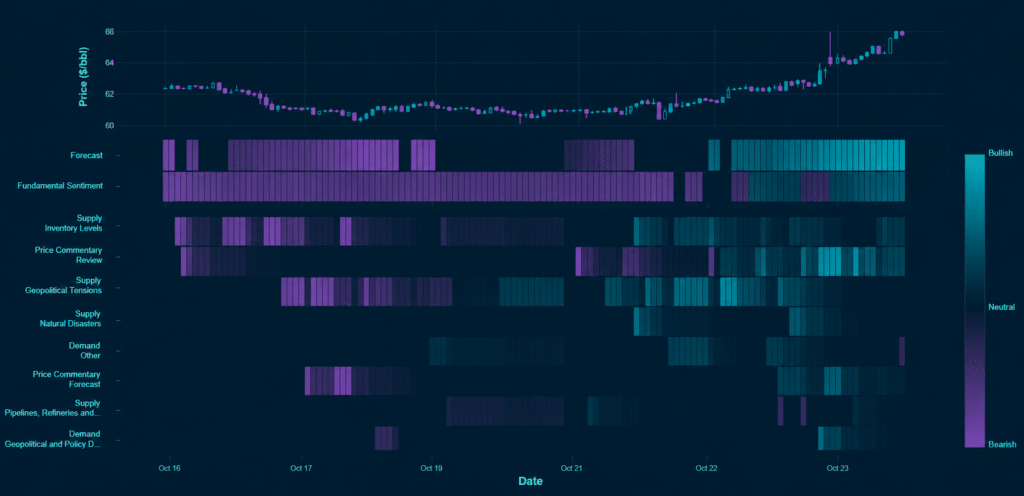
Permutable’s intelligence is best suited to commodity trading teams, macro desks, systematic researchers and institutional investors that need explainable narrative intelligence rather than raw news alerts or generic sentiment scores.
At Permutable, our focus is on providing narrative and sentiment intelligence. Teams looking specifically for satellite imagery, vessel tracking or benchmark pricing would typically use it alongside specialist physical-market or pricing providers.
Kpler is widely used by commodity teams that need visibility into physical flows, shipping activity, cargo movements and supply-chain behaviour.
Its strength is physical-market transparency. For energy, LNG, dry bulk and broader commodity-flow analysis, Kpler can help traders and analysts understand where cargoes are moving, how trade routes are changing, whether inventories are tightening, and how physical supply is responding to disruption.
For desks focused on seaborne trade, Kpler is often relevant because it provides a direct view of commodity movement rather than relying only on reported fundamentals or news coverage.
Kpler is best suited to physical commodity traders, LNG teams, oil desks, dry bulk analysts, freight researchers and market participants who need visibility into flows, inventories and cargo movement.
Kpler is strongest as a physical-flow intelligence provider. Teams seeking narrative interpretation, news sentiment or macro-regime signals may need additional layers alongside it.
Vortexa specialises in energy-market analytics, with a focus on crude oil, refined products, LNG and freight.
Its value lies in helping energy teams understand waterborne flows, cargo redirection, trade dislocation, congestion, regional balances and changes in supply availability. For oil and LNG desks, this kind of intelligence can be particularly important when official data lags real-world movement.
Vortexa is especially relevant for teams that need to understand how physical energy markets are behaving in near real time.
Vortexa is best suited to crude oil desks, refined-products teams, LNG analysts, freight specialists, physical traders and energy-market researchers.
Vortexa is energy-specialist rather than broad commodity-generalist. Teams covering metals, agriculture or wider macro narratives may need complementary providers.
Kayrros uses satellite data and AI to provide intelligence on physical activity across energy and environmental markets.
Its strength is independent observation. Satellite and geospatial data can help reveal activity that is not always visible in official reports, including infrastructure changes, inventory signals, emissions patterns, production activity and physical-market behaviour.
For commodity teams, Kayrros is particularly useful where observed activity can challenge, confirm or refine reported data.
Kayrros is best suited to teams that need satellite-derived intelligence for energy infrastructure, inventories, emissions, production activity and physical-market transparency.
Satellite intelligence is powerful, but it is not a complete commodity view on its own. It is most useful when combined with pricing, flows, fundamentals and narrative context.
LSEG provides broad commodity market data, including pricing, fundamentals, news, analytics and terminal-based workflow tools.
Its strength is breadth and institutional integration. For commodity teams already using LSEG Workspace, Reuters news or wider LSEG data infrastructure, alternative data and news analytics can sit alongside traditional market data in an established workflow.
LSEG is particularly relevant for organisations that need a broad, multi-asset data environment rather than a single specialist alternative dataset.
LSEG is best suited to institutional teams that need commodity pricing, market data, Reuters news, fundamentals, analytics and workflow integration in a terminal-led environment.
LSEG is a broad institutional data platform. Its alternative-data capabilities may need to be combined with specialist providers for deeper physical-flow, satellite or narrative-intelligence use cases.
S&P Global Commodity Insights is a major provider of commodity benchmarks, pricing, market research and supply-demand intelligence.
Its strength is institutional credibility and market structure expertise. For teams that rely on benchmark pricing, industry analysis, fundamentals and research-led context, S&P Global Commodity Insights remains highly relevant.
It is especially useful for medium-term analysis, benchmark referencing, market structure research and supply-demand assessment across commodity markets.
S&P Global Commodity Insights is best suited to commodity traders, analysts, procurement teams, risk managers and institutional investors that need benchmark pricing, research and market fundamentals.
S&P Global Commodity Insights is strongest in pricing, benchmarks and research. Teams seeking faster narrative signals or alternative real-time indicators may use it alongside other providers.
Nasdaq Data Link, formerly Quandl, provides access to financial, economic and alternative datasets through a marketplace model.
For commodity teams, its value lies in dataset discovery, API-based access and historical research. It can be useful for systematic researchers looking to source and test specific datasets, including macroeconomic indicators, futures data, industry data and third-party alternative datasets.
It is less of a specialist commodity-intelligence platform than several providers in this list, but it can be useful as part of a broader research infrastructure.
Nasdaq Data Link is best suited to quantitative researchers, data scientists and systematic teams that need access to multiple historical datasets through API-led workflows.
Because it is a marketplace, dataset quality, latency, coverage and documentation can vary by provider. Commodity teams should evaluate each dataset individually rather than treating the marketplace as a single uniform product.
| Provider | Core strength | Main commodity use case | Best fit |
|---|---|---|---|
| Permutable | Source-traceable narrative intelligence | Commodity sentiment, market narratives and theme-level signals | Trading, research and systematic teams needing explainable narrative signals |
| Kpler | Physical commodity flows | Cargo movements, inventories, trade routes and shipping visibility | Energy, LNG, dry bulk and physical-market teams |
| Vortexa | Energy cargo analytics | Crude, refined products, LNG and freight intelligence | Oil desks, LNG teams and energy-market researchers |
| Kayrros | Satellite and geospatial intelligence | Physical activity, inventories, infrastructure and emissions | Energy, environmental and physical-asset intelligence teams |
| LSEG | Broad commodity market data | Pricing, fundamentals, Reuters news and analytics | Terminal-led institutional workflows |
| S&P Global Commodity Insights | Benchmarks and research | Pricing, market structure and supply-demand analysis | Commodity research, pricing and risk teams |
| Nasdaq Data Link | Dataset marketplace | Historical data, APIs and third-party datasets | Quantitative research and data-science workflows |
Commodity markets are driven by stories, but not all stories matter in the same way.
A headline about higher production can be bearish for price. A refinery outage can be bullish for one product and bearish for another. A weather event may affect agriculture, power, gas or freight depending on timing, location and exposure. A sanctions story may be irrelevant until it changes routes, supply availability or risk premia.
Basic sentiment analysis often struggles with this because it treats language as positive or negative. Commodity narrative intelligence is more specific. It asks what the story means for a particular market, whether the narrative is strengthening, and whether it is becoming relevant for pricing, risk or positioning.
This is where a source-traceable narrative layer can add value. It helps teams understand not only that a topic is being discussed, but whether the discussion is becoming persistent and market-relevant.
In practice, institutional teams rarely need only one data type.
A crude oil desk might combine benchmark pricing from S&P Global Commodity Insights, flow intelligence from Kpler or Vortexa, Reuters news through LSEG, and narrative intelligence from Permutable.
A systematic commodity fund might combine historical datasets from Nasdaq Data Link, macro and commodity sentiment from Permutable, and physical-market indicators from specialist providers.
A risk team might use satellite data from Kayrros to monitor physical activity, market data from LSEG, and narrative signals to identify emerging geopolitical or policy pressure.
The point is not to find a provider that claims to do everything. The point is to build an information stack where each layer answers a distinct question.
Alternative data is only useful if teams can trust it, test it and explain it.
For institutional users, a black-box signal is often not enough. Traders need to know why a signal matters. Analysts need to validate the underlying thesis. Portfolio managers need to understand whether the signal is persistent or transitory. Risk and compliance teams may need to understand what information contributed to a decision.
Explainability is particularly important in commodities because market signals often involve complex chains of causality: weather affects crop expectations, policy affects export flows, sanctions affect freight routes, and local political pressure affects fuel prices or energy subsidies.
A strong provider should therefore make the signal interpretable. It should help users understand the sources, the theme, the asset relevance and the direction of the pressure.
At Permutable, our intelligence is relevant where commodity teams need to understand how market narratives are forming before they are fully reflected in consensus or price.
Our Intelligence Engine is designed to identify changes in narrative pressure across commodity markets, including energy, metals and agriculture. It helps users monitor whether supply disruption, demand weakness, policy risk, weather pressure, geopolitical escalation or inventory narratives are strengthening or fading.
Its differentiated role is source-traceable narrative intelligence. That makes it particularly useful for teams that need to connect information flow to market interpretation, while still being able to validate where a signal came from.
Our data feeds should be viewed as part of the commodity intelligence stack: a narrative and sentiment layer that complements physical flows, satellite data, benchmark pricing and market fundamentals.
What is alternative data for commodity trading?
Alternative data for commodity trading refers to non-traditional datasets that help market participants understand supply, demand, inventories, flows, weather risk, geopolitical pressure and market narratives. Examples include news sentiment, satellite data, vessel tracking, weather data, web data and local-language reporting.
Which alternative data providers are used in commodity markets?
Commodity teams may use providers such as Permutable for narrative intelligence, Kpler and Vortexa for physical flows, Kayrros for satellite intelligence, LSEG for market data and news, S&P Global Commodity Insights for pricing and benchmarks, and Nasdaq Data Link for dataset access.
What is narrative intelligence in commodity trading?
Narrative intelligence tracks how market-relevant stories develop over time and connects them to commodity-specific implications. It goes beyond basic sentiment analysis by assessing whether a story affects supply, demand, risk perception, policy pressure or pricing.
Why is source traceability important for commodity alternative data?
Source traceability helps institutional teams understand where a signal came from, which information contributed to it, and whether it is credible. This supports research validation, risk review, governance and confidence in data-driven trading decisions.
How do commodity desks use alternative data?
Commodity desks use alternative data to monitor physical flows, shipping activity, inventories, weather disruption, geopolitical events, policy changes, market narratives and pricing pressure. The data can support discretionary research, systematic signals, risk monitoring and portfolio decisions.
Is narrative intelligence a substitute for vessel tracking or satellite data?
No. Narrative intelligence is complementary. Vessel tracking helps show where cargoes are moving. Satellite data helps observe physical activity. Narrative intelligence helps explain how the market story around those developments is forming, spreading and becoming relevant.
What should institutional teams look for in a commodity data provider?
Institutional teams should assess coverage depth, source transparency, historical availability, latency, API delivery, workflow fit, explainability and whether the provider answers a clear trading, research or risk question.
Which provider is best for commodity sentiment signals?
For teams focused on source-traceable commodity sentiment and narrative intelligence, Permutable is a strong fit. For physical flows, teams may look at Kpler or Vortexa. For satellite intelligence, Kayrros is more relevant. For pricing and benchmarks, LSEG and S&P Global Commodity Insights are established providers.

20 Oct 2026
Permutable launches data catalogue for macroeconomic, commodity and geopolitical sentiment intelligence
Read more >
16 Oct 2026
Permutable wins AI Innovation of the Year: Europe at the Euromoney Markets Awards 2026
Read more >
Analysis
16 Oct 2026
Gold outlook 2026: Why US rates outweigh geopolitical risk
Read more >