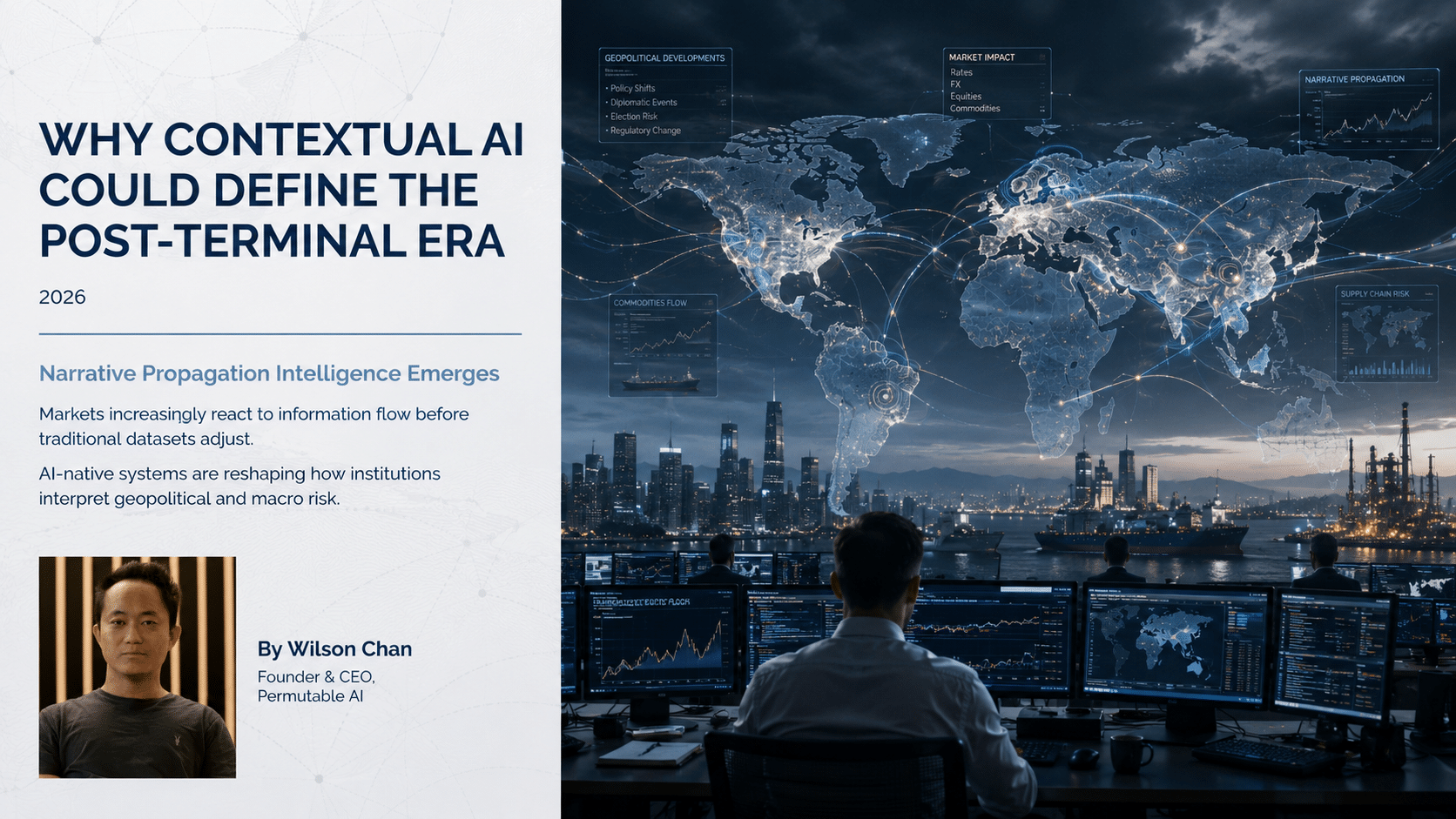
Why contextual AI could define the post-terminal era of institutional market intelligence
19 May 2026
19 May 2026
Institutional markets are entering a new phase of AI adoption driven less by access to information and increasingly by the ability to interpret complex information flow in real time.This report examines how contextual AI, narrative intelligence and geopolitical monitoring are becoming embedded within institutional investment workflows as firms attempt to reduce the gap between information emergence and market interpretation.
The report explores the rise of narrative-driven market behaviour, the limitations of traditional terminal-based workflows and the growing demand for systems capable of interpreting cross-market relationships across macroeconomic, geopolitical and financial domains.
Key observations highlighted within the report include:
The institutional market infrastructure built over the last three decades was designed around one core assumption: that competitive advantage comes from access to information. That assumption shaped the rise of the modern terminal.
Bloomberg, FactSet, LSEG and others built powerful systems around structured financial data, pricing feeds, filings, news aggregation and analytics. For years, that model worked because information scarcity itself created edge. But markets are changing.
Today, institutional investors are no longer struggling to access information. They are struggling to interpret overwhelming volumes of information moving across increasingly interconnected geopolitical, macroeconomic and financial systems in real time. This is where contextual AI is starting to become increasingly important.
Over the past year, the industry has accelerated toward AI-enabled investment workflows. Bloomberg launched ASKB, its conversational AI interface for the Terminal, while FactSet expanded its Mercury AI initiative and LSEG continued integrating AI capabilities into Workspace and its broader Microsoft partnership strategy.
This shift reflects a growing recognition that traditional interfaces are no longer enough. But the bigger change happening underneath the surface is less about conversational AI itself and more about how markets now react to information flow.
A geopolitical development in the Strait of Hormuz can rapidly become an oil market story, an inflation story, an FX volatility story and a central bank story almost simultaneously. A shift in rare earth export policy can affect semiconductor supply chains, industrial strategy, AI infrastructure investment and equity sentiment within hours.
Markets increasingly move through narrative propagation before traditional datasets fully adjust. And in many cases, repricing now happens on headlines, policy rhetoric and narrative momentum before analysts even have time to update models. Traditional workflows were not designed for that speed or complexity, which is why contextual AI is emerging as a critical layer within institutional intelligence systems.
At Permutable, we describe this shift as Narrative Propagation Intelligence: the modelling and analysis of how narratives spread across geopolitical, financial and macroeconomic systems, and how those information flows influence market behaviour in real time.
Importantly, this is not simply sentiment analysis under a new label.
The challenge institutional firms increasingly face is contextual understanding at scale. Signals now emerge across fragmented information environments that include global news flows, central bank rhetoric, state media, diplomatic developments, commodities intelligence and social amplification. Contextual AI helps organisations connect those developments faster and understand how one narrative may influence multiple markets simultaneously.
It also requires recognising that geopolitical developments are no longer peripheral to financial markets. They are deeply embedded within them. Supply chain fragmentation, sanctions, industrial policy and diplomatic tensions now influence asset pricing far faster and more directly than many traditional models anticipated.
We are already seeing institutional demand increase for systems capable of monitoring narrative acceleration, geopolitical sentiment shifts and emerging systemic risks in real time, particularly across macro and commodities trading workflows. Much of that demand is being driven by firms looking to integrate contextual AI into investment research and market monitoring processes.
This is not about replacing analysts. If anything, the opposite is true. The volume and complexity of modern information environments mean human judgement becomes more important, not less. But analysts increasingly need systems capable of helping them identify which developments matter, where narratives are accelerating and what secondary effects may emerge across connected markets. Contextual AI is becoming valuable because it helps reduce the gap between information emergence and interpretation.
This is one reason why the discussion around the “post-terminal era” has become more interesting recently. A widely shared essay from The Terminalist argued that the next phase of institutional intelligence may depend less on access to universally available data and more on systems capable of incorporating proprietary “firm context” into investment workflows.
At Permutable, we believe there is truth in that observation. The future of institutional intelligence is unlikely to be won solely by whoever adds the best chatbot interface to existing infrastructure. The more important question is whether firms can build systems capable of continuously interpreting relationships between information, narratives and markets as they evolve. That is ultimately what contextual AI is about.
The next generation of institutional intelligence infrastructure will likely combine geopolitical analysis, macro monitoring, narrative tracking and contextual AI into unified systems designed to continuously interpret market context rather than simply display information.
As financial markets become increasingly shaped by narrative acceleration, geopolitical fragmentation and cross-market contagion effects, institutional firms are likely to place greater emphasis on systems capable of contextual understanding rather than information retrieval alone. In this environment, competitive advantage may increasingly depend not on who receives information first, but on who can interpret its significance, secondary effects and market implications fastest.
The terminal era was built around access to information. The next era of institutional intelligence may be defined by interpretation, context and narrative understanding.

Analysis
06 Oct 2026
Copper Sentiment Data for Institutional Commodities Desks: How Sentiment Flagged the 2026 Supply Squeeze Early
Read more >
30 Sep 2026
The Hawkish Turn: G10 Central Bank Policy Outlook into Q4 2026
Read more >
Guide
30 Sep 2026
The complete guide to early macro regime sentiment signals for hedge funds and institutional investors
Read more >