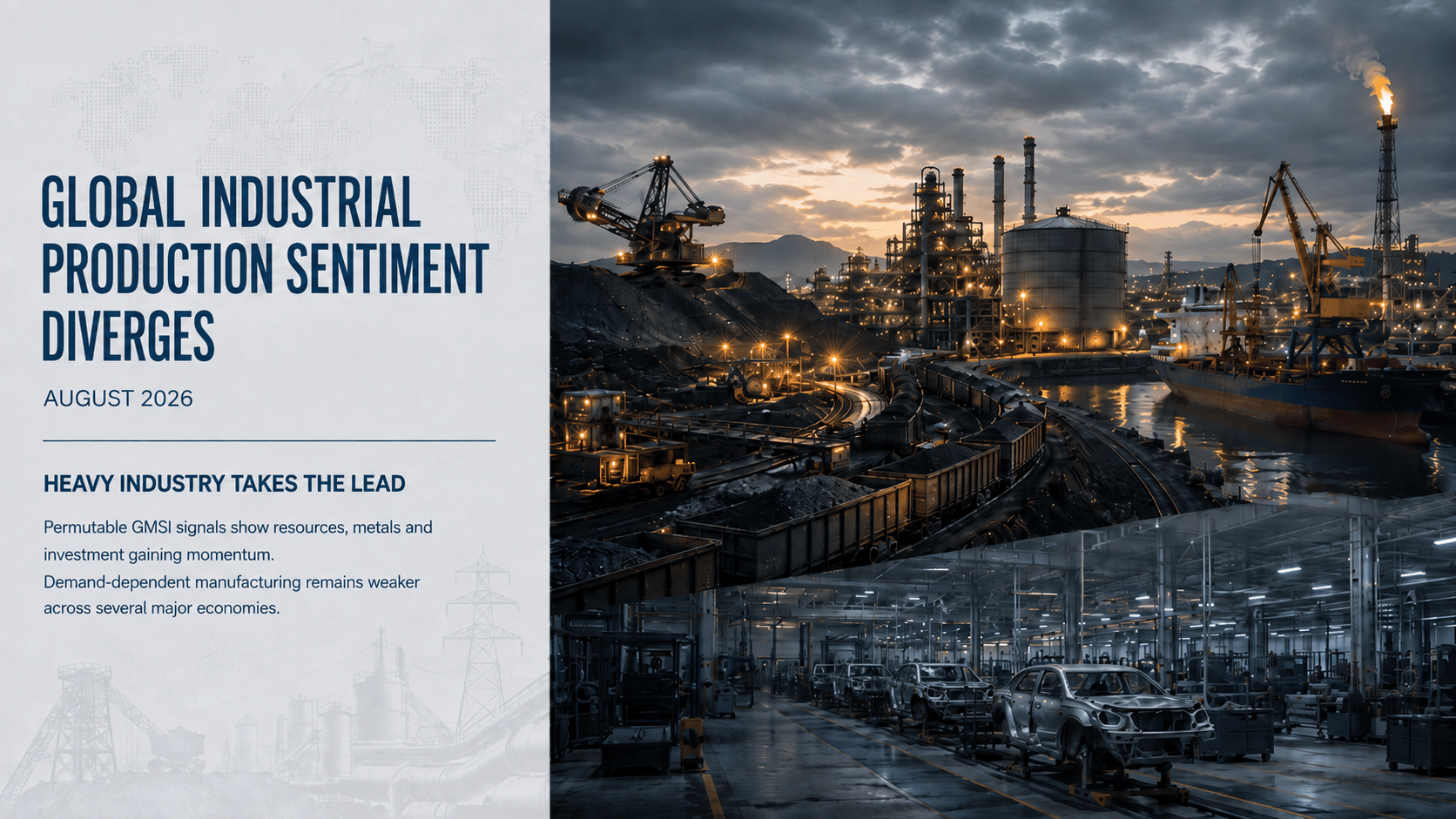
Global industrial production sentiment: Canada, India and South Korea Gain as the UK, Germany and China weaken
04 Aug 2026
04 Aug 2026
This analysis uses Permutable’s Global Macro Sentiment Indices (GMSI) to track shifts in industrial-production sentiment across major economies in 2026. It shows heavy industry gaining momentum in Canada, India, South Korea and Turkey, while the UK, Germany, China and Romania weaken. It is aimed at institutional investors, economists, strategists and corporate decision-makers monitoring global manufacturing, commodities, demand and industrial-cycle divergence.
The global industrial cycle has not so much turned as separated.
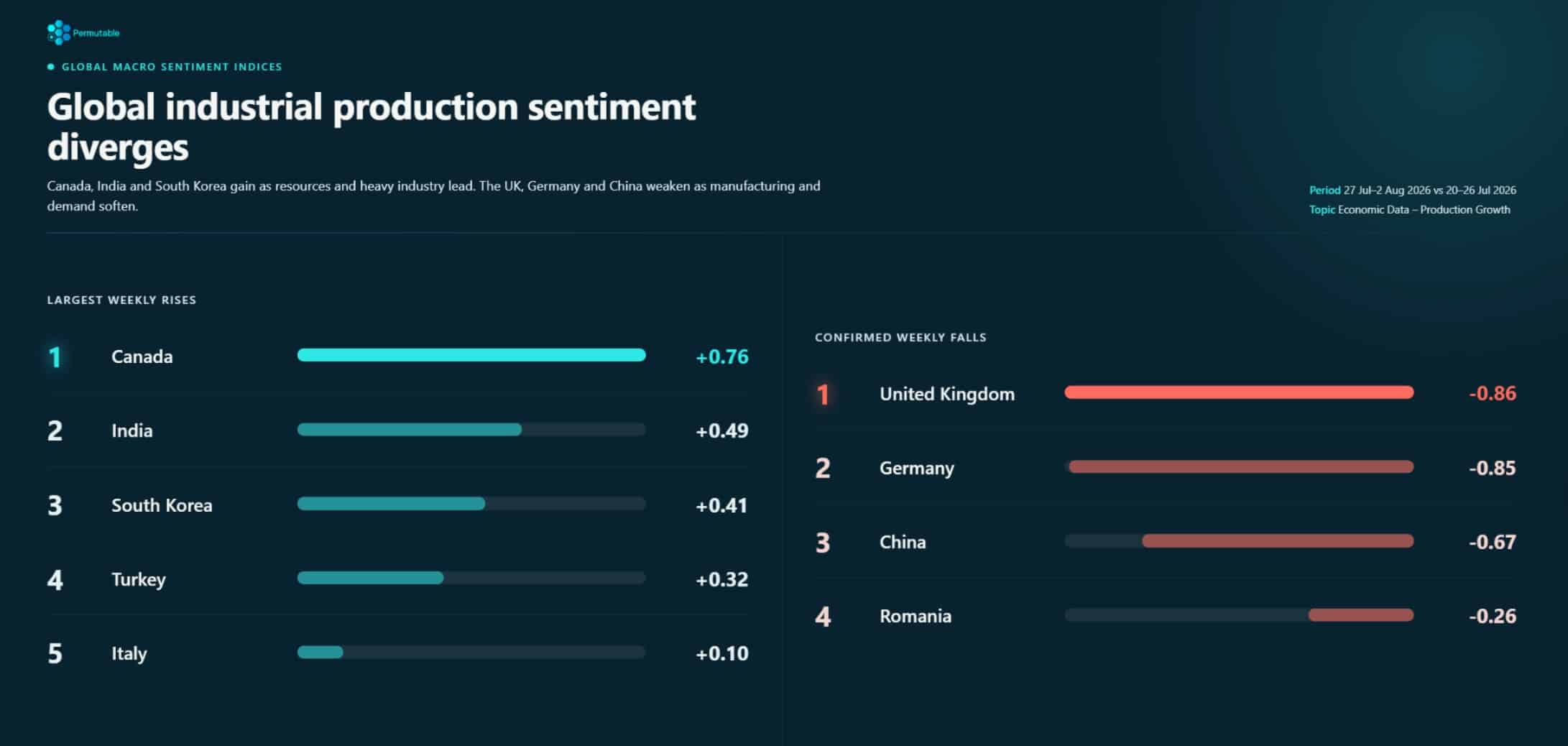
Permutable’s latest sentiment data shows the strongest GMSI signals have come from economies supplying the physical ingredients of growth: oil, coal, metals and productive capacity. Canada led this week’s rise, followed by India and South Korea. Turkey benefited from steel. Italy, after several false dawns, produced a somewhat firmer run of orders and sales.
The weaker group occupied another part of the factory floor. British vehicle production remained subdued. German industry had tolerable backward-looking data but an increasingly uncomfortable discussion about what comes next. China’s official manufacturing survey slipped below the line separating expansion from contraction in July.
None of this amounts to a synchronised industrial recovery. Mines, mills and power systems can gain momentum while manufacturers dependent on household demand, export orders and competitive pricing continue to wait for theirs.
The rankings compare average directional industrial-production sentiment per matched headline in the seven days ending 2 August with the preceding period, 20-26 July.
An average score is used because America naturally produces more economic news than Romania. That should not, by itself, constitute stronger industrial momentum.
A rising reading means the coverage became more consistently associated with higher production, new capacity or improving operating conditions. A falling one reflects a greater concentration of weak orders, lower output, closures or production constraints.
Countries require at least 15 matched headlines in both periods. A numerical move is published only where the dominant high-impact stories support it. This removes some of the excitement from a top-five ranking, but also some of the fiction.
| Rank | Country | Weekly change |
| 1 | Canada | +0.76 |
| 2 | India | +0.49 |
| 3 | South Korea | +0.41 |
| 4 | Turkey | +0.32 |
| 5 | Italy | +0.10 |
Canada recorded the largest rise as oil, gas and mining displaced the less persuasive parts of its manufacturing story.
This was not a factory renaissance. The improvement came from industries able to turn commodity demand and existing assets into additional production. Oil-sands performance strengthened, mining investment advanced and the resource economy regained its familiar role as the part of Canadian industry prepared to do the heavy lifting.
Commodity exporters are often accused of lacking industrial sophistication. They tend to mind less when commodity prices and investment are moving in their favour.
India’s rise was harder to dismiss as a collection of favourable coal and steel headlines.
Industrial production increased by 7.3% from a year earlier in June. Manufacturing rose by 7.8%, electricity and gas supply by 10.6%, and 19 of the 23 manufacturing groups recorded growth. The composition was as useful as the headline number: energy, capital goods and infrastructure-related production moved together.
India’s industrial story is becoming broader, which is generally preferable to becoming louder. Emerging-market growth releases have never suffered from a shortage of noise.
South Korea recorded one of the clearest improvements in the ranking.
Semiconductors remain central to the economy, as they have an inconvenient habit of being central to almost every discussion of Korean industry. This week’s signal was more interesting. Production strengthened alongside consumption, facility investment and business expectations.
South Korea often turns early in the manufacturing cycle. Whether it also leads the rest of the world is another matter, and usually where the forecast notes become longer.
Turkey’s industrial signal rose as steel and metals outweighed weakness closer to the household sector.
Heavy industry supplied the favourable comparisons, capacity plans and better export narrative. White goods and other interest-rate-sensitive industries remained under pressure. The economy, as ever, managed to contain more than one cycle at the same time.
The result was an industrial expansion with a pronounced lean towards infrastructure and external markets. Turkish households were less involved.
Italy completed the top five with the sort of improvement that requires careful handling.
Industrial production fell by 0.3% in May after three monthly increases, although output remained 1.1% higher than a year earlier. The three months to May were also stronger than the preceding quarter. This is not a boom, nor even much of a rebound. It is, however, better than an unbroken decline.
Italy’s ranking is best read as evidence of an industrial turn under consideration. Confirmation, in the Italian data tradition, can arrive later.
| Rank | Country | Weekly change |
| 1 | United Kingdom | −0.86 |
| 2 | Germany | −0.85 |
| 3 | China | −0.67 |
| 4 | Romania | −0.26 |
Only four countries passed the full evidence test for falling industrial sentiment.
Saudi Arabia recorded a large numerical decline, but its leading stories concerned plans to raise oil production. Ukraine was also removed because much of its signal came from reporting on Russian refineries damaged by Ukrainian attacks. Neither makes a particularly convincing account of weakening domestic production.
Several other countries lost numerical momentum while retaining predominantly expansionary headlines. A fifth fall would have made the table tidier and the analysis worse.
The UK recorded the largest confirmed decline as vehicle manufacturing returned to the centre of the industrial discussion.
Production remained weak during the first half of the year. Model changes, plant disruption and soft commercial-vehicle demand have all played a part. The precise mixture varies; the result has been more dependable.
Britain has many promising advanced-manufacturing strategies. Its existing car plants must meanwhile continue producing cars.
Germany’s GMSI score fell almost as sharply as Britain’s, although the hard data did not describe an industrial collapse.
Production rose by 0.9% in May and was unchanged from a year earlier. Orders and the backlog also strengthened. The deterioration occurred elsewhere: in the assessment of Germany’s competitive position, the future of its car industry and the willingness of companies to keep investing at home.
The German industrial model has not stopped working. That is a lower hurdle than it used to be.
China’s decline had a firmer cyclical basis.
The official manufacturing PMI fell to 49.2 in July from 50.3 in June, taking activity back below the expansion threshold. Production capacity was not the obvious problem. New demand was.
China has spent years demonstrating how much it can make. The more pressing task is finding buyers at margins producers are willing to accept.
Romania completed the falling group as energy availability became the main industrial constraint.
Lower electricity generation and weaker hydrocarbon output raised concerns over supply through the summer. New factories and future capacity plans still featured in the news. They were less useful to plants needing power now.
Industrial strategy generally sounds grander than grid reliability. The latter still determines whether the machines run.
Leadership within the industrial cycle passed towards the economies closest to physical production.
Canada benefited from extraction and mining investment. India combined stronger energy supply with wider manufacturing growth. Turkey drew momentum from metals. South Korea offered the more encouraging prospect of output, investment and consumption improving at the same time. Italy, cautiously, joined the group through a better pipeline of orders and sales.
The weaker economies arrived there by different routes.
Britain remained burdened by automotive production. Germany’s current output was steadier than its industrial self-confidence. China had ample capacity and less convincing demand. Romania encountered the older and less abstract difficulty of supplying enough power.
This leaves the world with an industrial expansion that is real, but selective. Mines can open, steel output can rise and power generation can improve without producing a broad recovery in manufactured trade or household demand.
The market consequences are equally uneven. Higher resource production can support capital expenditure and commodity supply. It does not guarantee stronger factory employment, consumer spending or export orders.
For now, the heavy industries are finding momentum. The rest of the factory cycle has yet to decide whether to follow.
Methodology: Permutable GMSI directional sentiment for Economic Data-Production Growth-Industrial, combining domestic and international coverage. The ranking compares average sentiment per matched headline in the seven days ending 2 August 2026 with the preceding seven-day period, 20–26 July. Countries required at least 15 matched headlines in both periods. Numerical moves were published only where their direction was supported by the dominant high-impact headlines.

Analysis
16 Oct 2026
Gold outlook 2026: Why US rates outweigh geopolitical risk
Read more >
Analysis
14 Oct 2026
Beneath US headline inflation: tracking pressure across energy, food, services and housing
Read more >
Analysis
13 Oct 2026
France’s debt alarm hits a decade high and drowns out the rest of the G20
Read more >