
Top commodity price intelligence providers for institutional investors in 2026: Comprehensive guide
07 Aug 2025
07 Aug 2025
This piece provides a comparative overview of the world’s leading providers of commodity price intelligence, aimed at traders, procurement professionals, and institutional investors seeking trusted sources of market insights. First published: 7 August 2025
Last updated: July 2026
Global commodity markets are shaped by an ever-changing mix of fundamentals, sentiment, and geopolitics. For market participants, commodity price intelligence is essential: it informs hedging strategies, supports procurement decisions, and underpins investment performance.
Commodity price intelligence providers help trading desks, procurement teams, risk managers and institutional investors monitor the factors that move energy, metals and agricultural markets. The strongest providers combine trusted price benchmarks, market fundamentals, forward curves, supply-demand data, geopolitical context and, increasingly, AI-driven narrative and sentiment signals.
Established providers such as S&P Global Commodity Insights, Argus Media, CRU, Expana and Benchmark Mineral Intelligence remain important for benchmarks and sector depth, while Permutable adds a forward-looking intelligence layer built around real-time narrative detection, sentiment analysis and institutional workflow integration.
| Provider | Best for | Main strength |
|---|---|---|
| Permutable | Institutional teams needing forward-looking commodity intelligence | Real-time sentiment, narrative detection and signal delivery |
| S&P Global Commodity Insights | Benchmark pricing and physical market reference data | Platts benchmarks and broad commodity coverage |
| Argus Media | Independent price assessments and physical commodity reporting | Regional market depth and price reporting |
| CRU Group | Metals, mining and fertilisers | Long-horizon fundamentals and cost curves |
| Benchmark Mineral Intelligence | Battery materials and EV supply chains | Lithium, cobalt, nickel and graphite intelligence |
| Expana | Agrifood commodities and procurement | Food, agriculture and supply-chain price intelligence |
| Mintec Analytics | Procurement and cost management | Supplier pricing, cost inflation and raw material tracking |
| CME Group | Exchange-traded commodity prices | Futures, options and regulated price discovery |
| Provider | Primary Focus | Coverage | Data / Outputs | Key Differentiators | Ideal For |
|---|---|---|---|---|---|
| Permutable | Predictive, AI-driven commodity price intelligence | Energy, metals, agriculture; cross-asset (incl. FX) | Real-time signals, narrative & sentiment analytics, Market 360 heatmaps, explainable summaries | LLM + reinforcement learning, human-in-the-loop, rapid narrative detection, API/dashboard integration | Trading desks, macro/CTA funds, procurement & risk teams seeking forward-looking signals |
| S&P Global Commodity Insights (Platts) | Benchmark price assessments & research | Energy, metals, ags, petrochemicals, shipping | Benchmarks, price curves, market reports, Platts Connect | Long-established benchmarks embedded in contracts, broad sector depth | Producers, traders, refiners, compliance-sensitive buyers needing contractable benchmarks |
| Argus Media | Independent pricing & analysis | Petroleum, gas, metals, agriculture, biofuels, emissions | Daily price assessments, news, fundamentals analysis | Strong independence credentials, global regional coverage | Physical market participants requiring impartial reference prices |
| Expana | Agrifood pricing & fundamentals | Grains, softs, broader agri supply chains | IOSCO-compliant prices, S&D models, weather & cost modelling | Specialist agrifood depth with integrated weather & fundamentals | Food & beverage, agri producers, procurement teams |
| Mintec Analytics | Procurement-centric cost intelligence | Food ingredients, packaging, raw materials | Price data, cost indices, forecasts, supplier benchmarking | Negotiation support and margin protection for buyers | Procurement & finance teams driving cost control |
| CRU Group | Metals, mining & fertilisers fundamentals | Steel, aluminium, copper, potash, nitrogen, etc. | Market studies, price outlooks, production & cost curves | Industrial depth and long-horizon fundamentals | Producers, OEMs, project finance & strategy teams |
| Benchmark Mineral Intelligence | Battery materials pricing | Lithium, cobalt, nickel, graphite; gigafactory tracking | IOSCO-assured assessments, supply–demand analytics | EV supply chain specialism with contract-grade prices | EV ecosystem, energy storage, specialty chemicals |
| Aranca | Bespoke research & cost forecasting | Cross-commodity raw materials | Custom studies, budgeting support, resource planning | Consultancy-style deliverables tailored to process | Corporates needing customised decision support |
| CME Group (CME/CBOT/NYMEX/COMEX) | Transparent price discovery (futures & options) | Energy, metals, ags & more | Market prices, curves, vol surfaces, market data feeds | Deep liquidity and regulated price formation | Hedgers, speculators, risk managers needing executable benchmarks |
If you need contract-grade benchmark prices, start with a price reporting agency. If you need forward-looking market intelligence, combine benchmark data with narrative, sentiment and real-time signal providers. For institutional trading and risk workflows, the strongest setup is often not one provider, but a layered data stack.
| Criterion | Why it matters |
|---|---|
| Benchmark credibility | Required for contracts, settlement and compliance |
| Asset coverage | Energy, metals and agriculture require different data models |
| Update frequency | Real-time and intraday signals matter for trading workflows |
| Point-in-time history | Necessary for backtesting and model validation |
| Narrative and sentiment coverage | Helps identify market-moving themes before price action |
| Delivery method | API, Excel, dashboard and data feed options affect usability |
| Explainability | Institutional users need to understand why a signal has moved |
| Workflow fit | Procurement, trading, risk and systematic teams need different outputs |
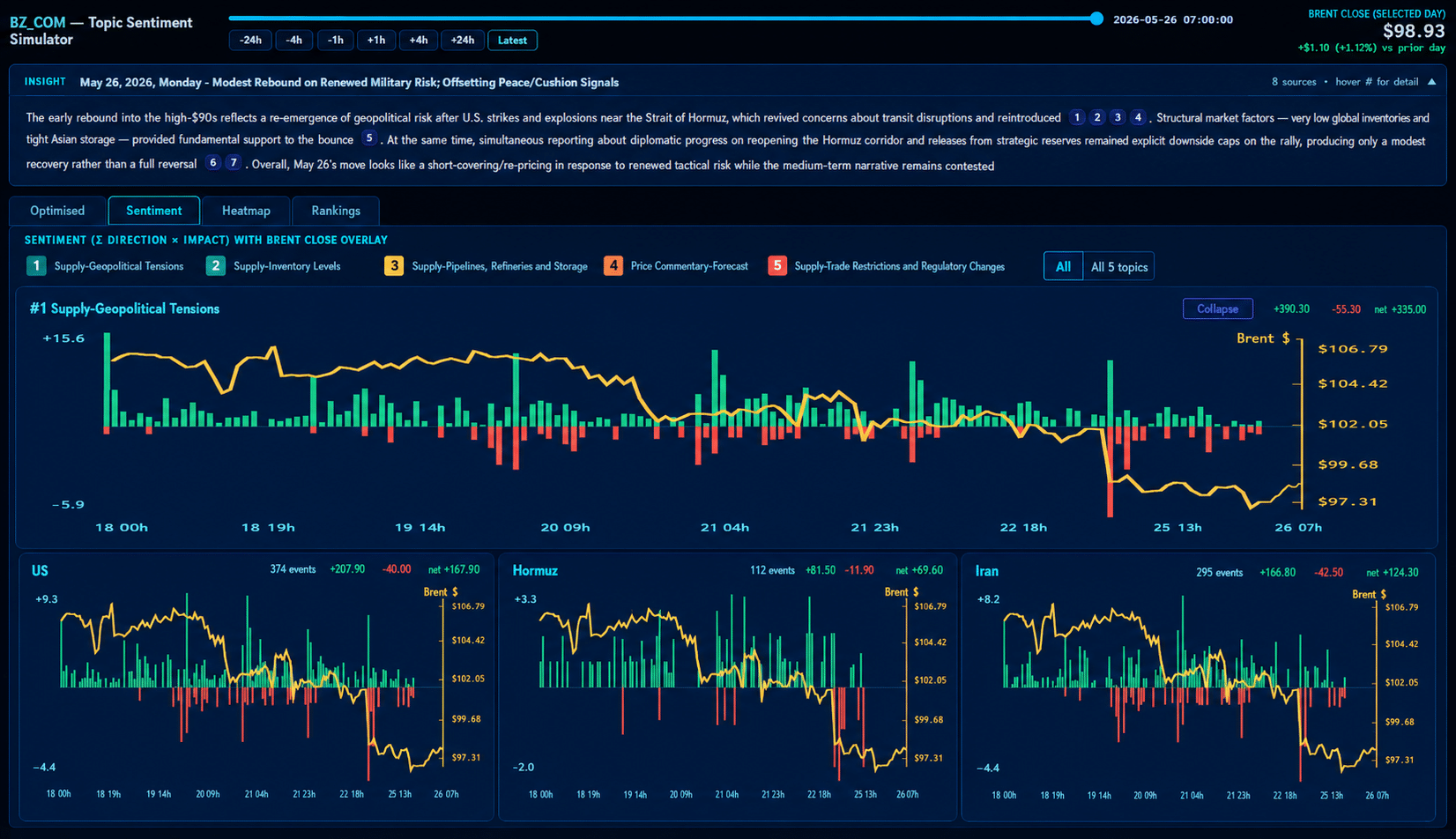
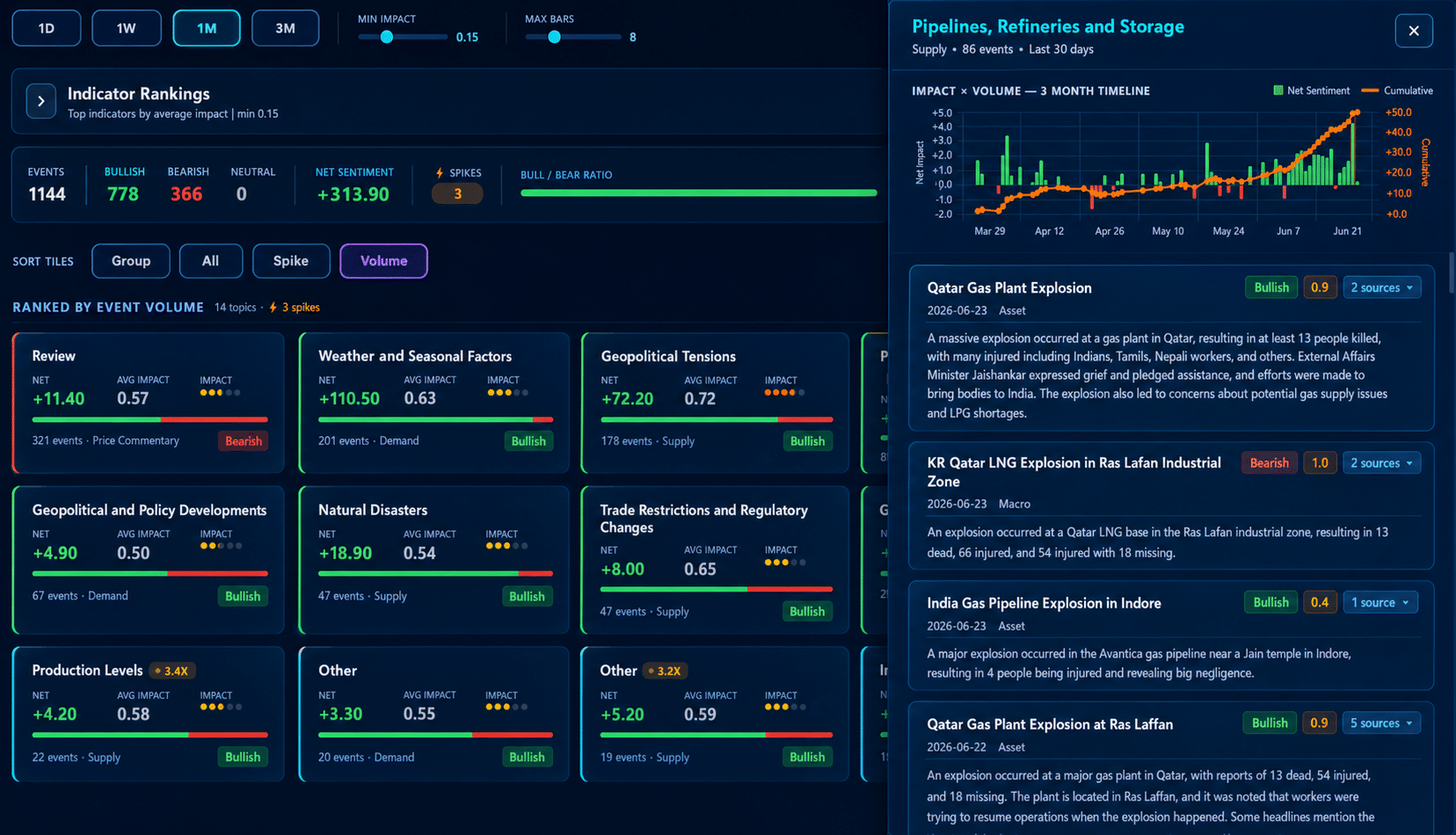
Permutable provides real-time commodity intelligence for trading, research, risk and investment teams that need to understand not only where prices are, but what is starting to move them.
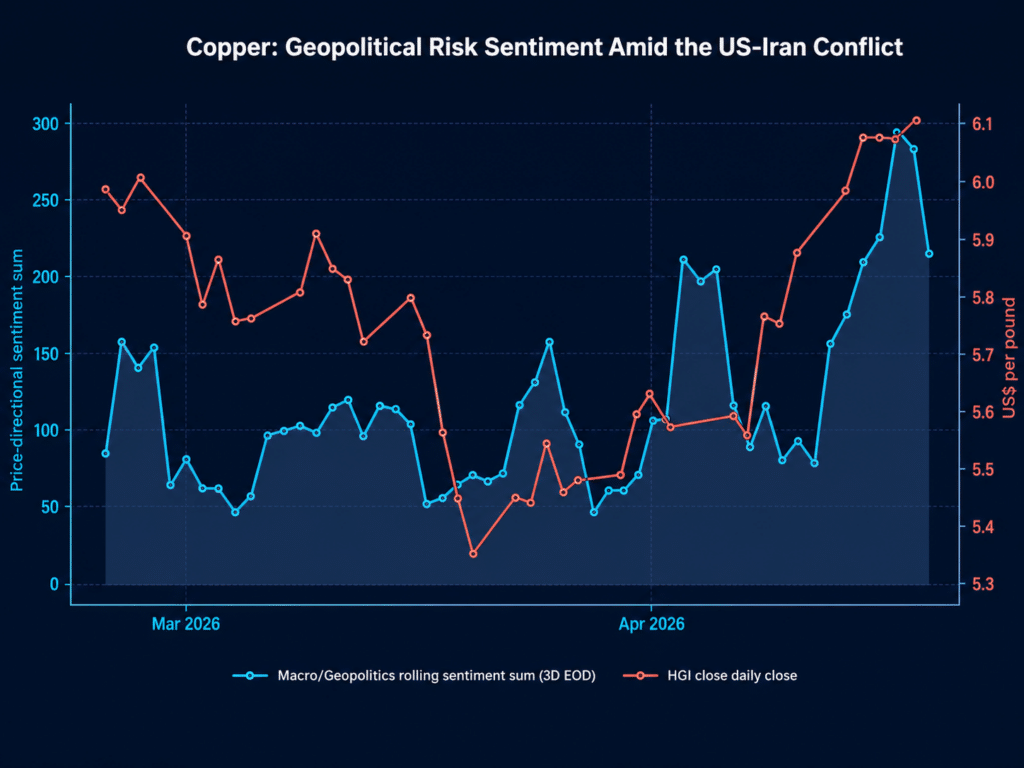
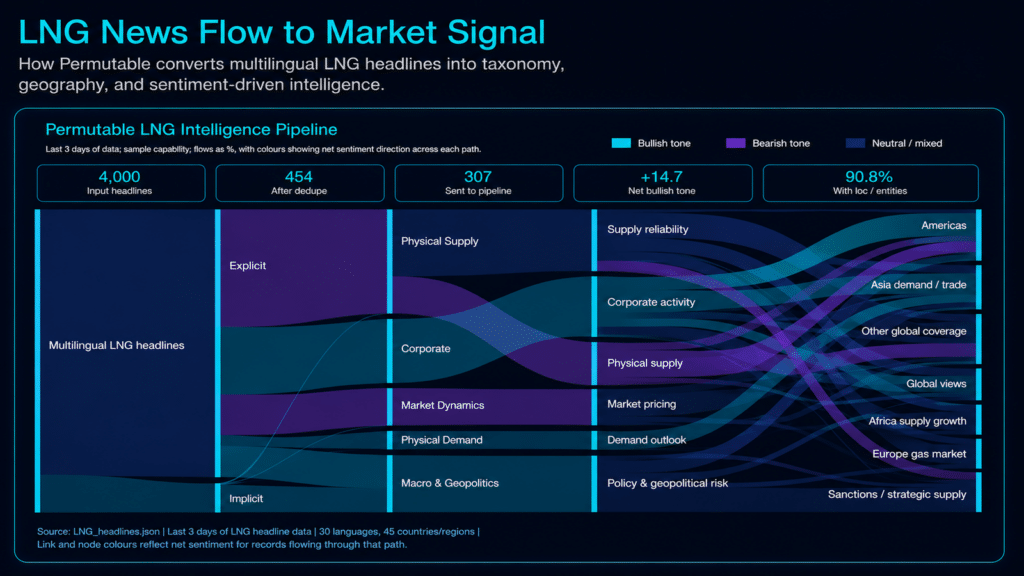
Our platform converts large-scale global information flows into structured market signals across energy, metals, agriculture, currencies, macro and geopolitical themes. For commodity markets, this means tracking the narratives that often build before they are fully reflected in price: supply disruption risk, policy shifts, weather-linked pressure, inventory concerns, demand uncertainty, sanctions, trade flows and cross-asset sentiment.
Permutable is best suited to institutional teams that already use benchmark prices, fundamentals and market data, but want an additional forward-looking layer that can be delivered through dashboards, APIs, data feeds and workflow integrations.
S&P Global is one of the most established names in commodity markets. Its role as a price reporting agency is foundational: benchmark assessments from Platts are embedded in contracts across oil, gas, and refined products. Beyond benchmarks, S&P Global Commodity Insights provides extensive data, analytics, and research across energy, metals, agriculture, shipping, and petrochemicals.
Tools such as Platts Connect deliver real-time pricing and analysis, making S&P Global indispensable for companies needing transparency and consistency in their contracts. Its authority stems from decades of market participation, and for many, it remains the default source of reference prices.
Argus Media is an independent provider that has carved out a strong reputation for impartiality and accuracy. Its daily prices, reports, and analysis span petroleum, natural gas, metals, agriculture, biofuels, and emissions markets.
One of Argus’s strengths is its global reach: with offices worldwide, it captures regional nuances while providing a consistent, globalised perspective. Argus reports are often embedded in physical contracts, similar to Platts, giving them strong weight in real-world transactions. For organisations that require commodity price intelligence validated by market adoption and trusted by regulators, Argus remains a leading choice.
Expana specialises in agrifood commodities, an area of increasing importance given global supply-chain pressures and climate volatility. Its IOSCO-compliant pricing, forecasting, and cost modelling provide buyers and producers with clarity on everything from grains to soft commodities.
Expana also integrates weather insights, supply-demand fundamentals, and forward-looking analysis into its platform. For procurement teams in food and beverage, or agricultural producers managing volatility, Expana delivers highly tailored and reliable intelligence.
Mintec Analytics is widely known in procurement circles. Its mission is to help buyers of raw materials reduce risk and improve profitability by equipping them with accurate data and forecasts.
Its platform allows users to benchmark supplier pricing, track cost inflation, and negotiate with greater confidence. Covering categories such as food ingredients, packaging, and raw materials, Mintec empowers procurement professionals to manage exposure across the supply chain. For corporates where commodity price intelligence is less about speculation and more about cost control, Mintec provides a clear edge.
UK-based CRU Group has long been respected for its depth in metals, mining, and fertilisers. CRU combines data-driven analysis with industry expertise to provide detailed reports on production, supply chains, and price trends.
Its intelligence covers a wide range of industrial commodities, from steel and aluminium to potash and nitrogen fertilisers. CRU’s focus on fundamentals and long-term analysis makes it especially valuable for companies making capital investment decisions in resource-heavy industries.
As the global energy transition accelerates, the demand for intelligence on battery materials has surged. Benchmark Mineral Intelligence is the leading authority on lithium, cobalt, nickel, and graphite – materials at the heart of the electric vehicle (EV) and energy storage revolution.
Benchmark provides IOSCO Type 1 assured price assessments, making its data suitable for financial contracts. Its research also extends to capacity tracking of gigafactories, giving clients a forward view of supply-demand dynamics in this critical sector.
Aranca offers bespoke research and intelligence across a broad spectrum of raw materials. Its work often supports budgeting, cost forecasting, and resource planning for corporates exposed to commodity inputs.
Unlike some providers with fixed product suites, Aranca brings a consultancy-style approach, tailoring outputs to client needs. This flexibility makes it attractive for firms seeking commodity price intelligence that aligns closely with internal processes.
Finally, no overview of commodity intelligence is complete without recognising the role of exchanges such as the CME Group (CME, CBOT, NYMEX, COMEX). While they are not intelligence providers in the traditional sense, their futures and options markets provide transparent and regulated price discovery.
Market participants rely on exchange data to hedge, speculate, and validate positions. Futures prices often set the tone for spot markets, making exchanges indispensable to the functioning of global commodity trade.
Our commodity intelligence suite exemplifies this shift, combining sentiment analysis, narrative detection, and reinforcement learning to offer predictive insights that complement traditional data. For traders and institutions, the opportunity lies not in choosing between old and new, but in integrating both-leveraging the authority of established benchmarks with the foresight of AI.
| Layer | Typical providers | Role |
|---|---|---|
| Exchange prices | CME, ICE, LME | Executable market prices and futures curves |
| Price assessments | S&P Global Commodity Insights, Argus | Benchmarks and physical market reference prices |
| Fundamentals | CRU, Expana, Benchmark, Mintec | Supply, demand, costs, production and inventories |
| Forward-looking intelligence | Permutable | Narrative shifts, sentiment signals, cross-asset context and real-time market drivers |
| Team | What they need | How intelligence is used |
|---|---|---|
| Discretionary traders | Fast explanation of what is moving the market | Narrative shifts, geopolitical risk, supply disruption sentiment |
| Systematic funds | Structured, historical signals | Point-in-time sentiment and event signals for backtesting |
| Procurement teams | Cost control and supplier negotiation support | Price benchmarks, inflation signals and supply-chain indicators |
| Risk teams | Early warning of volatility and stress | Cross-asset sentiment, geopolitical risk and concentration monitoring |
| Macro strategists | Links between commodities, FX, rates and policy | Commodity narratives connected to macro regimes |
Explore how Permutable fits in your workflow
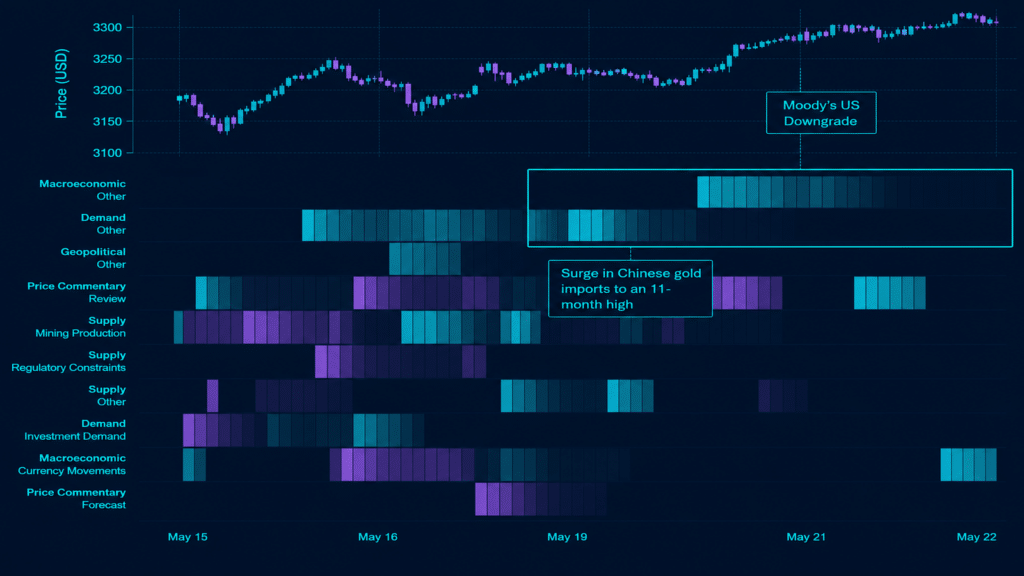
Combine trusted benchmarks with predictive commodity price intelligence. Discover our commodity intelligence suite for real-time narrative detection, sentiment-aware signals, and cross-asset context designed for traders, procurement teams, and investment professionals.
Book a short demo at enquiries@permutable.ai to see how our insights can complement your existing data stack and sharpen decision-making.
Commodity price data shows where a market is trading or where a benchmark has been assessed. Commodity price intelligence adds context around why the market is moving and what may affect it next. This can include supply-demand fundamentals, inventories, trade flows, weather, policy, geopolitical risk, market sentiment and narrative signals. Institutional teams often use both: price data for reference and execution, and intelligence for research, risk management and forward-looking decision support.
A: By integrating benchmarks, sentiment indices, and supply–demand models, commodity price intelligence can provide predictive signals that improve entry and exit timing. Systematic traders use these structured datasets as potential leading indicators to diversify factors and capture uncorrelated alpha.
A: Narrative analysis converts unstructured data—such as news, policy shifts, and geopolitical developments—into measurable indicators. For commodities, these signals often act as leading indicators, surfacing drivers of price movement before they are evident in fundamentals or technicals.
A: Commodity price intelligence enables proactive risk management by identifying early signals of disruption, such as weather patterns, policy announcements, or sentiment shifts. These insights allow trading desks to hedge exposures more effectively and reduce drawdowns during periods of volatility.
A: AI scales the capture and structuring of vast, unstructured information flows. Natural language processing and machine learning transform narratives, earnings commentary, and policy updates into structured signals. For systematic traders, this creates new inputs that can be backtested and integrated into models.
A: In energy markets, intelligence often focuses on geopolitical risk, inventories, and OPEC policy. Metals trading relies on production data, cost curves, and EV supply chain demand. Agriculture depends heavily on weather, planting data, and export flows. Each sector has unique leading indicators that can be captured systematically.
Yes. Incorporating leading indicators such as narrative sentiment or forward-looking supply models allows traders to anticipate stress events earlier, tightening risk controls and mitigating downside.
Lagging datasets such as reported inventories may offer limited predictive power. The challenge is to separate noise from true leading indicators—this is where AI and systematic validation become essential.
By surfacing early demand or sentiment shifts, AI-driven intelligence can improve trade timing and execution, helping systematic desks minimise slippage and take advantage of liquidity before market consensus forms.

Guide
07 Oct 2026
Commodity signal evaluation: from information flow to portfolio evidence
Read more >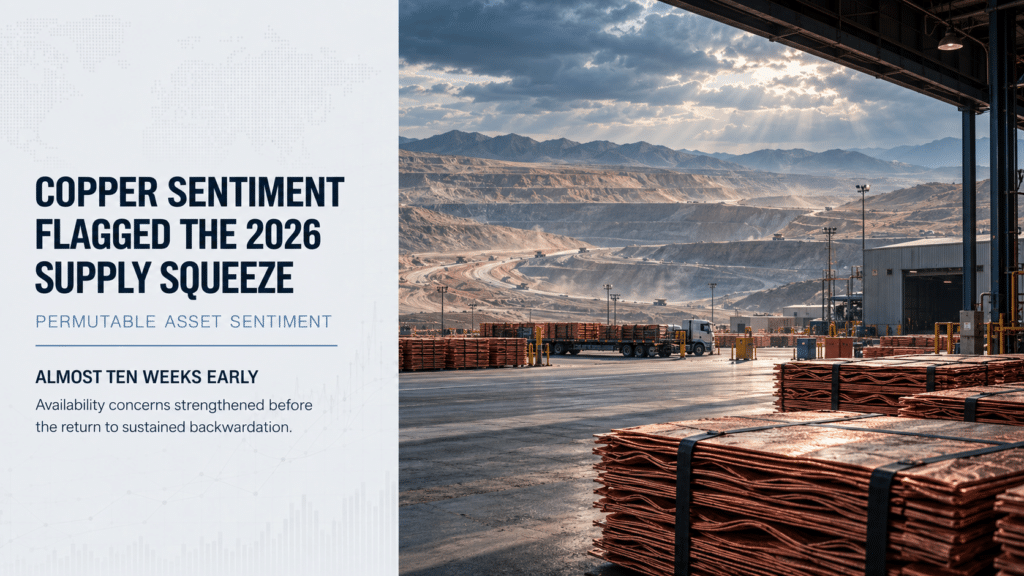
Analysis
06 Oct 2026
Copper sentiment data for institutional commodities desks: How sentiment Flagged the 2026 supply squeeze early
Read more >
Guide
14 Aug 2026
Measuring narrative momentum across global markets: A guide for institutional investors
Read more >