
Key macro factors driving energy and metal commodity markets 2025
12 Aug 2025
12 Aug 2025
This analysis examines the critical macro factors reshaping energy and metal commodity markets in 2025, aimed at hedge fund managers, commodity traders, and institutional investors seeking actionable insights.
The commodity markets have rarely been more complex, with multiple macro factors converging to create both unprecedented challenges and remarkable opportunities. At Permutable, our experience providing intelligence across energy and metal markets has provided us with unique insights into how these macro factors translate into actionable trading signals and measurable alpha generation.
The most significant macro factors we’re monitoring relate to global economic growth patterns, particularly the divergence between Chinese demand and the broader global slowdown. Through our AI-powered analysis, we’ve observed how softening growth outside China continues to weigh heavily on commodity demand, with weak industrial output creating headwinds for metals like iron ore.
What’s particularly interesting is the disconnect between physical demand and price action. Despite record import volumes – primarily for inventory restocking – underlying consumption remains subdued. However, the macro factors suggest a potential inflection point approaching. Stimulus measures and monetary easing, especially from China, could catalyse a cyclical rebound in metals demand by 2026, with our models working continually to track any related sentiment shifts across the landscape.
Geopolitical macro factors have become increasingly dominant in shaping commodity market dynamics with tariff escalations and trade friction creating pronounced volatility across both energy and base metals markets.
Recent moves in Brent, WTI, and TTF natural gas highlight how political risk and regulatory shifts are now dominating price formation in energy markets. In recent weeks, sanctions threats on Russian oil, new US–EU energy cooperation, and tariff measures targeting Indian and Chinese imports have driven bullish sentiment, overriding traditional supply-demand fundamentals.
Our Trading Co-Pilot captured early momentum shifts – flagging Brent’s rally above $71, WTI’s breakout from $66, and TTF’s heatwave-driven rebound – each aligned with policy risk, shifting trade alignments, and macroeconomic volatility. Short-term catalysts included sanctions rhetoric, LNG supply friction, and extreme weather, while structural headwinds such as weak industrial demand in Europe and potential Venezuelan supply returns remain in play.
The market’s sensitivity to enforcement threats, geopolitical alliances, and infrastructure bottlenecks indicate a transition towards a policy-driven regime – where anticipating political developments is as critical as tracking physical balances.
In live testing our AI-driven systematic strategies, we’ve found that these geopolitical macro factors often create opportunities for those positioned to react quickly. Disruptions in energy supply and export restrictions on critical minerals add layers of uncertainty that traditional analysis struggles to navigate, but AI-powered sentiment analysis excels at interpreting.

Above: Our Trading Co-Pilot captured the early inflection, as legal and political risk returned to dominate Brent price formation.
The monetary policy landscape represents one of the most nuanced macro factors affecting commodity markets. Take for example how easing rates and low interest levels provide strong support for precious metals like gold and silver, reinforcing their safe-haven characteristics amid geopolitical unrest.
Our experience with gold trading exemplifies this perfectly. Following Moody’s downgrade of the US credit rating, our AI detected a sharp shift in gold sentiment that preceded a rally, driving prices above $3,300 per ounce before the market fully appreciated the macro backdrop. Additionally, our systems flagged a surge in Chinese gold imports as an early demand signal.
Conversely, persistent inflation and potential tightening cycles create headwinds for broader commodity demand. These opposing macro factors require sophisticated analysis to navigate successfully -something we’ve built into our core platform capabilities.

Above: Our AI’s real-time sentiment analysis reveals the key drivers behind gold’s recent surge to over $3,300 per ounce. The heatmap displays sentiment factors from 15-22 May, with green bars indicating positive price drivers and red bars showing negative influences. Macroeconomic factors, particularly the Moody’s US downgrade, emerge as the primary catalyst, whilst a surge in Chinese gold imports to an 11-month high has provided additional demand-side support for the rally.
Energy market dynamics: Supply management in focus
Energy markets remain extraordinarily sensitive to shifts in supply management, and we’ve seen how macro factors around OPEC+ decisions create both risks and opportunities. Recent decisions to increase output hint at potential downward pressure on oil prices, particularly amid tepid demand.
Our natural gas trading provides a compelling example of how macro factors translate into trading profits. Our Trading Co-Pilot captured a 5.5% return on Henry Hub natural gas in just three days, detecting sentiment shifts around key inventory data and the BP-Woodside supply agreement before the broader market had reacted. This demonstrates how real-time, AI-driven analysis of macro factors can turn fleeting developments into actionable gains.
The combination of robust non-OPEC+ supply growth adds further complexity to these macro factors. At Permutable, we’ve learned that success in energy trading requires constant monitoring of supply-demand balances across multiple timeframes and geographies.

Above: Our Trading Co-Pilot data feeds capturing Henry Hub natural gas price movements from 2-5 May 2025. Note the ‘Severe Weather Alerts’ trigger that initiated the uptrend, followed by the ‘Colorado Snow Forecast’ that sustained momentum. Most telling is the persistent green fundamental, macroeconomic and forecast sentiment indicators that maintained bullish momentum demonstrating why leading energy desks are incorporating our sentiment technology for forecasting natural gas prices and market shifts in volatile market conditions.
Perhaps one of the most important macro factors relate to the global energy transition. Key metals – copper, lithium, nickel, cobalt, and rare earths – are central to electrification and renewable energy infrastructure, creating entirely new demand paradigms.
These markets exhibit high volatility due to supply constraints and concentrated control, but they also present compelling long-term opportunities. Lower energy production costs from renewables are enhancing metal producer margins, making metals like copper particularly attractive investments.
At Permutable, our market intelligence helps to position trading strategies to capitalise on both the short-term volatility and long-term structural shifts these macro factors represent. The transition isn’t just reshaping demand – it’s creating entirely new correlation patterns and market dynamics.
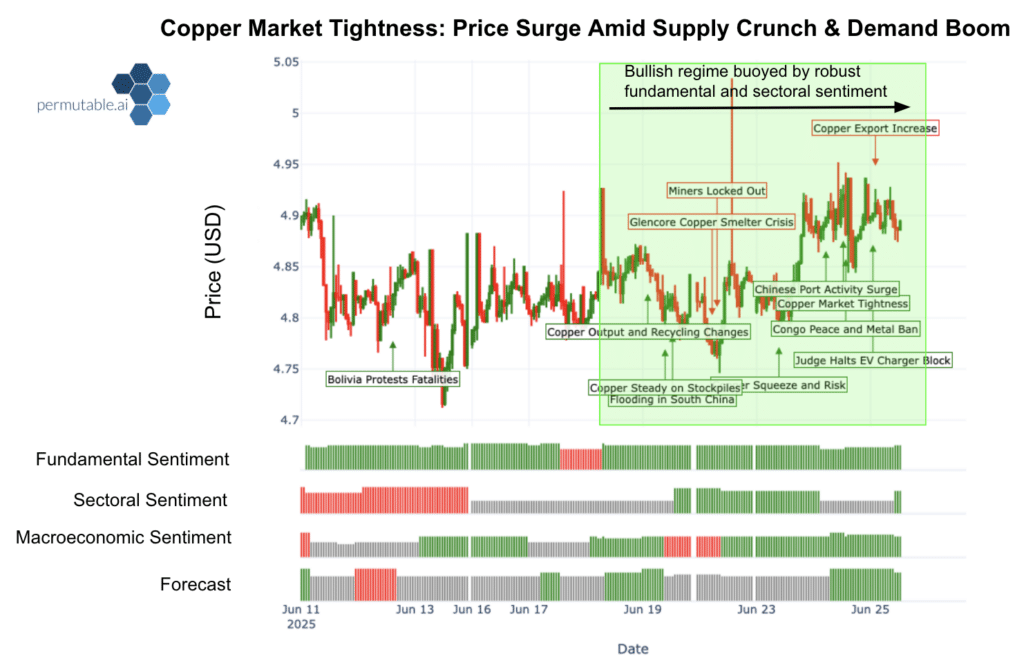
Above: Copper prices surged in June 2025, reflecting tight supply conditions and robust demand, signalling sustained bullish pressure in the near-term market outlook. Here, our Trading Co-Pilot flagged renewed bullish sentiment, underpinned by strong fundamental drivers and broad-based sectoral momentum.
Weather extremes continue to be significant macro factors, though their impact often gets underestimated in traditional analysis. Fluctuating conditions can dramatically affect energy supply requirements and disrupt mining or logistics operations.
Our experience has taught us that these macro factors require constant vigilance and robust risk management frameworks. While less predictable than economic or policy changes, weather-related disruptions often create some of the most profitable trading opportunities for those prepared to act quickly.
The complexity of modern commodity markets means that success increasingly depends on sophisticated interpretation of multiple, interconnected macro factors. Whilst traditional analysis struggles with the speed and complexity required, AI-powered approaches excel at identifying patterns and opportunities across vast datasets.
At Permutable, we’ve learned that the most successful commodity trading strategies don’t just monitor macro factors – they integrate them into comprehensive frameworks that can react to changing conditions in real-time. The macro factors shaping today’s commodity markets are more complex than ever, but they’re also creating unprecedented opportunities for those equipped with the right tools and insights.
Discover how leading energy trading desks and hedge funds use our market sentiment intelligence to capture alpha from macro factor shifts before they’re fully priced in. Simply email enquiries@permutable.ai to request a demo.

Guide
14 Aug 2026
Measuring narrative momentum across global markets: A guide for institutional investors
Read more >
Analysis
27 Jul 2026
Saudi supply risk and import costs drive energy inflation sentiment higher
Read more >
Analysis
15 Jul 2026
The Price of Passage: How Geopolitical Sentiment Led the Repricing of Gulf Crude-Flow Risk
Read more >