
Crude oil sentiment going into 2026: What the market is really pricing
09 Jan 2026
09 Jan 2026
This article analyses crude oil sentiment going into 2026 using Permutable AI’s proprietary sentiment intelligence. Aimed at commodities traders, analysts and macro investors, it explains how geopolitical disruption, surplus narratives and narrative momentum – rather than fundamentals alone – are shaping price behaviour and volatility in global oil markets.
As we move into 2026, crude oil sentiment remains one of the most complex dynamics in global markets. Price alone tells an incomplete story. Beneath the surface, crude oil sentiment has been shaped by a persistent clash between structural surplus expectations and episodic geopolitical disruption, with narratives accelerating faster than fundamentals can be confirmed.
Using our proprietary crude oil sentiment intelligence – which tracks and structures thousands of real-time headlines, policy statements, shipping updates and geopolitical events – we can see clearly that crude oil sentiment is clearly regime-based, narrative-led and highly sensitive to event sequencing.
This article outlines the dominant forces shaping crude oil sentiment as 2026 begins, and what they reveal about market behaviour beyond price action.
Our sentiment data shows that crude oil sentiment since late 2025 has rotated rapidly between bullish and bearish regimes without sustaining conviction in either direction.
On one side sits a structural surplus narrative: recurring inventory builds, rising U.S. production, and the expectation that OPEC+ flows will eventually loosen. On the other sits a persistent geopolitical risk premium, repeatedly reintroduced by sanctions enforcement, tanker seizures, military actions and regional instability.
The result is a market that rallies aggressively on disruption headlines, only to unwind those gains once flow relief, de-escalation or surplus confirmation emerges. Importantly, this is not noise – it is a consistent behavioural pattern visible across our sentiment time series. Crude oil sentiment is therefore best understood not as fragile, reactive and event-driven.
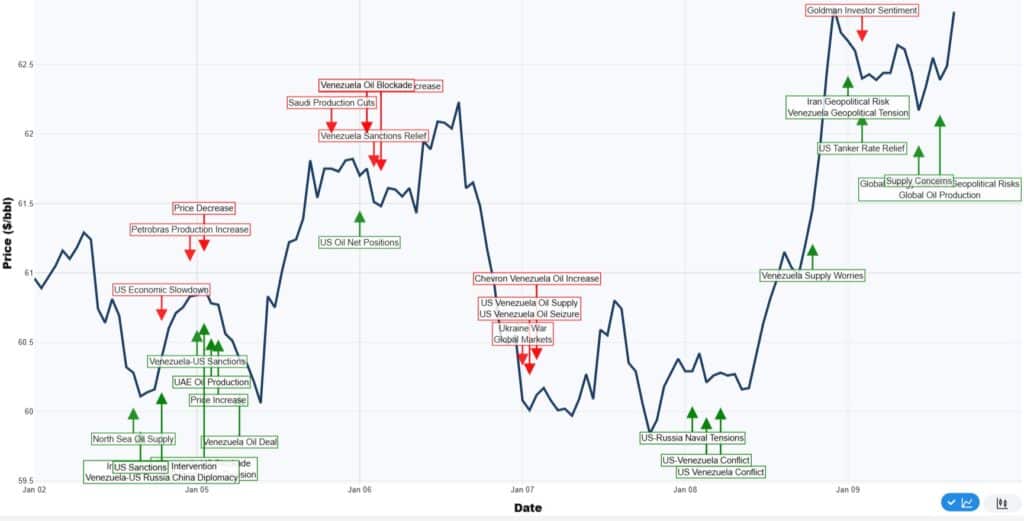
Above: Crude oil price action over early January illustrates how sentiment, not just fundamentals, is driving market moves. Each rally and pullback aligns closely with shifts in geopolitical, sanctions and supply narratives. The chart highlights how crude oil sentiment reacts rapidly to evolving headlines, with risk premia building and unwinding faster than physical balances change, reinforcing the importance of tracking narrative momentum alongside price.
Our intelligence shows that geopolitical developments remain the most reliable source of upside crude oil sentiment – but also the least durable.
Events such as tanker seizures linked to Venezuelan and Russian shipments, sanctions enforcement, drone attacks on infrastructure, and Middle East escalation have consistently triggered sharp sentiment spikes. These episodes rapidly inject a disruption premium into prices, often producing multi-percent intraday moves.
However, sentiment data also shows that these rallies fade quickly once the market begins asking the next question: where do the displaced barrels actually go? This explains why crude oil sentiment repeatedly shifts from bullish to neutral within days. The market is pricing risk optionality, not confirmed supply loss.
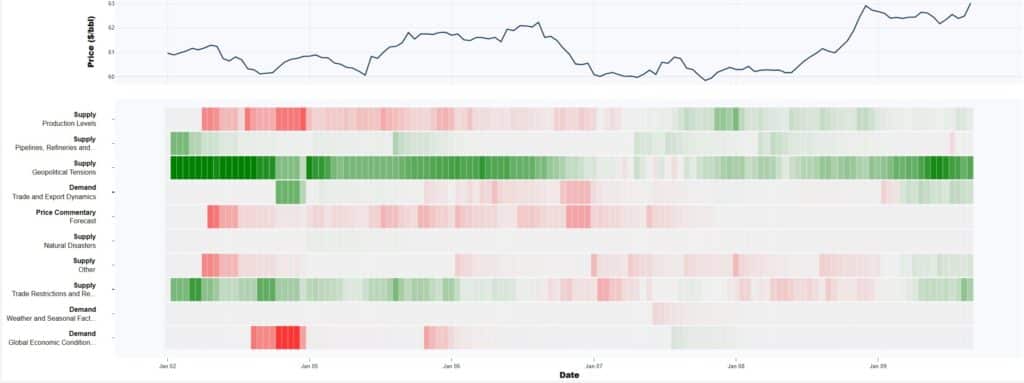
Above: This heatmap highlights how geopolitics continues to be a dominant driver of crude oil sentiment. Sustained positive sentiment around geopolitical tensions consistently aligns with price support and breakout phases, while fluctuations in production, trade and demand narratives play a secondary role. The chart shows that when geopolitical risk intensifies – from sanctions enforcement, regional conflict and shipping security concerns – crude oil sentiment turns decisively bullish, reinforcing the outsized influence of geopolitics on market behaviour relative to traditional supply-demand signals.
One of the most influential sentiment drivers entering 2026 is Venezuela – not because of absolute production levels, but because of uncertainty around enforcement, oversight and re-entry.
Our sentiment indicators show repeated cycles:
Expectations of Venezuelan output recovery and export normalisation weaken crude oil sentiment
Seizures, sanctions or shipping disruption instantly reverse that bias
Flow-relief headlines then cap the rally
This has made Venezuela a sentiment pivot, capable of flipping market tone without any immediate change in physical supply.
A notable evolution we see in our data is the elevation of tanker enforcement and shipping security into a first-order sentiment driver. Unlike earlier cycles where sanctions were absorbed gradually, current enforcement actions produce immediate repricing. The market has learned that shipping disruptions can propagate quickly across regions, creating contagion risk even when volumes are small.
As a result, crude oil sentiment responds to logistics risk as much as production risk – a structural shift that increases volatility and shortens sentiment cycles.
OPEC+ continues to play a stabilising role in crude oil sentiment, but our intelligence suggests its influence has changed. Statements signalling discipline or steady policy help establish a floor and reduce downside acceleration. However, they rarely generate sustained bullish sentiment unless accompanied by a visible tightening catalyst.
Markets appear conditioned by 2025’s experience: OPEC+ messaging can slow declines, but surplus narratives and inventory data ultimately dominate medium-term sentiment.
Demand remains important – but asymmetrically so. Our sentiment data shows that strong Chinese or Indian demand headlines tend to provide short-term support. However, weak demand prints, downward forecast revisions or soft macro data have a much larger and more persistent negative impact on crude oil sentiment.
This asymmetry reflects an underlying concern: in a market already sensitive to surplus risk, weak demand confirms bearish narratives faster than strong demand builds bullish conviction.
Speculative positioning plays a secondary but important role. Short covering amplifies upside moves during disruption events, while profit-taking accelerates reversals once narratives soften.
Crucially, positioning follows sentiment rather than leads it. The muted momentum entering 2026 reflects cautious participation, low conviction and compressed volatility – conditions that make the market vulnerable to sharp, headline-driven repricing.
Crude oil sentiment going into 2026 is not defined by confidence, but by conditionality.
Prices are anchored, positioning is cautious, and volatility is compressed – yet the market remains one headline away from repricing risk. Our sentiment intelligence makes clear that the dominant driver is no longer supply or demand in isolation, but how events are interpreted, amplified and traded before fundamentals are confirmed.
In this environment, the ability to track narrative momentum in real time is no longer optional. It is essential to understanding why crude oil moves – and why those moves so often reverse.
If crude oil is part of your investment portfolio, clarity matters – especially in markets defined by volatility, geopolitics and rapidly shifting narratives. Our proprietary crude oil sentiment intelligence helps investors cut through complexity, understand what is actually driving price moves, and identify regime shifts that inform better positioning and more timely entry and exit decisions.
Get in touch to see how our crude oil sentiment intelligence can support your crude oil strategy. Reach out to our team to learn how our crude oil sentiment intelligence can be applied in practice via email or simply request a demo.
Guide
07 Oct 2026
Commodity signal evaluation: from information flow to portfolio evidence
Read more >
Guide
14 Aug 2026
Measuring narrative momentum across global markets: A guide for institutional investors
Read more >
Analysis
27 Jul 2026
Saudi supply risk and import costs drive energy inflation sentiment higher
Read more >