Venezuela Risk Pulse one month on: How sentiment signals flagged escalating geopolitical risk
07 Jan 2026
07 Jan 2026
This article analyses how Permutable AI’s sentiment signals identified escalating geopolitical risk around Venezuela before it was fully priced by markets. Aimed at macro investors, risk managers, commodities desks and policymakers, it explains how narrative clustering and velocity of sentiment signals now drives cross-asset repricing, highlighting why FX, havens and credit reacted ahead of oil in early 2026.
In this insight, we revisit Venezuela one month after our December Risk Pulse report. Last weekend’s US operation marked an inflection point, accelerating the shift in how geopolitical risk is transmitted and priced across markets. Our sentiment signals captured that change as it took hold, before it was fully reflected in positioning and price.
US forces took Maduro into custody and transported him to New York, where he appeared in Manhattan federal court on January 5th, pleading not guilty and describing the operation as illegitimate. But the significance extends far beyond the theatrics, these events signal the new direction in geopolitics and the macro landscape.
Markets are now pricing a world where escalation narratives can jump from sporadic build-up to direct intervention faster than ever. The evidence mounted throughout 2025. The shift in market sentiment that followed has been telling as risk has appetite pivoted. President Trump has framed this opening episode of 2026 as the beginning of a broader reset, with resource security and national interests at its core. Whatever the ultimate policy goal, markets must now treat US policy reach as active rather than a theoretical what if.
This is precisely why our December Risk Pulse hit the mark. We didn’t chase sporadic headlines or hypotheticals. We built a framework for identifying when sentiment velocity and narrative clusters become persistent enough to force positioning shifts across assets not a single commodity, particularly in this case for safe havens and credit.
Markets treated this as a geopolitical shock, not an oil shock. When uncertainty sets in and control vacuums emerge, markets position defensively. The first move typically involves flight to liquidity and protection, expressed through currencies and traditional havens like the dollar and precious metals.
The dollar firmed early in the week, reaching a near four-week high versus major peers before paring gains and closing modestly lower. Traders framed the initial move as a geopolitical premium which then shifted mid-week as the domestic data story took the reins. The dollar index hit its highest level since December 10th before easing back.
Risk pricing has surfaced across multiple channels. Defence stocks led the move as investors rebuilt a geopolitical risk premium into equities. The same risk off impulse lifted precious metals, with markets increasingly focused on Washington’s posture shift going from pressure to action, while tensions across the major powers continue to sharpen the sense of strategic risk.
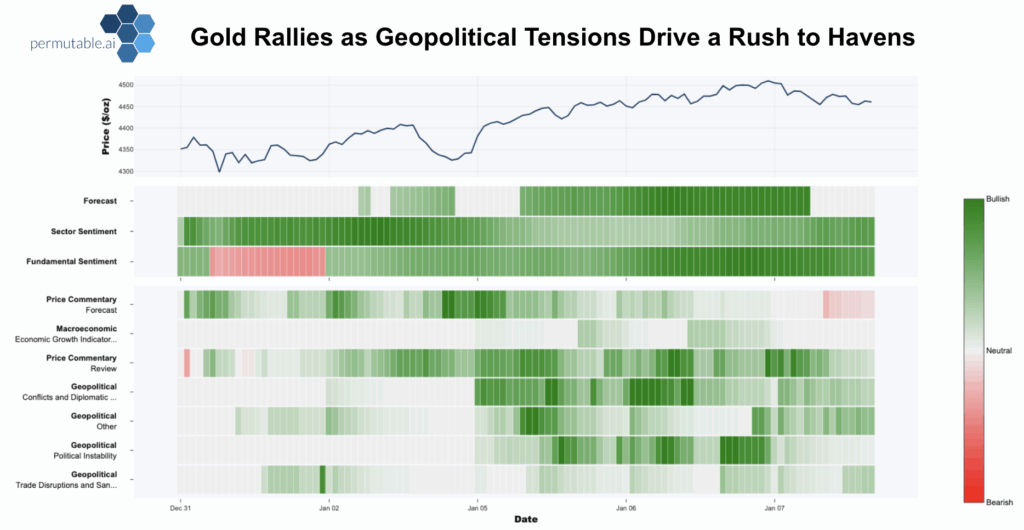
In that backdrop, safe haven demand stayed well supported. Gold pushed towards $4,500/oz, up almost 3%, while silver jumped above $80/oz, up more than 5%, leaving both near all time highs. Even copper broke $13,000/t on the LME for the first time, helped by speculation around infrastructure spending tied to a potential Venezuelan reconstruction cycle.
Credit markets sent the cleanest macro signal. Venezuelan sovereigns and bonds jumped as investors shifted from geopolitical headlines to tangible transition, restructuring timelines, recovery values and what a post Maduro state rebound could look like.
This was never about barrels. It was about a change in the rules, enforcement and risk, and markets moved quickly once that started to feel tradable.
Crude moved, but not in proportion to the geopolitical shock. Brent settled up $1.01 (1%) at $61.7, while WTI gained $1.00 (1.7%) to $58.3 after a choppy session. Traders assessed what the intervention actually meant for flows while juggling strikes at refineries in Eastern Europe. Oil settled higher, but the price action remained measured relative to the headline scale. Meanwhile, energy equities priced a longer-run path. US oil names like Chevron rallied on prospects of improved access and a multi-year rebuilding cycle, even as the physical timeline remained uncertain.
A raid happens overnight, but an actual supply change takes years. Venezuelan output currently runs at roughly 1 million barrels per day, about 1% of global production, having collapsed from historical highs of 3 million barrels per day, due to decades of underinvestment, political unrest, and mismanagement. Any material change in production, exports, sanctions enforcement, and operational control operates on a time frame that markets cannot compress within a short window. Crude stayed unfazed while optionality and recovery narratives found expression through the channel of equities, safe havens and distressed credit.
Meanwhile, OPEC+ reinforced the “steady balance” stance by sticking with its decision to pause output increases through Q1 2026. That position removed the market’s excuse to extrapolate Venezuela into an immediate global shortage.
Crude’s marginal gains mid-week didn’t come from action in Venezuela, but FX, havens, defense, and distressed credit all reacted with conviction. Markets are signalling that geopolitical spheres and risk channels have become dominant, not instant physical disruption. Oil didn’t need to spike for this to register as a major event. In fact, oil’s relative calm was itself the signal. This wasn’t a single commodity story but a cross-asset one – a point we made back in December.
Our December Risk Pulse mapped the escalation in sentiment signals around Venezuela and the Caribbean, identifying the conditions under which it would transition from background risk to something macro and risk desks couldn’t ignore. Three elements held up.
US operational intent and strategic signalling: We argued that Washington’s posture had moved beyond diplomacy-plus-sanctions into territory where direct action was more than plausible. The strikes in Caracas and Maduro’s detention gave merit to that point.
Oil as strategic leverage, not just supply: We framed Venezuela’s geopolitical situation as leverage as much as barrels. That lens explains why crude didn’t behave like a classic supply shock while equities, safe havens, credit priced longer-run access and restructuring potential.
Regional spill-over as the key transmission channel: We flagged wider Caribbean and global contagion as the clearest route from contained event to systemic corridor risk, through the channels of insurance, freight, sanctions friction, and route vulnerability that has amassed, with Russian navy guarding its Venezuelan oil tankers from the US blockade.
Here’s the pattern our sentiment signals revealed:
Narrative density built early: Not isolated headlines, but clustering across geopolitics, sanctions policy, insurance, freight, energy security, and operational posture.
The story became persistent rather than episodic: Sentiment signals stopped being scattered noise and achieved coordination across sources and themes.
FX and havens would lead, crude would follow conditionally: This matched our base case for cross-asset transmission unless physical flows faced a clear threat as the oil market saw this as a longer term repricing.
When sentiment signals cluster and accelerate together: The pattern, momentum and build-up of sentiment signals becomes tradable before the underlying asset breaks decisively.
Our sentiment intelligence system rests on a simple premise that markets rarely wait for certainty. They reprice when enough independent signals converge, even if each represents only a partial view of the same emerging reality. The threshold is synchronisation. Once that happens, repricing tends to arrive before confirmation, not after.
By capturing millions of headlines each day, our system uses clustering of sentiment signals to spot when separate stories start to move as one. Our sentiment indices ingest tens of thousands of articles globally, picking up early narrative build ups across producers, shipping lanes, policy decisions and geopolitical fault lines.
We do not just measure whether sentiment is positive or negative. We measure how concentrated it is, how quickly it is spreading, and whether it is gaining conviction. When multiple themes begin to align, clustering shows where the market sentiment is at, often before it is fully reflected in price.
In recent weeks, our system flagged a sharp drop in geopolitical sentiment around Venezuela, with readings between -0.3 and -0.9. This was not one headline driving the move. Sentiment weakened because three themes started to move together.
We also saw more mentions of Russia, China and Iran, which pushed sentiment towards a wider great power angle rather than a contained event.
The key is where the risk shows up first. If the shock is truly about energy supply, oil normally moves early, then inflation expectations and yields follow.
If the shock is mainly uncertainty, the first move is usually in risk appetite. Investors hedge, liquidity becomes more valuable, and the dollar and havens often react before oil does.
Early January looked like the second case. Risk sensitive assets moved more than crude, which fits a market pricing uncertainty first.
For macro and risk teams, the lesson is not about Venezuela specifically, but about how risk now surfaces and propagates across markets:
Applied consistently, sentiment signals provide a structured way to integrate geopolitical risk into daily workflows.
By using sentiment intelligence it provides a repeatable framework for tracking when sentiment moves from noise to a signal of sustained stress, creating an earlier and more defensible basis for action.
One month ago, our Venezuela Risk Pulse identified the region entering elevated-risk territory where US posture, energy leverage, and spillover dynamics could converge quickly. The events of the past week validated that stance. Markets repriced Venezuela through sentiment channels first, pulling positioning toward liquidity and protection while crude remained anchored, as the market treated supply changes as gradual and policy-dependent.
The opening weeks of 2026 remind us that markets now reprice narrative formation as fast as state action. The edge isn’t seeing the headline first. It’s identifying patterns early, measuring them consistently, and knowing which channel activates first.
If your institution needs a sharper read on macro and geopolitical risk, and how it is likely to transmit into markets, our sentiment signals and Risk Pulse Report provide a disciplined, data driven framework for earlier, more defensible decisions.
For a briefing or to see our sentiment signals in action, contact us at enquiries@permutable.ai

Analysis
16 Oct 2026
Gold outlook 2026: Why US rates outweigh geopolitical risk
Read more >
Analysis
14 Oct 2026
Beneath US headline inflation: tracking pressure across energy, food, services and housing
Read more >
Analysis
13 Oct 2026
France’s debt alarm hits a decade high and drowns out the rest of the G20
Read more >