
Institutional energy trading data: From headlines to tradable intelligence
10 May 2026
10 May 2026
The article explains the evolution of institutional energy trading data and why energy markets increasingly depend on real-time narrative intelligence, explainable AI and structured event data. It explores how institutional traders, systematic funds and risk teams use advanced data intelligence to identify market-moving developments faster and convert information into tradable signals and is aimed at institutional energy traders, commodities desks, hedge funds, macro strategists, quantitative researchers, risk managers and financial institutions seeking an edge through faster, more explainable and actionable market intelligence.
Energy desks do not lose edge because they lack information. They lose it because the market reprices faster than human interpretation. Crude headlines hit, LNG policy shifts emerge overnight, refinery outages ripple through cracks, and weather revisions reframe petrol balance assumptions within minutes. Institutional energy trading data matters because it compresses that interpretation gap. It converts narrative flow, event risk and cross-market signals into machine-consumable inputs that can be researched, monitored and acted on before consensus is fully formed.
For institutional trading desks, that distinction is material. Raw news is abundant. Actionable energy intelligence is scarce. The difference lies in structure, latency, explainability and relevance to actual trading decisions.
At institutional level, energy trading data is not a single feed. It is a stack of datasets with different time horizons and different uses across discretionary and systematic workflows. Traditional market data still matters – futures curves, options surfaces, freight, storage, physical differentials, refinery runs and shipping activity remain core inputs. But those datasets explain only part of price formation.
A growing share of short-term repricing comes from unstructured information: ministerial comments, sanctions language, pipeline disruptions, maintenance updates, geopolitical escalation, weather narrative shifts, OPEC signalling and broader macro risk transmission. Institutional energy trading data increasingly sits at the intersection of these structured and unstructured domains.
That means the highest-value datasets are not merely descriptive. They are interpretive. They classify events, score sentiment, map entities, identify sector exposure, timestamp narrative shifts and quantify whether a development is likely to matter for crude, products, LNG or adjacent markets. In practice, desks want a feed that tells them not only what is happening, but why it is happening, and whether there is also historical relevance for price action.
The older institutional model assumed that if a desk had quality pricing, analyst notes and strong domain expertise, it could build an informational advantage. That model has weakened. Everyone has access to broad news coverage, exchange data and consensus research. The harder problem is filtering and ranking what matters in real time.
This is especially clear in energy, where narratives travel across assets. A policy remark on Russian exports can affect crude spreads, European petrol, freight assumptions and inflation pricing. A hurricane update can alter US natural petrol demand expectations, refinery utilisation and products volatility. A strike in metals or agriculture can still matter if the broader macro complex reprices commodity risk as a basket rather than a silo.
The trade-off is obvious. Human analysts provide nuance and context, but they do not scale across every market-moving source at machine speed. Purely quantitative feeds scale well, but often miss meaning if they treat all headlines as equal. Institutional energy trading data needs both breadth and judgement. That is where structured event intelligence and explainable AI have become increasingly important.
The first requirement is speed, but speed alone is not enough. A fast feed that floods a desk with low-value alerts creates noise rather than alpha. Institutional users need low-latency detection paired with disciplined signal ranking.
The second requirement is schema quality. If event data is poorly labelled, hard to map across assets or inconsistent over time, it becomes difficult to backtest and even harder to trust in production. Researchers need stable taxonomies, clear entity resolution and enough historical depth to test whether a given signal genuinely leads price moves.
The third requirement is explainability. This is not a branding preference. It is an operational necessity. Portfolio managers, risk committees and desk heads need to know why a model elevated a specific development, what language or event characteristics drove the classification, and how similar episodes behaved historically. Black-box alerts are difficult to deploy at scale in institutional settings, particularly where execution and risk management are involved.
The fourth requirement is integration. Even strong intelligence loses value if it sits outside the desk workflow. Data needs to enter research environments, execution systems, dashboards and internal models without friction. API delivery, normalised formats and interoperability with existing market data infrastructure are therefore part of the product, not an afterthought.
On a discretionary macro or commodities desk, the immediate use case is earlier detection of inflection points. A trader does not need another generic headline terminal. They need to identify whether the latest refinery outage is operational noise or the beginning of a broader supply repricing. They need to know whether LNG narrative momentum is strengthening across multiple jurisdictions or whether the move is confined to one local story with limited market transmission.
For systematic teams, the use case is different but related. They want institutional energy trading data that can be converted into features: event counts, sentiment dispersion, entity-level shock indicators, topic acceleration measures, and cross-asset narrative shifts. The question is not whether a headline sounds important. The question is whether the structured representation of that development adds incremental predictive power when tested against returns, volatility, spreads or flow changes.
Risk teams use the same intelligence differently. They are less focused on entry timing and more focused on emerging concentration. If market narrative begins to cluster around sanctions, weather risk or infrastructure outages, that can materially alter scenario distributions before spot and curve pricing fully settle. Early warning matters when the objective is not just alpha capture, but avoiding avoidable drawdown.
In energy markets, false positives are expensive. Headlines are frequent, and many are repetitive, speculative or only relevant at the margin. A useful institutional data feed must distinguish between commentary and catalyst, between general sentiment and asset-specific risk, and between narrative persistence and one-off noise.
This is where cross-source validation becomes valuable. If a geopolitical development appears in isolation, its signal strength may be modest. If it is reinforced across official statements, shipping updates, sector commentary and correlated macro narrative, the probability of sustained market relevance increases. Signal quality improves when the system can weight not just the headline, but the context around it.
Coverage depth also matters. Energy traders do not operate in one commodity stream. For instance, crude, refined products, LNG, freight etc and macro rates all interact. A feed that captures only one corner of that network can still be useful, but it will miss transmission channels. For many desks, the real edge comes from seeing how an energy story migrates into FX, inflation expectations, equities or sovereign risk.
There is a tendency to treat AI in market data as either marketing language or a fully autonomous forecasting layer. In practice, the most valuable institutional applications sit in the middle. AI is most useful when it structures unmanageable information volume into transparent signals that analysts and traders can interrogate.
That means identifying which narratives are accelerating, which entities are driving the change, how sentiment is shifting across time, and whether the move aligns with historical price reactions. It means reducing the manual burden of reading thousands of items without stripping out market context.
For professional users, explainability is what makes the output deployable. If an energy strategist can trace a bullish signal back to weather revisions, storage commentary, policy remarks and previous analogue episodes, the data becomes actionable. If they cannot, it remains an interesting artefact rather than a trading input.
As institutional desks look beyond traditional market feeds, the focus is increasingly shifting toward platforms capable of transforming fast-moving narrative flow into structured, explainable trading intelligence. This is where providers like Permutable fit into the modern institutional energy trading data stack.
Rather than treating energy news as isolated headlines, we apply explainable AI and real-time event intelligence to identify which developments are most likely to influence commodity markets, cross-asset positioning and macro sentiment. Our platform structures vast volumes of unstructured information into machine-readable signals that can be integrated directly into research, risk and execution workflows.
For energy and commodities desks, this means monitoring not just crude price movements, but the underlying narrative drivers shaping volatility across oil, LNG, natural gas, freight, inflation-sensitive assets and broader macro markets. Geopolitical escalation, sanctions language, refinery outages, OPEC signalling, weather revisions and supply chain disruptions can all be mapped, classified and analysed in real time.
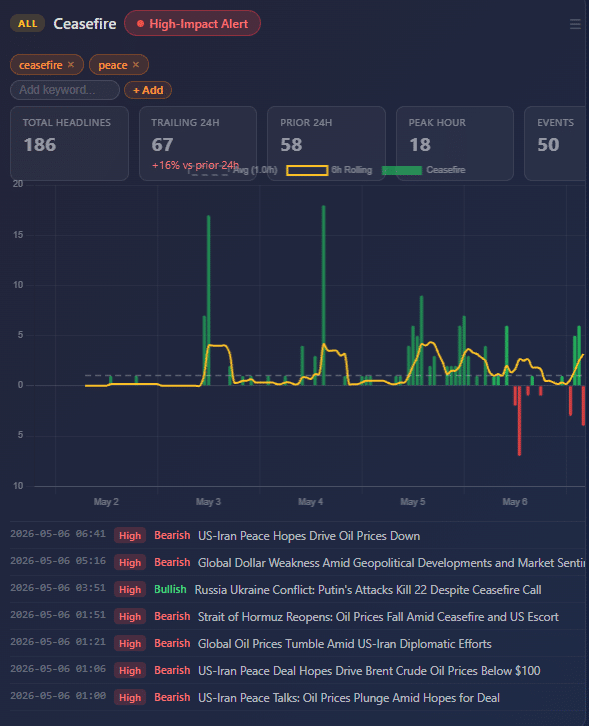
Above: Permutable’s customised Brent crude sentiment tracker identified a sharp reversal in ceasefire and de-escalation narratives before oil markets rapidly unwound geopolitical risk premia.
A key differentiator is explainability. Institutional users increasingly require transparency around why a signal is elevated, how sentiment is changing, which entities are involved and whether similar historical events have led to meaningful price reactions before. Rather than operating as a black-box forecasting layer, at Permutable, we focus on delivering interpretable intelligence that traders, analysts and risk teams can validate and operationalise.
Our intelligence platform also reflects a broader industry shift. Institutional markets are no longer paying simply for access to information. They are paying for faster interpretation, cleaner signal extraction and infrastructure that allows structured intelligence to move seamlessly into existing trading environments through APIs, dashboards and quantitative research pipelines.
For discretionary traders, that can mean earlier visibility into narrative inflection points before consensus pricing fully settles. For systematic teams, it means access to structured features such as sentiment momentum, entity-level event signals and cross-market narrative acceleration that can be tested against volatility, returns and spread behaviour. For risk managers, it provides a way to identify emerging concentrations and macro transmission risks before they become obvious in price action.
In increasingly narrative-driven energy markets, the competitive edge comes less from reading more information and more from identifying which developments matter first. That is the role institutional energy trading data platforms are increasingly expected to perform.
When evaluating institutional energy trading data, desks should ask a narrow set of practical questions.
There is no universal answer because the right configuration depends on strategy. A discretionary oil desk may prioritise geopolitical event detection and refinery intelligence. One systematic strategy may care more about narrative momentum, weather-linked signals and storage-related classification while another may place greater weight on cross-commodity and cross-asset transmission.
What does hold across use cases is that generic feeds rarely create durable edge. Edge comes from relevance, speed and the ability to convert information into repeatable decisions.
Institutional markets are no longer paying simply for access to information. They are paying for better interpretation at lower latency, with cleaner integration into the research and trading stack. Energy is one of the clearest examples because price formation is so exposed to narrative shocks, policy language and supply chain complexity.
The desks that gain an advantage are not those reading more headlines. They are the ones using structured intelligence to rank what matters, test it properly and act before the market has fully normalised the story. That is the practical value of institutional energy trading data.
The useful question for any desk is not whether more data exists. It is whether your current stack turns fast-moving energy narratives into signals you can trust when timing, risk and conviction all matter at once.
Explore how Permutable delivers institutional-grade energy and macro intelligence through explainable AI, real-time event detection and structured narrative signals designed for modern trading, research and risk workflows by requesting a walkthrough.

20 Oct 2026
Permutable launches data catalogue for macroeconomic, commodity and geopolitical sentiment intelligence
Read more >
16 Oct 2026
Permutable wins AI Innovation of the Year: Europe at the Euromoney Markets Awards 2026
Read more >
Analysis
16 Oct 2026
Gold outlook 2026: Why US rates outweigh geopolitical risk
Read more >