Permutable releases updated deforestation impact ranking 2024 revealing worst companies for deforestation

In an analysis released today to mark International Day of Forests, Permutable AI unveils its 2024 Best and Worst Companies For Deforestation Impact Ranking, spotlighting corporate deforestation practices. 

Using state-of-the-art AI and sentiment analysis, Permutable AI has meticulously analysed over 500,000 articles from an average of 10,000 sources daily. This robust analysis aims to gauge public and market sentiment towards corporate practices related to deforestation.

The ranking – which provides an update to the Deforestation Impact Ranking 2023 release–  reveals that Nestle, Unilever, and Barry Callebaut lead with positive sentiment, showcasing the food and cosmetics/personal care industries’ efforts towards sustainable practices and reduced deforestation impact. These companies have been recognised for their commitment to ethical sourcing, sustainable agriculture, and proactive steps towards zero net deforestation, reflecting a growing trend of corporate responsibility and environmental stewardship.

The analysis criticizes JBS, Blackrock, and Michelin for their sustainability efforts, particularly regarding deforestation, urging these companies to bridge the gap between their environmental promises and real-world impacts. It calls for JBS to overhaul its supply chain practices linked to Amazon deforestation, for Blackrock to align its investments with its sustainability claims, and for Michelin to source natural rubber more responsibly. 

“Our 2024 Deforestation Impact Ranking highlights the critical role of corporate actions in environmental conservation,” said Wilson Chan, CEO & Founder of Permutable AI. “As we approach International Day of Forests, it’s imperative to recognise the companies leading the way in sustainability and those that have significant room for improvement. Our analysis provides a unique lens through which the public, investors, and companies themselves can evaluate and enhance their environmental impact strategies.”

Permutable AI’s innovative approach to analyzing sentiment and public opinion opens new avenues for understanding the complex dynamics between corporate practices and environmental sustainability, encouraging positive change towards a more sustainable future.

Best and Worst Companies for Deforestation Impact: Findings
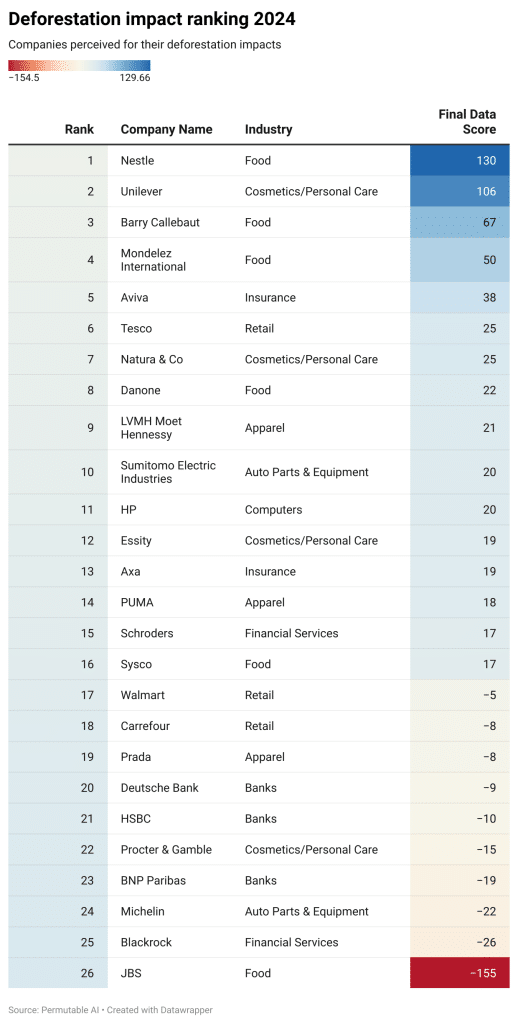
table of best and worst companies for deforestation impact 2024 ranking

  • JBS, Blackrock, and Michelin are perceived negatively due to their association with deforestation-driven industries. JBS’s cattle ranching in the Amazon, Blackrock’s investments in deforestation-linked sectors, and Michelin’s reliance on natural rubber all contribute to their environmental scrutiny. Despite sustainability efforts, their substantial impacts on deforestation remain a critical concern.
  • BNP Paribas, Procter & Gamble, and HSBC are highlighted for their roles in deforestation, with BNP Paribas financing deforestation-linked sectors, Procter & Gamble using palm oil and pulp from high-deforestation areas, and HSBC funding companies in destructive industries. Despite commitments to sustainability, their significant environmental footprints highlight ongoing challenges in mitigating deforestation impacts.
  • Nestle, Unilever, and Barry Callebaut earn positive recognition for their commitment to sustainability, focusing on responsible sourcing to combat deforestation. Nestle and Unilever’s sustainable practices in ingredient sourcing, alongside Unilever’s involvement with the RSPO, set industry standards. Barry Callebaut’s support for sustainable cocoa farming emphasizes environmental responsibility. 
  • Mondelez International, Aviva, and Tesco are perceived positively due to their commitment to sustainability and efforts to mitigate environmental impacts. Mondelez’s Cocoa Life programme focuses on sustainable cocoa farming to prevent deforestation. Aviva promotes responsible investment for environmental sustainability, while Tesco aims for zero net deforestation in its supply chain.
  • Natura & Co, Danone, and LVMH stand out for their sustainability initiatives aimed at reducing their environmental footprint. Natura & Co is positively perceived for its ethical sourcing and biodiversity conservation efforts, particularly in the Amazon. Danone prioritizes regenerative agriculture and sustainable ingredient sourcing to combat deforestation. LVMH focuses on sustainable sourcing of raw materials for its luxury goods.
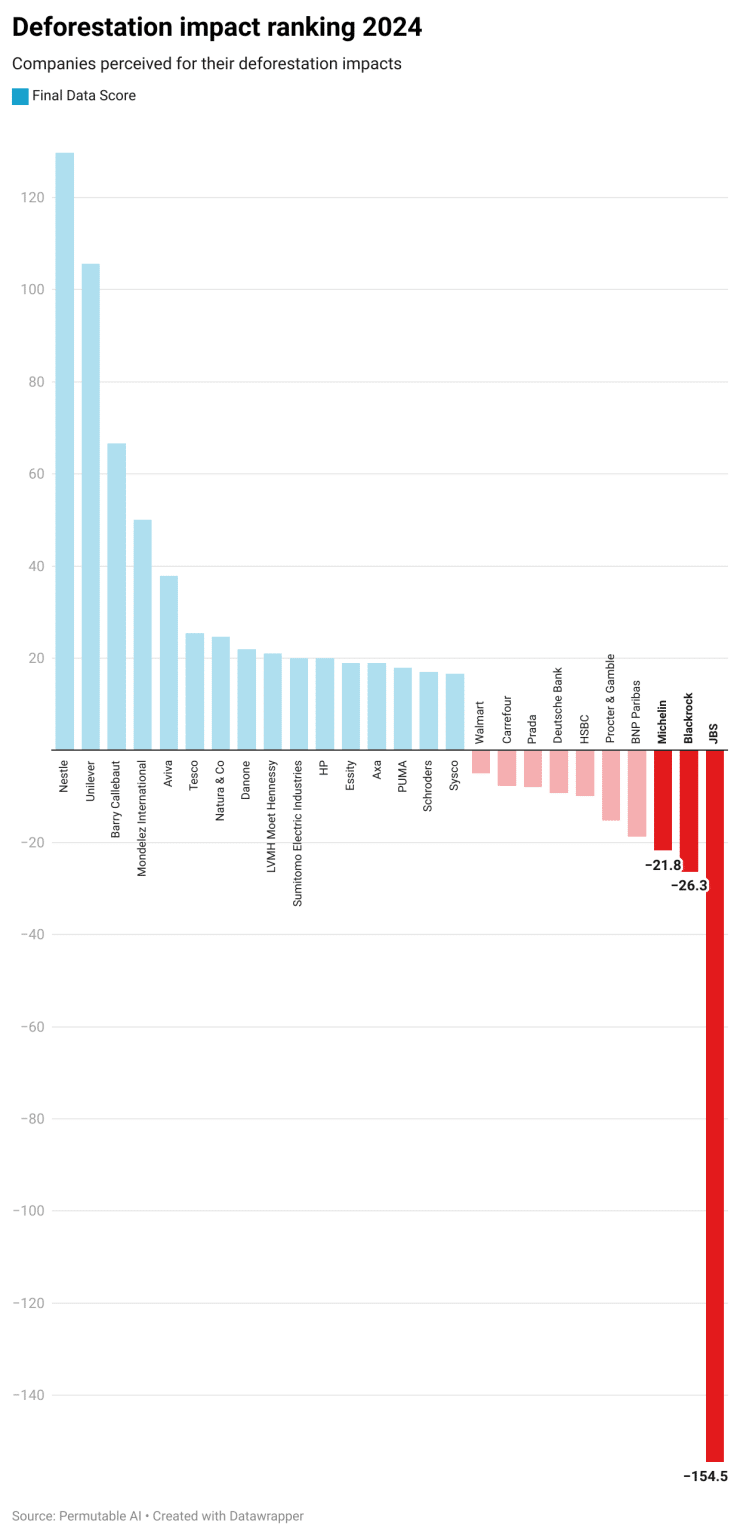
bar chart showing best and worst companies for deforestation 2024 impact ranking

Methodology used for Best and Worst Companies for Deforestation Impact Ranking 2024

Permutable AI’s analysis is rooted in a sophisticated methodology designed to capture a wide spectrum of sentiment towards companies, in this case specifically regarding deforestation impact. The dataset encompassed on average  500,000 articles scanned daily, ensuring a comprehensive and current representation of market sentiments.

Sentiment analysis was meticulously conducted on textual data from articles related to each company, assessing overall sentiment—positive, negative, and neutral—towards the company in the media. The methodology involved identifying and quantifying specific positive and negative data points within the articles, offering a nuanced view of public perception.

A final sentiment score, ranging from -100 to 100 was then allocated to reflect an aggregate evaluation of each company’s perceived deforestation impact. This scoring system is based on a balanced assessment, factoring in both positive and negative sentiments to provide a holistic view of each company’s market perception.

To ensure robust and reliable analysis of best and worst companies for deforestation, companies with significant market influence were selected based on a minimum market capitalisation threshold of £10 million, with a minimum data cap in force to ensure substantial data coverage, enhancing the accuracy of the sentiment analysis.

Chan emphasizes, “Our methodology for our Best and Worst Companies for Deforestation Impact Ranking is designed not merely to pinpoint areas for improvement but to stimulate a conversation that encourages companies towards adopting greener practices. By shedding light on these concerns, we aspire to foster a marketplace that is more transparent, informed, and committed to ethical environmental practices.”

Find out more

For further insights and a deeper dive into our 2024 Deforestation Impact Ranking, we invite journalists, industry experts, and sustainability advocates to get in touch. Our comprehensive analysis, spanning over half a million articles and thousands of sources, offers an unparalleled view of corporate practices and their impact on our planet’s forests. If you’re looking to explore the data behind our rankings, seek detailed case studies, or wish to discuss the findings with our experts, please don’t hesitate to reach out.

Fill in the form below or reach out to us at enquiries@permutable.ai to request more detailed data, arrange interviews with our analysts, or discuss how these insights can inform your work. 


Loading

See our other rankings below

– Software companies data security rankings 

– Corporate behaviour rankings 

– Company labour standards rankings 
– Company consumer protection rankings 

Worst pharmaceutical companies perceived for governance

Permutable AI unveils deforestation impact rankings: Companies perceived to be at the forefront

Permutable AI  has recently unveiled its deforestation impact rankings. This comprehensive ranking system based on our sentiment analysis sheds light on the environmental practices of major corporations and their perceived impact on deforestation. The data serves as a valuable resource for investors, consumers, and stakeholders concerned about the ecological impact of major corporations.

Despite the fact that deforestation in Brazil’s Amazon fell 34% in the first half of 2023, the world is moving too slowly to meet pledges to end deforestation by 2030. Around 4.1m hectares of primary tropical rainforest was lost globally in 2022 – an increase of 10% from 2021 with Brazil, the Democratic Republic of the Congo (DRC) and Bolivia topping the table for tropical primary forest loss.

Deforestation Impact Rankings: Companies Perceived To Be Mitigating Deforestation

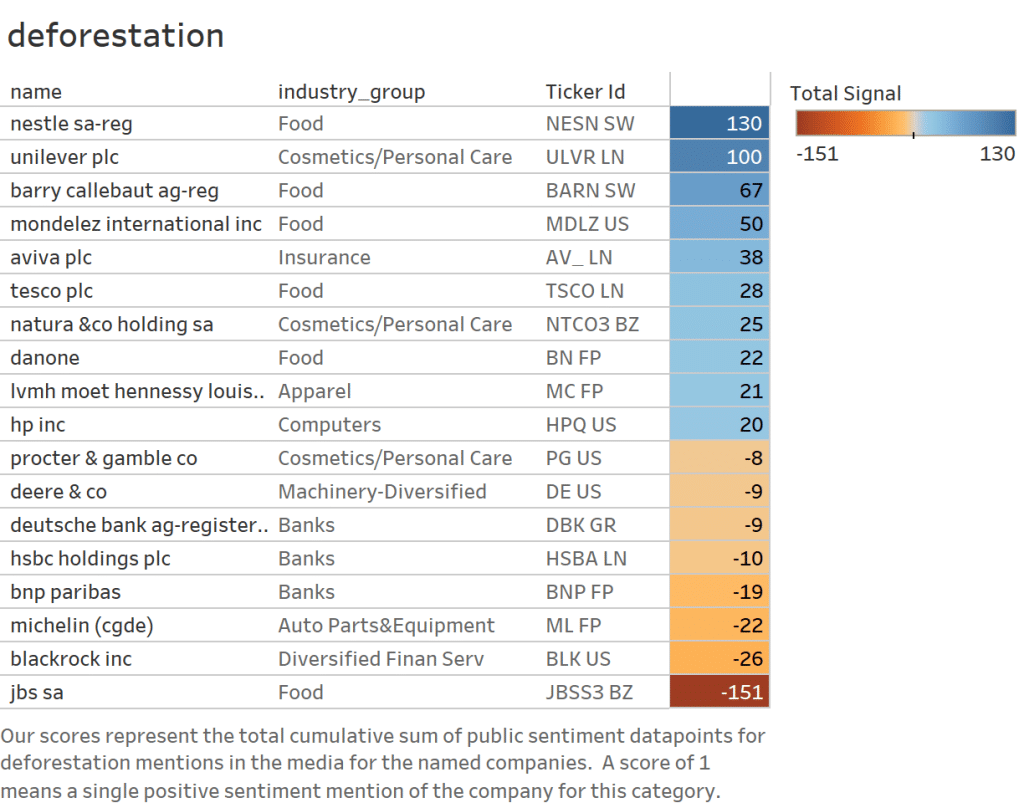
In our rankings, several companies stand out as being recognised for their efforts in mitigating deforestation. NestléBarry Callebaut and Mondelez International in the food sector,  Unilever in cosmetics/personal care, and Aviva in finance are positively perceived for their commitment to sustainable practices and have earned top positions in the rankings. These companies have made public commitments to sourcing deforestation-free palm oil, cocoa, and other commodities. Additionally, they have invested in traceability and certification processes, collaborating with farmers and other stakeholders to promote sustainable practices within their supply chains.

Deforestation Impact Rankings: Companies Facing Scrutiny for Deforestation

Conversely, the rankings highlight companies facing increased scrutiny for their perceived negative impact on deforestation. JBS in the food sector, BlackRockBNP Paribas and HSBC in financial services and Michelin in auto parts and equipment are openly criticized for their role in deforestation. These companies have been linked to deforestation in the Brazilian Amazon, invested in companies involved in deforestation, consumed rubber often grown in deforested areas, and lent to companies associated with deforestation. Furthermore, these companies lack transparency and accountability regarding deforestation issues, putting them under pressure from investors, consumers, and NGOs to take action and address deforestation concerns.

deforestation impact rankings

Deforestation Impact Rankings Methodology: Comprehensive News Sentiment Analysis

Permutable AI’s rankings are based on comprehensive news sentiment analysis. The company’s commitment to transparency and data-driven insights aims to encourage positive change within the business landscape. By analysing news sentiment, Permutable AI provides an objective evaluation of companies’ perceived impact on deforestation, offering stakeholders valuable insights into corporate responsibility in the realm of environmental conservation.

Significance of Deforestation Impact Rankings: Promoting Corporate Transparency

Wilson Chan, CEO of Permutable AI, highlights the significance of these rankings, stating, “The release of these rankings underscores the importance of environmental considerations in evaluating corporate practices. We believe that transparency and awareness can drive positive change, and we encourage companies to reassess and enhance their sustainability efforts.”

Empowering Responsible Business Practices

Manuela Moollan, Sustainability Lead at Permutable AI, expressed the company’s commitment to providing actionable insights that empower responsible business practices. She stated, “At Permutable AI, we are committed to offering clear pictures of corporate responsibility. These rankings provide an opportunity for companies to further prioritise sustainability in their operations and investments.”

These deforestation impact rankings by Permutable AI offer a timely and essential tool for stakeholders looking to make informed decisions about the environmental practices of major corporations. By incorporating transparency, comprehensive analysis, and a commitment to positive ecological change, Permutable AI continues to lead in providing valuable insights for a sustainable business landscape. For more information please contact enquiries@permutable.ai.

See Our Other Rankings Below

– Software companies data security rankings 

– Clean and affordable energy company rankings

– Corporate behaviour rankings 

– Company labour standards rankings 

Company consumer protection rankings 

– Worst perceived pharmaceutical companies for governance

Understanding the new EU deforestation law: Implications for your supply chain

In today’s global economy, supply chains are often complex and far-reaching, extending across continents and involving numerous stakeholders. While this complexity can bring many benefits, it also creates significant challenges, particularly around sustainability and environmental protection. Recently, the European Union (EU) has taken a major step forward in this area with the introduction of a new law aimed at tackling deforestation. This law has important implications for businesses operating in the EU, as well as those who supply goods and services to the region. In this article, we will explore what the EU’s new deforestation law means for your supply chain, and how you can ensure that your business is compliant and well-positioned to meet evolving environmental standards. Whether you are a supplier, manufacturer, or retailer, understanding the implications of this law is essential for maintaining a sustainable and responsible supply chain. So, let’s dive in and explore what this new law means for you.

What is deforestation and why is it a concern?

Deforestation is the process of clearing forests or trees from a land area, often for agricultural or commercial purposes. It has been estimated that deforestation accounts for around 10% of global greenhouse gas emissions, making it a significant contributor to climate change. Deforestation also has many other negative impacts, such as loss of biodiversity, soil erosion, and disruption of local communities.

The scale of deforestation is staggering. According to the World Wildlife Fund, we lose around 18.7 million acres of forests each year, which is equivalent to 27 football fields every minute. This issue is particularly pressing in tropical regions, where deforestation rates are highest.

Given the environmental, social, and economic impacts of deforestation, it is clear that action is needed to address this issue. That’s where the EU’s new deforestation law comes in.

Overview of the new EU law and its scope

The proposal for the EU’s new deforestation law was launched in November 2021 and is set to come into effect in 2023. The law is intended to tackle deforestation and forest degradation associated with the production of certain agricultural commodities, such as soy, palm oil, and beef. These commodities are often linked to deforestation in tropical regions like the Amazon, the Congo Basin, and Southeast Asia.

The law establishes a due diligence obligation for EU-based companies placing certain commodities on the market. This means that companies will be required to identify, prevent, mitigate, and account for the risks of deforestation and forest degradation associated with their supply chains. The law covers both direct and indirect suppliers, meaning that companies will need to look beyond their immediate suppliers to assess the risks and impacts of their entire supply chain.

The scope of the law is significant. It applies to all companies placing the specified commodities on the EU market, regardless of where they are produced. This means that companies based outside the EU will also be subject to the law if they want to sell their products in the EU.

Implications for businesses and their supply chains

The EU’s new deforestation law has important implications for businesses and their supply chains. Companies that rely on the specified commodities will need to take steps to ensure that their supply chains are free from deforestation and forest degradation. This may involve working with suppliers to implement more sustainable practices, such as agroforestry or zero-deforestation policies.

Businesses will also need to establish robust due diligence systems to identify and mitigate the risks of deforestation in their supply chains. This could include mapping the origin of their commodities, assessing the environmental and social risks associated with different suppliers and regions, and implementing measures to prevent deforestation and forest degradation.

The law also has implications for the wider business environment. Companies that are unable to demonstrate compliance with the law may face reputational damage, loss of market access, and legal or financial penalties. On the other hand, companies that can demonstrate their commitment to sustainability and responsible business practices may gain a competitive advantage in the market.

Key requirements of the new law

To comply with the EU’s new deforestation law, companies will need to meet a number of key requirements. These include the following:

  1. Identification of risks: Companies will need to identify the risks of deforestation and forest degradation associated with their supply chains, including both direct and indirect suppliers. This will involve mapping the origin of their commodities, assessing the environmental and social risks associated with different suppliers and regions, and establishing due diligence systems to prevent deforestation.

  2. Prevention of risks: Companies will need to take measures to prevent deforestation and forest degradation in their supply chains. This may involve working with suppliers to implement more sustainable practices, such as agroforestry or zero-deforestation policies, and monitoring supplier compliance.

  3. Mitigation of risks: Companies will need to establish measures to mitigate the risks of deforestation and forest degradation in their supply chains. This may involve supporting reforestation efforts or investing in alternative, more sustainable commodities.

  4. Reporting: Companies will need to report on their due diligence efforts and the measures they have taken to prevent deforestation and forest degradation in their supply chains. This information will need to be made publicly available and updated regularly.

Steps businesses can take to comply with the law

To comply with the EU’s new deforestation law, businesses can take a number of steps. These include:

  1. Conducting a supply chain assessment: Companies should conduct a comprehensive assessment of their supply chains to identify the risks of deforestation and forest degradation associated with their commodities.

  2. Mapping the origin of commodities: Companies should map the origin of their commodities to identify the regions and suppliers that pose the greatest risk of deforestation.

  3. Establishing due diligence systems: Companies should establish robust due diligence systems to identify, prevent, and mitigate the risks of deforestation in their supply chains.

  4. Working with suppliers: Companies should work with their suppliers to implement more sustainable practices, such as agroforestry or zero-deforestation policies, and monitor supplier compliance.

  5. Investing in sustainable commodities: Companies should consider investing in alternative, more sustainable commodities that are less likely to be associated with deforestation, such as regenerative agriculture or agroecology.

Risks of non-compliance and potential penalties

Non-compliance with the EU’s new deforestation law can have serious consequences for businesses. Companies that fail to comply with the law may face reputational damage, loss of market access, and legal or financial penalties.

The law includes provisions for fines and other penalties for non-compliance, including the possibility of exclusion from public procurement procedures. Companies that are unable to demonstrate compliance with the law may also face legal action from NGOs or other stakeholders.

Given the potential risks associated with non-compliance, it is essential that businesses take the necessary steps to ensure that their supply chains are free from deforestation and forest degradation.

Case studies of companies impacted by deforestation

There are many examples of companies that have faced reputational damage or legal action as a result of their involvement in deforestation. One high-profile case is that of Nestle, which faced a consumer boycott in the 2000s over its use of palm oil linked to deforestation. The company subsequently adopted a zero-deforestation policy and committed to sourcing sustainable palm oil.

Another example is that of Cargill, which has faced criticism for its involvement in deforestation in the Amazon. The company has since committed to ending deforestation in its supply chains and has established a number of initiatives to promote sustainability in the palm oil and soy sectors.

These cases highlight the importance of taking action to address deforestation in supply chains and the potential risks of non-compliance.

Collaborative initiatives to combat deforestation

Collaborative initiatives have emerged in recent years to tackle deforestation in supply chains. One example is the Soy Moratorium in Brazil, which was established in 2006 to prevent the expansion of soy production into areas of the Amazon that are at high risk of deforestation. The moratorium has been successful in reducing deforestation associated with soy production in the region.

Another example is the Roundtable on Sustainable Palm Oil (RSPO), which was established in 2004 to promote the production and use of sustainable palm oil. The RSPO has developed a set of standards for sustainable palm oil production and has certified over 19% of global palm oil production as sustainable.

Collaborative initiatives like these can help to promote sustainability in supply chains and reduce the risks of deforestation and forest degradation.

Conclusion and call to action for businesses to act now

The EU’s new deforestation law is a significant development in the global effort to address deforestation and forest degradation. It represents an important step forward in promoting sustainability and responsible business practices in supply chains.

For businesses operating in the EU or supplying goods and services to the region, understanding the implications of this law and other regulations is essential. By taking steps to identify and mitigate the risks of deforestation in their supply chains, companies can ensure that they are compliant with the law and well-positioned to meet evolving environmental standards.

The risks of non-compliance are significant, and the potential benefits of sustainable and responsible business practices are equally great. By taking action now, businesses can help to promote sustainability, protect the environment, and meet the growing demand for responsible and ethical products and service.

Get in touch to find our how our technology can help you identify deforestation in your supply chain in real time