The first principle of understanding GBPJPY movements lies in recognising the complex interplay between two major economies at crucial policy junctures. For several years, both nations have followed divergent monetary paths, but recent developments suggest a potential convergence that’s dramatically impacting the currency pair. In this article we’ll look at developments across one of the most volatile currency pairs, taken from our Trading Co-Pilot, where we are gearing up to a roll out of FX on our market intelligence platform.
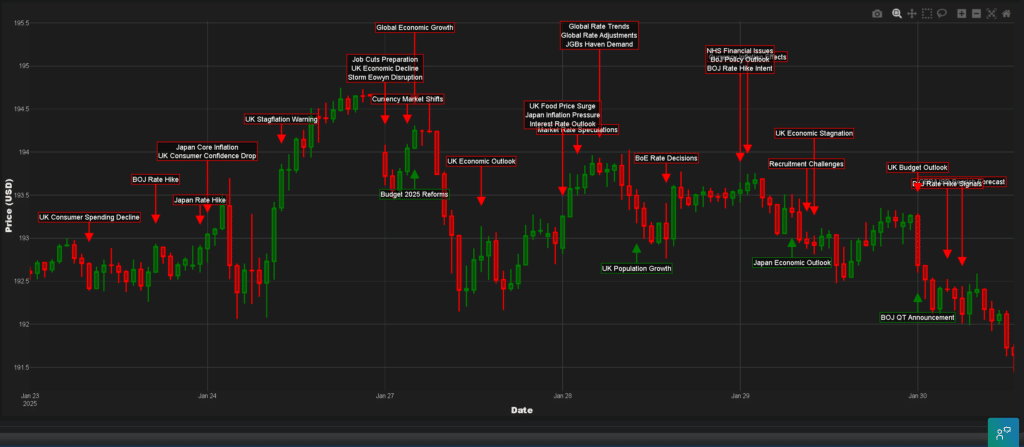
Let’s start with the fact that the Bank of Japan’s monetary policy is undergoing its most significant transformation in decades. There is evidence of fundamental change as the BOJ raised rates to 0.5%, making it one of the most substantial policy shifts since 2008. This is obviously a pivotal moment for FX traders, with more than just rate differentials at stake. The BOJ’s planned balance sheet reduction of nearly $500 billion through quantitative tightening measures signals a fundamental shift in Japanese monetary policy that could support long-term yen strength, suggesting this may be just the beginning of a longer-term policy normalisation cycle.
It is the story of contrasting economic narratives. While Japan emerges out of the doldrums of deflation, the UK faces mounting challenges. Only after this week’s data releases did the full picture emerge, showing UK consumer confidence hitting its lowest level in over a year. This contrasts with Japan’s gradual but steady economic recovery. The compound effects are particularly visible in employment markets, where UK firms report the largest decline in output and profit since the pandemic.
Market sentiment towards GBPJPY reflects these divergent economic trajectories, whilst technical aspects show no signs of abating volatility. The consequences of these movements are far-reaching, particularly given the pair’s sensitivity to risk sentiment. Trading volumes suggest institutional investors are actively repositioning their portfolios in response to these shifts. Meanwhile, our event analysis has identified a notable increase in correlation between GBPJPY movements and global risk sentiment indicators, suggesting the pair could become increasingly sensitive to broader market dynamics beyond purely bilateral economic factors
What many observers have found surprising is the pace of the BOJ’s policy evolution, especially considering Japan’s corporate service inflation reaching 2.9%. Part of this attitude has developed from years of ultra-loose monetary policy. Beyond the immediate rate decision, the UK’s projected population growth of five million by 2032 due to migration presents a complex economic variable that could influence long-term GBPJPY trends. Though the current situation has unique characteristics given the global monetary policy environment, previously similar policy transitions have typically led to sustained currency trends.
However, we are not out of the woods yet with GBPJPY volatility. The acceleration of Japan’s policy normalisation, combined with UK economic uncertainty, creates an important reminder that currency markets can shift rapidly. A range of factors, from interest rate differentials to economic growth trajectories, continues to influence the pair’s direction, and particular attention should be paid to signs of BOJ policy normalisation acceleration and UK employment figures.
The compound effects of the above factors require a sophisticated approach to risk management, and so far, analysts reckon that the pair’s direction will heavily depend on both central banks’ next moves and economic performance indicators. This is magnified by the current global economic environment and shifting monetary policy landscapes. Ultimately, the answer will fall to several key factors in the coming weeks, but traders who maintain disciplined risk management and stay informed of both economies’ developments will be best positioned to navigate these challenging markets – and for that, there is the FX roll out on our Trading Co-Pilot.
As we prepare for the FX roll-out on our Trading Co-Pilot platform, our mission is to bring the same level of comprehensive market intelligence we’ve delivered in commodities markets to currency trading. Our platform processes over 10,000 articles daily, providing real-time event detection and analysis that helps traders stay ahead of market-moving developments.
Want to be among the first to experience our FX capabilities? We’re currently accepting registrations from enterprise clients for early access to our beta testing programme. Our platform offers real-time currency market event detection, advanced geolocation filtering, cross-asset correlation analysis, customisable event alerts, and comprehensive macro monitoring.
Contact us at enquiries@permutable.ai to learn more about how we can help you navigate FX market complexity together or fill in the form below to register interest.
In the fast paced world of forex trading, market sentiment is a key component of any successful trading strategy. Forex traders who can tap into sentiment analysis – of the like that we offer at Permutable – will find themselves better equipped to navigate the forex market and make more money. In this article, we’ll explore how to use market sentiment in forex trading to get an edge.
Market sentiment in forex trading means the overall mood or attitude of the market towards a currency pair or the market as a whole. This can be influenced by economic data, geopolitical events, investor psychology and the news. By understanding and reading these sentiment cues forex traders can get a better idea of the direction of the market and make better trading decisions.
Market sentiment in forex can move prices and volatility. When sentiment is positive traders will take more risk and buy more of certain currency pairs and push their prices up. When sentiment is negative traders will become risk averse and sell certain currencies and push their prices down. Understanding market sentiment is key for forex traders because it allows them to anticipate and trade the price swings. By knowing the sentiment traders can enter or exit positions at the right time and increase their profits and reduce their risks.
Sentiment analysis in the forex market is the systematic evaluation of various data sources to gauge the overall mood and expectations of the market. This can include news articles, social media posts, economic reports and other market data to find patterns and trends in investor sentiment.
At Permutable AI, we leverage advanced machine learning algorithms and artificial intelligence to enhance sentiment analysis in relation to forex trading. Our platform analyzes vast amounts of data in real-time, including news articles, financial reports, and other publicly available information to accurately gauge market sentiment. By using natural language processing (NLP) techniques, we can detect subtle shifts in investor mood and market expectations, which might be missed by traditional methods.
At Permutable AI, our market sentiment intelligence empowers forex traders to maximize their profits by leveraging a variety of sentiment-driven strategies. Our real-time market sentiment analysis allows traders to seamlessly identify and follow dominant market trends, enabling them to take positions aligned with the prevailing sentiment. By including our sentiment analysis in trading strategies, a forex trader can find trading opportunities and make better decisions. For example if our sentiment analysis shows a currency pair is shifting to positive sentiment it could be a buy opportunity to enter a long position before the price goes up. Conversely if our sentiment analysis shows a currency pair is shifting to negative sentiment it could be a short opportunity or to exit a long position. By trading with our sentiment forex traders can increase their chances of trading the market and maximize their profits.
For those looking to capitalize on market corrections, our market sentiment intelligence supports contrarian strategies, allowing traders to trade against the sentiment when conditions suggest a potential reversal. Additionally, our sentiment analysis capabilities enable traders to manage risks more effectively through sentiment-driven hedging, as well as optimize position sizing based on the current market mood. By providing real-time insights into market sentiment, our insights help traders time their entries and exits with precision, ensuring they can ride sentiment shifts to enhance their profitability.
While sentiment analysis is a powerful tool for forex traders it’s important to acknowledge the risks and challenges of relying too much on sentiment for trading decisions. Sentiment can be influenced by many factors, some of which are irrational or unpredictable and can change or reverse suddenly. Also sentiment analysis is not a science and traders should be careful when interpreting the signals from sentiment indicators. Over relying on sentiment analysis can lead to emotional trading decisions which can result to losses if the market doesn’t behave as expected.
To effectively use our sentiment analysis in your forex trading strategy, it’s important to follow key best practices. Firstly, start by diversifying your approach: integrate our sentiment analysis with other trading tools, such as technical and fundamental analysis, to create a well-rounded and balanced strategy. Secondly, make sure to monitor multiple sentiment indicators within our platform to gain a comprehensive understanding of market sentiment. As market conditions evolve, refine and adapt your sentiment analysis techniques to stay aligned with current dynamics. It goes without saying that you should always maintain discipline and prioritize risk management, ensuring that sentiment-driven insights complement, rather than dictate, your trading decisions. Finally, commit to continuous education and improvement by staying informed about the latest developments in sentiment analysis and enhancing your trading skills over time.
Ready to take your forex trading to the next level? Discover the power of our market sentiment analysis data and see how it can transform your trading strategies. We’re offering a free sample of our cutting-edge sentiment data to help you gain that competitive edge in the fast-paced world of forex. But that’s not all – we’re also gearing up to launch our innovative Trading Co-Pilot, and you have the chance to be among the first to experience it. Don’t miss out on this opportunity to elevate your trading game. Request your free sample today and join the waitlist for our Trading Co-Pilot by emailing us at enquiries@permutable.ai or filling in the form below.