Why is Tesla stock dropping? Let’s start with the obvious: Tesla’s stock has been on a wild ride of late. Our Trading Co-Pilot chart paints a vivid picture of over the past month, with several dramatic dips and recoveries. This striking difference hints at a complex interplay of factors influencing investor sentiment. But what’s really driving these fluctuations? Get our latest thinking in this article with insights from our Trading Co-Pilot.
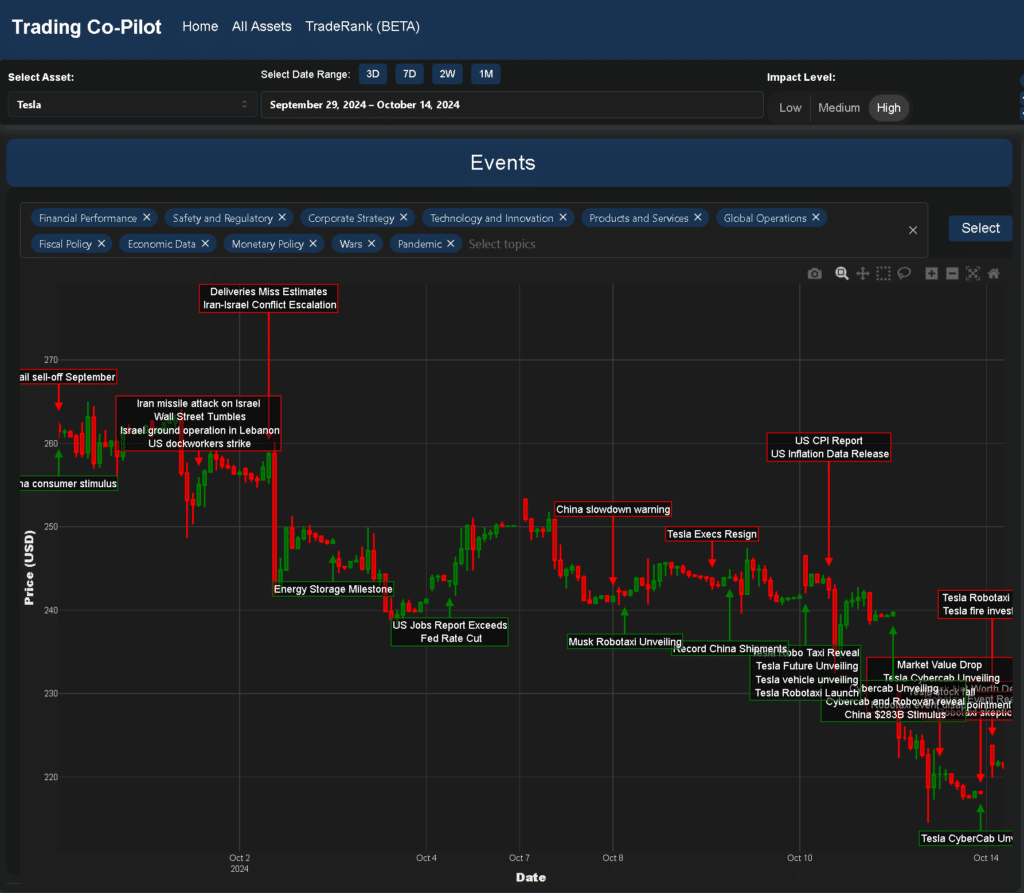
For starters, the chart highlights a significant sell-off in late September, coinciding with an escalation in geopolitical tensions. The Iran-Israel conflict escalation spooked investors, leading to a broader market tumble. You might say that Tesla, being a high-profile and volatile stock, often amplifies broader market movements. Yet here’s the rub: while geopolitical events certainly play a role, they don’t tell the whole story of Tesla stock dropping. There is also evidence that company-specific factors are at play, which we’ll get into in more detail below.
One thing is clear, the problem isn’t a lack of innovation at Tesla including developments in energy storage and of course, the recent Robotaxi unveiling which failed to impress investors. But we must remember the bigger picture here, which is that Tesla is consistently pushing the boundaries of electric vehicle technology and energy solutions. Nonetheless, the market’s reaction to these announcements has been mixed at best with Tesla stock dropping continues to be the prevailing trend at the moment. This suggests that the market believes that these innovations may not translate into immediate revenue growth or profitability
Another bone of contention is the recent resignation of Tesla executives – indicated on our Trading Co-Pilot chart as “Tesla Execs Resign” as a significant event. This internal turbulence could be contributing to investor unease. There is broad consensus that leadership stability is crucial for a company as innovative and disruptive as Tesla. The expectation that top talent might be leaving the company could be weighing heavily on investor confidence.
Again and again, you can see the same pattern: macroeconomic events having a significant impact on Tesla’s stock price. The US Jobs Report exceeding expectations and a potential Fed Rate Cut initially gave the stock a boost. However, this was followed by concerns about a China slowdown, which likely contributed to Tesla stock dropping once more.
It has now emerged that Tesla’s fortunes are closely tied to both US and Chinese economic health. The catalyst for many of the stock’s movements can be traced back to these broader economic indicators.
Little wonder that investors are keeping a close eye on Tesla’s market position. The present state of play in the electric vehicle market is one of increasing competition. While our Trading Co-Pilot chart doesn’t explicitly mention competitors, the overall downward trend in Tesla stock dropping could reflect growing concerns about market saturation and rivalry from both established automakers and new EV startups.
Now look to where our Trading Co-Pilot highlights “Deliveries Miss Estimates” as a significant event. This is at the core of Tesla’s recent struggles. Achieving its ambitious production and delivery goals is crucial for maintaining investor confidence. This requires a finely tuned supply chain and manufacturing process.
By leveraging its world-class production capabilities, Tesla has historically been able to ramp up deliveries quarter after quarter. However, the recent miss suggests that the company may be facing headwinds in this area.
So much of the past, what of the future? Insights from our Trading Co-Pilot chart shows several events related to future products and innovations, such as the Robotaxi. These announcements are clearly aimed at shaping investor perceptions of Tesla’s long-term potential, despite investors being less than impressed by the recent unveiling.
However, the continued pattern of Tesla stock dropping suggests that investors may be adopting a “show me” attitude. They’re looking for concrete results rather than future promises. In fact, some say the expectation that Tesla can maintain its astronomical growth rates indefinitely may be waning. Nonetheless, it’s important to note that the company still enjoys a significant market cap and brand loyalty that many competitors envy.
Much has changed since Tesla’s early days as an EV pioneer. The company now faces the challenges of being an industry leader in a rapidly evolving market. The good news is there’s a big wheel moving in the right direction in terms of global EV adoption, but Tesla must navigate carefully to maintain its pole position in face of competition that is fiercely hotting up.
In a bizarre twist, the very success that Tesla has had in popularising electric vehicles has created a more competitive landscape that now challenges its market dominance. This trend has ramped up significantly in recent years with the likes of Nio and Lucid hot on Tesla’s heels.
Beyond the fanfare of product launches and ambitious goals, Tesla must grapple with the realities of production scaling, market competition, and delivering on its promises to maintain investor confidence.
Over the past month, Tesla stock dropping has been the prevailing narrative. But in the fast-paced world of tech and automotive innovation, fortunes can change quickly and it is likely this trend will reverse at any given time. For investors and industry observers alike, Tesla remains a company to watch closely, as its trajectory could well indicate the future direction of the entire electric vehicle market.
Tesla, the trailblazing EV manufacturer, has been the subject of intense scrutiny and speculation among investors, analysts, and industry enthusiasts over the years. As the company continues to push the boundaries of innovation and reshape the automotive landscape, the question on everyone’s mind is: What is the Tesla stock prediction 2025?
Several factors contribute to the fluctuations in Tesla’s stock price, including technology and innovation, market adoption and demand, regulatory environment, competition and industry dynamics, financial performance and growth prospects, and leadership and vision. Thankfully, Tesla has demonstrated a remarkable ability to navigate these complex factors. The good news is that the company’s innovative approach and market leadership position it well for future growth. But there’s a broader point of view here: Tesla’s success is not guaranteed, and investors must carefully consider the risks and challenges facing the company.
To understand the potential future trajectory of Tesla’s stock price, it is essential to examine the company’s historical performance. Over the years, Tesla’s stock has experienced significant volatility, with periods of rapid growth followed by sharp declines. However, when you take a step back, the data shows that Tesla’s stock price has been on an upward trend, despite the occasional setbacks.
Consider that Tesla’s stock price has experienced a meteoric rise since its initial public offering in 2010. We could go on about the various factors that have contributed to this growth, but it is, we think, this last point that is most significant: Tesla’s ability to consistently innovate and capture market share in the rapidly evolving EV industry.
As of today, Tesla’s stock is trading at $253.35, with a current market cap of 794.15 billion. Tesla’s stock has seen varied performance over the past few months. In September 2024, the stock experienced a surge of nearly 5%, fueled by anticipation for Tesla’s Robotaxi Day, where it plans to showcase its Full Self-Driving technology. This event, scheduled for October 10, 2024, is expected to boost investor confidence and could lead to a positive impact on the stock if the presentation goes well.
However, the stock also faced some fluctuations earlier, particularly in response to global economic conditions and investor sentiment surrounding the EV market. As of mid-September 2024, Tesla’s stock was trading at around $209 per share, with mixed analyst ratings—some predicting a decline due to external challenges like tariffs and competition from Chinese EV manufacturers. Overall, the stock has maintained relatively stable ground, but its performance hinges on upcoming events and broader market trends.
Based on the analysis of various factors, historical trends, and expert opinions, predictions for Tesla’s stock price in 2025 vary widely. The Tesla stock prediction for 2025 is currently $332.36, assuming that Tesla shares will continue growing at the average rate. However, it’s crucial to note that this figure is not set in stone and could change significantly based on numerous factors from time of writing.
Consider that this prediction is based on current market conditions and historical growth patterns. We could go on about the various factors that might influence this prediction, but it is, we think, this last point that is most significant: Tesla’s ability to execute its ambitious plans will play a crucial role in determining its future stock price. To be clear, stock market predictions are inherently uncertain, and investors should not rely solely on these forecasts when making investment decisions. Actually, it’s essential to consider a range of scenarios and continuously monitor Tesla’s performance and market conditions.
Now, here’s a simple question: How might this prediction change in response to major technological breakthroughs or shifts in the competitive landscape? Ultimately, the context for this is the rapidly evolving nature of the EV industry and Tesla’s position within it.
While Tesla’s growth potential is significant, the company also faces various risks and challenges that could impact its stock price. Setting that aside, let’s focus on some of the key risks: regulatory and policy changes, increasing competition from companies like Rivian, Nio and Lucid to name a few, production challenges and supply chain issues, technological advancements and innovation risks, and reputation and regulatory concerns.
Let’s say that Tesla manages to navigate these challenges successfully. And all that without considering the potential impact of macroeconomic factors and geopolitical events on the company’s performance. Even then, the company’s stock price could still be influenced by factors beyond its control as it has been before in the past.
For instance, global economic downturns, trade tensions, or shifts in government policies towards electric vehicles could all have significant repercussions. We say this because Tesla’s fortunes are inextricably linked to broader market conditions and international relations. What about the possibility of unforeseen technological breakthroughs or disruptive innovations from competitors? These too could dramatically alter Tesla’s market position and, consequently, its stock price. When you take a step back, the sheer number of variables at play underscores the complexity of predicting Tesla’s future stock performance with any certainty.
Factors affecting Tesla stock price: Insights from our Trading Co-Pilot
Predicting Tesla’s stock price for 2025 is a complex task fraught with uncertainty. While the current prediction of $332.36 provides a useful benchmark, it’s crucial to approach this figure with a healthy dose of scepticism. The EV market is evolving at a breakneck pace, so much so that some believe that the EV bubble will soon burst. Ultimately, Tesla’s fortunes are inextricably linked to a myriad of factors, both within and beyond its control.
Amid the furore surrounding these predictions, it’s unlikely that any single forecast will prove entirely accurate. But what about the underlying trends and factors that could influence Tesla stock price prediction 2025? The result is something of a disparity between short-term volatility and long-term potential. And so, bruising sentiment in the market can create opportunities for savvy investors who understand Tesla’s long-term prospects.
When all is said and done, the Tesla stock price prediction for 2025 should be viewed as a starting point for discussion rather than a definitive forecast. Investors would do well to keep a close eye on Tesla’s technological advancements, market penetration, and financial performance in the intervening years. After all, in the rapidly evolving world of EVs, today’s predictions could easily become tomorrow’s footnotes.
Are you ready to embrace the future of trading? Our Trading Co-Pilot, powered by advanced machine learning, provides real-time insights and context-aware strategies. Harness AI to analyse global sentiment and market events, giving your firm the edge with more precise, risk-aware trading decisions. Contact us at enquiries@permutable.ai or via the form below to explore how our Trading Co-Pilot can transform your trading approach.
Get in touch to register your interest to see how our Trading Co-Pilot can help you make smarter trading decisions, faster.
Disclaimer: The information provided by Permutable AI is for informational purposes only and does not constitute financial advice, investment advice, or a recommendation to buy, sell, or hold any securities. While we strive to provide accurate and up-to-date information, we do not guarantee the completeness, accuracy, or reliability of the data. All investments involve risks, including the loss of principal. Past performance is not indicative of future results. Users are advised to conduct their own independent research and consult with a licensed financial advisor before making any investment decisions. Permutable AI, its affiliates, or its employees shall not be held liable for any losses or damages resulting from reliance on the information provided.
Looking for more stock price predictions? See below for:
Intel stock price prediction 2025
Nio stock price prediction 2025
Palantir stock price prediction 2030
Microsoft stock price prediction 2025
DJT stock price prediction 2025
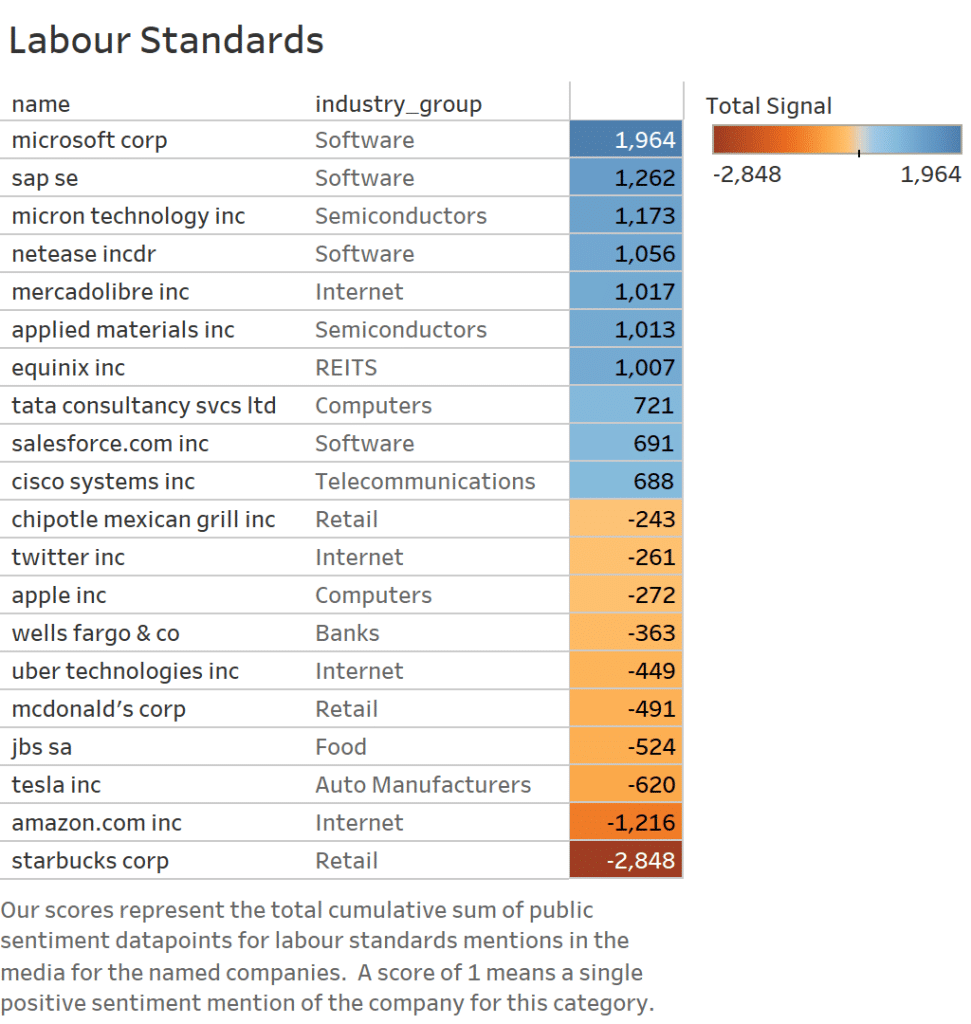
Permutable AI, at the forefront of data analytics, unveils its highly anticipated 2023 ranking of company labour standards, shedding light on perceived corporate labour standards. As the world anticipates Human Rights Day on December 10, this groundbreaking analysis, based on Permutable’s cutting-edge news sentiment analysis, explores the commendable practices of industry leaders like Microsoft and the challenges faced by companies like Starbucks, Amazon.com, and Tesla.
Topping the ranking is Microsoft, setting an exemplary standard with an impressive sentiment score of 1964.19. Microsoft’s commitment to fair and ethical employment practices is evident, positioning it as an industry leader in positive perceptions regarding labour practices. Closely following, SAP secures the second position with a noteworthy sentiment score of 1261.61. SAP’s dedication to high labour standards contributes significantly to its positive industry reputation, reflecting a commitment to fostering an ethical work environment.
In the third position is Micron Technology, showcasing a commitment to excellence, not only in technology but also in labour standards, earning a sentiment score of 1172.88. Micron Technology’s emphasis on maintaining high standards aligns with the evolving expectations of the workforce and stakeholders.
These companies stand out for their robust corporate policies prioritising employee well-being, development, and diversity. Microsoft’s continuous training and diversity and inclusion initiatives, SAP’s focus on mentorship and career advancement, and Micron Technology’s investments in education collectively contribute to a positive workplace culture.
Moreover, these industry leaders actively engage in corporate social responsibility initiatives, aligning with broader ethical business practices. This comprehensive approach positions them as champions in fostering fair, inclusive, and ethical working conditions, earning positive perceptions in the realm of company labour standards.
On the flip side, companies such as Starbucks, Amazon.com, and Tesla find themselves facing scrutiny for their labour standards.
Starbucks Corp, positioned at the bottom of the list, faces significant negative sentiment with a score of -2847.98. The renowned coffee chain must address concerns about its labour practices to improve its standing within the industry. The e-commerce giant, Amazon.com, faces ongoing challenges in its labour standards perception, earning a sentiment score of -1216.36. This is attributed to reported concerns about workplace conditions, employee treatment, and the company’s resistance to unionization efforts.
Despite its prominence in the auto industry, Tesla Inc lags in perceived labour standards, earning a sentiment score of -619.79. The company has been under scrutiny for workplace safety concerns, reports of employee dissatisfaction, and its stance on unionization. These challenges collectively contribute to the negative public perception of their labour standards, prompting calls for improved working conditions and ethical employment practices within these companies.
Wilson Chan, CEO of Permutable AI, shares his vision:
“At Permutable AI, we believe that data has the power to drive positive change. Our latest sentiment analysis on company labour standards serves as a catalyst for important conversations about the ethical responsibilities companies bear towards their workforce. As we approach Human Rights Day, we aim to contribute to a dialogue that prompts reflection and meaningful action.”
Manuela Moollan, Sustainability Lead at Permutable AI, emphasises the broader implications for sustainability:
“Sustainability extends beyond environmental considerations; it encompasses the ethical treatment of workers. Our analysis shines a light on the vital role companies play in fostering fair and ethical labour practices. By identifying industry leaders and those with room for improvement, we seek to inspire positive change and promote a business environment aligned with global human rights standards.”
Permutable AI’s sentiment analysis provides valuable insights for investors, consumers, and stakeholders seeking to align themselves with socially responsible corporations. As Human Rights Day approaches, this data prompts reflection on the importance of ethical labour practices within the global business community. In a rapidly changing corporate landscape, the call for ethical leadership and responsible business practices becomes more pronounced than ever before.
As we unveil the 2023 ranking of company labour standards, we invite you to delve deeper into the intricate world of corporate ethics and practices. To gain a comprehensive understanding of the landscape, we encourage you to get in touch by filling in the form below to request additional data.
– Company deforestation impact rankings
– Software companies data security rankings
– Clean and affordable energy company rankings
– Corporate behaviour rankings
In today’s fast-paced and ever-evolving market, Tesla Inc, headquartered in Austin, Texas, remains a hot topic of discussion and speculation. As investors and enthusiasts closely monitor the ebb and flow of Tesla’s stock price, it’s crucial to understand the key factors that shape its fluctuation. This article delves into the insider insights surrounding Tesla Inc stock price, providing you with a deeper understanding of the forces at play in the company that has become world-renowned that designs, manufactures, and sells electric vehicles.
From production numbers and vehicle deliveries to Elon Musk’s Twitter activity, technological advancements in energy storage and solar panels, not to mention its stance against ESG, there are several factors that influence Tesla’s valuation. The company operates across multiple sectors, including Tesla Motors for electric vehicles and its solar division for solar panels and solar roof products. By exploring these factors, we aim to unravel the complexities of Tesla Inc stock price and offer you valuable insights that can inform your investment decisions.
With the EV market gaining momentum and Tesla’s dominant position in the industry, understanding the key drivers behind its stock price is more important than ever. Investors should pay close attention to Tesla’s earnings dates, as these quarterly reports often cause significant movements in the stock price. Whether you’re a seasoned investor or simply curious about the inner workings of the automotive industry, this article is sure to provide you with the knowledge and analysis needed to navigate the turbulent waters of Tesla’s stock market performance.
The stock market is a complex and dynamic environment influenced by a myriad of factors. Understanding these factors is crucial to making informed investment decisions. When it comes to Tesla inc stock price, there are several key drivers that shape its valuation.
One of the primary factors that influence stock prices is the company’s financial performance and revenue growth. Investors closely analyze Tesla’s quarterly and annual financial reports to assess its profitability and growth potential. Positive revenue growth and strong financial indicators often lead to an increase in stock price, while poor financial performance can result in a decline.
Another significant factor is Tesla’s product innovation and technological advancements. As a leader in the electric vehicle industry, Tesla’s ability to introduce groundbreaking technologies and improve its product offerings has a direct impact on its stock price. The release of new models, updates to existing vehicles, and advancements in battery technology can all drive investor confidence and contribute to stock price appreciation.
Government regulations and policies also play a crucial role in shaping Tesla Inc stock price. As countries around the world embrace sustainable transportation, governments are implementing various incentives and regulations to promote the adoption of electric vehicles. These policies can have a significant impact on Tesla’s sales and market share, thereby influencing its stock price. Additionally, changes in government regulations related to emissions standards and subsidies can impact the overall demand for electric vehicles, indirectly affecting Tesla’s stock performance.
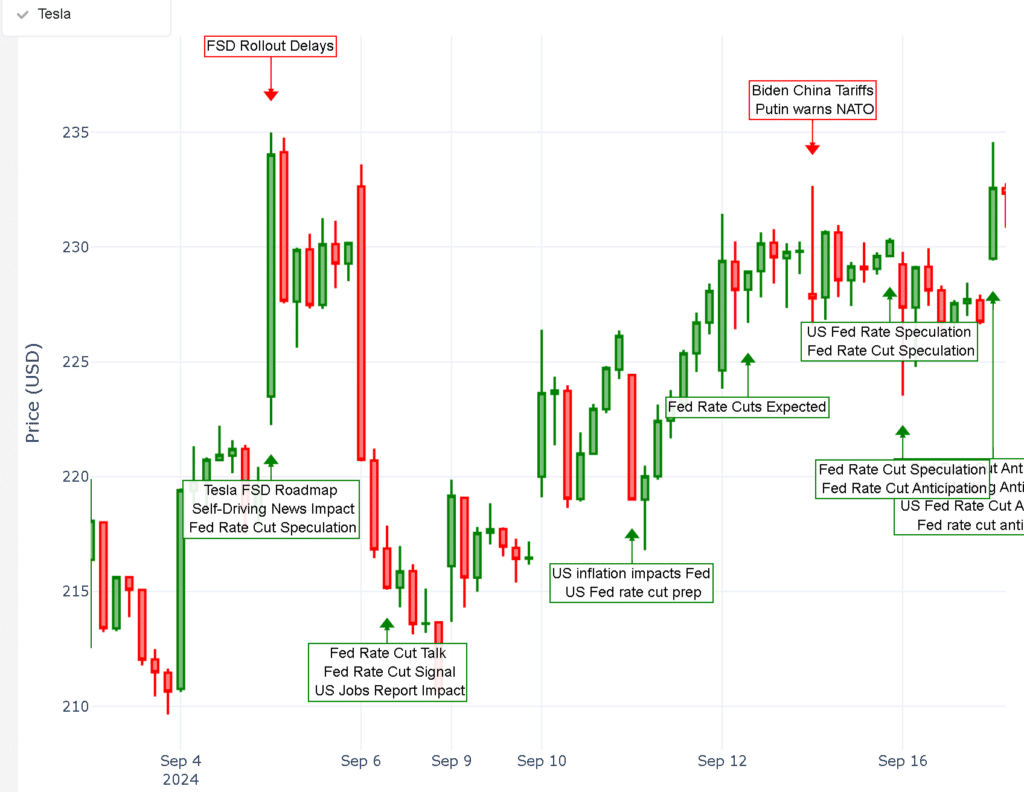
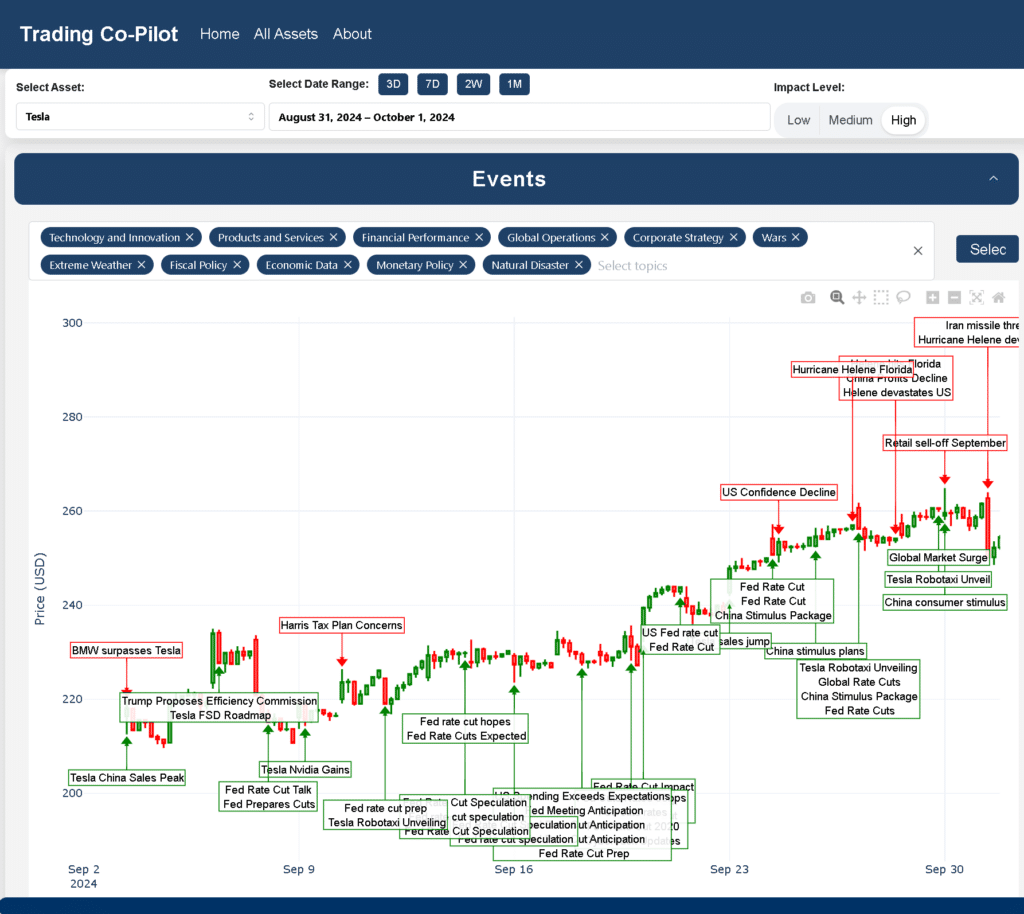
Macro and asset events affecting Tesla stock price performance – insights from our Trading Co-Pilot (BETA)
Tesla’s financial performance is a key aspect that investors closely monitor to gauge its growth potential and stock price trajectory. In recent years, Tesla has experienced significant revenue growth, driven by increased vehicle deliveries and expansion into new markets.
In 2020, Tesla reported total revenue of $31.5 billion, a 27% increase compared to the previous year. This growth was primarily fueled by a record number of vehicle deliveries, with Tesla delivering 499,550 vehicles in 2020, surpassing its target of half a million vehicles. The increase in vehicle deliveries indicates strong demand for Tesla’s products and has a positive impact on its stock price.
Tesla’s ability to generate consistent revenue growth is also influenced by its expansion into new markets. The company has been actively expanding its presence in international markets, including Europe and China, which has contributed to its revenue growth. For example, Tesla’s revenue from China increased by 124% in 2020, highlighting the company’s success in tapping into the world’s largest automotive market.
Investors closely analyze Tesla’s financial performance to assess its profitability and cash flow. While Tesla has reported positive net income in recent quarters, it is worth noting that the company’s profitability has been influenced by various factors, including regulatory credits and the sale of Bitcoin. As such, investors need to carefully evaluate Tesla’s financials to gain a comprehensive understanding of its financial performance and its potential impact on stock price.
Tesla’s relentless focus on product innovation and technological advancements has been a key driver of its success and stock price appreciation. The company continually pushes the boundaries of electric vehicle technology, introducing industry-leading features and capabilities that set it apart from competitors.
One of Tesla’s notable innovations is its Autopilot system, which enables semi-autonomous driving. This feature has garnered significant attention and praise from both consumers and industry experts. The continuous improvement and expansion of the Autopilot system not only enhance the driving experience but also position Tesla as a leader in autonomous vehicle technology. The advancements in autonomous driving technology are closely watched by investors and can have a substantial impact on Tesla’s stock price.
In addition to Autopilot, Tesla has made significant strides in battery technology. The company’s development of high-capacity batteries with improved energy density and longer range has been instrumental in driving the widespread adoption of electric vehicles. Tesla’s Gigafactories, which produce batteries at scale, have played a critical role in reducing production costs and increasing efficiency. These advancements in battery technology have positioned Tesla as a frontrunner in the industry and have a direct positive impact on its stock price.
Furthermore, Tesla’s product lineup continues to evolve, with new models and updates being introduced regularly. The introduction of the Model Y, a compact SUV, has been met with great enthusiasm from consumers and investors alike. The expansion of Tesla’s product portfolio not only increases its market reach but also diversifies its revenue streams, further contributing to its stock price growth.
Government regulations and policies have a significant impact on the electric vehicle industry as a whole and directly influence Tesla’s stock price. As countries strive to reduce greenhouse gas emissions and transition to sustainable transportation, governments have implemented various incentives and regulations to promote the adoption of electric vehicles.
One such example is the tax credits and subsidies offered by governments to encourage consumers to purchase electric vehicles. These incentives can significantly reduce the cost of owning an electric vehicle, making them more affordable and appealing to a broader consumer base. Tesla, as one of the leading electric vehicle manufacturers, benefits from these incentives and experiences increased demand for its vehicles, positively impacting its stock price.
Additionally, government regulations related to emissions standards can have a direct impact on Tesla’s stock price. Stricter emissions regulations often favour electric vehicles over traditional internal combustion engine vehicles, creating a more favorable market environment for Tesla. By aligning its product offerings with these regulations, Tesla can capitalize on the growing demand for electric vehicles and experience stock price appreciation.
However, it is worth noting that changes in government policies and regulations can also pose risks to Tesla’s stock price. Shifts in political landscapes or policy priorities can lead to the withdrawal or modification of incentives, potentially impacting the demand for electric vehicles. Investors need to closely monitor the evolving regulatory environment to assess potential risks and opportunities for Tesla’s stock price.
As the electric vehicle market continues to grow, competition among manufacturers intensifies. Tesla faces competition from both established automakers and emerging startups, each vying for a share of the rapidly expanding market.
Established automakers such as General Motors, Ford, and Volkswagen have been ramping up their electric vehicle offerings, aiming to challenge Tesla’s dominance in the market. These companies have the advantage of existing manufacturing infrastructure and established brand recognition, which can pose a threat to Tesla’s market share and stock price.
At the same time, a growing number of startups are entering the electric vehicle space, focusing on niche markets and innovative technologies. These startups often bring fresh perspectives and unique value propositions, attracting investor attention and potentially disrupting the market. While some of these startups may fail to gain significant market traction, others could emerge as formidable competitors to Tesla, impacting its stock price.
Market trends and consumer preferences also influence Tesla’s stock price. As sustainability becomes increasingly important to consumers, the demand for electric vehicles is expected to grow. Tesla’s early entry into the market and its strong brand recognition position the company well to benefit from this trend. However, changing consumer preferences or the emergence of new technologies could alter the market dynamics, impacting Tesla’s stock price.
Investor sentiment and market speculation play a significant role in shaping Tesla’s stock price as is the case with other major corporates like Apple and Microsoft, for example. Tesla, led by its charismatic CEO Elon Musk, has garnered a dedicated following of investors and enthusiasts who closely follow the company’s developments and announcements.
Elon Musk’s Twitter activity has been known to impact Tesla’s stock price. Whether it’s a tweet about new product features, production targets, or controversial statements, Elon Musk’s tweets often generate significant market reactions. Investors carefully analyze these tweets, attempting to gauge their impact on Tesla’s future prospects and stock price.
Tesla’s stock price has also been influenced by short-term market speculation. The volatility of Tesla’s stock has attracted both retail and institutional traders looking to capitalize on short-term price movements. This speculative activity can lead to sharp fluctuations in Tesla’s stock price, driven by factors unrelated to the company’s fundamental performance.
Investors need to be mindful of the potential impact of investor sentiment and market speculation on Tesla’s stock price. While these factors can create short-term opportunities for traders, long-term investors should focus on the company’s financial performance and underlying fundamentals to make informed decisions.
Looking for more stock market insights? See our articles on the factors that determine Advanced Micro Devices stock price, Lucid stock price, Berkshire Hathaway stock price, Tencent Holdings stock price, Nvidia stock price, Google stock price, Walmart stock price, Apple stock price, Microsoft stock price and Amazon stock price with more added weekly.
Tesla’s stock price is influenced by a complex interplay of factors:
Tesla typically releases earnings reports quarterly, usually in the months of January, April, July, and October. The exact dates can vary and are announced a few weeks in advance. These reports provide crucial information on financial performance, production numbers, and future guidance, often leading to significant stock price movements.
Tesla currently leads the global EV market in terms of sales volume and brand recognition. In 2022, Tesla delivered over 1.3 million vehicles worldwide. However, competition is intensifying:
Elon Musk’s tweets can have a significant and immediate impact on Tesla’s stock price:
Tesla’s energy business, while smaller than its automotive segment, is increasingly important:
Global economic factors significantly impact Tesla’s stock:
Opinions on Tesla’s valuation vary widely among analysts and investors:
Tesla’s ESG profile is complex:
Advancements in autonomous driving could significantly impact Tesla’s stock:
Experience the power of instant analysis with our Trading Co-Pilot (BETA). This cutting-edge tool allows you to see the factors influencing Tesla’s stock price in real time, providing you with a competitive edge in the market. Currently available for trial to select enterprise clients, our Trading Co-Pilot offers unparalleled insights into Tesla and other high-profile stocks. Don’t just follow the market – stay ahead of it. Contact us today to learn how you can be among the first to leverage this game-changing technology in your investment strategy.
Elon Musk, the enigmatic billionaire and visionary behind Tesla, SpaceX, and Neuralink, is no stranger to controversy. From his bold predictions about the future of space travel to his eccentric Twitter antics, Musk has always managed to capture the attention of the public. He has recently been on the rampage again expressing his opposition to ESG (Environmental, Social, and Governance) scores. These scores have gained significant popularity in the world of investing, with many using them as a tool to evaluate a company’s sustainability and social impact. However, Elon Musk is against ESG, arguing that ESG scores are flawed and fail to capture the true essence of a company’s mission and potential. Doe he have a point?
In this intriguing exploration, we delve deep into the controversy surrounding Musk’s opposition to ESG scores, seeking to unravel the reasons behind his stance and understand the implications it may have on the future of sustainable investing. Get ready to uncover the truth and challenge your own perceptions in this thought-provoking journey into the mind of one of the world’s most influential entrepreneurs.
ESG scores, which measure a company’s environmental, social, and governance performance, have become increasingly popular as a means of evaluating a company’s sustainability and impact on society. These scores provide investors with a standardized way to assess companies and make informed decisions about where to allocate their funds. However, Elon Musk has been a vocal critic of ESG scores, arguing that they are inherently flawed and fail to capture the true essence of a company’s mission and potential.
Musk believes that ESG scores are too narrow in their focus and fail to take into account the bigger picture. While they may provide some insights into a company’s environmental and social practices, they do not adequately capture the long-term potential of companies that are working towards transformative solutions. For Musk, the true measure of a company’s impact lies in its ability to disrupt industries and drive innovation, rather than simply meeting a set of predefined criteria.
The rise of ESG scores has not been without controversy. Critics argue that these scores can be easily manipulated, and that companies may prioritize ticking boxes rather than implementing meaningful change. This is something we have seen within our own data as companies furiously put out green and social announcements in the media to try and mitigate any adverse news in the public domain. This green and social washing effectively drowns out the negativity and undermines the potentially powerful impact of ESG scores. One only has to take one look at the impossibly high ESG scores across companies in the lithium mining industry to see this play out.
Additionally, there is a lack of standardization across different ESG rating agencies, resulting in inconsistencies in how companies are evaluated. This has led to concerns about the reliability and credibility of ESG scores, prompting some to question their usefulness as a tool for sustainable investing.
The controversy surrounding ESG scores is further fuelled by the fact that they are often used as a marketing tool by companies. Some argue that companies may prioritize improving their ESG scores for the sake of positive PR, rather than genuinely committing to sustainability and social responsibility. This raises questions about the authenticity of companies’ efforts and the effectiveness of ESG scores in driving meaningful change.
One of the key arguments against ESG scores is that they are overly focused on compliance and risk management, rather than on encouraging innovation and transformative change. Critics argue that by reducing sustainability and social impact to a set of metrics, ESG scores fail to capture the true potential of companies that are pushing boundaries and driving progress in their respective industries. This approach, they argue, stifles creativity and discourages companies from taking bold risks that could lead to significant positive change.
Another criticism of ESG scores is their lack of standardization and transparency. Different rating agencies use different methodologies and criteria, resulting in inconsistencies in how companies are evaluated. This lack of clarity makes it difficult for investors to compare companies and make informed decisions about where to allocate their funds. Additionally, the opacity of the scoring process raises concerns about the potential for bias and manipulation.
Elon Musk’s opposition to ESG scores stems is rooted in the potential for greenwashing practices (an area we are working hard on at Permutable AI to address) to inflate scores artificially and from his belief that they fail to capture the true essence of a company’s mission and potential. Well, he has a point. How can tobacco companies have a far higher ESG rating than that of his own company Tesla (still, they are no angels in they way they treat their people or in terms of their environmental impacts of producing their cars (cobalt and lithium mining anyone?).
Musk has always been a proponent of disruptive innovation and transformative change, and he believes that companies should be evaluated based on their ability to drive progress and solve pressing global challenges. According to Musk, ESG scores are too focused on compliance and fail to adequately capture a company’s long-term potential. He argues that by reducing sustainability and social impact to a set of metrics, ESG scores discourage companies from taking bold risks and pursuing ambitious goals. Musk believes that true innovation requires a mindset that goes beyond meeting predefined criteria and focuses instead on pushing boundaries and creating a better future.
Elon Musk’s opposition to ESG scores has sparked a broader debate about the effectiveness and relevance of these metrics in evaluating companies’ sustainability and social impact. His influential voice has drawn attention to the limitations of ESG scores and has prompted investors and rating agencies to reconsider their approach.
Musk’s criticism has also highlighted the need for a more holistic and forward-thinking approach to sustainable investing. Many investors are now questioning the reliance on ESG scores as the sole measure of a company’s impact and are exploring alternative approaches that take into account a company’s potential for transformative change.
In response to the limitations of ESG scores, alternative approaches to evaluating companies’ sustainability and social impact are emerging. These approaches seek to capture the transformative potential of companies and encourage innovation, rather than focusing solely on compliance and risk management.
One such approach is impact investing, which goes beyond traditional ESG metrics and looks at companies’ ability to generate positive social and environmental outcomes. Impact investors prioritize companies that are actively working to address pressing global challenges, such as climate change, poverty, and inequality. This approach recognizes that true sustainability goes beyond meeting predefined criteria and requires a commitment to creating positive change.
Another alternative approach is the use of thematic investing, which focuses on specific themes or sectors that are aligned with sustainability goals. This approach allows investors to target companies that are at the forefront of innovation and are driving progress in areas such as renewable energy, clean technology, and healthcare.
While Elon Musk’s opposition to ESG scores has gained support from some corners, it has also faced criticism. Some argue that Musk’s perspective is overly focused on high-risk, high-reward ventures and fails to recognize the importance of responsible governance and risk management. They contend that ESG scores provide a valuable tool for evaluating companies’ compliance with regulations and their ability to manage potential risks.
Critics also argue that Musk’s opposition to ESG scores overlooks the fact that these metrics serve as a starting point for investors looking to incorporate sustainability and social impact considerations into their investment decisions. While they may not capture the full complexity of a company’s mission and potential, ESG scores provide a standardized framework that can help investors navigate the vast landscape of sustainable investing.
The controversy surrounding ESG scores has prompted a re-evaluation of their role and effectiveness in evaluating companies’ sustainability and social impact. While some argue for a complete overhaul of the current system, others advocate for improvements and standardization to address the limitations and inconsistencies.
The future of ESG scores may lie in striking a balance between compliance and transformative potential. This could involve incorporating additional metrics that capture a company’s ability to drive innovation and create positive change, as well as evaluating the feasibility of their claims (again watch this space – in development at Permutable!) while still ensuring that responsible governance and risk management are taken into account.
As the field of sustainable investing continues to evolve, it is likely that ESG scores will undergo significant changes to better reflect the complexities of evaluating a company’s sustainability and social impact. The debate sparked by Elon Musk’s opposition has brought these issues to the forefront and has paved the way for a more comprehensive and nuanced approach to evaluating companies’ contributions to a sustainable future.
Elon Musk’s opposition to ESG scores has ignited a fiery debate about the effectiveness and relevance of these metrics in evaluating companies’ sustainability and social impact. While ESG scores have gained popularity as a tool for sustainable investing, Musk argues that they fail to capture the true essence of a company’s mission and potential for transformative change. This controversy has prompted investors and rating agencies to re-evaluate their approach to evaluating companies’ sustainability and social impact.
While ESG scores have faced criticism for their potential for manipulation and lack of standardization, they have also provided a starting point for investors looking to incorporate sustainability and social impact considerations into their investment decisions. The future of ESG scores may lie in striking a balance between compliance and transformative potential, incorporating additional metrics that capture a company’s ability to drive innovation and create positive change.
As the field of sustainable investing continues to evolve, it is important to challenge our own perceptions and consider alternative approaches to evaluating companies’ sustainability and social impact. Elon Musk’s opposition to ESG scores serves as a reminder that true sustainability requires a mindset that goes beyond meeting predefined criteria and focuses instead on pushing boundaries and creating a better future.