All eyes have been on gold markets once again this week, with prices surging to an all-time high of 2902.50. As geopolitical tensions escalate, for traders seeking to navigate these volatile conditions, understanding the underlying drivers becomes increasingly key. In this article, we’ll take a lookback at the latest from the gold markets over the last week, with insights from our Trading Co-Pilot.
Safe to say, that all of this dovetails with growing concerns about Trump’s recent tariff announcements, which has been amplified by deteriorating US-China relations. Only a few days earlier, gold had been trading at 2849.75, but escalating trade tensions pushed prices to new records. It has come to something when even seasoned traders are surprised by the pace of these movements, suggesting a fundamental shift in market dynamics that requires careful analysis.
What is it about gold markets that makes them so sensitive to geopolitical tensions? Both feature in our analysis: safe-haven demand and inflation concerns. Incidentally, the European Central Bank’s recent rate cut has added another dimension to the bullish narrative, creating a perfect storm of supportive factors that continues to drive prices higher.
For those of us who follow gold markets closely, the emergence of physical supply constraints is also another interesting factor in the mix. A significant shortage in London, driven by increased stockpiling in New York, has emerged. But still, the market continues on, albeit with increased volatility. Trading strategies must now account for these physical market dynamics, which can create unexpected price movements and arbitrage opportunities.
So what, you may think, about these supply constraints? But what’s important to note here is the potential for these shortages to create additional price pressures. These days, the interplay between physical and paper gold markets has become increasingly complex, requiring traders to maintain awareness of conditions in both markets to execute effective strategies.
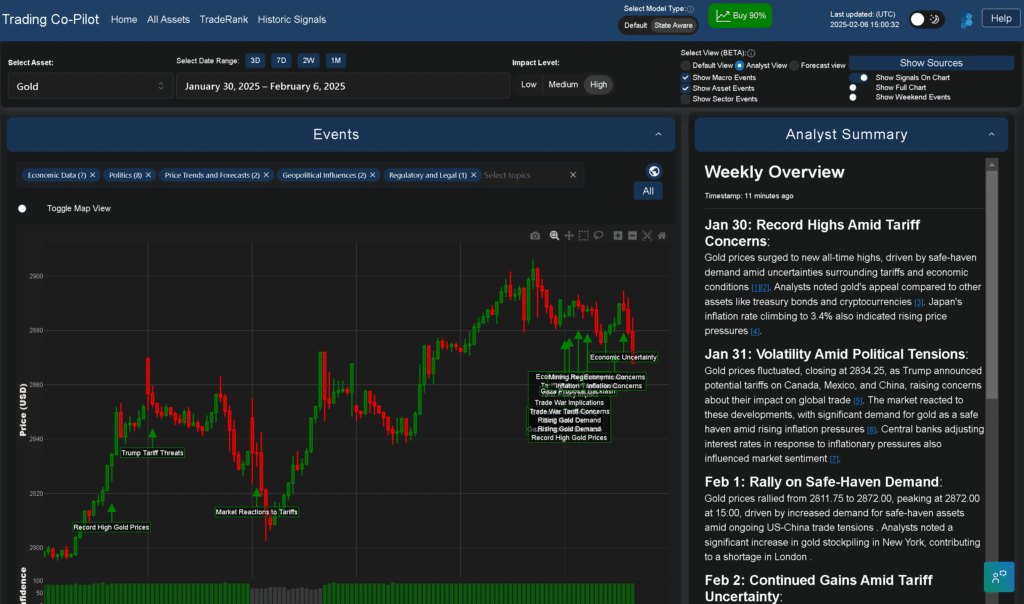
Above: Gold markets sentiment and price drivers using Analyst View of our Trading Co-Pilot
And then there has been significant central bank purchases, which reveals an underlying shift in institutional attitudes toward gold. Many will still find it surprising that central banks are increasing their gold reserves at such a rapid pace, particularly given the elevated price levels. This institutional buying provides a strong fundamental underpinning to the market that simply cannot be ignored.
Obviously, this fact has contributed to the current price levels, principally because of the signal it sends to other market participants about deeper concerns regarding global economic conditions.
There is, as ever, a strong correlation between geopolitical uncertainty and gold prices, Not merely because of safe-haven demand, but also due to currency market volatility. The answer, it turns out, lies in the complex interplay between various market factors that traders must monitor continuously. And so, understanding these correlations will continue to provide valuable insights for timing market entries and exits.
Interestingly, the market has maintained relatively orderly trading despite the record prices. And it will be fascinating to see how these patterns develop, particularly if trade tensions continue to escalate with Trump pressing down on nation states. Overall, gold traders will need to pay special attention to volume patterns and market depth, which can provide early warning signals of potential price movements.
Looking ahead, gold traders should focus on several key areas. Ongoing trade tensions and tariff concerns continue to dominate sentiment, while physical supply constraints in key markets may create additional volatility. Meanwhile, strong central bank buying activity suggests sustained institutional interest, while increasing safe-haven demand could provide support during periods of market stress. And then there’s the potential for trade policies to generate inflation pressures adds another layer of complexity to the market outlook.
Suffice to say that successful trading in current gold markets requires a comprehensive understanding of all of these factors. Traders will be keeping a close eye on developments in US-China trade relations – and quite rightly so – as these continue to drive short-term price movements. Ultimately, changes in central bank buying patterns could signal shifts in institutional sentiment, while physical supply dynamics between London and New York may create arbitrage opportunities. All this means that currency market volatility and inflation indicators provide important context for price movements.
The current situation in gold markets reflects a complex interplay of geopolitical, economic, and market-specific factors. As prices continue to trade near record highs, understanding these dynamics becomes increasingly important for gold and precious metals traders. In the current scenario, the combination of trade tensions, safe-haven demand, and physical supply constraints suggests that volatility may continue in the near term, making careful risk management essential for successful trading outcomes.
And with that, we’d like to invite you to experience how our Trading Co-Pilot can improve your precious metals trading results. Our platform seamlessly integrates real-time analysis of geopolitical events, supply chain dynamics, and market sentiment to provide you with actionable insights across gold, silver, platinum, and palladium markets.
Over a personalised live demo, we’ll help you discover how our AI-driven platform can enhance your trading operations and how we’re already Our helping institutional traders identify emerging opportunities, manage risk more effectively, and stay ahead of market-moving events. For qualified enterprise clients, we’re currently offering a 14-day trial of our platform, allowing you to experience firsthand how our advanced analytics can complement your existing trading strategies.
Simply get in touch with us at enquiries@permutable.ai or scheduling a demonstration by filling in the form below and be part of a group of early adopter trading houses who are already using our next-generation market intelligence to navigate the evolving commodities trading landscape.
US Federal Reserve Chairman Jerome Powell’s announcement about upcoming interest rate cuts signals a key shift in the world’s economic scene. The Fed now aims to boost economic growth by lowering borrowing costs, after years of sharp rate increases to control inflation. This change comes as inflation in the United States seems to be moving towards the central bank’s 2% goal. Yet, this choice affects more than just the US. Countries worldwide are keeping a close eye on these changes and the United States inflation rate.
Jerome Powell’s speech at the Jackson Hole meeting points to a big shift in US monetary policy. The Fed, which had been hiking interest rates fast to fight the worst inflation in years now plans to cut these rates. US inflation hit 9.1% in June 2022 but fell to 2.9% in July 2024, so the central bank thinks it has a handle on price growth and can start to loosen its money stance. Powell also noted “downside risks” to jobs, with unemployment up a bit. This shows the Fed worries about the economy slowing down if tight money rules stay too long.
People expect the Fed to cut rates to keep the US economy from falling into a recession. When the Fed lowers interest rates, it tries to make borrowing cheaper for companies and consumers, which should boost economic activity. This is part of a bigger plan to achieve a “soft landing,” where inflation returns to normal without causing a major economic slump. But when and how fast these cuts happen will be key and will depend on ongoing economic numbers and risks.
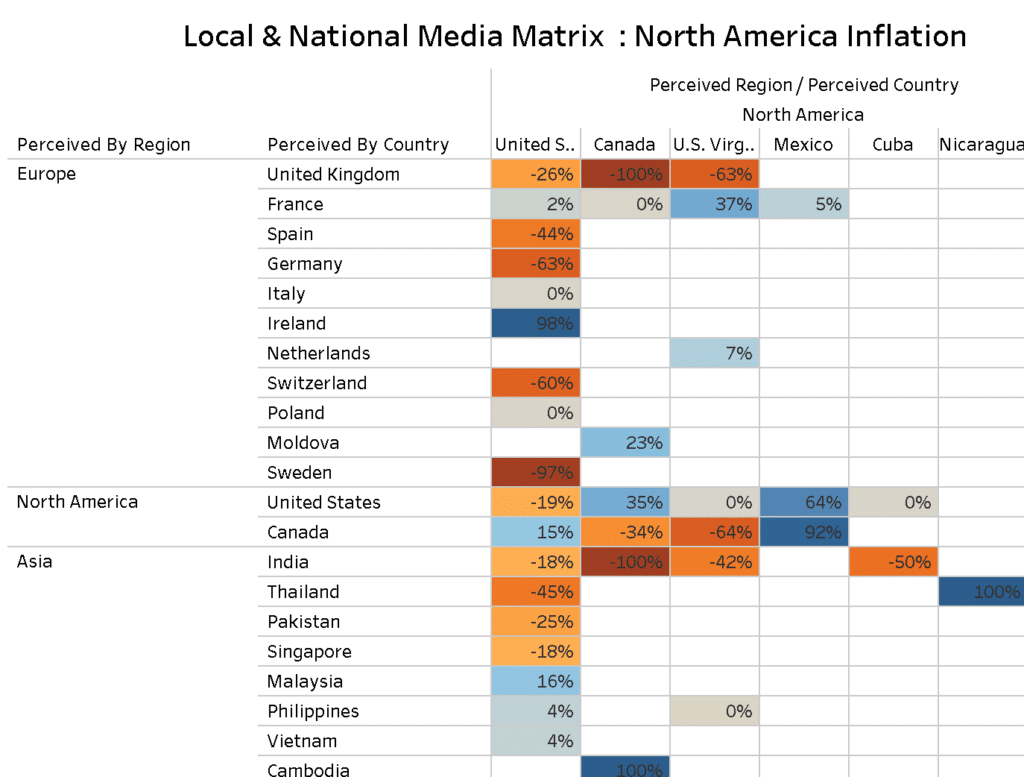
The US, as the world’s biggest economy, has a big influence on global financial markets. When it changes its monetary policy, like adjusting interest rates, this has widespread effects. The way different parts of the world see the United States inflation rate, based on our news sentiment analysis data taken from our Country Bias Matrix, part of our Geopolitical Dataset, gives us a good feel of how various regions view the situation.
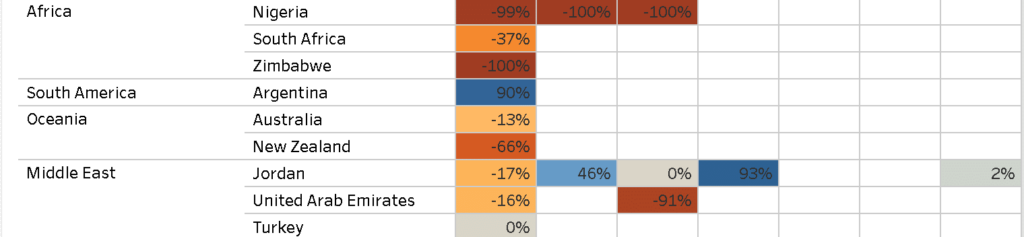
In Europe, perceptions of US inflation vary significantly. Big economies like Germany and Spain mostly view the United States inflation rate negatively . They worry about how US economic policies might affect their own economies. Take Germany, for example. It relies heavily on international trade. It might be afraid that US inflation and high interest rates could make fewer people buy its goods. Spain has a similarly negative perception, suggesting it’s concerned about keeping its economy stable and how US inflation might impact the Eurozone.
Still, nations like Ireland stand out with a positive outlook maybe showing a more upbeat view of economic bounce-back and gains from trade across the Atlantic. This split in views within Europe highlights the ins and outs of the region’s economic scene where different countries feel the effects of US money policies in different ways and to different degrees.
Asian countries have different views on United States inflation rate. India and Thailand have a negative outlook because they worry about how the United States inflation rate and interest rates might affect money flows and exchange rates in their economies. A stronger US dollar backed by high interest rates, can cause money to leave emerging markets. This makes their currencies weaker and increases the cost of imports key products like oil.
Vietnam however, sees US inflation in a positive light. This suggests they feel good about their economic ties with the US and might see chances for trade and investment. These different views across Asia show how various economies think about and get ready for the effects of US policies. Their unique economic links and dependencies shape these outlooks.
In Africa, people see US inflation as bad news in countries like Nigeria and Zimbabwe. These countries already face significant money problems. They think the US inflation and the interest rates that come with it make their economic troubles worse, making it harder for them to handle debt and get new investments.
Oceania, including Australia and New Zealand also has a negative view. These countries depend a lot on global trade. They worry that US economic choices will affect global demand and the prices of raw materials. This matters a lot to their economies, which rely on selling goods to other countries.
North America shows a split in views. The US has a mixed outlook, with both good and bad sentiment about inflation. This divide shows the wider argument in the US about how inflation and Fed policies affect different parts of the economy.
Canada also has a mix of bad and good views. This is likely because it’s so tied to the US economy. Changes in US inflation and interest rates shape Canadian economic factors, from trade balance to how strong the currency is.
The US Federal Reserve’s choice to reduce interest rates is set to have a big impact on world money markets. Countries that don’t see US inflation in a good light, like those in Africa and some parts of Europe and Asia, might worry about ups and downs in money flows, currency rates, and economic steadiness. These countries may need to take steps to protect their economies from possible shocks.
On the flip side, countries with a brighter view such as Ireland and Vietnam, might see the Fed’s moves as a chance to build stronger economic bonds with the US. They could take advantage of cheaper loans and the better economic outlook in the world’s biggest economy.
As the US Federal Reserve prepares to lower interest rates, the world economy keeps a close eye feeling both excited and worried. The different views shown by our Country Bias Matrix show how complex and linked today’s global economy is. For leaders and companies around the world, it’s key to understand these views to handle the ups and downs that will come as the Fed starts this new phase in how it manages money. Ultimately, the US’s chance to pull off a “soft landing” will not test its own economy but also signal how stable the world economy might be in the coming years.
If you’re interested in understanding more about how global perceptions of inflation or other market factors can influence geopolitical dynamics, or if you want to explore our comprehensive geopolitical intelligence offerings, reach out to us. To discover how our cutting-edge data insights can help your business stay ahead of global trends and make informed decisions in an ever-changing economic landscape simply email us at enquiries@permutable.ai or fill out the form below.
Have you been wondering recently how the UK is perceived in Europe? As the long shadow of Brexit continues to linger on, years on how do our European neighbours perceive the UK’s economy? The results may just surprise you, according to our AI-driven news sentiment analysis.
In this article, we’ll delve into the views of our continental cousins about the financial health of Britain as we take a closer look at how the UK is perceived in Europe, specifically through the lens of economic data.
First let us all breathe a huge sigh of relief. Regardless of what happened with Brexit, perhaps remarkably, most of Europe still considers Great Britain to be an economically stable country. Like being voted “Most Likely to Succeed” in Europe’s economic world yearbook – it’s flattering if a bit perplexing given our recent performance and erratic behaviour over the years.
Interestingly, Bulgaria in particular seems to be head over heels for us with an astonishing 91% positive rating. And then there is Hungary and Finland not very far behind in terms of how they view the UK and it’s economic prowess.
While this is certainly positive news with regards to how the UK is perceived in Europe, it’s not completely smooth sailing – unsurprisingly. The negative end of the spectrum finds Ukraine not singing our praises at all with -20% bias. Perhaps a little harsh?
When you look closer home, Ireland and Portugal portray a certain frostiness level, which is best characterized as a lukewarm handshake– not an outright rejection but perhaps there’s space for improving attitudes towards us here.
Ah, France. Our dear neighbours across the channel view us with a modest 10% positive bias. It is an economic shrug, a Gallic shrug – not bad, yet no popping of champagne corks either. Meanwhile, Germany is right in the middle, without being biased. It is their way of saying “We are watching you, UK but we’ll keep our opinions to ourselves at the moment”. Very diplomatic indeed!
Here’s where it gets interesting in terms of the UK is perceived in Europe. Surprisingly enough, Russia seems to think that our economy isn’t too shabby after all, boasting of a 33% positive bias. It’s like unexpected praise from your colleague you constantly disagree with smiling back at you – sweetly puzzling as hell.
So in terms of how the UK is perceived in Europe with regards to its economic standing, what do all these varied opinions mean? It is clear that Britain’s economy has a reputation as diverse as the weather in England – mostly sunny but with some showers. For policy makers and business leaders, these perceptions according to our LLM-driven news sentiment analysis are more than just trivia. They can affect everything from trade deals to investment decisions mentioned above.
When exploring how the UK is perceived in Europe through the lens of economic performance, understanding these attitudes may be crucial for navigating the stormy waters of global economics as we embark on our new post-EU reset. Sadly, we have a knack for souring relationships with our immediate neighbours; and things may even get more interesting yet. At present, we should strive to keep the ship afloat; maybe win over those who remain unconvinced while cherishing those in which we are already doing well. It is like throwing a dinner party where some of your guests are known to you since childhood, others are new acquaintances while the remaining are weighing up whether they really like what you cooked or not.
From all indications, the UK remains one of the most significant players in the EU economic space, a notion which is bolstered by the IMF’s recent prediction that the Britain is to be Europe’s fastest major growing economy. Everyone has an opinion on Britain’s economy – and those opinions of course tend to vary as our news sentiment analysis demonstrates. It’s complicated; just as international economics has always been. It would be prudent for us to keep an eye on these perceptions as we march ahead under a new government. In view of this, the United Kingdom still plays a leading role in Europe’s economic drama, attracting much attention towards itself.
Want to gain a deeper understanding of how countries perceive each other? Try our Geopolitical Risk Intelligence Dashboard and explore our interactive Country Bias Matrix. Uncover hidden trends and insights that can inform your strategic decisions by contacting us.
Looking for more insights? Why not explore our analysis on US regional concerns or explore what wars are happening now.
Looking for more global insights? Why not read our articles on:
How countries of Europe view each other’s economy according to GDP
How the UK’s economy is perceived in Europe
How France’s political situation is viewed
An analysis of sentiment around the UK property market recovery
How the world views Russia in terms of wars, politics and the economy
An analysis of global perceptions towards the Germany economy
The relationship between news sentiment and GDP gross domestic product performance has long been a topic of interest for economists and policymakers. Understanding how news sentiment impacts the economy can provide valuable insights into economic forecasting, business decision-making, and policymaking. In this article, we will explore the concept of news sentiment analysis and its connection to GDP performance.
News sentiment analysis is the process of determining the sentiment or tone of news articles, social media posts, and other textual data. It involves using natural language processing algorithms to classify text as positive, negative, or neutral. By analyzing the sentiment of news, economists and analysts can gain a better understanding of public perception and its potential impact on economic variables such as GDP.
News sentiment analysis relies on advanced machine learning techniques that can accurately identify sentiment from large volumes of text data. These techniques use algorithms to analyze the words, phrases, and context of the text to determine sentiment. By classifying news articles into positive, negative, or neutral categories, analysts can quantify the overall sentiment of the news and its potential influence on the economy.
Positive news sentiment has been shown to have a positive impact on GDP gross domestic product performance. When the news is filled with positive stories and optimistic forecasts, it can boost consumer and investor confidence. This increased confidence often leads to higher spending, investment, and overall economic growth.
For example, during periods of positive news sentiment, consumers may feel more optimistic about their financial situation and be more willing to make purchases. This increase in consumer spending can stimulate economic activity and contribute to GDP gross domestic product growth. Similarly, positive news sentiment can also encourage businesses to invest in expansion, hiring, and research and development, further driving economic growth.
On the other hand, negative news sentiment can have a detrimental effect on GDP performance. When the news is dominated by negative stories, such as economic downturns, political instability, or natural disasters, it can create a sense of uncertainty and fear among consumers and investors. This increased uncertainty often leads to reduced spending, investment, and economic activity.
During periods of negative news sentiment, consumers may become more cautious about their spending, fearing potential economic hardships. This decrease in consumer spending can have a cascading effect on businesses, leading to reduced sales, layoffs, and a contraction in economic activity. Negative news sentiment can also deter investors from making new investments or expanding existing ones, further impacting economic growth.
To better understand the relationship between news sentiment and GDP gross domestic product performance, let’s examine two different case studies.
This study by the European Central Bank (ECB) examined the use of news sentiment analysis for “nowcasting” GDP growth in the Eurozone. Nowcasting refers to predicting economic activity in the very near future, typically within a quarter.
The ECB compared news sentiment metrics derived from newspaper articles to traditional economic indicators like the Purchasing Managers’ Index (PMI). They found that news sentiment offered valuable insights, particularly in the first half of a quarter when other data might be unavailable.
Interestingly, the study also highlighted the importance of considering the specific economic climate. News sentiment analysis proved especially effective during crisis periods like the Great Recession and the COVID-19 lockdowns.
This study by the Bank for International Settlements (BIS) looked at the relationship between news sentiment and economic activity in Malaysia [2]. The researchers used news sentiment analysis to forecast various economic indicators, including private investment growth and GDP growth.
Their findings suggested that news sentiment was a reliable predictor of private investment growth, particularly within a 2-3 quarter timeframe. However, the link between news sentiment and broader measures of GDP growth was less clear.
This case study highlights the potential limitations of news sentiment analysis. While it can provide valuable insights into specific economic sectors, it might not always capture the full picture of a nation’s GDP.
These two case studies demonstrate that news sentiment can be a useful tool for understanding and potentially predicting economic activity. However, it’s important to consider the specific context and limitations of this approach.
Several factors can influence the correlation between news sentiment and GDP gross domestic product performance. Firstly, the credibility and reliability of news sources can impact how individuals perceive and react to news sentiment. If news sources are viewed as biased or unreliable, their impact on sentiment and subsequent economic behaviour may be diminished.
Additionally, the timing and intensity of news sentiment can also affect its impact on GDP performance. For example, a short-lived positive news sentiment may not have a significant and lasting effect on economic variables. Conversely, a prolonged period of negative news sentiment can have a more profound and enduring impact on economic behaviour.
Furthermore, the specific economic conditions and structural factors of a country can influence the relationship between news sentiment and GDP performance. For instance, a country with a robust and diversified economy may be less susceptible to the impact of negative news sentiment compared to a country heavily reliant on a specific industry.
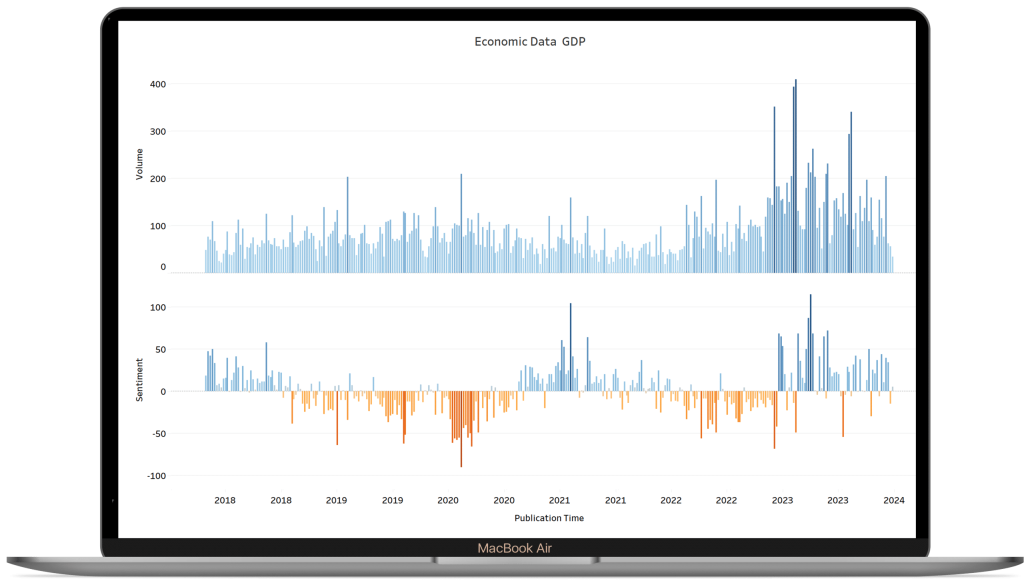
At Permutable AI, we have harnessed the power of cutting-edge natural language processing technologies to develop a robust platform that systematically evaluates the sentiment of global news sources towards GDP gross domestic product performance. We used state-of-the-art machine learning models to scan, categorize, and analyze large volumes of news data. This process not only identifies the general sentiment of articles—whether they are positive, negative, or neutral—but also captures the nuances and context that could influence economic indicators.
Our technology performs real-time tracking of news sentiment related to GDP trends. This data intelligence allows users to observe how shifts in media tone correlate with economic activity, offering insights into potential GDP movements before traditional economic data is available. Our data feeds offer insights based on sentiment trends. For policymakers, this could assist with adjusting economic policies in anticipation of changes signaled by news sentiment. For businesses, it can provide a basis for strategic planning and risk management, particularly in volatile markets.
Above: Our economic data GDP gross domestic product data intelligence
News sentiment analysis has gained popularity as a valuable tool for economic forecasting. By incorporating news sentiment data into forecasting models, economists and analysts can improve the accuracy of their predictions. News sentiment data provides real-time insights into public perception, which can be used to anticipate changes in consumer behaviour, investment trends, and overall economic performance.
For example, if news sentiment analysis indicates a rising positive sentiment, economists may forecast an increase in consumer spending and subsequent economic growth. Conversely, if news sentiment analysis reveals a declining negative sentiment, economists may forecast a decrease in consumer spending and a potential economic downturn.
By leveraging news sentiment analysis for economic forecasting, policymakers and businesses can make more informed decisions and develop strategies to mitigate potential risks or capitalize on emerging opportunities.
The link between news sentiment and GDP gross domestic product performance has significant implications for businesses and policymakers. Businesses can benefit from monitoring news sentiment to gauge consumer and investor confidence, identify emerging trends, and adjust their strategies accordingly. By understanding how news sentiment affects consumer behavior and economic activity, businesses can make informed decisions about product development, marketing campaigns, and investment opportunities.
Policymakers can also utilize news sentiment analysis to inform their economic policies and decision-making. By monitoring news sentiment, policymakers can gain valuable insights into public perception and adjust their policies to promote economic growth and stability. For example, during periods of negative news sentiment, policymakers may implement measures to boost consumer and investor confidence, such as tax incentives or stimulus packages.
The connection between news sentiment and GDP gross domestic product performance provides a fascinating area of study for economists and analysts. By understanding the impact of news sentiment on economic variables, businesses, and policymakers can make better-informed decisions and develop strategies to promote economic growth.
News sentiment analysis offers a powerful tool for analyzing public perception and its influence on economic behaviour. By leveraging advanced techniques and tools, economists and analysts can extract valuable insights from large volumes of textual data. Incorporating news sentiment analysis into economic forecasting models can improve the accuracy of predictions and enable businesses and policymakers to stay ahead of economic trends.
Ready to harness the power of Permutable’s data intelligence on GDP gross domestic product? To find out more about our data intelligence feeds and how it can benefit your organisation visit our dedicated data intelligence hub or request a free trial below.