
Gold prices fall as safe-haven demand fades amid policy and FX pressure
20 Mar 2026
20 Mar 2026
This analysis examines why gold prices falls despite escalating geopolitical tensions, highlighting the dominant influence of monetary policy, real yields, and FX sentiment. Using Permutable AI’s sentiment intelligence, it identifies early signals of repositioning across macro markets. Aimed at institutional investors and commodities traders, it provides forward-looking insights into gold’s shifting drivers and near-term directional risks.
Gold had every reason to rally. Yet, as gold prices fall, the market is signalling a decisive shift in macro drivers.
Escalating tensions between the United States and Iran, alongside broader instability across the Middle East, would traditionally reinforce gold’s safe-haven appeal. Historically, such geopolitical stress has provided a strong bid for gold.
However, this time the reaction function has changed. Instead of responding to geopolitical risk, markets have repriced around monetary policy and currency dynamics – leaving gold exposed.
The primary catalyst behind why the fall lies in the repricing of interest rate expectations and US dollar strength.
The Federal Reserve held rates steady, but more importantly, revised its 2026 inflation forecast higher to 2.7%. Chair Jerome Powell explicitly flagged energy price spillover as justification for maintaining a restrictive policy stance.
The implication is clear: higher-for-longer has extended firmly into 2026. For gold, this is structurally bearish. As a non-yielding asset, gold becomes less attractive in an environment where real yields are rising and expected to remain elevated. At the same time, the US dollar has strengthened, further increasing the opportunity cost of holding gold.
The result: gold prices fall as macro capital rotates toward yield-bearing assets.
Our real-time sentiment indicators captured this shift before it was fully reflected in price action. Ahead of the recent breakdown – with gold moving from above $5,000 to approximately $4,660 – our asset sentiment indices were already signalling a coordinated macro repositioning.
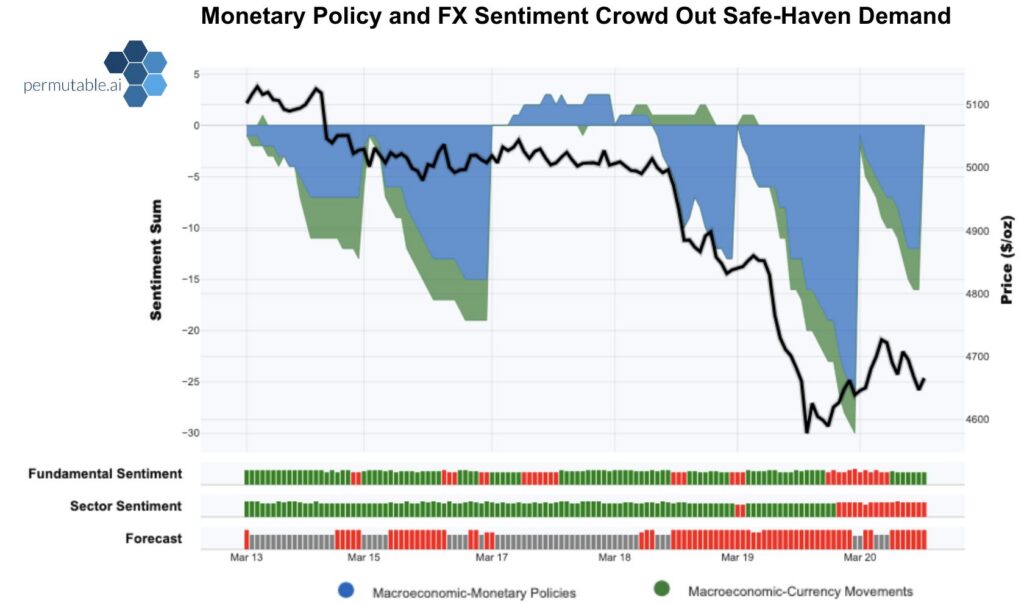
Turned decisively bearish through mid-March, indicating that markets were already internalising a higher-for-longer rate environment well ahead of the Fed’s confirmation.
Shifted strongly in favour of the US dollar, creating sustained downward pressure on gold as FX dynamics became the dominant driver.
Rolled over into bearish territory into March 19th, signalling a broad-based narrative shift across commodities – one that forced repositioning across institutional portfolios.
This alignment of sentiment factors explains why gold prices have fallen even in the presence of supportive geopolitical conditions.
As gold prices fall, it’s not just the move that it notable, but why. Historically, gold’s safe-haven status would dominate in periods of geopolitical stress. However, the current environment reflects a hierarchy of macro drivers:
Real yields
US dollar strength
Monetary policy expectations
Geopolitical risk
Right now, the first three are outweighing the fourth. The geopolitical premium that had been building in gold over recent months has rapidly unwound as markets re-anchor around rates and FX.
As gold prices fall, the forward path will depend on whether current macro drivers persist or begin to shift.
Any softening in US economic data could weaken the dollar, providing gold with room to stabilise or recover.
If energy-driven inflation persists, it strengthens the case for restrictive policy – keeping downward pressure on gold.
Sustained elevated real yields remain the most critical headwind. A reversal here would be the clearest signal for a change in gold’s direction.
Gold has not lost its safe-haven credentials. Rather, the current environment shows that macro hierarchy matters. When yields and the dollar move decisively, they can override geopolitical support – at least in the short term.
When gold prices fall despite heightened geopolitical risk is itself a signal: markets are prioritising policy and FX over traditional hedging behaviour. At Permutable, this is precisely the type of shift our sentiment intelligence is designed to capture early.
By identifying changes in narrative across monetary policy, FX, and commodities, our models provide institutional investors with a forward-looking edge – enabling them to reposition before these dynamics are fully priced in.
Discover how our real-time sentiment intelligence can integrate directly into your macro and commodities workflow – helping you identify shifts in gold, FX, and policy narratives before they show up in price.
For institutional investors, get in touch for a personalised walkthrough by emailing enquiries@permutable.ai

Analysis
16 Oct 2026
Gold outlook 2026: Why US rates outweigh geopolitical risk
Read more >
Analysis
14 Oct 2026
Beneath US headline inflation: tracking pressure across energy, food, services and housing
Read more >
Analysis
13 Oct 2026
France’s debt alarm hits a decade high and drowns out the rest of the G20
Read more >