How news sentiment swung in the run-up to the 2026 US midterms
05 Nov 2026
05 Nov 2026
Polls capture what voters say. News sentiment captures the stories shaping their views, day after day, long before anyone reaches a ballot box in the US midterms. Our Global Macro Sentiment Indices (GMSI) tracked how favourably US news portrayed the issues closest to American households throughout 2026, measuring each against its own norm over the previous two years. Conflict and energy dominated the early deterioration in tone. By election eve of the US midterms, prices had become the chief concern among the sentiment topics tracked.
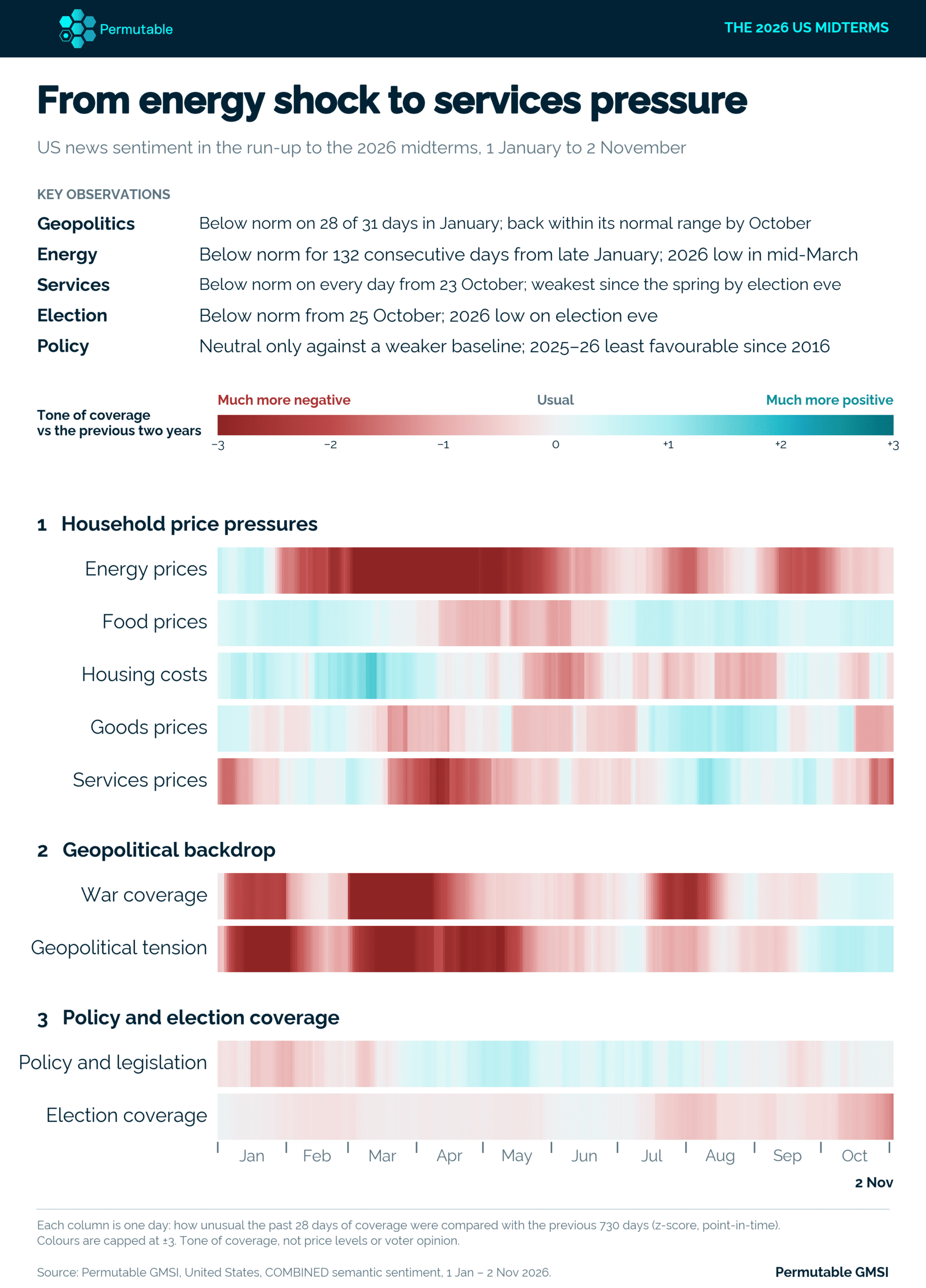
Energy coverage was already souring before the conflict escalated. Sentiment became unusually negative in late January, then deteriorated sharply around the US strikes on Iran at the end of February. By mid-March, energy sentiment had reached its weakest point of the year. War coverage recovered from its initial plunge by late April, but energy sentiment remained unusually negative into June. The initial military headlines had eased; the household cost story had a longer run.
That sustained coverage matters beyond its immediate place in the news cycle. Energy bills and petrol prices connect distant events to everyday spending, giving geopolitical developments a personal relevance. A subsequent improvement in coverage need not erase the impression left by months of unwelcome news, particularly where households still feel the expense. The headlines can move on before the household budget does.
The spring’s unfavourable tone also extended across other household costs. Goods and services coverage became unusually negative in March, with services reaching their spring low in April. Food and housing followed later. This was a broader run of uncomfortable reporting about the things households buy and the bills they pay. For readers encountering these stories over successive months, separate price concerns may have reinforced a more persistent impression that living costs remained difficult.
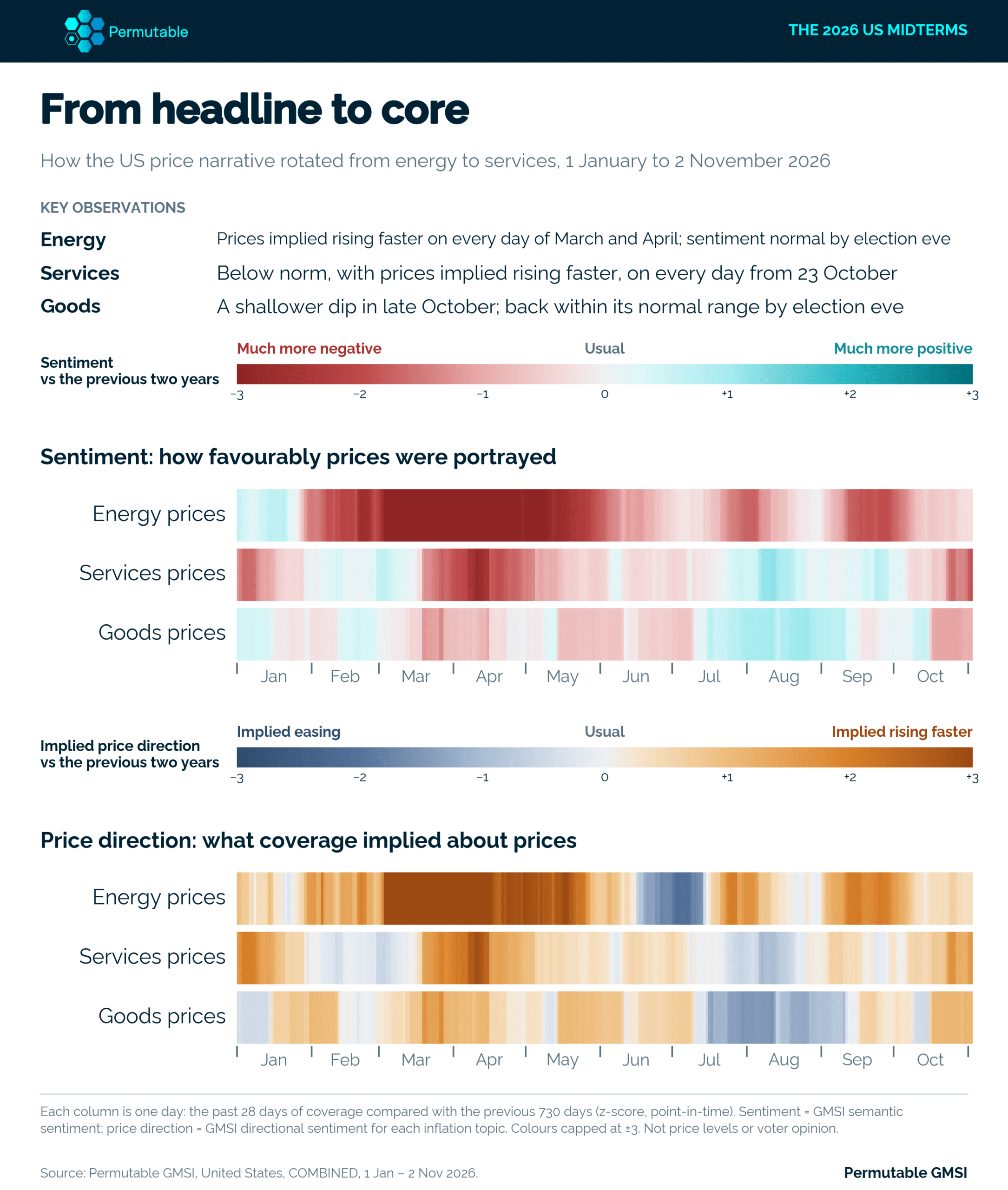
The directional measure adds economic context to that deterioration in tone. During the spring, less favourable goods and services coverage coincided with a stronger upward-price signal. Higher energy costs can spread through transport, utilities and suppliers, leaving businesses to absorb the increase or pass it to customers. The pattern is consistent with that process, although the charts alone cannot establish how much of the wider pressure originated in energy.
Services coverage became markedly less favourable again as polling day approached. Following a summer recovery, semantic sentiment turned unusually negative in late October and remained so through election eve, accompanied by a stronger upward-price signal. Goods showed a milder deterioration, while energy coverage was much closer to its historical norm. The renewed services concern arrived after a year already marked by sustained negative reporting on energy and other household costs. Its recency may have refreshed those earlier impressions, keeping affordability prominent as voters weighed their choices.
Democrats subsequently won both chambers of Congress. The sentiment record helps describe the environment in which that result took shape: an intense spring energy episode, wider household cost concerns and a renewed deterioration in services coverage near the vote. It offers a way to assess which economic developments may have acquired political weight through their persistence, proximity and relevance to daily life.
For analysts assessing US political and macroeconomic risk, tracking that sequence provides an input into weighing possible outcomes. The strength, duration and recency of coverage help identify issues that may be gaining public salience, including pressures that remain influential after the initial burst of reporting fades. Read alongside polling, household surveys and economic releases, GMSI can inform judgements about the concerns surrounding voters, the pressures facing policymakers and the economic issues likely to command attention after an election. The value lies in following how that environment develops, while those judgements are still being formed.
Want to monitor where the next turn in US political and macroeconomic risk move next? Explore Permutable’s Global Macro Sentiment Indices in our Data Discovery catalogue to find datasets for tracking the policy outlook, public-debt stress and inflation by subtopic in your own research.

Analysis
05 Nov 2026
Gold, coffee and iron ore: What Permutable’s 2026 Commodity case studies reveal
Read more >
05 Nov 2026
Join Permutable for a webinar on commodity markets, sentiment and strategies
Read more >
Guide
04 Nov 2026
Best AI platforms for hedge fund research in 2026: Six tools compared
Read more >