
Brent geopolitical premium: how sentiment caught it fading before the midterm sell-off
06 Nov 2026
06 Nov 2026
Much of the Brent geopolitical premium came out of the market around the US midterm elections, as the price fell 17% in three trading sessions, from $113.43 on 30 October to $94.62 on 4 November. The vote played its part, as Democratic control of both chambers of Congress raised expectations of pressure on the administration to wind down the conflict with Iran. But the timing points elsewhere. About half the decline came before any results were known, led by a 7.6% fall on 2 November as Washington and Tehran signalled a willingness to talk.
Our Brent Sentiment Indices track directional price sentiment and is broken down at the thematic driver level. From geopolitics and supply disruptions to inventories, demand and OPEC+ policy. Each driver is scored on how bullish or bearish its news flow is for the price, against its own six-month norm. The geopolitical driver peaked on 23 October, lost much of its bullish tilt over the following week and dropped below its norm on 1 November, the day before the sell-off began.
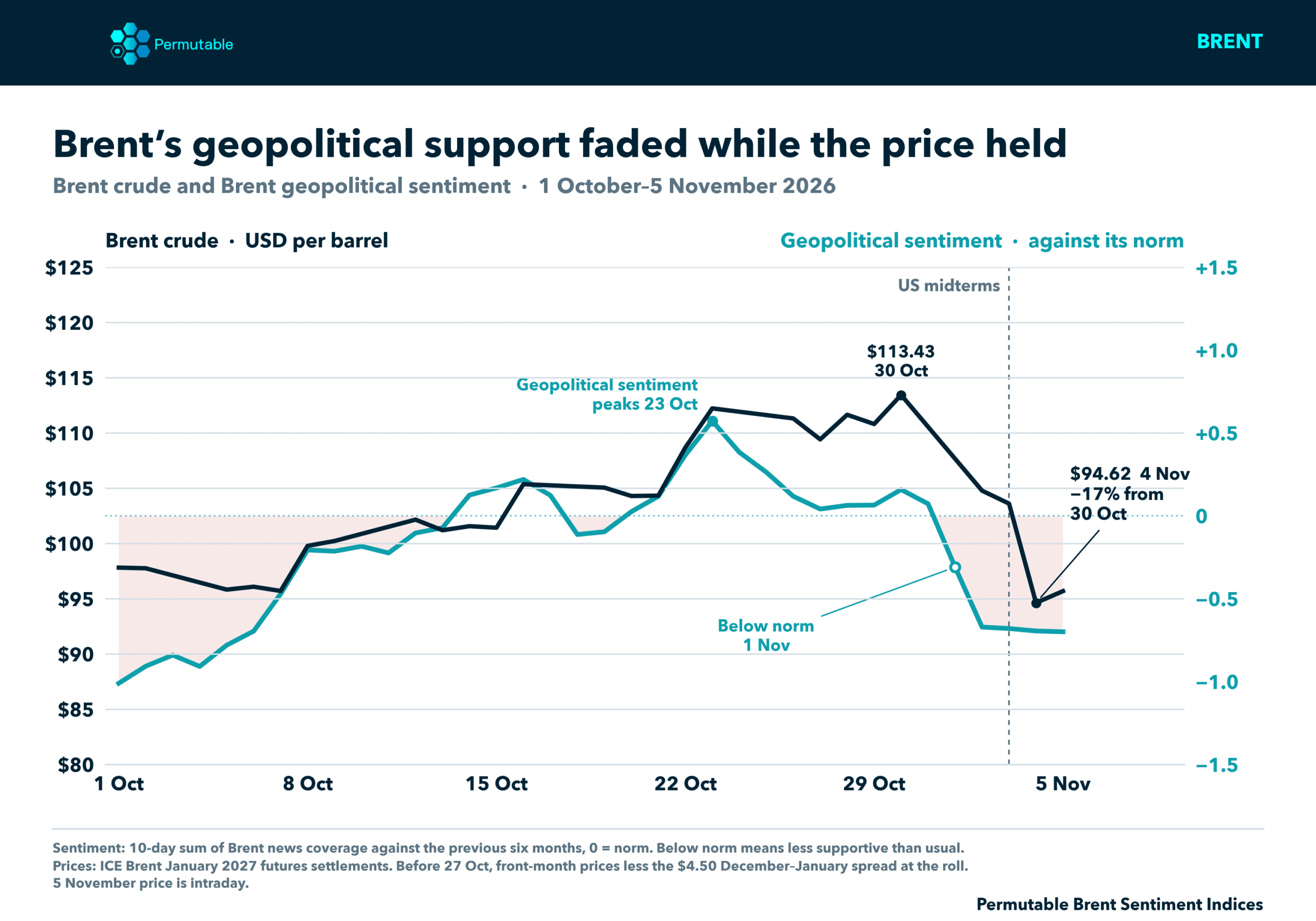
Geopolitical sentiment peaked on 23 October, after one of its most supportive two-day runs of the past six months. The following week was quieter. The price did not follow at first. January Brent settled at $113.43 on Friday 30 October, its highest close of the period, and the expiring December contract finished that day at $117.64. Coverage was still net supportive. It was simply much less supportive than the conflict had been generating, and that gap was not yet in the price.
The repricing began on Monday 2 November. Brent fell 7.6% as signals from Washington and Tehran raised hopes of talks, even as the US struck Iran’s Qeshm Island. By Tuesday’s settlement of $103.60, more than half of the eventual fall had happened. Supply-disruption sentiment had been held out bearish since 25 October, inventories since 31 October and geopolitics since 1 November. Coverage of price action and overall Brent sentiment followed on 2 November.
The vote supplied the second leg as Brent fell 8.7% on 4 November to $94.62, its lowest settlement since late August, after Democrats won both chambers and President Trump said in an interview that he had no immediate plans to strike Iran. The sharpest hourly fall, around midday in New York, came in the hour with the day’s most negative geopolitical sentiment. The election extended a repricing that the news flow, had already begun.
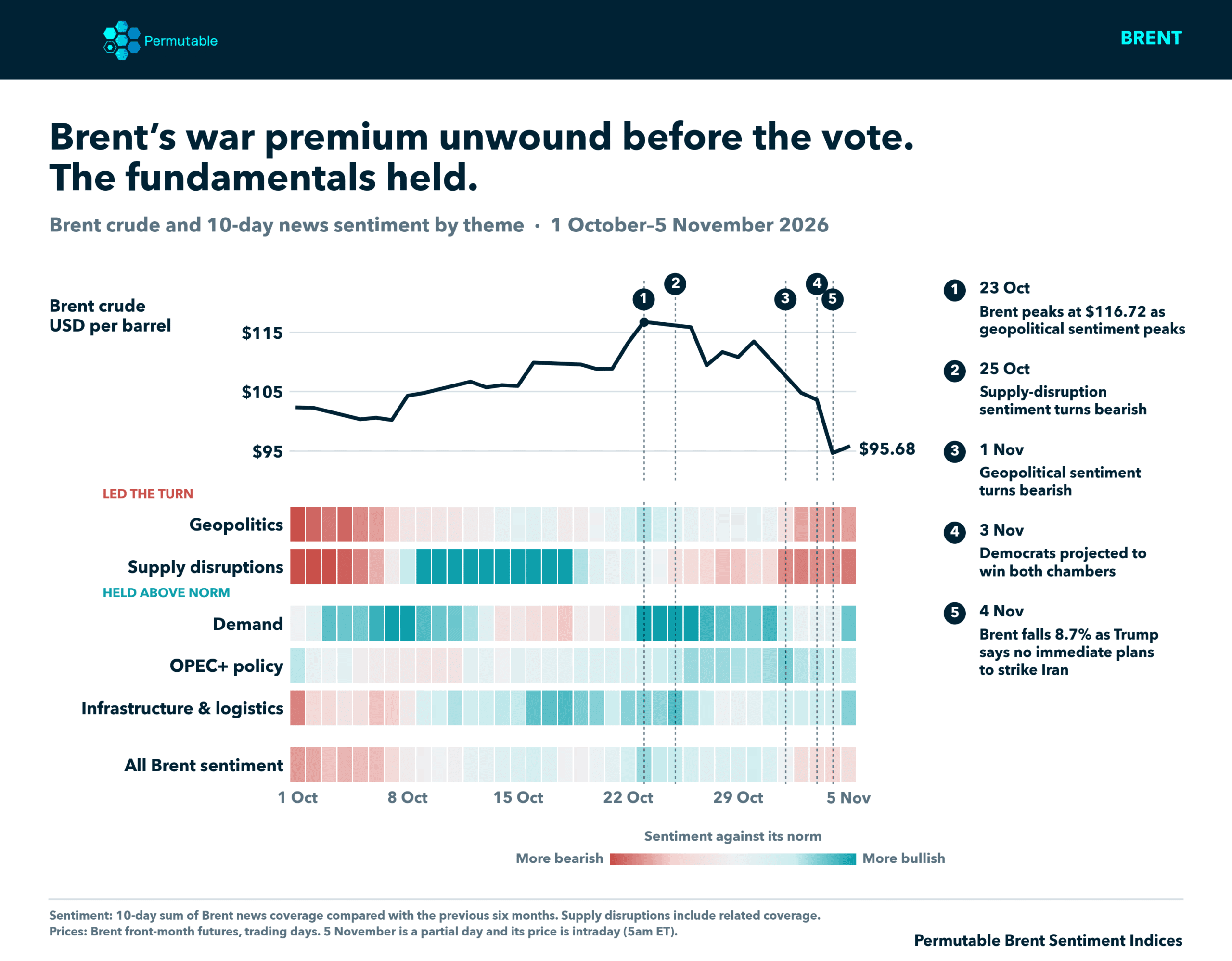
The themes that cooled were the ones carrying the war premium, namely conflict, supply disruptions and market action. Coverage of infrastructure and logistics, OPEC+ policy and global demand stayed above its norm on every day of the sell-off. Production coverage strengthened as the supply discussion moved from outages towards output. Inventories coverage dipped below its norm on 31 October and was back above it by 4 November.
That fits a market in which the risk premium moved faster than the barrels. US distillate stocks fell to their lowest since 2003 in the week to 30 October, while crude flows from the Gulf have been recovering and demand has softened. A smaller conflict premium and tight product markets can coexist, and the sentiment data showed both.
Brent rebounded 3.9% to $98.29 on Thursday as attacks on tankers near the Strait of Hormuz continued. It traded around $98 on Friday, still down about 13% on the week. Iran is reported to be reviewing proposals from mediators, but its demands include lifting the US naval blockade and sanctions relief. Escalation risk has not gone away, and the new Congress is not seated until January so there is still room for more episodes of escalation.
The reading worth watching is geopolitical sentiment. If it stays below its norm, that would be consistent with a fading premium. A move back above it would be an early sign that conflict risk is returning to the coverage. This is one episode, not proof of a reliable lead, and the measure is best read alongside prices, positioning and physical data.
A price chart shows that Brent fell. It cannot show whether the move came from fading conflict risk, weaker demand or looser supply. Sentiment broken down by thematic driver can. In this sell-off, the geopolitical driver lost its bullish tilt while Brent held near $113, and the physical drivers stayed above their norms as the premium was sold.
Track Brent’s geopolitical premium as it moves. Explore Permutable’s Brent Sentiment Indices in our Data Discovery catalogue, with theme-level series for geopolitics, supply disruptions, demand and producer policy.
Analysis
05 Nov 2026
How news sentiment swung in the run-up to the 2026 US midterms
Read more >
Analysis
05 Nov 2026
Gold, coffee and iron ore: What Permutable’s 2026 Commodity case studies reveal
Read more >
05 Nov 2026
Join Permutable for a webinar on commodity markets, sentiment and strategies
Read more >